
Online English lessons for beginners: choose a format and plan your first 10 lessons
Published
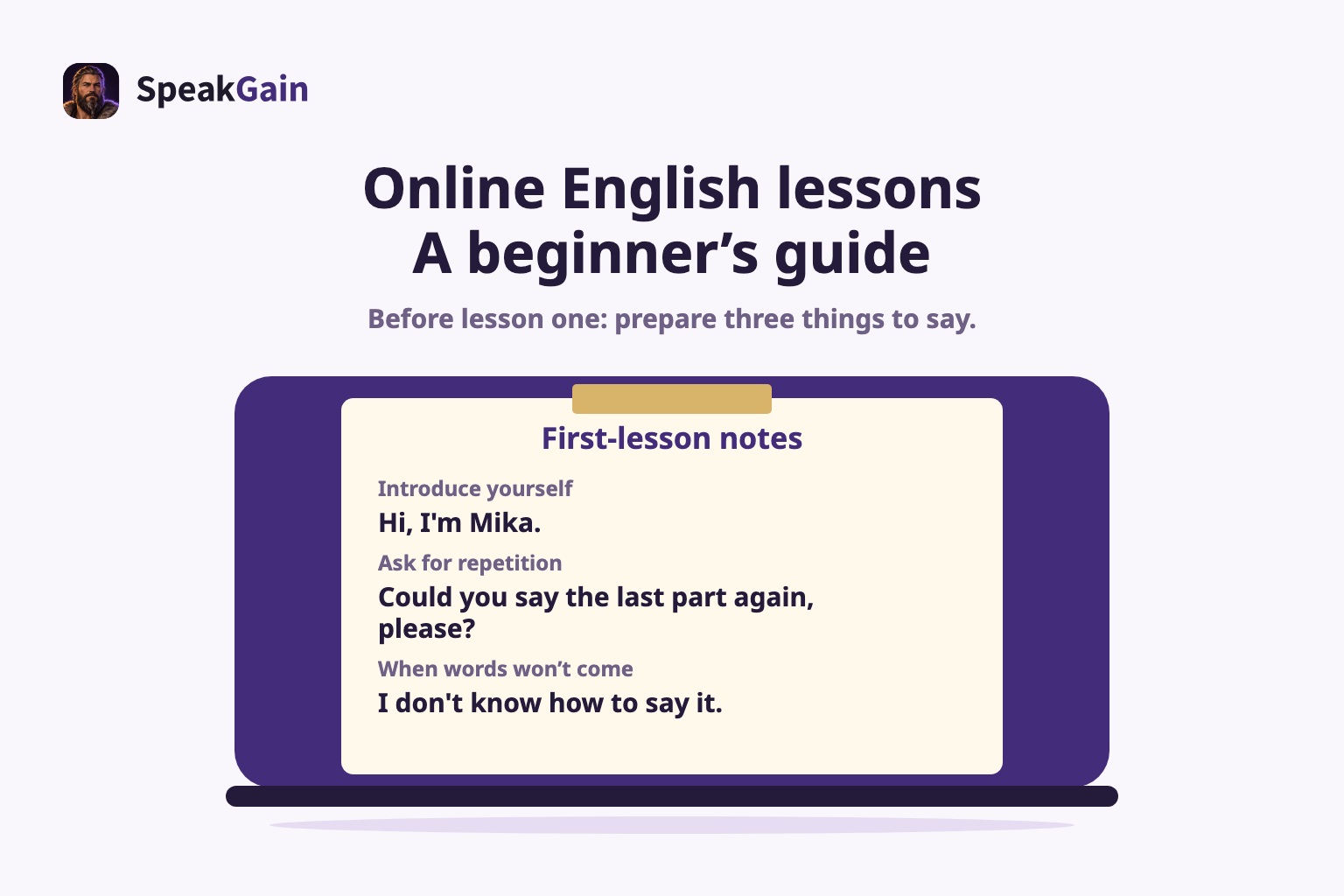
For your first online English lessons, choose a tutor you can ask for help and beginner materials with a clear sequence. Prepare a short introduction and one request to repeat, then use your first 10 lessons to answer, ask again and eventually ask a question yourself. After each lesson, take one sentence you could not say and prepare to use it next time.
This guide is for adults who have barely spoken English, including those who tried a lesson and froze. The recommendations, practice times and 10-lesson plan are our editorial suggestions, not a service ranking or a promise to reach a level in 10 classes. Your first decision is what help you need when the exchange stops.
Which lesson format fits your starting point?
“Beginner friendly” does not tell you whether the tutor can explain in your language or only the booking team can. Tutor background, materials, lesson length, booking and payment are separate choices; do not assume they come as one package.
| Type or condition | Who we would choose it for | What to check officially or in a trial | Common trap |
|---|---|---|---|
| Tutor who speaks your first language | You cannot yet ask what an instruction means | The actual tutor’s language support and eligible plan | Spending the entire lesson in your first language |
| Tutor who learned English as another language | You understand simple sentences and want guided practice | Beginner teaching experience, pace and correction | Judging teaching by nationality |
| Native English-speaking tutor | You have a particular region or situation to practise | Beginner support, slower delivery and written help | Assuming native means easier to understand |
| Support desk or learning adviser in your language | You need help choosing a course or booking | What advice is included and any extra fees | Confusing customer support with in-class support |
| Beginner curriculum | You need a clear task each time | First unit, preparation page and repeat options | Choosing news just because you are an adult |
| Topic-based conversation | You can prepare a short answer on one subject | Advance topic choice and return to materials | Beginning with completely open conversation |
| Short or longer lessons | Short if anxiety is high; longer if you need examples, practice and correction | Duration, early finish rules and credits used | Assuming one unit always fits a time slot |
| Advance booking or regular tutor | A booked time helps you prepare; continuity reduces repeated explanations | Availability at your actual hours and cancellation deadline | Expecting a popular tutor to be available every time |
| Immediate lessons | Your schedule varies and you have a sentence ready | Available tutors, material choice and reservation charges | Treating no booking as a guarantee of your chosen tutor |
| Monthly lesson allowance or pay-as-you-go | You want to test a manageable preparation-and-review routine | Expiry, tutor-specific credits, carryover and cancellation | Taking lessons only to consume remaining credits |
| Daily allowance or unlimited plan | You also have time to prepare and reflect | Daily limits, eligible tutors, reservations and renewal | Calculating value from the theoretical maximum |
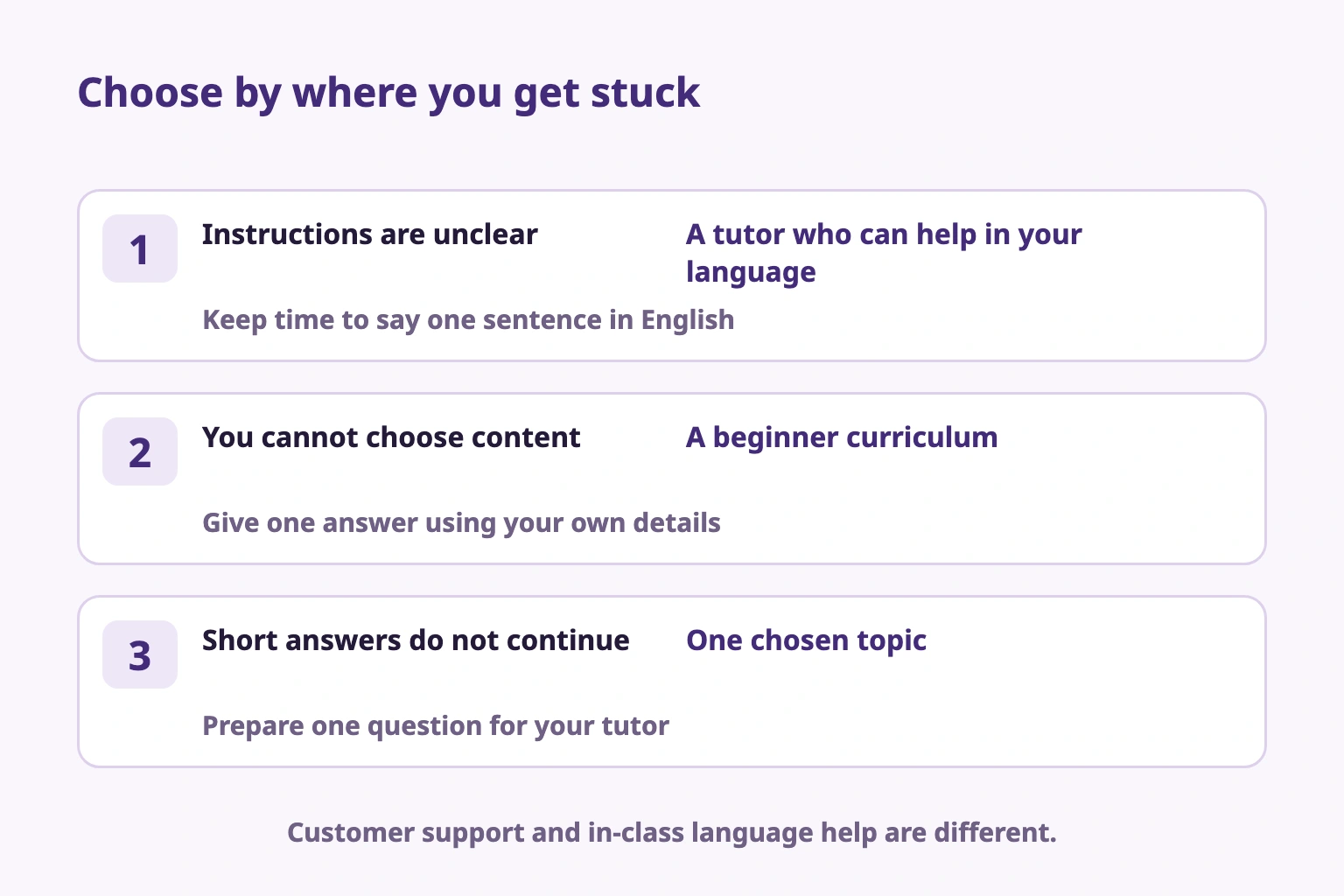
Our choice: if even the instructions leave you stuck, use a tutor who can help in your language plus beginner materials. If you can read a sentence but cannot say it, use a beginner-aware tutor and repeat the same unit. If short answers already come, choose one familiar topic. Japanese-language support is relevant to Japanese learners; elsewhere, look for your own language or another form of support you understand.
Prepared line: “I’m a beginner. Can we use a simple lesson today?” Practice: check the first unit, in-class help and your usual time slot; ask about one unclear condition. Mistake: comparing price and tutor counts without checking whether the lesson you need can be booked. For solo practice options, see our conversation-app comparison.
A flexible plan for your first 10 lessons
Returning to a familiar task makes it easier to see what changed. These are lesson goals, not deadlines. Repeat a stage when needed; replace the personal details with your own.
| Lesson | Goal | Sentence to prepare | After the lesson |
|---|---|---|---|
| 1 | Say you are new and give a short introduction | I’m new to English lessons. | Say your name and location without reading |
| 2 | Answer after hearing the question | I live in Osaka. | Keep the situation “asked where I live” |
| 3 | Ask for the part you missed | Could you say the last part again, please? | Practise asking, listening again and answering |
| 4 | Check one word | What does “weekend” mean? | Use it in one personal sentence |
| 5 | Answer about a hobby | I like cooking at home. | Practise the question and your answer together |
| 6 | Add one reason | I like it because it’s relaxing. | Add a reason to one short answer |
| 7 | Ask your own question | What do you like to do on weekends? | Wait for the answer and react briefly |
| 8 | Practise a familiar situation | I’d like a small coffee, please. | Change one word when the order changes |
| 9 | Say what you missed last time | I wanted to say that I was tired. | Save the confirmed sentence with the situation |
| 10 | Recheck an introduction and one exchange | What should I practice next? | Note one success, one difficulty and one next goal |
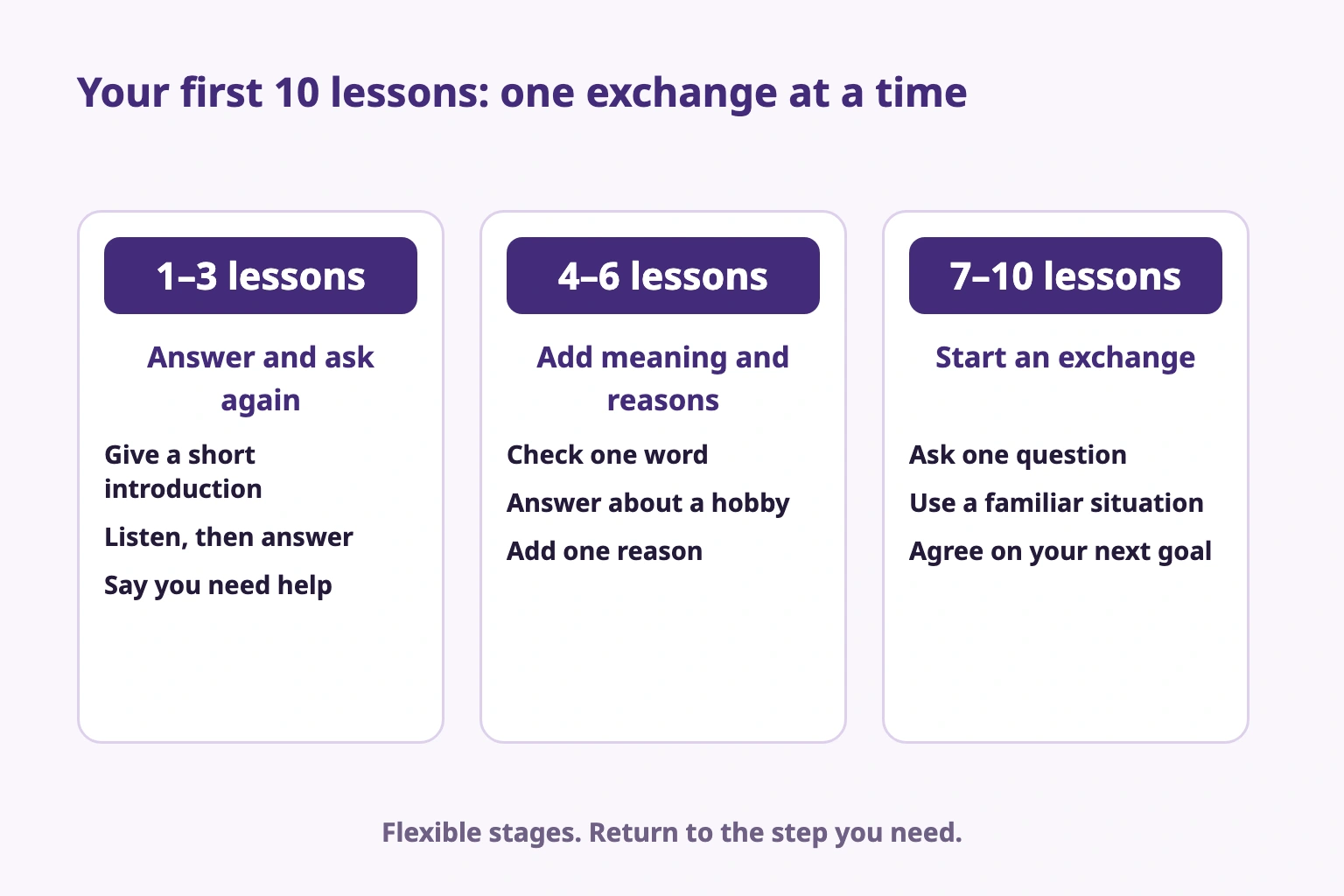
Practice: choose one row before booking and state a concrete goal: answer about my hobby, not “improve my English.” Mistakes: changing material every class, or reading a prepared answer regardless of the question. Listen first; ask again if your answer does not fit.
What should a trial lesson show you?
A trial is a chance to test how help works when you get stuck. Check the official free allowance, payment details required and what happens after it ends.
Prepared line: “Could you write that in the chat?” Practice: answer one beginner question, ask for repetition, and check where a corrected sentence can be saved. Afterwards, note whether the tutor shortened the question, offered understandable help and gave you another attempt. Check bookings at your usual hours too. Mistake: choosing a long contract only because you were praised. With a monthly plan, use your realistic attendance; with credits, check expiry and tutor costs.
Prepare a two- or three-sentence introduction
An opening may involve your name, location, interests or purpose, but the order varies. Prepare separate answers rather than one memorised speech.
| Purpose | Example | What to change |
|---|---|---|
| Name | Hi, I’m Mika. | Your name |
| Location | I live in Osaka. | Your city or region |
| Interest | I like cooking at home. | Something you actually enjoy |
| Goal | I want to use English when I travel. | Your intended situation |
| Explain your starting point | I’m new to English lessons. | Use when it is true |
Practice: say each answer, hide the English and respond to a situation cue. You need not share a detailed address. Use the short introduction guide to build more. Mistake: writing a long professional biography with words you cannot say, or preparing only on paper.
What can you say when you freeze?
Missing the sound, losing track of the speed and not knowing how to express your answer need different help.
| Difficulty | Rescue line | Meaning |
|---|---|---|
| Missed the final part | Could you say the last part again, please? | Ask to hear that part again |
| Too fast | Could you speak a little more slowly? | Ask for a slower pace |
| Cannot express the answer | I don’t know how to say it in English. | Explain why you are stuck |
| Need thinking time | Let me think for a moment. | Ask for a brief pause |
| Audio breaks up | Your sound is cutting out. | Report a connection problem |
Our worked example is “Could you say the last part again, please?” Use it when the final part is what you missed. If the whole question is unclear, ask for slower speech, writing or help with the material instead.
Practice: see the cue “missed the end,” say the line, then answer a simple repeated question with “I like cooking at home.” Mistakes: saying “Yes” without understanding or apologising repeatedly. Short conversational responses help you react, but they should not disguise a question you did not understand.
Move into conversation through one topic
You may manage a textbook exercise yet find open conversation overwhelming. Keep the material available and choose one familiar topic.
Prepared line: “Can we talk about food today?” Practice: note a favourite food, what you cook and one question for the tutor. Begin with “I like curry,” then ask “What food do you like?” and listen. The conversation-topic guide offers starting points. Mistake: choosing news or abstract arguments before you can organise the content in your first language. If reading works but speaking does not, revisit the practice sequence for speaking English.
Carry one sentence into your next lesson
Instead of copying everything, keep one situation where you needed a sentence you will use again.
Prepared line: “Can we practice that sentence again next time?” Practice: allow roughly 10 minutes as a practical limit: note the situation, confirm one sentence, hide it and say it, then try again the next day and before the next lesson. Fewer items are fine. The lesson-review guide explains the loop in detail.
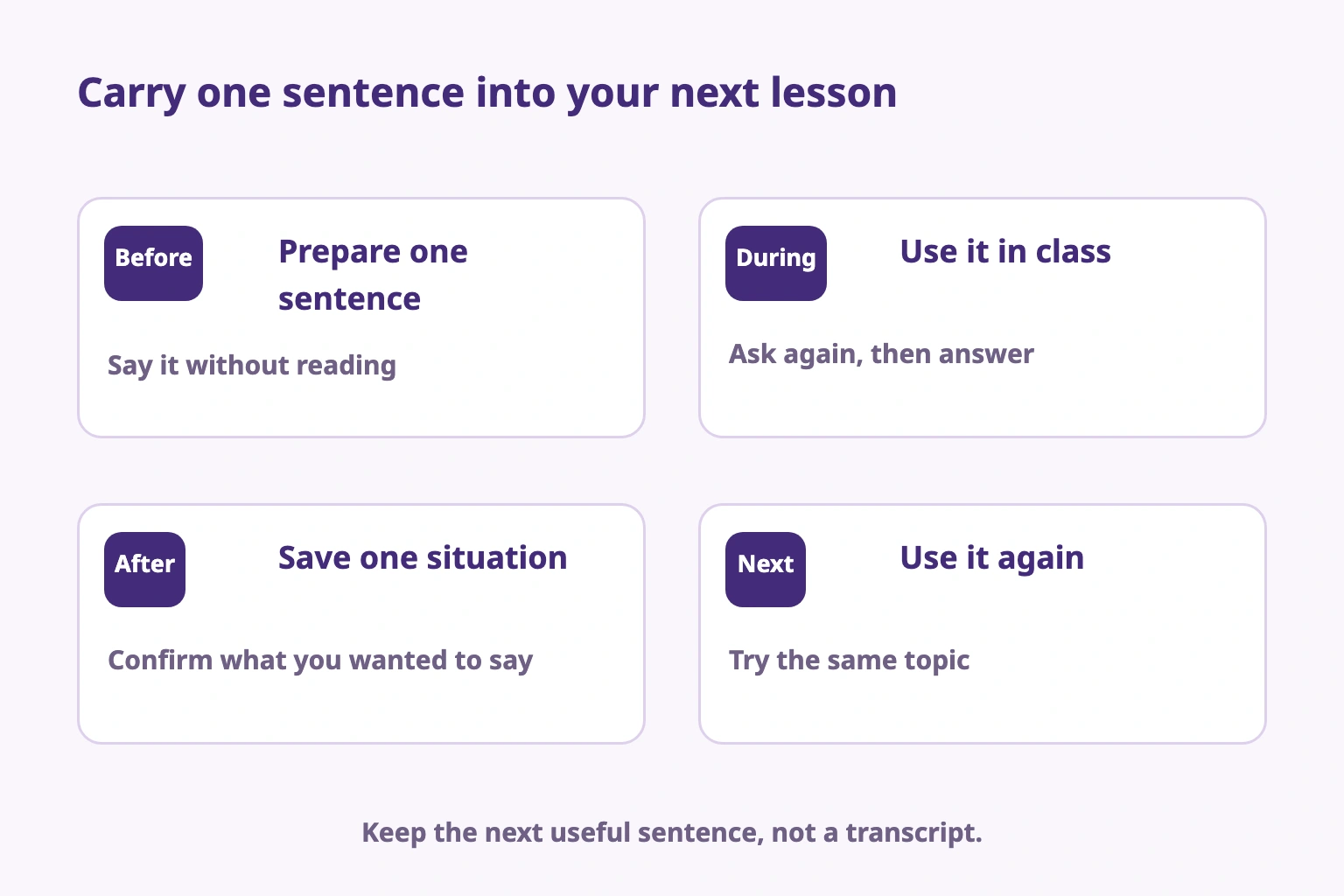
Mistakes: collecting every correction, assuming reading means you can retrieve it in conversation, or repeating an uncertain sentence as if it were confirmed. Paper and tutor chat are enough to start. Tools such as SpeakGain can be considered when you want your chosen sentence and audio together; using it in the next real lesson remains the goal.
Keep your first-lesson sentence with audio in SpeakGain
Paper and tutor chat also support this practice. If you want your chosen sentence and audio together, SpeakGain, which we provide, is an option. On 15 October 2026 we created this rescue sentence once through the normal flow and reached its study screens.
The verified sequence was Library → Knowledge → Learn this card → Listening with the sentence hidden → guess what you heard and say it aloud → Reveal answer to see the sentence and generated explanation. Answer showed playback and review-interval choices; we selected Good once.
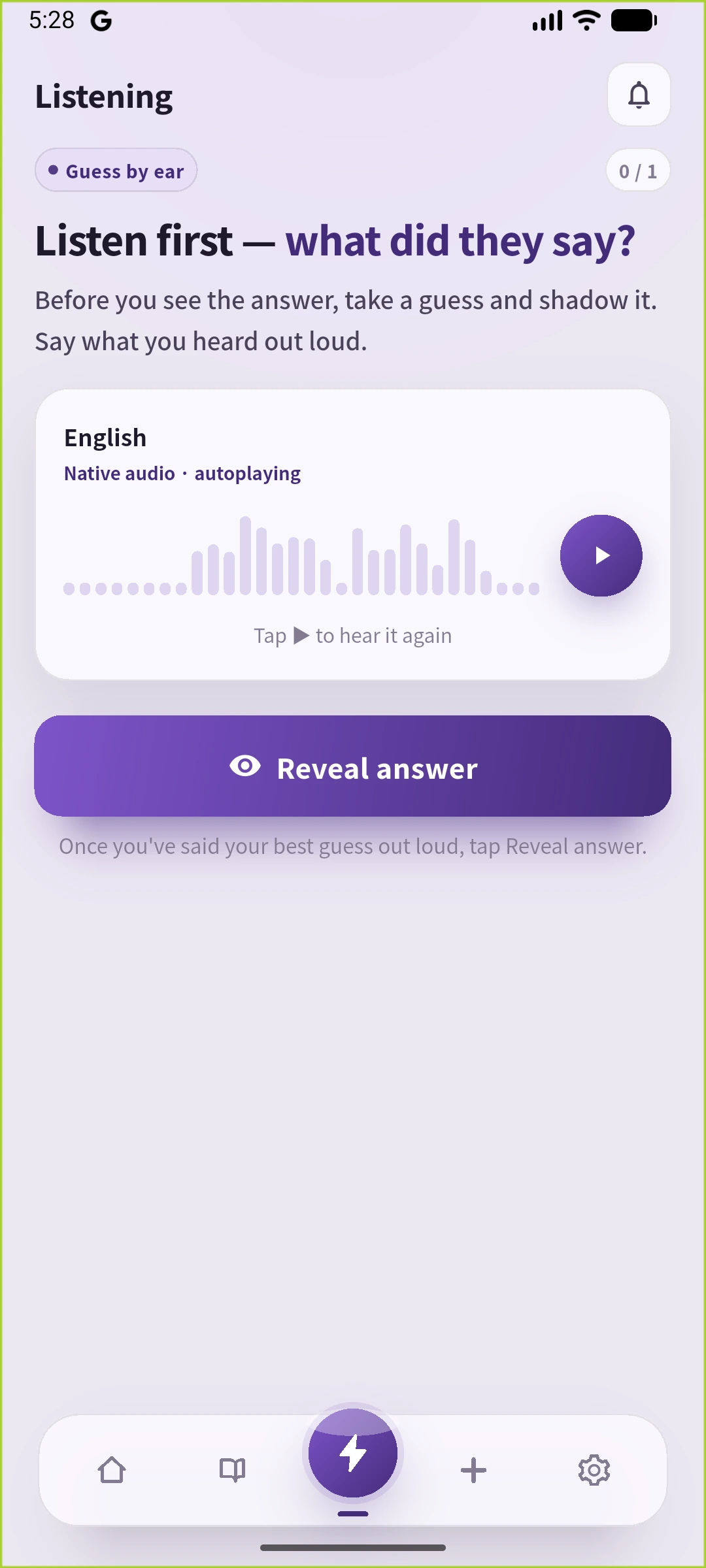
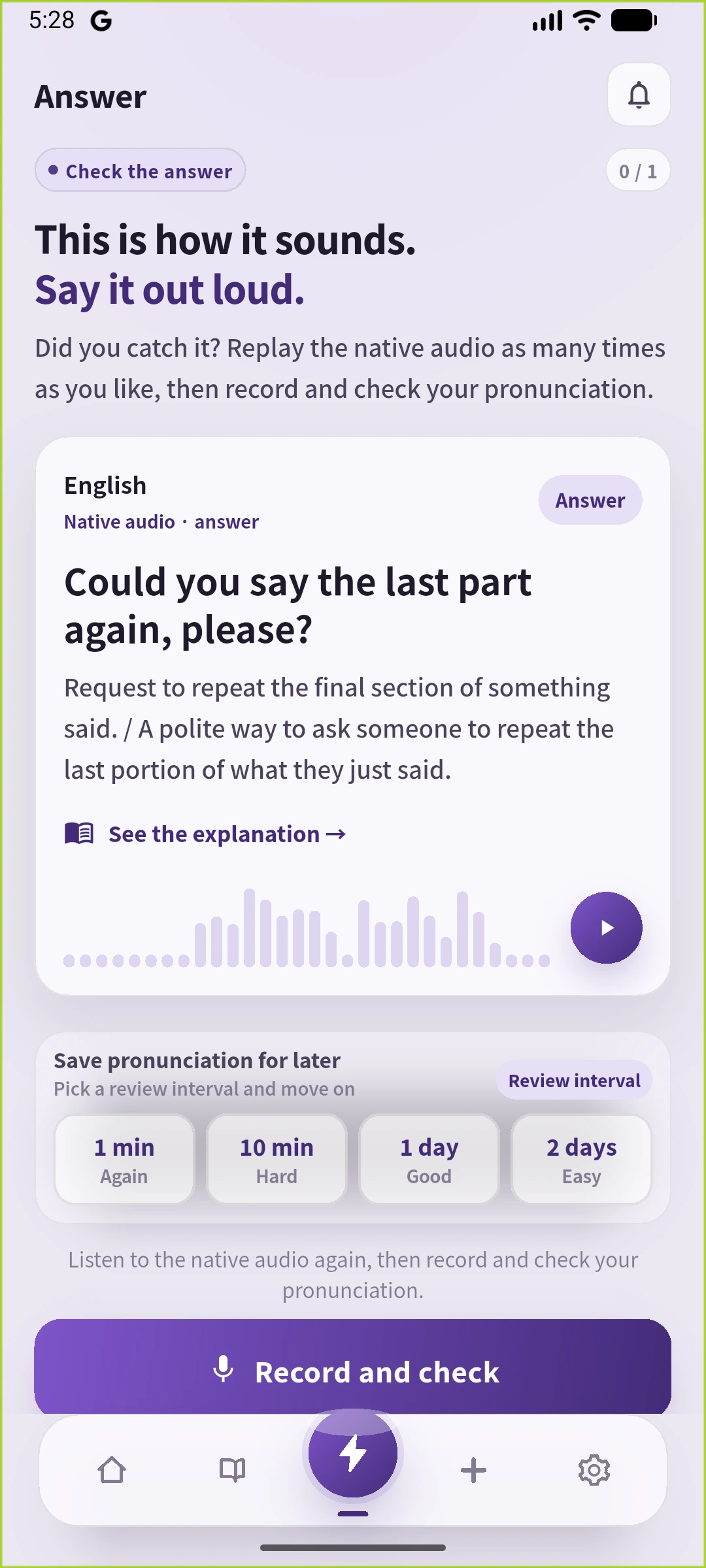
The clip says Could you say the last part again, please? It asks to hear the final portion once more. This is one AI-generated Viking sample reused across all languages, not a recording by a human native-speaking tutor. The app’s “Native audio” label refers to that generated audio.
SpeakGain is not a replacement for lessons or a conversation partner. We did not use recording or pronunciation checking and do not describe it as scoring answers or pronunciation. Practise the request, then use it in a real lesson and answer the repeated question.
Starting methods we would not recommend
Only free talk from day one: you must choose content, form English and understand the response at once. Ask “Can we use a simple lesson today?” and answer one guided question, then personalise it. The mistake is assuming supported practice is not real practice.
Daily bookings with no preparation: lesson counts can rise while the same obstacle returns. Prepare “I’d like to practice this sentence today,” spend about five minutes saying one line and save one item afterwards. Daily lessons are fine when the preparation and review also fit; attendance alone is not evidence that you can use more expressions.
Relearning all grammar before booking: if you cannot form an introduction, review the part you need, such as “I live in Osaka,” and try it with a beginner-aware tutor. Do not make finishing every basic topic an indefinite prerequisite for answering a person.
FAQ
Can I start if I cannot speak at all?
Choose support that lets you understand instructions and prepare your name and location. The CEFR A1 description includes simple interaction when the other person speaks slowly and clearly and helps. That supports allowing assistance, not a promise about 10 lessons. Council of Europe global scale.
A tutor who speaks my language or a native speaker?
If you cannot ask for help in English, we would choose language support first. If a region or situation matters, consider that background. Check beginner teaching and pace rather than nationality alone.
Should I take lessons every day?
No fixed frequency is necessary. Start with a schedule that includes preparation and review. For a busy learner we might try twice a week first; that is a planning suggestion, not a proven optimum.
Should I switch services after a silent lesson?
Identify the cause first: difficult material, unclear instructions or missing words. Try easier tasks, understandable help or a short prepared answer. If requesting the help you need repeatedly fails, reconsider the tutor or format.
What matters in a free trial?
Can you return to practice after asking again, get another attempt, and book at your real hours? Check renewal and extra charges officially.
Which material should I choose?
Start with personal introductions and everyday questions. Choose a unit whose instruction you understand and whose question you can answer briefly; repeat it with the tutor when needed.
How many months until I feel comfortable?
There is no universal duration. Compare the same situation: could you introduce yourself, ask again and reuse last time’s sentence? Record those changes.
Do I also need an app?
No. A note and tutor chat can support the routine. Consider SpeakGain when you want a chosen sentence and audio together. Decide on the next sentence before adding tools.
Our final editorial verdict
Choose language support if instructions stop you, repeatable beginner materials if you understand but cannot speak, and one chosen topic if short answers already come. Prepare two or three introduction sentences and one rescue line. Use your first 10 lessons to test an exchange, request help and ask your own question, then carry one useful sentence into the next class.
Reference
- Council of Europe: CEFR global scale, checked 15 October 2026. Used for A1’s support conditions, not the lesson plan or a learning-time claim.