
English job interview preparation: 8 core questions, STAR and speaking practice
Published
For an English job interview, prepare short answers about your background, motivation, strength, weakness, achievements, challenges, reason for moving, and questions for the employer, using your own experience. Our editors recommend organising experience answers with STAR, then recording a timed response, listening back and fixing one thing. Prepare a line for asking the interviewer to repeat a question and another for taking a moment to think.
When recruitment includes a language test, Versant preparation helps identify the exact product and plan responses separately from interview answers.
Reading a polished answer is easier than producing one when someone asks a different version of the question. Before adding more scripts, choose your material and the order in which you will explain it. You should be able to return to your own experience when asked why or how.
This guide concerns employment interviews conducted in English. All questions, examples, answer patterns and home-practice timings are editorial examples, not official employer questions or hiring criteria. The “what is being checked” column is our editors’ preparation lens. Employer-specific statements have public sources and a check date; they do not establish universal standards. For your wider study routine, see how to study English.
Which eight questions should you prepare first?
Start with eight answer categories that connect your experience to the job, rather than translating your entire employment history. They are a preparation starting point, not a prediction that every interviewer will ask them. Add technical, specialist or case preparation required by the job description and interview invitation.
| Practice question | Editorial preparation lens | Answer pattern | First recording window |
|---|---|---|---|
| Could you give me a brief overview of your background? Background |
Experience linked to the role | Present → experience → role | 45–60 seconds |
| What makes this role a good next step for you? Motivation |
Why this work; contribution | Duty → experience → contribution | 45–60 seconds |
| Which strength would you bring to this team? Strength |
How a strength was used | Strength → action → use | 45–60 seconds |
| What are you working to improve at work? Weakness |
Awareness and improvement | Difficulty → effect → response | 30–45 seconds |
| Walk me through a result you helped achieve. Achievement |
Your contribution and result | STAR | 60–90 seconds |
| How did you handle a project that was going off track? Challenge |
Decisions, cooperation, reflection | STAR → later change | 60–90 seconds |
| What are you looking for in your next position? Moving jobs |
Next aim and role connection | Experience → aim → fit | 30–45 seconds |
| What would you like to ask about the role? Your questions |
Clarify work and assess fit | Unclear point → specific question | 10–20 seconds |
These seconds are recording windows at home. Follow an interviewer’s request for a brief answer or more detail instead. Keep extra information for follow-ups rather than forcing everything into the first response.
Amazon’s interview-loop guide says different interviewers assess different aspects of skills and experience at Amazon (checked 10 October 2026). Read your own employer’s published requirements rather than turning one company’s process into a rule for all interviews.
Connect the job to your own answer material
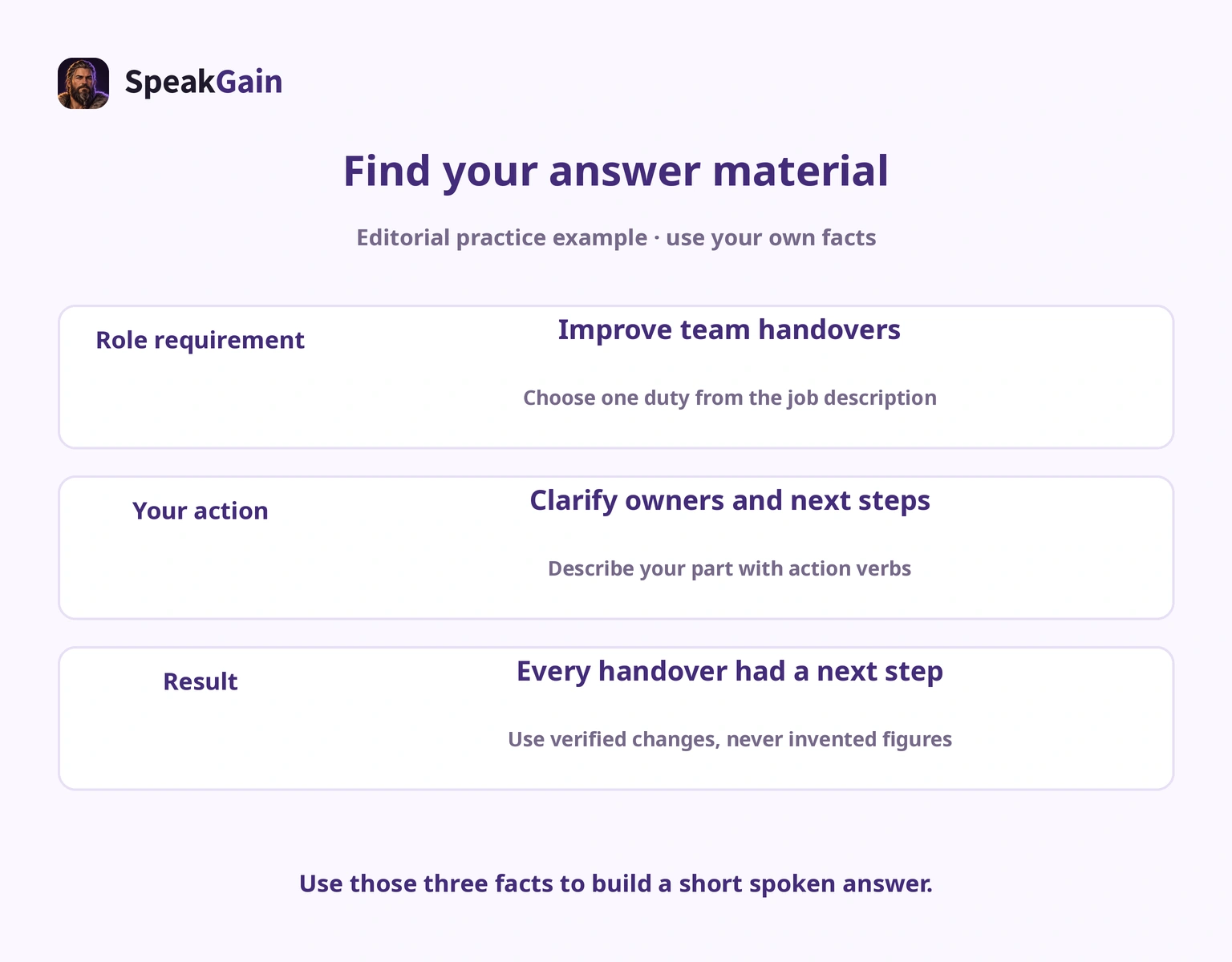
Choose one job requirement, something you actually did, and a result you can verify before writing English. If the role involves team handovers, your material might be missing weekend details, your checklist and a change in what the handover included. That is our invented practice scenario: replace it with your own facts, dates and responsibilities.
Students can draw on coursework, research, part-time work or campus projects. Pick one incident you can explain rather than inflating its importance. Separate the team’s result from your own contribution. Do not invent numbers; an observable change or a met deadline can be useful evidence. Keep confidential customer details and figures out of your answer.
Write short sentences you can say. Explain what a role involves if its internal title would not tell an unfamiliar listener much.
1. Background: create an entry point into the role
What is being checked?
Our editors treat this as a chance to connect your current work and relevant experience to the position. Choose the experience you want to discuss next, rather than giving equal weight to every detail of your life.
Editorial pattern and short example
Use present role → relevant experience → connection to this job.
I work in customer support. I also help new colleagues learn our ticket system. I would like to bring that experience to a team training role.
The speaker works in customer support, helps new colleagues learn a ticket system, and connects that experience to team training. Add one concrete duty if useful; the short example is not a complete timed answer.
Make it your own
Replace the title with a description of what you do, then choose one relevant responsibility. For a first job, use your field of study, a project role and the work you want to do. Start with the requested background rather than an apology about your English.
Practise alone
Record the question first, hide the full script and answer for 45–60 seconds. Listen for whether your first 15 seconds explain what you do. Fix only “add one duty after the title”, record again, then try a question asking specifically for relevant experience.
Common mistakes
Starting with childhood, spending too long on hobbies or reading the CV aloud can bury the role connection. Save the longer history for follow-ups. Use our introduction guide for other settings, then select the job-related part here.
2. Motivation: explain the work you want to do
What is being checked?
Our preparation lens is why you chose this work and how your experience connects to it. Robert Half’s public preparation guide recommends explaining company interest and contribution (checked 10 October 2026); that advice is not your employer’s scoring rubric.
Editorial pattern and short example
Use a duty that interests you → related experience → contribution.
This role includes improving customer handovers. I have helped document handover steps in my current team, and I would like to build on that experience here.
The speaker links an interest in improving customer handovers to experience documenting them. Use this only where that duty really belongs to the advertised role.
Make it your own
Choose one duty from the vacancy and a related incident. Keep the public company page you read so you can explain what interested you. Separate work motivation from important conditions such as location or pay; you need not pretend those conditions do not matter.
Practise alone
Record 45–60 seconds. If replacing the company name changes nothing, fix “name one specific duty”. Record again and answer a follow-up about which part of the work interests you most.
Common mistakes
Stopping at “it is famous”, “I want to grow” or “I want to use English” leaves the work unspecified. Our editors would explain whom you would work with and what you would do.
3. Strength: attach an action to the label
What is being checked?
Our editors focus on how you used a strength in one situation. “Responsible” becomes easier to explain when you identify how you checked ownership, shared a problem or completed a review.
Editorial pattern and short example
Use strength → one action → where it helps in the role.
I am good at making tasks easy to follow. On a busy project, I made the next step clear for everyone on the team.
The example describes making tasks easy to follow, then clarifying a team’s next step. Add the actual method and result rather than relying on the self-description.
Make it your own
Recall a responsibility repeatedly assigned to you or one occasion someone thanked you for your work. Describe your action with verbs. Distinguish the part you organised from what colleagues executed.
Practise alone
Record 45–60 seconds. Check whether there is an action after the strength. Fix “include one incident”, record again and answer “What did you change?” without adding more adjectives.
Common mistakes
Listing three strengths without evidence or choosing an unrelated quality leaves little to discuss. Start with one relevant strength and keep another incident as a backup.
4. Weakness: separate the difficulty from current action
What is being checked?
Our lens is whether you can recognise a difficulty and describe your response. Robert Half’s guide advises identifying a real improvement area and steps you are taking (checked 10 October 2026). Required job skills still need separate, honest checking.
Editorial pattern and short example
Use difficulty → effect on work → current response.
I sometimes spend too long checking small details. I now set a review deadline and ask a colleague to check the most important points first.
The speaker spends too long checking details and now sets a deadline and asks a colleague to prioritise key points. The answer describes a current practice, not a claim that the problem has disappeared.
Make it your own
Choose a real incident and identify its effect and what you now do differently. If a required skill is missing, explain your current scope and learning honestly. Do not describe a planned action as already completed.
Practise alone
Record 30–45 seconds. Listen for a clear current action at the end. Fix “add the action in present tense”, record again, then explain what has changed or remains difficult.
Common mistakes
Saying there is no weakness or disguising praise as a weakness avoids the issue. A long problem description with almost no action also needs revising. Specify the response rather than dramatising the difficulty.
5. Achievement: use STAR to show your contribution
What is being checked?
Our editors separate the achievement from your part in it. Amazon’s recruiting-manager advice recommends STAR for its behavioural interview questions (checked 10 October 2026). That is Amazon’s guidance, not proof that every company uses this format.
Editorial pattern and short example
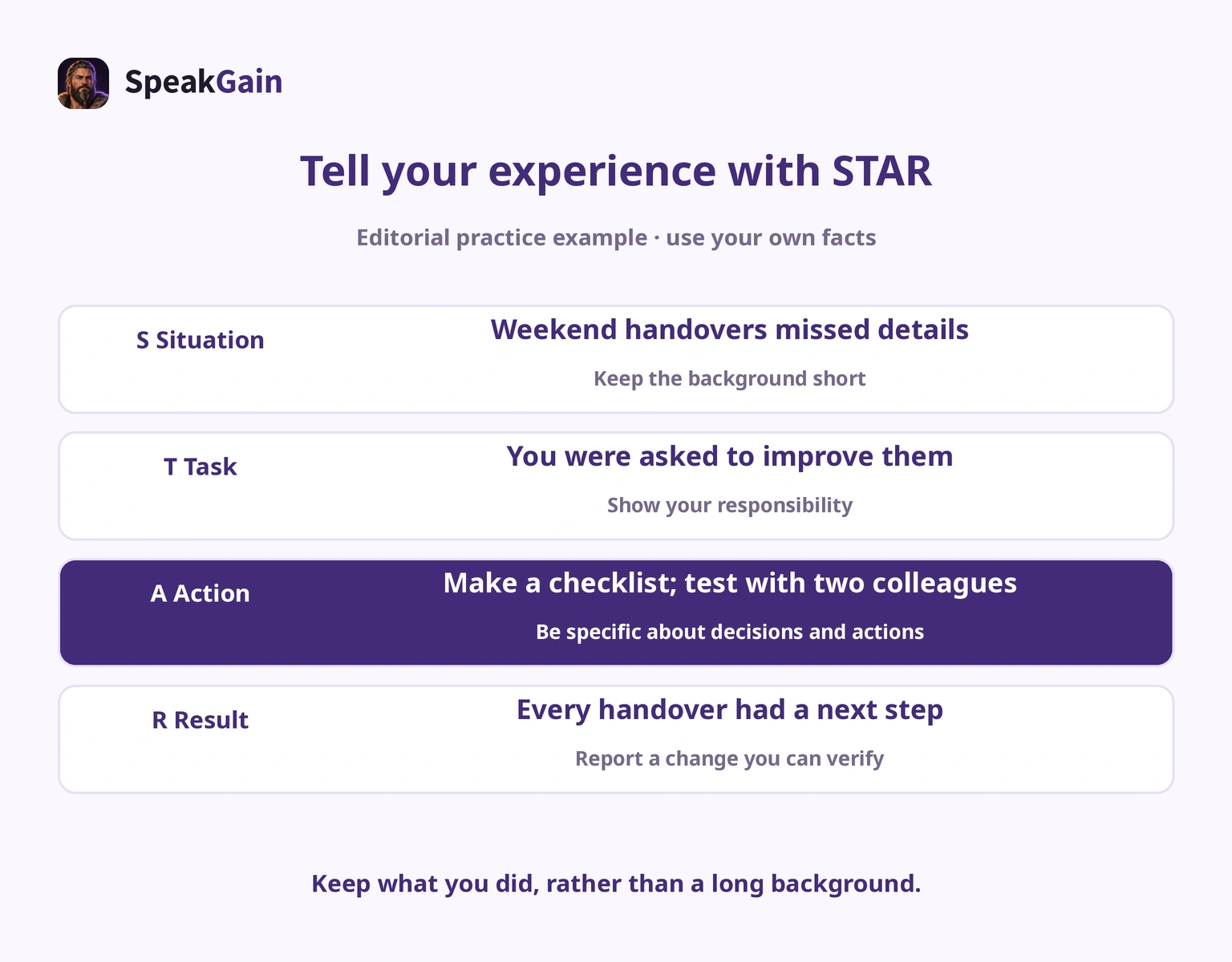
STAR means Situation → Task → Action → Result: background, your responsibility, what you did, and the outcome. You do not need to announce those headings in the interview.
Our weekend handovers were missing details. I was asked to improve the process. I made a short checklist and tested it with two colleagues. In the next month, every handover included an owner. Every handover had a next step.
In this invented example, weekend handovers missed details, the speaker was asked to improve them, tested a checklist with two colleagues, and found clearer ownership and next steps the following month. “Every handover had a next step.” is the concrete result line on the article image. It is a fictional practice result, not a testimonial.
Make it your own
Choose one incident and write a fact for each part. Add the action that connects you to the result. Without figures, describe who could do what afterward or whether you met a deadline. Be accurate when several people contributed, and protect confidential details.
Practise alone
Record 60–90 seconds. If background occupies more than half, fix “one background sentence, two actions”. Record again and answer why you chose that method, rather than replaying the whole story.
Common mistakes
Using “we” throughout can hide your role. Inflating results or running out of time during the background also weakens the explanation. Filling four headings is not enough: a listener should be able to follow your decision and action.
6. Challenge: show the adjustment you made
What is being checked?
Our preparation lens is what you checked and how you worked with others when plans changed. If you reuse an achievement story, shift the focus to the decision during the difficulty. An incomplete outcome can still be explained honestly.
Editorial pattern and short example
Use STAR → what you changed afterward.
Two teams had different priorities, and the deadline was at risk. I listed the tasks we both needed and agreed on a smaller first release. We delivered that version on time. Afterward, I started checking priorities earlier.
The example concerns two teams with different priorities, a reduced first release delivered on time, and earlier priority checks afterward. It is invented material to replace with your own facts.
Make it your own
Choose a delay, misunderstanding or rework incident. Replace judgements about a colleague’s personality with the work differences you observed. If the goal was not fully achieved, separate what worked from what remained, and specify your next action.
Practise alone
Record 60–90 seconds. Listen for your response rather than just the problem. Fix “replace a complaint with the fact I checked”, record again, then answer what you would change now.
Common mistakes
Blaming others, claiming never to have failed or ending with “try harder” leaves the response vague. Specify who you would check with, when and about what. For short opinion phrases, use speaking up in English meetings as partial practice.
7. Moving jobs: connect your experience to your next role
What is being checked?
Our lens is what you seek and how the position connects to it. A contract ending, practical needs or pay can be real reasons. Do not invent a growth story to conceal facts; explain what you can share and what work you want next.
Editorial pattern and short example
Use current experience → next aim → connection to the vacancy.
I have learned a lot in a support role. I now want to work more closely with product teams, and this position includes that collaboration.
The speaker moves from support experience toward collaboration with product teams, where that collaboration genuinely belongs to the vacancy.
Make it your own
Write the factual reason and the next aim separately. First-job candidates can use what they have studied and the work they want to begin. Keep dates and employment types consistent with your application.
Practise alone
Record 30–45 seconds. Fix “state the work I want next” if it is unclear. Record again, then answer whether you could do that work in your current position using facts.
Common mistakes
A long complaint about the employer or an evasive unrelated answer can obscure your aim. Keep necessary context brief and return to the conditions you seek in the next role.
8. Your questions: find out how the work happens
What is being checked?
Our editors see this as a time to clarify the work and assess fit for yourself. Choose something not yet answered, rather than trying to manufacture an impressive question.
Editorial pattern and short example
Use a duty discussed → one specific point to clarify.
You mentioned handovers between teams. How does the team decide who owns the next step?
The speaker asks how teams assign ownership of a next step, after handovers have actually been mentioned. Do not claim that a topic was discussed when it was not.
Make it your own
Prepare two unanswered points about early responsibilities, expected outcomes or collaboration. Read supplied information on conditions too. Ask who can clarify a condition if the current interviewer is not the right person.
Practise alone
Record one question for 10–20 seconds. Fix “one issue per question” if you combine several. Record again, read an invented short reply and ask just one follow-up aloud.
Common mistakes
Asking only what the website already explains, repeating an answered question or using a long preamble wastes the opportunity. Drop prepared questions once you know the answer.
What can you say when you miss a question or freeze?
Ask for the part you need rather than answering a different question. These original practice lines specify the missed information, a clarification or a brief pause.
| English line | Meaning | Use it when |
|---|---|---|
| Could you repeat the last part of the question? | Ask to hear the final part again. | The end was inaudible. |
| Are you asking about my role or the team’s overall result? | Clarify whether the interviewer wants your role or the team result. | The focus is unclear. |
| Let me take a moment to choose a clear example. | Take a brief moment to choose an example. | You need to think. |
| Let me correct that: I supported the project; I did not lead it. | Correct the scope of your contribution. | You described your role inaccurately. |
| The audio cut out for a moment. Could you say that again? | Ask again after an audio interruption. | The connection interrupted the question. |
After clarification, answer the question you confirmed. Practise the complete sequence: play a recorded question, ask again, replay it and answer without stopping the recording. Do not just read the recovery line. If you know words but cannot retrieve them, use our guide to words not coming out; use short sentence-building practice for a difficult clause, then return to the answer.
Practise alone: record, listen and fix one thing
Speak without the script once, then decide what will change in the next take. Our editorial 20-minute session is three minutes choosing material, three recording, five listening, four revising and five re-recording and changing the question. It is a starting routine, not a research-established optimum.
- Choose two questions and record their prompts. Hide full answers; keep three keywords.
- Time the response. Correct yourself and continue rather than restarting after each error.
- Listen first for content: an answer to the question, your role and a connection between action and result.
- Choose one correction with a location in the recording: shorten the opening, identify your role, fix a past-tense verb or make a key work word clearer.
- Record again, then answer a different version of the question. Save dated first takes, revisions and changed prompts.
Self-recording cannot establish what another person understood or fully test unexpected follow-ups. If possible, ask someone to question you once and tell you what work they understood you had done. Check that meaning before collecting every language correction.
Use SpeakGain for one difficult sentence
Practise a short core line separately from your full interview recording. The new original line prepared for this article was:
I made the next step clear for everyone on the team.
It means that you clarified the next action for everyone on the team. Use it in your answer only if that matches your experience. Being able to repeat it does not prove you can explain the entire incident.
On 10 October 2026, we created one card through the normal app flow. Generation failed, and one retry of the same card did not finish it. The original publication had no audio player; the same card now has Viking audio below. These screenshots show a different, existing successful card, not successful generation of the interview sentence.
This AI-generated Viking sample comes from a card created through the app’s normal Add flow; it is not a human native speaker’s recording.
I made the next step clear for everyone on the team. — Describe making the next step clear to the whole team.
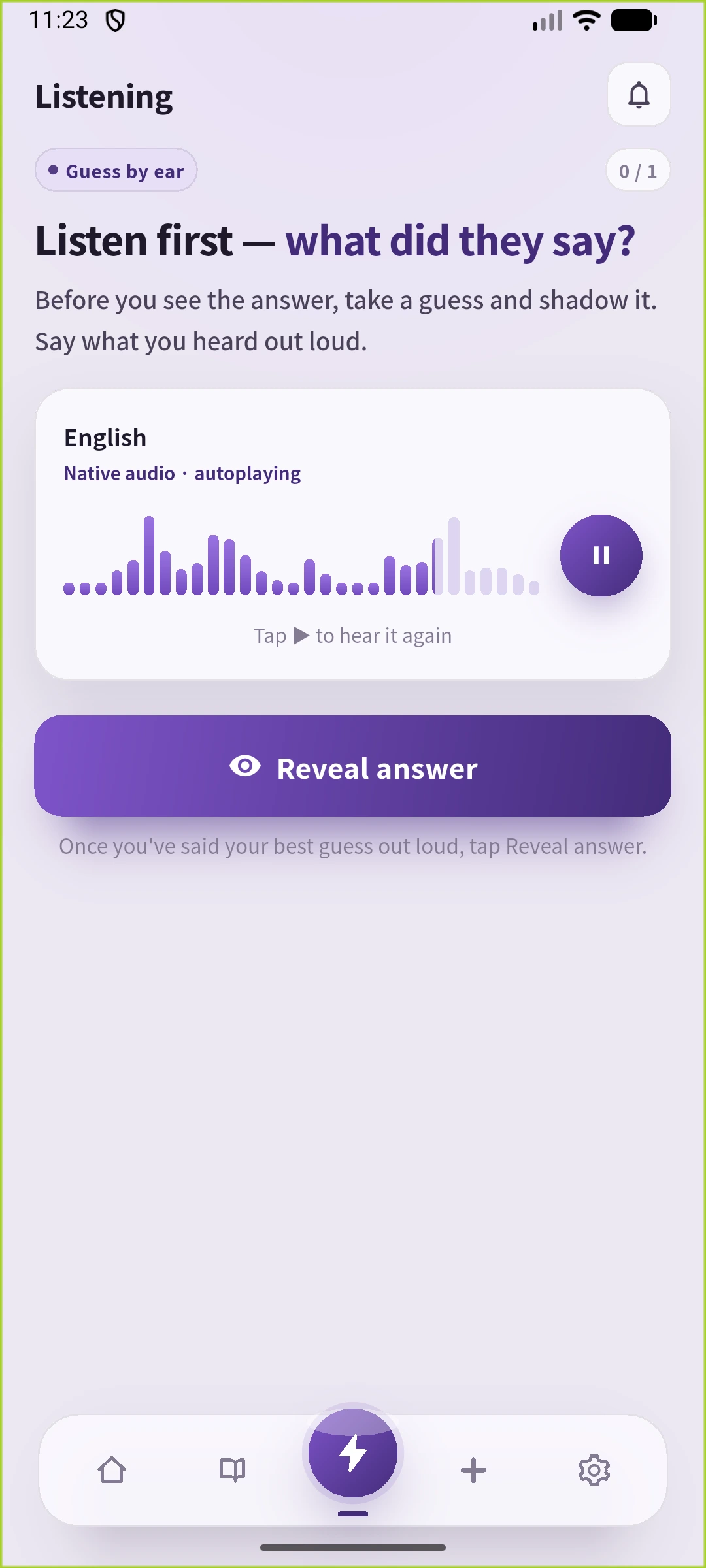
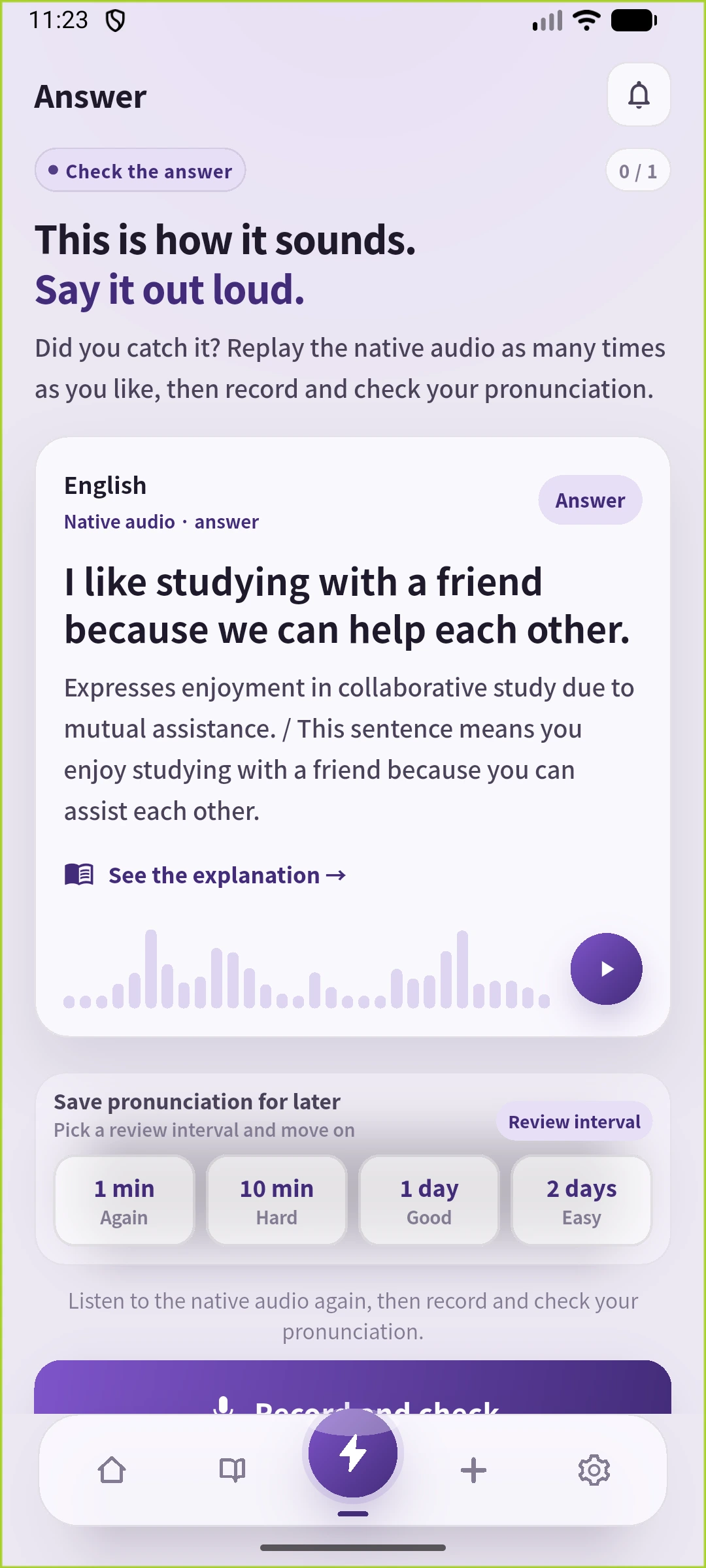
We verified opening an existing card from the library into study, a listening stage that hides the English and offers playback, and an answer stage with the sentence, explanation, recording entry and review intervals. Resume position depends on the card’s state. The explanation on the existing card remains in English. Recording-score completion was not tested; these are not interview assessment results. Use full-answer recording to check content and role fit. See what SpeakGain does for the wider feature description.
A practice plan until interview day
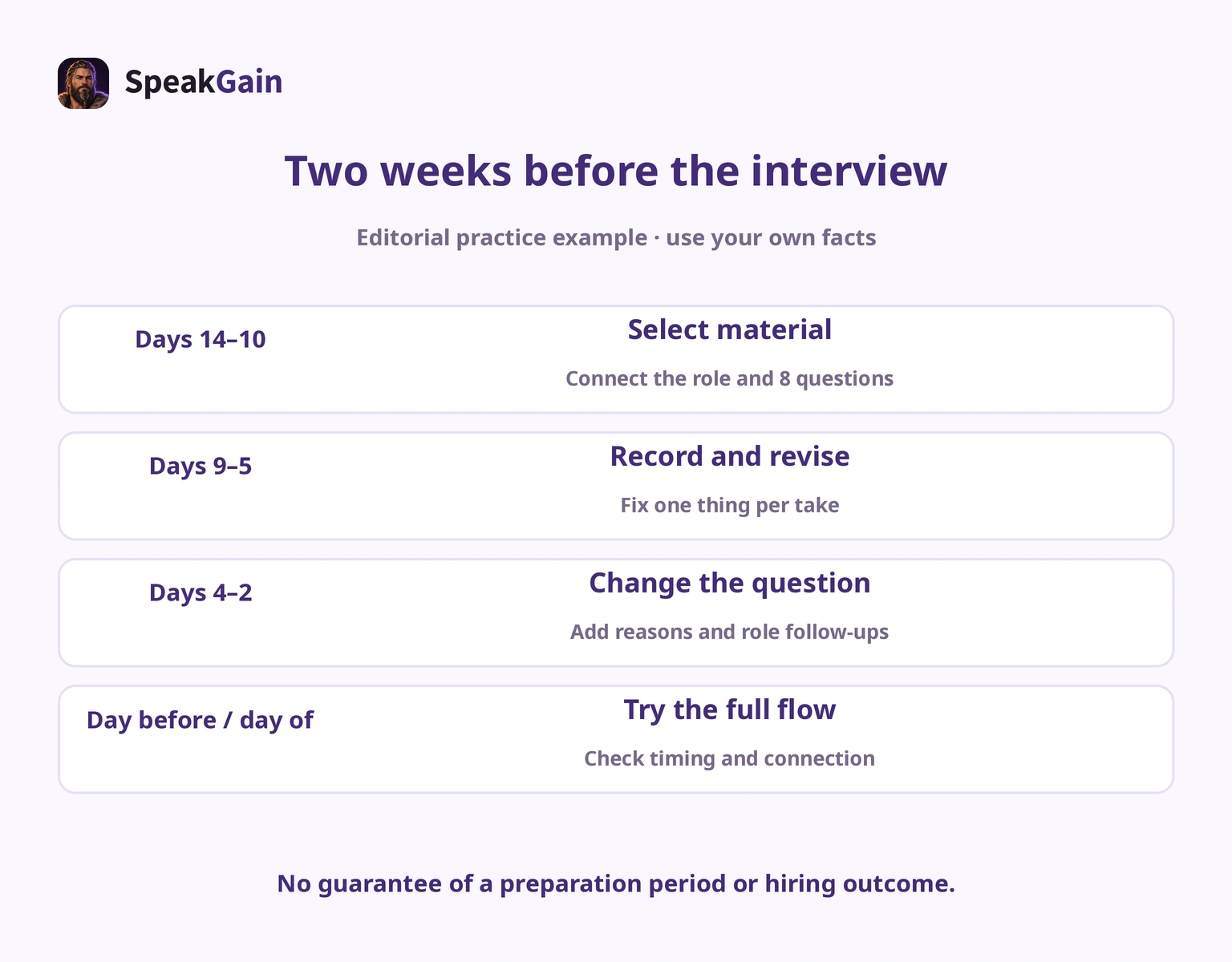
Choose material first, then record and revise, then test follow-ups and the complete flow. This two-week schedule is an editorial example, not a guaranteed preparation period or hiring outcome.
| When | Work to do | Keep |
|---|---|---|
| 14–10 days before | Read the role, select material for eight categories and organise one incident with STAR | Facts and key points |
| 9–5 days before | Record two questions per day; fix one thing and change the wording | First take, revision and note |
| 4–2 days before | Shuffle questions and add why, role and result follow-ups | Keywords rather than scripts |
| Day before | Rehearse from greeting to your questions; check time zone, location and connection instructions | Travel or connection plan |
| Interview day | Say one line aloud and check sound and connection | First point and recovery line |
With only three days, make background, motivation, one experience and your questions on day one and record them. Revise and try follow-ups on day two; do the full flow the day before. Other questions may still arise. Allocate time to technical preparation if it has been requested.
For video interviews, follow the invitation’s rules on notes. Where permitted, our editors prefer keywords to a full script: practise looking back to the question instead of reading. Test the actual camera, microphone and connection, and check the contact instructions for a connection failure.
Preparation our editors would avoid
We would avoid memorising other people’s sample experiences, reading a long script, judging only fluent delivery, fixing every error at once and inventing figures. Replace those habits with your own actions, three keywords, a content check, one correction and verified outcomes. Rehearse familiar opening or recovery lines, then practise selecting the rest of the material for the actual question.
Frequently asked questions
Does my English have to be perfect?
Required English depends on the employer and role. Check the language requirement and practise explaining relevant work, clarifying questions and answering follow-ups. Do not assume English is never assessed or that a qualification score alone prepares the conversation.
What if I do not understand the question?
Ask for the missed part or clarify the meaning before answering. Use the repeat line above, then answer the confirmed question. We do not invent a pass/fail limit on requests to repeat.
Can I read a script in a video interview?
Follow the interview instructions. If notes are allowed, our editors suggest key points rather than full text, then practising a response in your own words when the wording changes.
How long should each answer be?
Follow the request and start with the main point. At home, try 45–60 seconds for background or motivation and 60–90 for experience. These are editorial windows, not common official limits; expand or shorten when asked.
What should I ask the employer?
Ask about work that remains unclear after the vacancy and conversation. Early responsibilities, collaboration and expected outcomes are possible areas. Ask one point at a time and drop what has already been explained.
How many days do I need?
Record a baseline as soon as the date is known. The necessary time depends on your material and what you can already say. Close to the date, preserve an initial take, correction and full run instead of expanding the question bank.
What goes into STAR without work experience?
Use one real responsibility from study, research, part-time work or a campus project. Explain context, responsibility, action and outcome honestly and connect it to the role. Do not present it as employment you have not had.
Editorial verdict: prepare material you can select again
Our recommendation is eight answer categories → short responses → a recording with one correction → different wording and follow-ups. Keep your action in STAR and use a recovery line to return to the question when necessary.
Today, read one role requirement and record your introduction and one incident. Check whether a listener could understand what you did and decided before adding a longer answer. Keep short-sentence practice and full-answer practice in your plan.
Public sources checked
- Amazon Jobs: Interview loop: Amazon’s account of assessing skills and experience. Checked 10 October 2026.
- Amazon recruiting-manager tips: its behavioural interviews and STAR. Checked 10 October 2026.
- Robert Half: Interview Prep Tips: public advice on motivation and weaknesses. Checked 10 October 2026.
Questions, example answers, patterns, timing and plans are independently written editorial proposals. The verified app scope and the added audio sample are stated above.