
How to prepare a short English speech: structure, scripts and practice
Published
Prepare an English speech with a greeting and opening, one message, a concrete example and a closing. For a one-to-three-minute speech, our editorial recommendation is to learn the first three sentences, the keywords and one closing sentence rather than memorising every word. Read aloud, speak from keywords, record, listen back, fix one thing and then record again with a timer.
For an assigned-side, judged exchange, see how to debate in English for role-based rebuttals and practice.
Perhaps you need to speak in class, welcome a colleague or say goodbye to a friend. Before collecting impressive expressions, write down who will listen and what you want them to remember. One experience that supports that meaning gives a short speech something worth saying.
This guide is for short speeches without slides. All scripts are original, fictional editorial examples. Timings, word counts and schedules are our rules of thumb, not assessment standards; follow your class or event rules. For slides, data or questions afterwards, use our English presentation guide. For your wider routine, see how to study English.
To turn a talk you have heard into your own short speech, try summarising TED and adding your own view, keeping the speaker’s claim separate from your response.
What structure should a short English speech use?
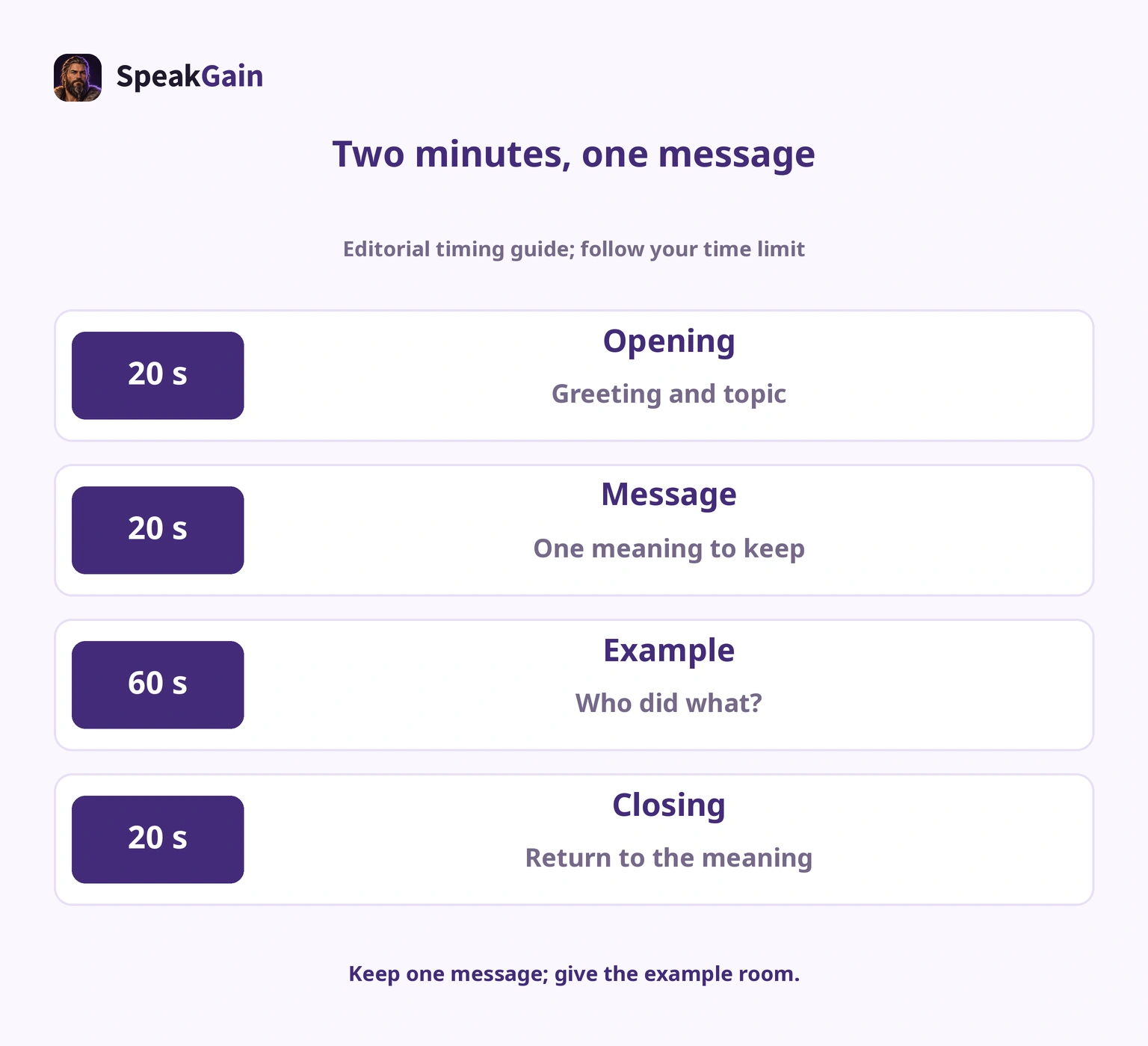
Invite the audience into one topic, explain its meaning with an example, then return to it. This two-minute plan is an editorial starting point. For one minute, shorten the example; for three minutes, add useful details to the same story rather than adding unrelated topics.
| Part | Job | Target length: editorial two-minute plan | Example line |
|---|---|---|---|
| Greeting and opening | Establish the speaker and topic | 20 seconds | Hello, everyone. I’d like to share a small moment from my first week here. |
| One message | Give listeners a meaning to keep | 20 seconds | One small act of kindness can make someone feel welcome. |
| Concrete example | Explain who did what and what changed | 60 seconds | A classmate invited me to join her group when I was sitting alone. |
| Closing | Return to the meaning, thank or invite action | 20 seconds | Let’s make room for someone new today. Thank you. |
These add up to 120 seconds to help organise rehearsal, not because they are official judging criteria. Toastmasters’ preparation guidance recommends an opening, main points and summary, plus timed rehearsal. Our specific allocation adapts that general advice to a short speech.
An opening does not require a joke or quotation. “I’d like to share a small moment” is enough to introduce a story. At a welcome event, greet the newcomers; at a wedding, explain your connection to the couple. If the host has introduced you, keep your own introduction short.
Build the script from your audience, message and experience
Choose three pieces of material before translating a long essay: the listeners, the one meaning you want to leave, and an event that shows it. A useful outline might be “alone at lunch → invited into a group → now I invite newcomers”. Replace the fictional experience with something that actually happened to you.
Write short sentences with a clear subject. Instead of packing the situation, cause and feeling into one sentence, try: “On my first day, I ate lunch alone. A classmate invited me to sit with her. I felt welcome.” This is our own rewriting example. You can write a complete draft first; avoiding full-script memorisation does not mean avoiding preparation.
Read it aloud and replace words you cannot explain or comfortably say. Split long connections into two sentences. Keep names, dates and facts accurate; don’t invent a dramatic result to make the speech sound better.
How many words fit in one, two or three minutes?
Time yourself speaking. For an initial draft, we suggest 80–100 words for one minute, 160–200 for two and 240–300 for three. These are editorial rules of thumb for learners who leave pauses, not measured average speaking rates. Include pauses, names and any audience response in the real timing.
If 80 words take too long, cut repetition before speaking faster. If three minutes need more material, add what happened before the event, what you did and what changed. Extra adjectives and greetings rarely explain the story better.
Six short speech scripts to adapt
These scripts are starting frameworks, not guaranteed one-minute texts. They may take less than a minute. Extend them with your own details and time the result. The names and experiences are fictional; use the structure, not somebody else’s identity.
1. School: explain what one experience taught you
For a class speech, choose an experience you can explain rather than borrowing a large issue you know little about.
Hello, everyone. I’m Hana. Today I’d like to talk about asking for help. Last month, I could not finish a science project on my own. I asked a classmate to check my plan, and we found a mistake together. I learned that asking for help is part of learning. Next time, I will ask sooner. Thank you for listening.
The speaker couldn’t finish a science project, asked for help and learned to ask sooner. The ending names a next action rather than claiming a complete personal transformation.
Change for your speech: replace the name, task, difficulty and help received. A club activity, group assignment or reading project can work. To extend it, say where you got stuck and what you checked. Avoid revealing another student’s private information.
Practise: make the contrast between “on my own” and “together” clear. Use “project / asked a classmate / ask sooner” as cues. Close the script and ask a listener what lesson they heard.
2. Farewell: one act of help and a wish for the future
For someone moving to a new team, school or place, choose one specific kindness instead of reciting their whole history.
Good evening, everyone. Today we say goodbye to Alex. When I joined this team, Alex took time to answer my questions. One afternoon, we checked a difficult task together, and I finally knew where to begin. Alex, thank you for making time for us. We wish you a wonderful start in your new role. Please keep in touch.
The story thanks Alex for helping a newcomer find a starting point. It ends with a wish and an invitation to keep in touch.
Change: use the real name and help you received. For a school farewell, replace “team” with “class” and “new role” with “new school”. If future plans are private, say “all the best for what comes next” instead of disclosing them.
Practise: check the name’s pronunciation and look towards the person when thanking them. Keep the final “Please keep in touch” audible. Don’t add an embarrassing anecdote simply to get a laugh.
3. Welcome: offer a concrete way to join in
A welcome to students, colleagues or club members can include one next activity, rather than only “ask if you have questions”.
Hello, everyone. Welcome to our group. I’m Sam, and I help organize our weekly activities. When I first came here, someone invited me to join a small task, and I felt less alone. You do not need to know everything today. Please join us after this meeting, and we can choose your first activity together. We are glad you are here.
Sam shares how a small invitation helped, reassures newcomers and offers a first activity.
Change: replace your role, the activity and the time or place. Don’t promise a gathering after the meeting if none is planned. You can welcome everyone without knowing every name. Our English self-introduction guide helps shorten the name-and-role section.
Practise: pause after “You do not need to know everything today.” Check that your recording makes the practical invitation clear, as well as sounding welcoming.
4. Wedding: celebrate the couple with a shared story
As a friend, choose a moment involving both partners. Confirm the host’s plan before asking guests to raise glasses.
Good evening, everyone. I’m Mia, a friend of Jamie and Taylor. I remember a rainy afternoon when our plans changed, and the two of them turned it into a lovely day at home. They listened to each other and made everyone feel included. Jamie and Taylor, I wish you many more days of kindness, laughter, and shared plans. Congratulations to you both.
The changed rainy-day plans show the couple listening to each other and including others. The wish is for more days of kindness and shared plans.
Change: use the couple’s names, your connection and a memory they are comfortable sharing. Avoid past relationships, private jokes and embarrassing details. If you have been assigned the toast, you can end with “Please raise your glass to Jamie and Taylor”, adapted to the actual names and event customs.
Practise: rehearse the names and “Congratulations to you both” separately. Ask whether a guest who wasn’t there can understand what the story celebrates. Cut background that hides the couple’s qualities.
5. Workplace event: recognise one result and the people behind it
A short milestone or recognition speech is different from a detailed progress report. Show what the group achieved and who helped.
Hello, everyone. I’d like to thank the people who helped us finish our first shared guide. At the start, each team explained the same task differently. We compared our notes and agreed on one clear set of steps. Thank you for checking the details and testing the guide with new colleagues. Let’s keep improving it together.
The shared guide replaces inconsistent instructions. The thanks identify checking and testing, and the ending invites continued improvement.
Change: replace the result, original difficulty and contribution. Include only verified, shareable numbers. If external guests are present, explain internal terms and remove confidential details. Don’t present a team’s work as yours alone.
Practise: listen for two distinct points: what was completed and what you are thanking people for. Finish with one shared next action. Prepare slide-based reports separately.
6. Speech contest: support a claim with an experience
Check the topic, time limit, notes policy and rules about quotations or outside help. A contest requiring recitation of a fixed text needs a different memorisation plan.
Can a small invitation change someone’s day? I believe it can. On my first day at a new club, I stood near the door because I did not know anyone. One member asked me to help set up the chairs. That simple invitation gave me a place in the group. Now I look for someone who is standing alone. We can make our communities kinder, one invitation at a time.
An invitation to set up chairs gives the newcomer a role; they now look for others who are alone. The story returns to the opening question.
Change: use your real setting, invitation and subsequent action. For three minutes, add what you hesitated about and how you now include people. Don’t treat one personal event as proof of a claim about all communities.
Practise: pause after the question, then say “I believe it can.” Finish “one invitation at a time” clearly. If notes are prohibited, complete the final rehearsal without them. Eiken Grade 1 interview practice offers another way to organise reasons and examples; its exam requirements are separate from your contest.
Learn the first three sentences, keywords and one closing line
Fix the start and finish; recall the middle from the order of ideas. Three opening sentences are a small editorial practice target, not a scientifically optimal number. They can cover greeting, identity and topic.
For the school script, learn “Hello, everyone. I’m Hana. Today I’d like to talk about asking for help.” Keep “science project / asked a classmate / ask sooner” in the middle. Learn “Thank you for listening” as the closing line and check that you can explain what you learned from the cues.
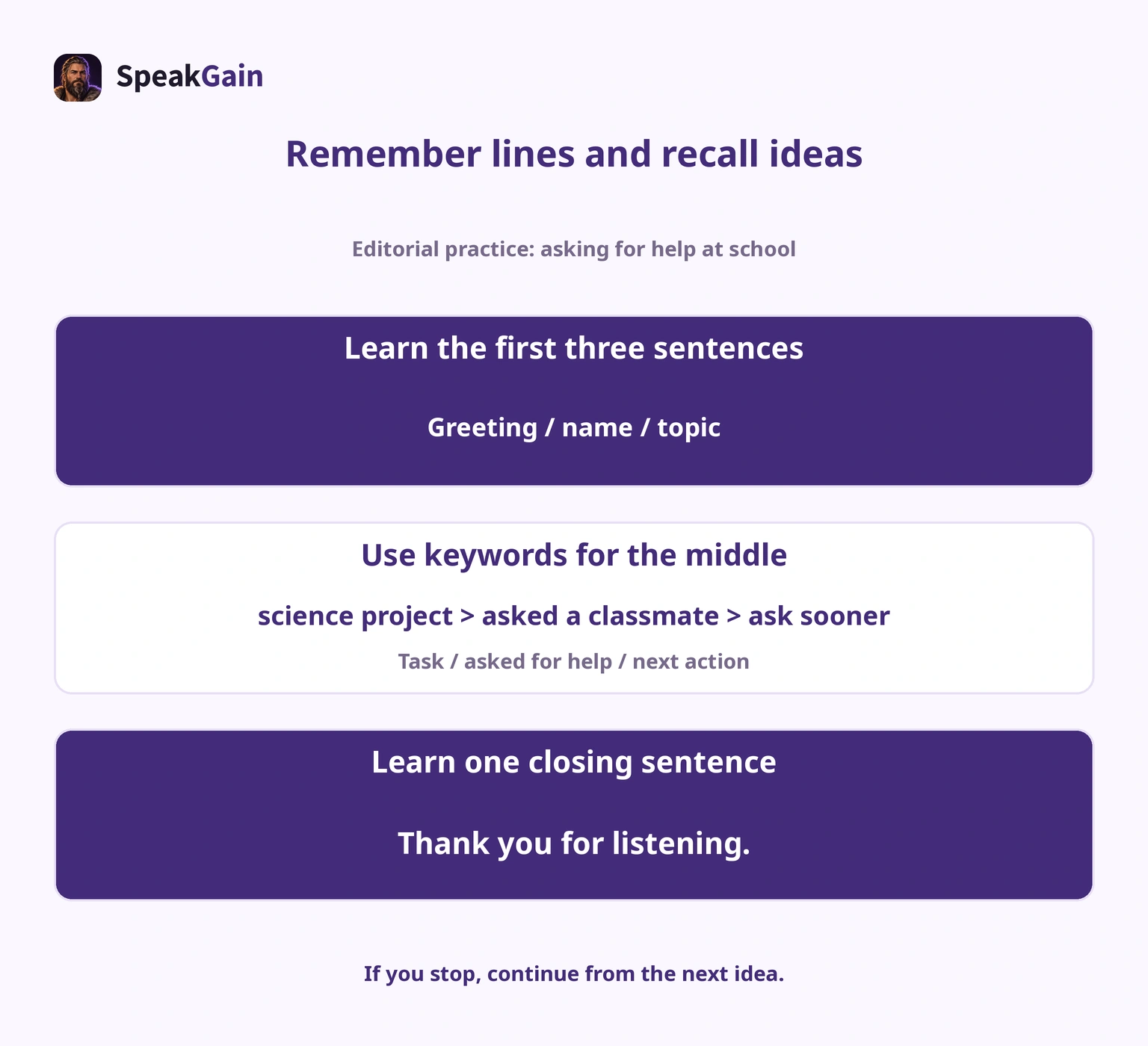
When a word disappears, a cue can bring you back to the next idea. This is rehearsed speaking, not unprepared improvisation. MIT’s delivery guidance discusses weaknesses of full-text memorisation and flexible, practised delivery. It assumes presentations with visuals; our keyword method is an editorial adaptation for a speech without slides.
If permitted, write large cues, names and essential figures on a small sheet. If a ceremony requires a written text, prepare it and practise looking up at sentence endings. Follow the event rules. See remembering English sentences for practice away from the text.
Practise from reading aloud to a complete recording
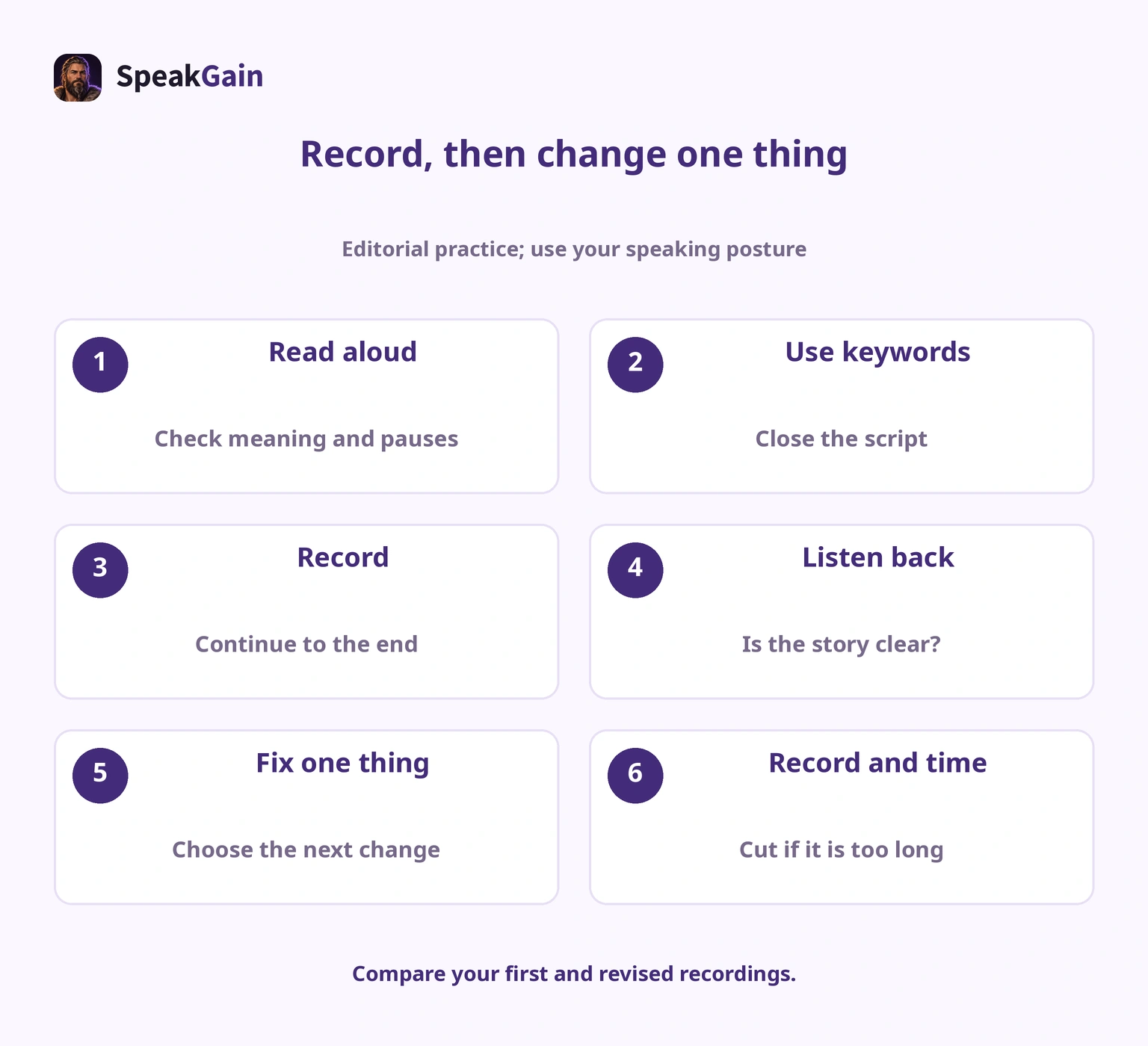
Check readability, meaning and duration in that order. A recorder and timer are enough for this editorial six-step plan.
- Read aloud. Understand each line, then mark meaningful pauses. Fix unfamiliar words instead of merely repeating them. See reading English aloud.
- Use keywords. Close the script and follow opening, event, lesson and closing. Different wording is fine if the meaning stays accurate.
- Record the whole speech. Use your actual speaking posture. Continue through minor mistakes rather than repeatedly restarting.
- Listen without the script. Can you hear the topic, a clear event and the final meaning? Check content before hunting every pronunciation error.
- Fix one thing. Add a concrete action, cut a repetitive greeting or pause around a name. Write down the single change.
- Record again and time it. If it is too long, cut a second example before increasing speed.
If the first recording says only “The club was friendly; I was happy”, add the invitation to set up chairs. Compare just whether the listener can now understand the kindness. In a pronunciation session, select one important word, such as “invitation”, rather than fixing everything together.
Your own recording cannot tell you exactly what another person understood. Ask one listener what message they took away and which scene they imagined. Toastmasters’ guidance on speaking nerves also suggests aloud practice, recording and re-recording, and rehearsing recovery from mistakes.
An editorial plan for the remaining week
| When | What to do | What to keep |
|---|---|---|
| 7–5 days before | Choose audience, message and event; draft and read aloud | Readable script and first timing |
| 4–3 days before | Practise opening and closing; record from cues | First and revised recordings, one change |
| 2 days before | Rehearse standing and ask one listener | Their understanding and duration |
| The day before | Don’t add content; check notes, names and equipment | Final cues and practical arrangements |
| On the day | Say opening and closing; confirm the setting | Position, starting signal and ending |
This is a planning suggestion, not a one-week guarantee. With three days, draft and record on day one, revise from cues on day two and complete a full rehearsal before the event. With one day, retain one message and one event, plus recording, one fix and a timed check.
Use SpeakGain for one sentence at the centre of your speech
Practise a difficult sentence separately, then return to the whole speech. Our new practice sentence is:
One small act of kindness can make someone feel welcome.
It expresses how a small kindness can help someone feel included. Use it only if it fits your story; create the surrounding example yourself.
On 11 October 2026, we created one card through the normal Add flow on the dedicated Android capture environment. Generation succeeded. We checked Library → Knowledge → Learn this card → Listening with the sentence hidden → Reveal answer → the sentence and explanation. These are the new card’s real screens, in English UI with an English explanation.
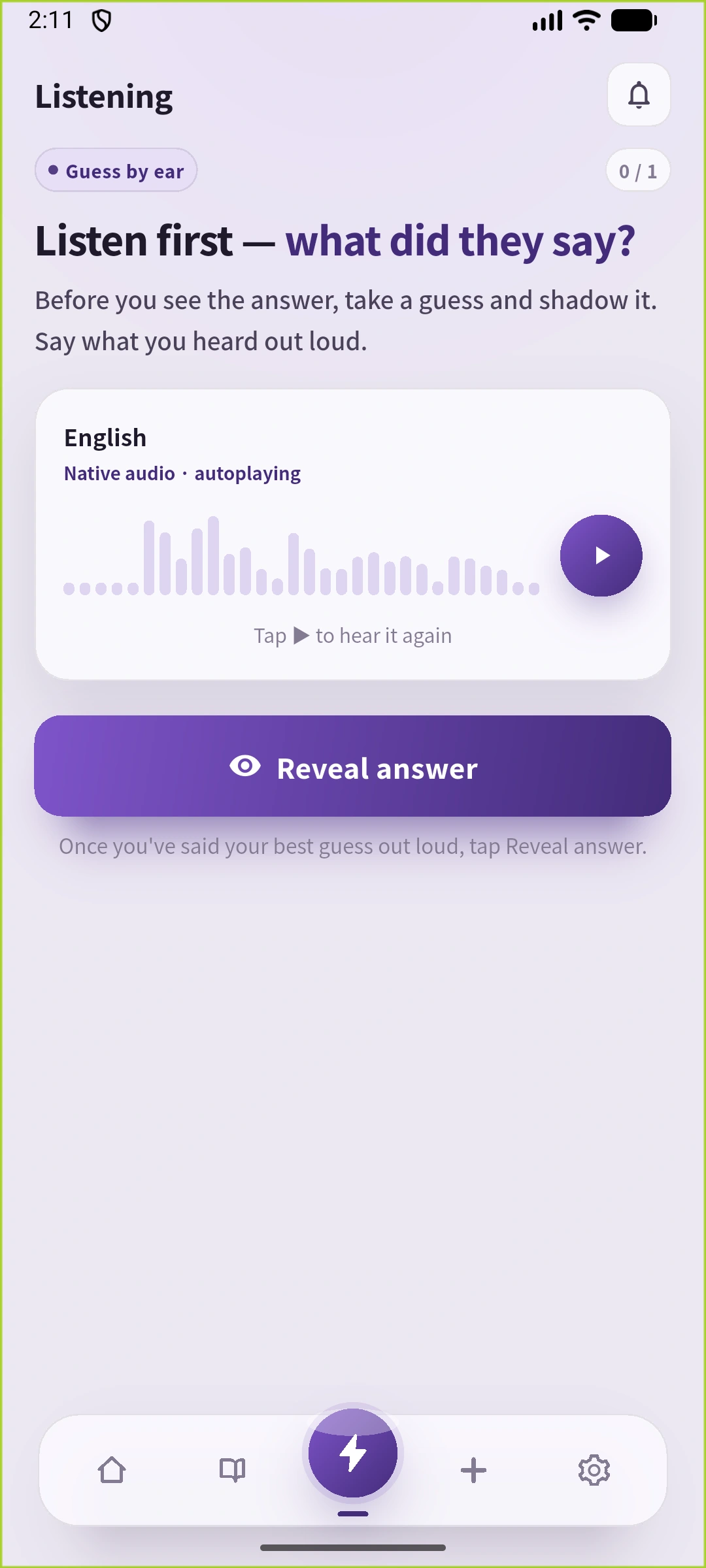
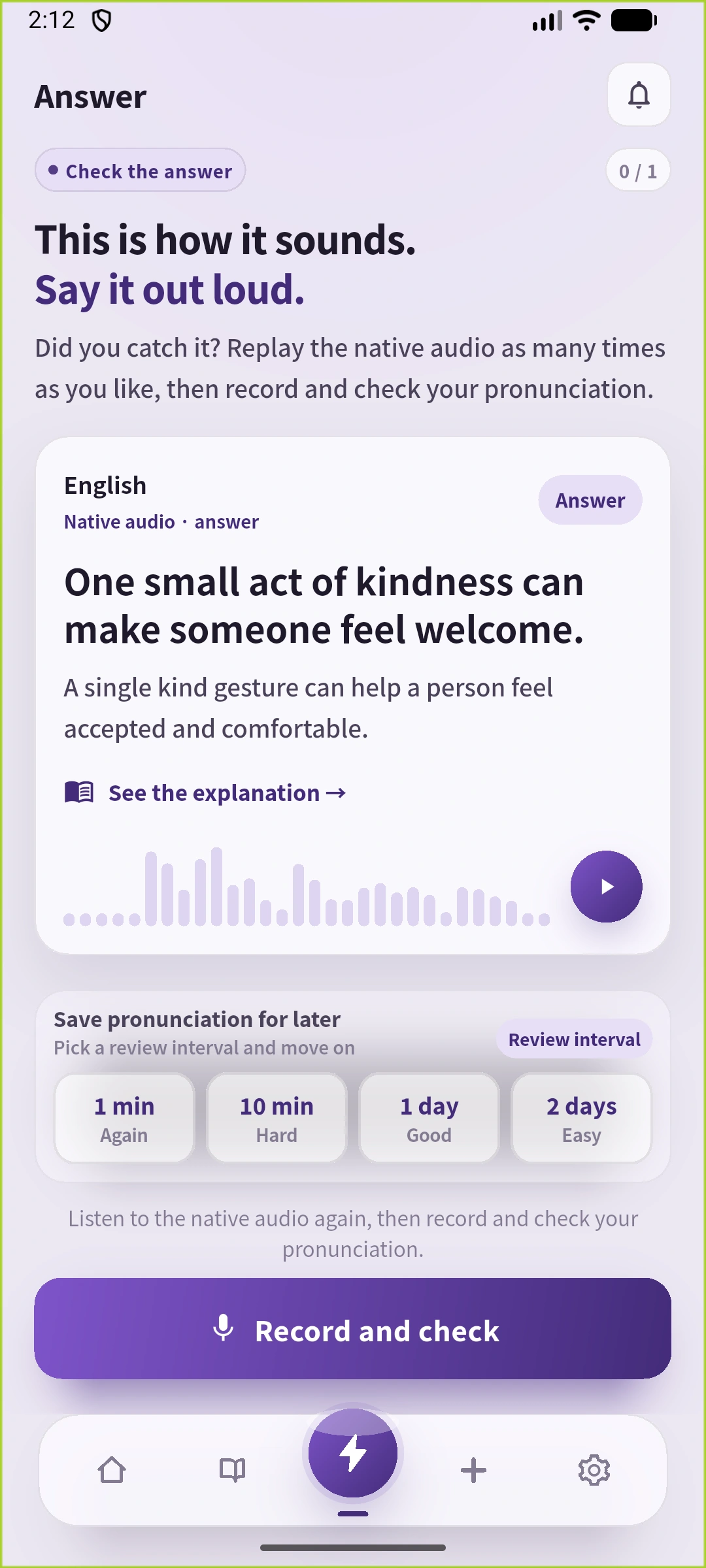
Selecting “Record and check” showed recording in progress and “Stop and check”. We verified recording start, not assessment results or accuracy. We are not presenting SpeakGain as scoring, correcting or generating whole speeches. See what SpeakGain does.
The original publication had no audio player; the same card now has Viking audio below. The verified card flow illustrates sentence practice. After practising the line, leave the screen and add your own example in a full rehearsal; successful playback or recording of one line is not evidence that your speech communicates its whole message.
This AI-generated Viking sample comes from a card created through the app’s normal Add flow; it is not a human native speaker’s recording.
One small act of kindness can make someone feel welcome. — Explain how a small kind gesture can help someone feel welcome.
If you get nervous, return to the next keyword
Prepare how to continue instead of requiring nerves to disappear. Say the opening once and check where you stand, where notes go and how the microphone will be handled. Rehearse in that posture.
If you try gentle breathing, practise beforehand rather than trying it for the first time on stage. NHS breathing guidance recommends comfortable, unforced breathing and regular practice. It does not guarantee a successful speech.
Pause when you lose a word. Check the next cue, use “Let me put that simply” or return to the lesson with “What I learned was…”. At home, deliberately stop in the example and continue towards the closing. Correct a wrong name or fact with “Let me correct that”; don’t restart the whole story over an omitted adjective.
Common mistakes and what we would change
| Preparation to avoid | A useful alternative |
|---|---|
| Judging readiness only by full-script recall | Speak from cues and practise recovering |
| Reading a long translation unchanged | Split it into sentences you can explain |
| Adding difficult words or famous quotes | Choose your own event and its meaning |
| Rushing to meet the limit | Cut repetition and a second example |
| Forcing a joke | Use a story everyone can understand |
| Fixing all errors at once | Compare recordings after one change |
For famous speeches, use official records such as Stanford’s 2005 Steve Jobs address. Observe openings and pauses; don’t reproduce the text as your own script or make a long commencement address the standard for a one-minute class speech.
Frequently asked questions
How many words should a one-minute speech have?
Our draft guide is 80–100 words; your spoken timing takes priority. It is not a measured average. Include pauses and cut content if you exceed the limit.
Can I look at the script?
Follow the event rules. If allowed, use cues, names and necessary figures. If reading a full text is required, practise looking up after sentences.
How should I begin and end?
Greet the audience, name the topic, then finish with its meaning and thanks. Try “I’d like to share a small moment” at the start. Adapt the ending to a welcome, farewell or congratulation.
Do I need a joke?
No. Choose an understandable event and an opening that still works without laughter. Avoid embarrassing or private stories.
Can I prepare with limited English?
Start with short sentences you understand and can say. Requirements vary, but unfamiliar vocabulary is not the starting point. Choose one message and one event.
How can I avoid forgetting without memorising everything?
Learn the start and closing, use keywords in between and practise continuing after a pause. Fixed-text recitation tasks require their own approach.
What if I freeze?
Pause and return to the next idea. “What I learned was…” can bring you back to the point. Practise that recovery before the day.
When should I start practising?
Make a short recording when you know the date. Use it to see what needs work. Even close to the event, retain one fix and a timed rehearsal.
Does SpeakGain assess or write the entire speech?
That is not what this guide demonstrates. We verified one-card study and recording start. Check whole-speech structure, facts, timing and listener understanding separately.
Editorial verdict: one story you can finish from cues
We recommend audience and message → a short script from your experience → a fixed opening and closing → recording from keywords and one revision. Full-script memorisation, impressive vocabulary and reading a long translation are not our starting point for this task.
Today, write one meaning and one supporting event. Read aloud, close the text and record from cues. Keep both sentence practice and a full rehearsal in your speaking posture.
Sources inspected
- Toastmasters: Preparing a Speech — organisation, timing and setting.
- MIT: Delivery — flexible delivery and full-text memorisation.
- Toastmasters: speaking nerves — aloud practice, recordings and recovery.
- NHS: breathing exercises — gentle, regular breathing practice.
- Stanford: Jobs’ 2005 address — official record only.
Checked 11 October 2026. Scripts, word counts, allocations, schedules and revision examples are our own editorial suggestions. Device evidence is limited to the SpeakGain section.