
How to debate in English: formats, roles, rebuttals and solo practice
Published
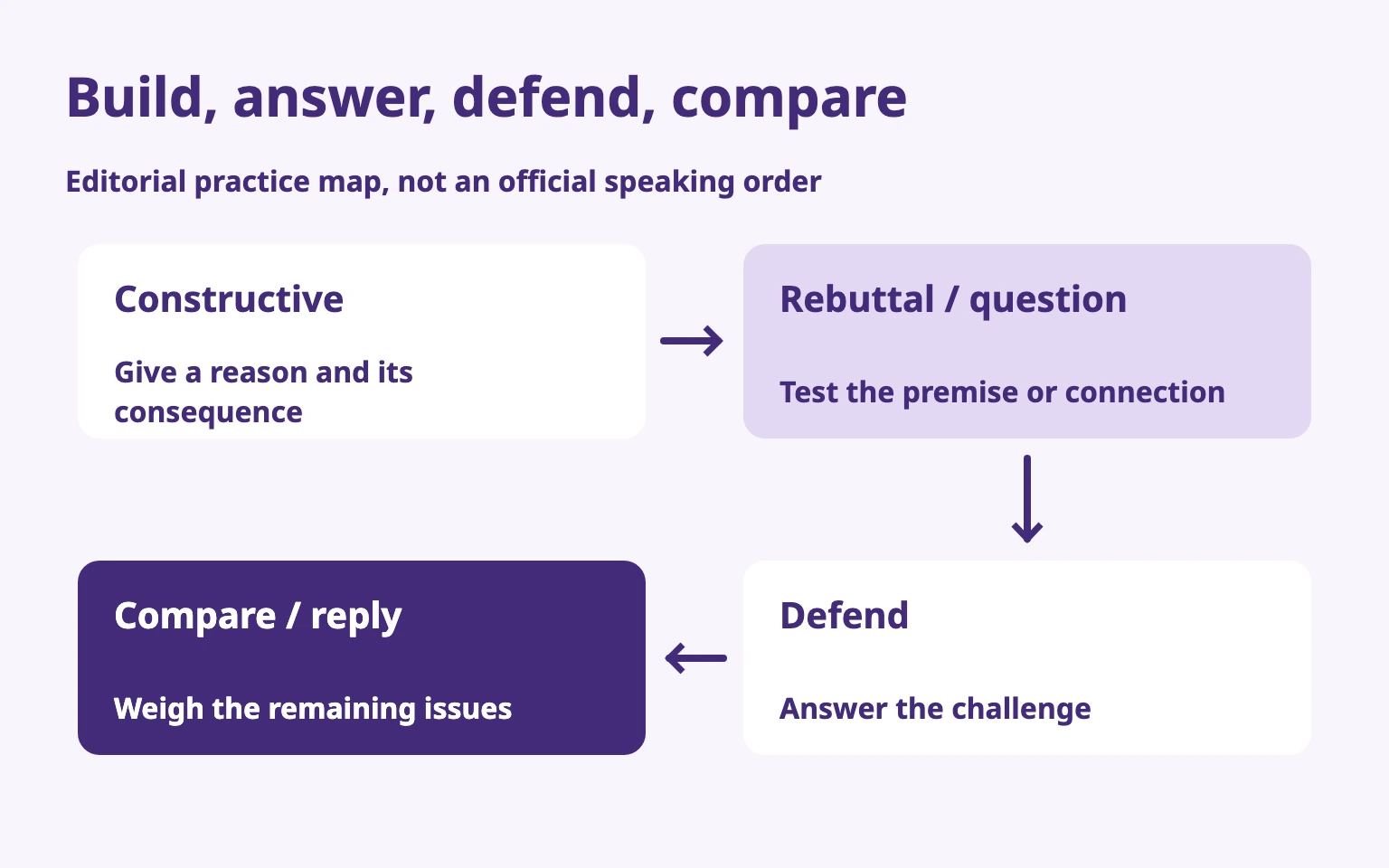
English debate is a structured, judged exchange in which you defend an assigned side using an agreed speaking order and time limits. Its basic jobs are to establish the motion and position, build a case, respond through rebuttals or questions, and compare the remaining issues; the exact order depends on the competition. Start by saying one claim with a reason, then answering one opposing reason in a short sentence.
This guide is for school and university classes, debate clubs, and adults practising how to argue a position. If English is an additional language, begin with the argument you need to make rather than translating a long essay. All practice motions and English examples below are our own; they are not past tournament questions or official model answers.
Compare formats before you practise the timing
There is no universal team size, preparation period or speech length. These are examples from Japanese organisations, not rules for every English-speaking country. Sources were checked on 14 October 2026; use the current rules for your own event.
| Format and document | Preparation | Debaters per team | Example speaking order and times | Official source |
|---|---|---|---|---|
| Prepared: HEnDA nationals 2025 | Predetermined motion; fixed number of advance research days not stated officially. In-round breaks: 1, 1, 2, 2, 2 minutes | 4 competing, 4–6 registered | Constructive/question stages → attack/question stages → defense → summary. Constructives 4 minutes each, question stages 2 each, other speeches 3 each; full order below | 2025 guidelines and format attachment, published by the managing organisation; predetermined motion in HEnDA’s historical rules §2 |
| Impromptu: HPDU Competition 2027, 14 June 2026 version | 20 minutes; grand final only 25 | 3 | PM → LO → MG → MO → Government Whip → Opposition Whip: 5 minutes each, grand final 7; Opposition Reply → Government Reply: 4 each | Official guidelines pp.2,5–6 |
| University events: JPDU tournament regulations §2 | Not stated officially in the inspected regulations | Not stated officially in the inspected regulations | Spring/Gemini use AP; Autumn/Japan BP use BP. Detailed order and speech times not stated officially in this document | JPDU regulations; referenced international rules and event changes must also be checked |
“Not stated” concerns the document inspected, not all documents the organisation may publish. JPDU references UADC rules for AP and WUDC rules for BP and allows event-specific adjustments. Do not import HPDU’s three-person example into a university event with a similar name.
Prepared versus impromptu concerns when the motion becomes available and what preparation is permitted. HPDU’s cited guidelines restrict consultation with people outside the team and electronic devices after release of the motion. Our app-based drills belong to practice outside a competition; check the permitted materials before an actual round.
For a US parliamentary event, consult the organiser’s own documents, such as the NPDA’s November 2024 bylaws, checked on 14 October 2026. We have not imported any team sizes, preparation periods or speech times from that governance document. Its title is not evidence that a Japanese parliamentary format applies to an American tournament.
Debate is different from discussion
In this guide’s formal debate, you defend the side assigned, even if it differs from your personal view, and work within a judging framework. A discussion may instead explore ideas or develop a shared proposal. See joining English discussions for participation skills and speaking up in English meetings for workplace contributions. A rebuttal formula is not a reason to stop listening in everyday conversation.
Four speaking jobs and short sentence openings
These are learning functions, not universal speaker titles. A sentence starts the job; it does not replace the explanation needed in a full speech.
| Job | What to say | Our original sentence | Caution |
|---|---|---|---|
| Constructive | Position and reason | We oppose this rule because not every family can afford a tablet. | Explain how the reason leads to an important outcome |
| Rebuttal | Weakness in the other side’s reasoning | That may save schools money, but it would put the cost on families. | Answer the reason actually given |
| Question/POI | One premise or condition to clarify | How would students without a tablet take part? | Separate question periods from permitted interventions |
| Summary/reply | Comparison of the main issues | Equal access matters more than a small saving because every student needs to take part. | Compare what was established; do not invent a last-minute case |
Follow the argument through the round
Listen for whether a speaker is introducing a reason, challenging it, rebuilding it, or comparing its importance. Keep a short record of the claim and the response rather than attempting to transcribe every word.
The HEnDA 2025 attachment gives this order: affirmative constructive → negative questions → negative constructive → affirmative questions → negative attack → affirmative questions → affirmative attack → negative questions → affirmative defense → negative defense → affirmative summary → negative summary. With its preparation breaks, the example totals 42 minutes. Official managing-body materials.
HPDU’s cited 2027 format instead ends with the opposition reply first and the government reply last. The third speaker handles rebuttal, rebuilding and issue organisation; a first or second speaker gives the reply. Do not carry HEnDA’s separate question periods or summary order across. HPDU guidelines pp.5–6.
What is judged?
HPDU’s cited version assesses content 40%, presentation/organisation 40%, and strategy 20%, as connected elements of the speech’s contribution to the team’s position. It determines results and individual speaker scores. Difficult vocabulary alone is not a winning criterion. Guidelines pp.6–9.
HEnDA’s 2025 guidelines specify two judges per preliminary round, and three or five in elimination rounds, with competition governed by its rules and judging standards. A detailed judging calculation is not stated officially in those implementation guidelines. Do not substitute HPDU’s percentages. HEnDA §§13,16.
1. Constructive: connect the claim to a consequence
What to say: Establish your position and explain why it follows. Our worked motion is “Schools should require students to buy their own tablets.” On the opposing side, consider families unable to buy one.
Sentence opening: “We oppose … because …”
We oppose this rule because not every family can afford a tablet.
Then explain the consequence: “Students without one may miss the same learning activities.” This is a hypothetical practice situation, not a claim about every school’s lending or subsidy arrangements. A favourable opening is “We support this rule because students could use the same device at home and at school.” Explain when that advantage would hold.
Solo or small-group drill: Make four notes: requirement → family payment → inability to buy → participation. Explain them in 30 seconds. With a partner, ask “why?” once and add one sentence. Change sides on the next attempt. Thirty seconds is our drill length, not an official speech time.
Common mistakes: Saying only “It is useful,” confusing an illustration with evidence, or inventing statistics. Use a real source where your claim needs data, and explain its conditions. For a longer prepared contribution, use short English speech preparation; practise responses separately.
2. Rebuttal: identify the weak connection
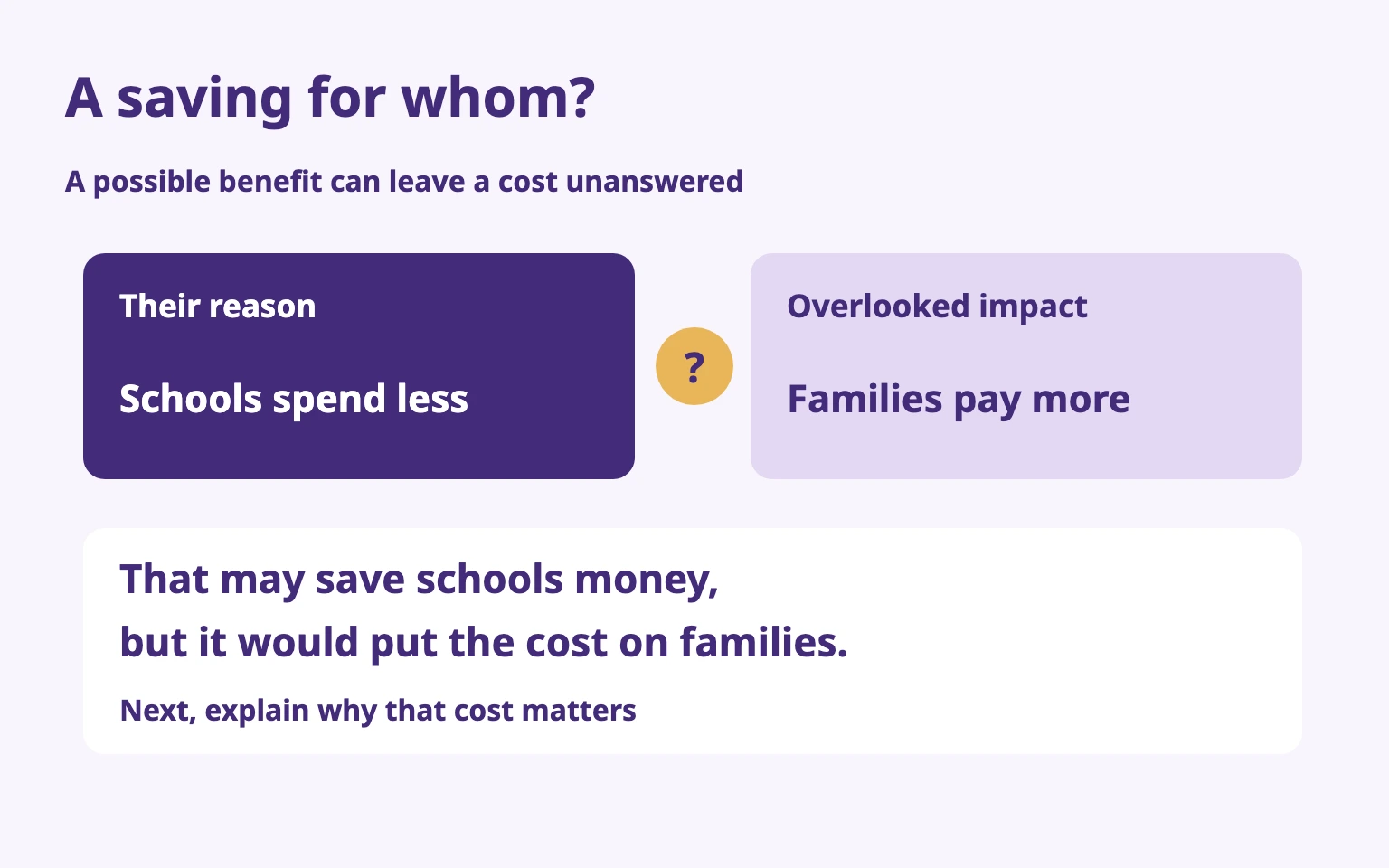
What to say: Locate the opposing reason, then test its premise, causal link or overlooked impact. Suppose the other side says “This rule would save schools money.” You need not deny that possibility to raise a problem.
Sentence opening: “That may …, but …”
That may save schools money, but it would put the cost on families.
Here “may” leaves the saving possible; “would” describes the proposed policy’s consequence. Add why the transferred cost matters. If the other side provides free devices to everyone, this answer may no longer fit: address what they actually propose.
Solo or small-group drill: Record the opposing sentence, play it back, and choose one question: which cost, who pays, or what support exists? Give a rebuttal. Change the condition to a lending scheme and revise your answer. With two people, accurately restate the opposing reason before responding. A third listener identifies which reason you answered.
Common mistakes: Repeating “I disagree,” attacking a stronger claim than the speaker made, or answering an invented number. When stuck, ask: was the premise shown; does the outcome follow; was another impact compared? Pick one. If a technical word disappears, practise English paraphrasing: “the cost for families” can express what you need without “financial burden.”
3. Questions and POIs: ask one thing, then use the answer
What to say: Clarify a condition that affects your next argument.
Sentence opening: “How would …?”
How would students without a tablet take part?
If the answer is school lending, examine how it is funded or provided. If families must buy, examine access for those who cannot. Adapt the next response to the answer rather than delivering your memorised attack regardless.
HEnDA’s 2025 example has separate question periods. In HPDU’s 2027 example, a POI is a permitted question, rebuttal or comment during another speaker’s speech: at most 15 seconds after acceptance, excluding the first and last 30 seconds, or first and last minute in the final. There are no POIs during replies. HPDU pp.2,5–6.
Solo or small-group drill: Write one question and record two possible answers. Respond differently to each. With a partner, practise question → answer → response; for POIs, wait for acceptance and observe the relevant protected time.
Common mistakes: Asking three questions at once, interrupting an answer, or making a long speech disguised as a question. Permission and timing are part of the exercise.
4. Summary and reply: compare the clash
What to say: Choose a remaining disagreement and explain why your side’s impact should matter more.
Sentence opening: “A matters more than B because …”
Equal access matters more than a small saving because every student needs to take part.
Calling the saving “small” needs support from what happened in the round. If the other side showed a serious funding problem, address it instead of dismissing it with an adjective. HPDU’s cited guidelines describe replies as explaining victory through a few issues; the third speaker cannot give the reply. HPDU p.6.
Solo or small-group drill: Listen to one recording from each side. Note the clash, each reason, and your comparison criterion. Give a 30-second comparison without inserting unrecorded facts. With three people, the listener chooses the issue they found hardest to decide, and both sides summarise it.
Common mistakes: Retelling the round in order, saying only “We win,” or adding a completely different benefit at the end. Our practice advice is to compare established arguments rather than expand the case.
Original practice motions
| Motion | Consider for | Consider against |
|---|---|---|
| Schools should require students to buy their own tablets. | Home/school continuity | Cost and access |
| Schools should give students one homework-free day each week. | Rest and chosen activities | Review time and concentrated deadlines |
| Universities should make attendance optional for recorded lectures. | Flexible schedules | Live questions and participation |
| Local libraries should stay open later on weekdays. | Access after work or school | Staffing and running costs |
These are our practice proposals, not past motions. Agree who acts, what changes and who pays before practising. Do not assume you can redefine an official motion freely.
Solo practice and a three-week plan
Assign a side, write a claim/reason/impact note, record a one-minute argument, listen, answer from the other side, fix one thing, then compare. One minute is a partial drill. A real opponent and an experienced listener are still useful for unexpected questions and full-format practice. If sentence building stops you, use spoken sentence-building practice; for the wider routine, see how to study English.
Our suggested schedule is three sessions weekly, about 10–15 minutes each. It organises work; it does not promise wins or an optimal learning dose.
| Week | Three-session focus | Keep | Try with others |
|---|---|---|---|
| 1 | For case → against case → explain both | Claim, reason, impact and recording | One “why?” from a listener |
| 2 | Hear a reason → question its premise → revise after an answer | Original reason and linked rebuttal | Question/answer/response with role changes |
| 3 | Compare → answer strongest rebuttal → full-format practice | One decisive issue and one next fix | Current official order/timing with informed feedback |
Change one condition, such as subsidies or existing loans, to check whether your response changes too. Listen for the argument’s connection, not every language error at once.
What we do not recommend
We would not start with memorising a long script: an unexpected opposing reason can leave it disconnected. Keep argument notes and practise returning to the meaning in different words. We also avoid stacking difficult vocabulary you cannot explain; “pay,” “cost” and “afford” can carry a clear causal argument. Finally, do not paste the cost rebuttal into every topic: practise choosing when a sentence fits as well as saying it.
Review one rebuttal with SpeakGain
Save the short rebuttal rather than a whole speech, then practise starting it aloud. On the device, we entered the English sentence through the normal Add flow and opened Knowledge → Learn this card from the library after generation. Listening hides the answer: hear the audio and say your guess, then use Reveal answer to see the saved English and explanation. The answer screen lets you replay the audio and choose Again, Hard, Good or Easy as a review interval. You choose that review setting yourself.
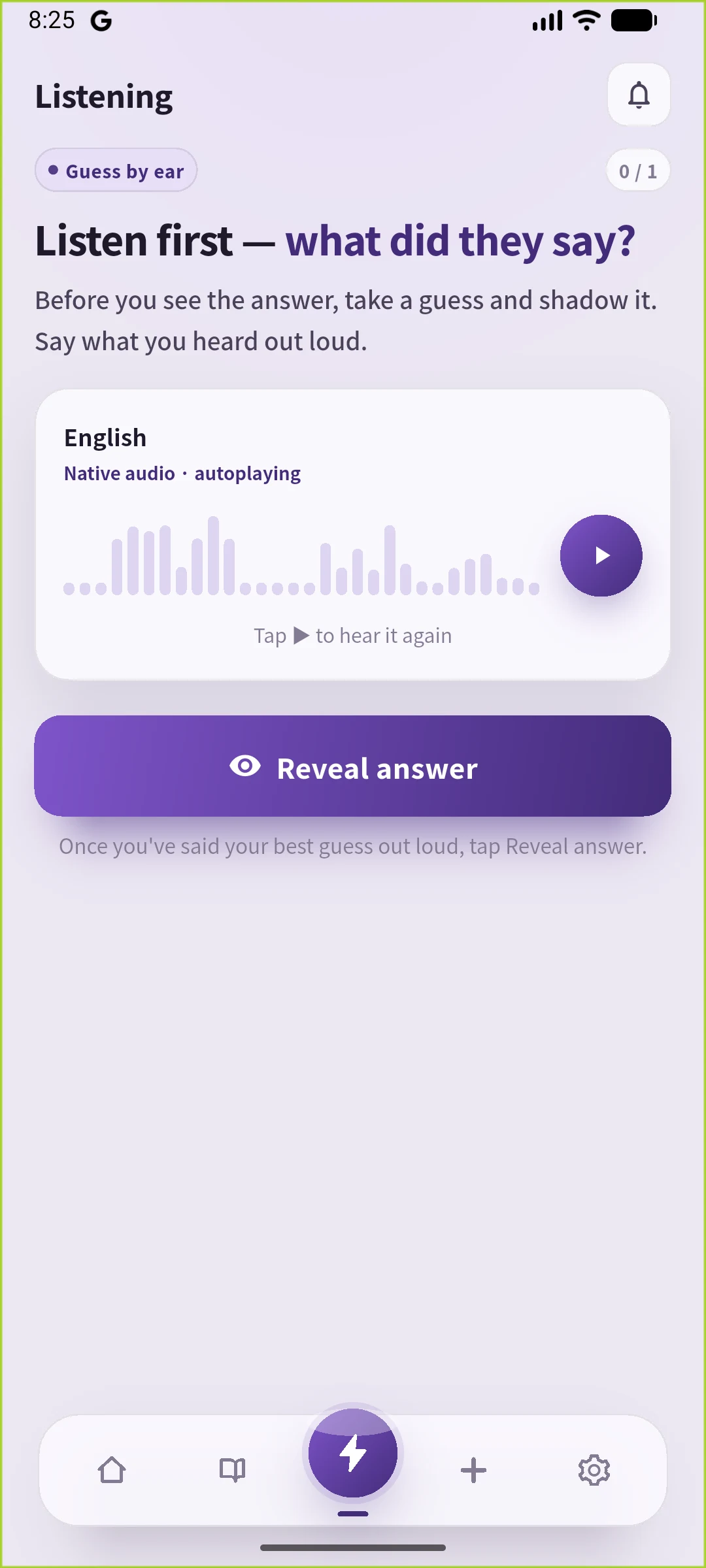
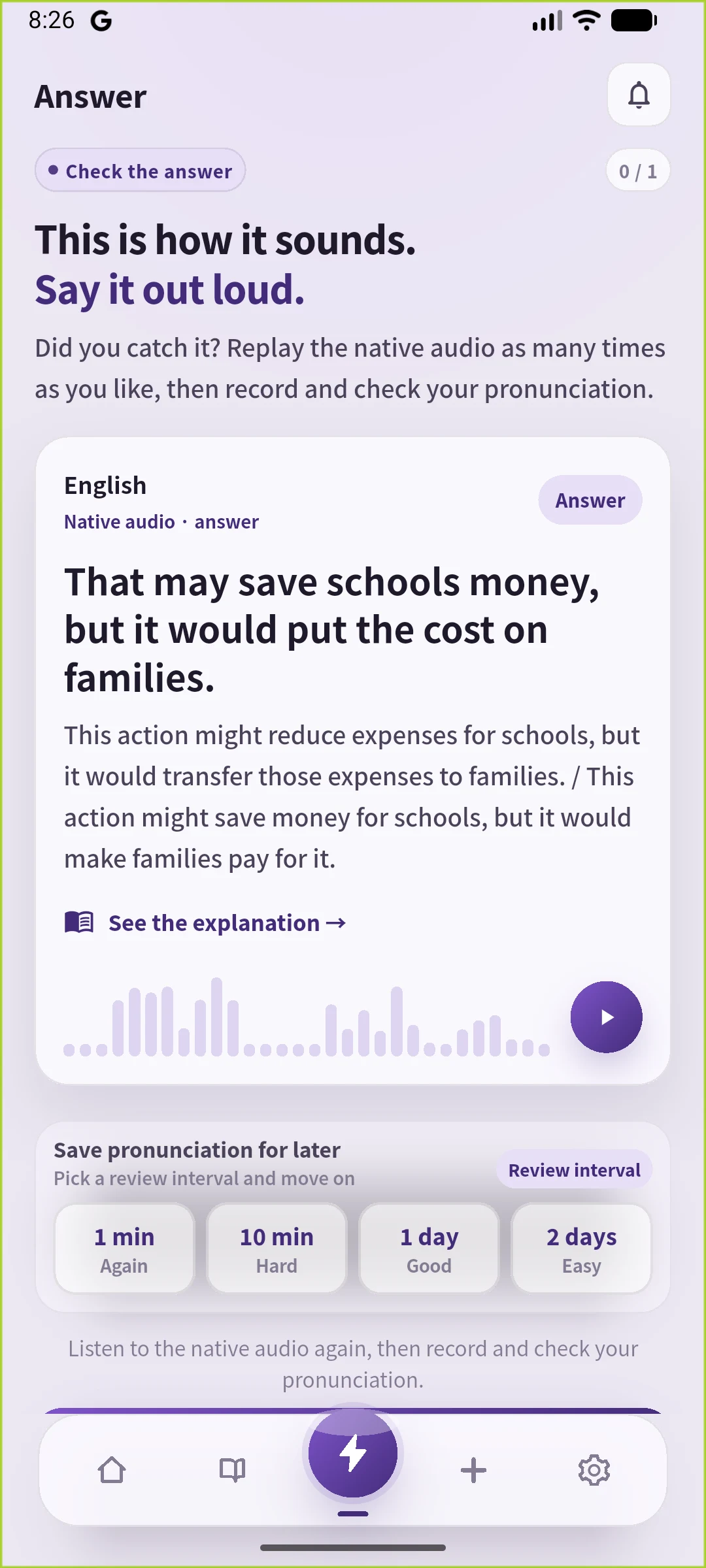
That may save schools money, but it would put the cost on families.
Viking audio for our worked sentence (AI-generated)
After saying the sentence, leave the screen and add your own reason why the family burden matters. We verified sentence saving, audio playback, answer display and review-interval selection. Use the two-side drills above or other people to practise responding to an opposing argument.
Frequently asked questions
Is debate the same as discussion?
No. This guide’s debate uses assigned positions and a judging framework. Discussions may explore ideas or seek a shared outcome. Check the purpose of your class activity.
Can I begin with limited English?
Yes: practise one claim and one reason on each side. That is a starting drill, not proof you are ready for an entire tournament round.
Prepared or impromptu first?
Use the format assigned by your class or club. For independent practice, we would prepare a familiar reason, try a short rebuttal, then limit preparation time.
What if I cannot think of a rebuttal?
Test one premise, causal connection or overlooked impact. Clarify important unknown conditions through the permitted questioning opportunity.
Can I practise alone?
Yes, record both sides and compare them. Add small-group practice for unpredictable responses and intervention timing.
How do I choose a motion?
Choose a clear action with concrete reasons on both sides. Our motions are original drills, not tournament history.
Can a POI interrupt at any time?
No. The cited HPDU version has acceptance, duration and protected-time restrictions and excludes replies. Your event may differ.
Our editorial verdict
We would check the format, build one reason on each side, answer the reason heard, then compare the clash. Today, respond to the school-saving claim with the family-cost sentence and add why the cost matters. Then change the policy’s conditions and check whether your answer still fits. Responsiveness is a better starting practice target than perfect recall of a long script.
Official references
- HEnDA 2025 nationals materials, official managing organisation: speakers, schedule and judge numbers.
- HEnDA historical rules §2: predetermined motion; not used as current timing rules.
- HPDU 2027 guidelines, 14 June 2026 version: format, roles, POIs and judging.
- JPDU tournament regulations: event formats and referenced rules.
Checked 14 October 2026. Dated examples are not universal rules. Timed drills, original sentences, motions and the three-week plan are editorial suggestions.