
How to join English discussions: speaking patterns, preparation and solo practice
Published
To join an English discussion, state one opinion, give one reason, then respond to what someone else says. Beforehand, prepare one position and one reason for each likely topic; on your own, read a prompt, record a roughly 20-second opinion and reason, listen back, fix one thing, then answer a counter-opinion in one sentence. Our editorial recommendation is to practise a relevant contribution rather than memorise a long phrase list.
For an assigned-side, judged exchange, see how to debate in English for role-based rebuttals and practice.
In a seminar, you may understand the topic yet miss your chance to speak. In training or a group task, an objection may leave you silent. Start with a smaller goal than a fluent speech: make your view understandable once, then listen for the next response. A question or a careful summary can also move the discussion forward.
This guide covers classes, seminars, training, group discussions and informal conversation. For workplace agendas and responsibilities, see speaking up in English meetings; for a wider learning plan, see planning your English study. All English examples are written by our editorial team. Timings and practice schedules are editorial suggestions, not scientifically established optimums or promises of progress.
Eight contribution patterns: choose the job of your next turn
Decide what your contribution should do before searching for a phrase. You can ask about a reason, clarify something you missed or organise the ideas so far without already having a firm opinion. Begin with an opinion and a request for repetition; you do not need to use all eight patterns in one session.
| Purpose | Pattern | Short original example | Caution |
|---|---|---|---|
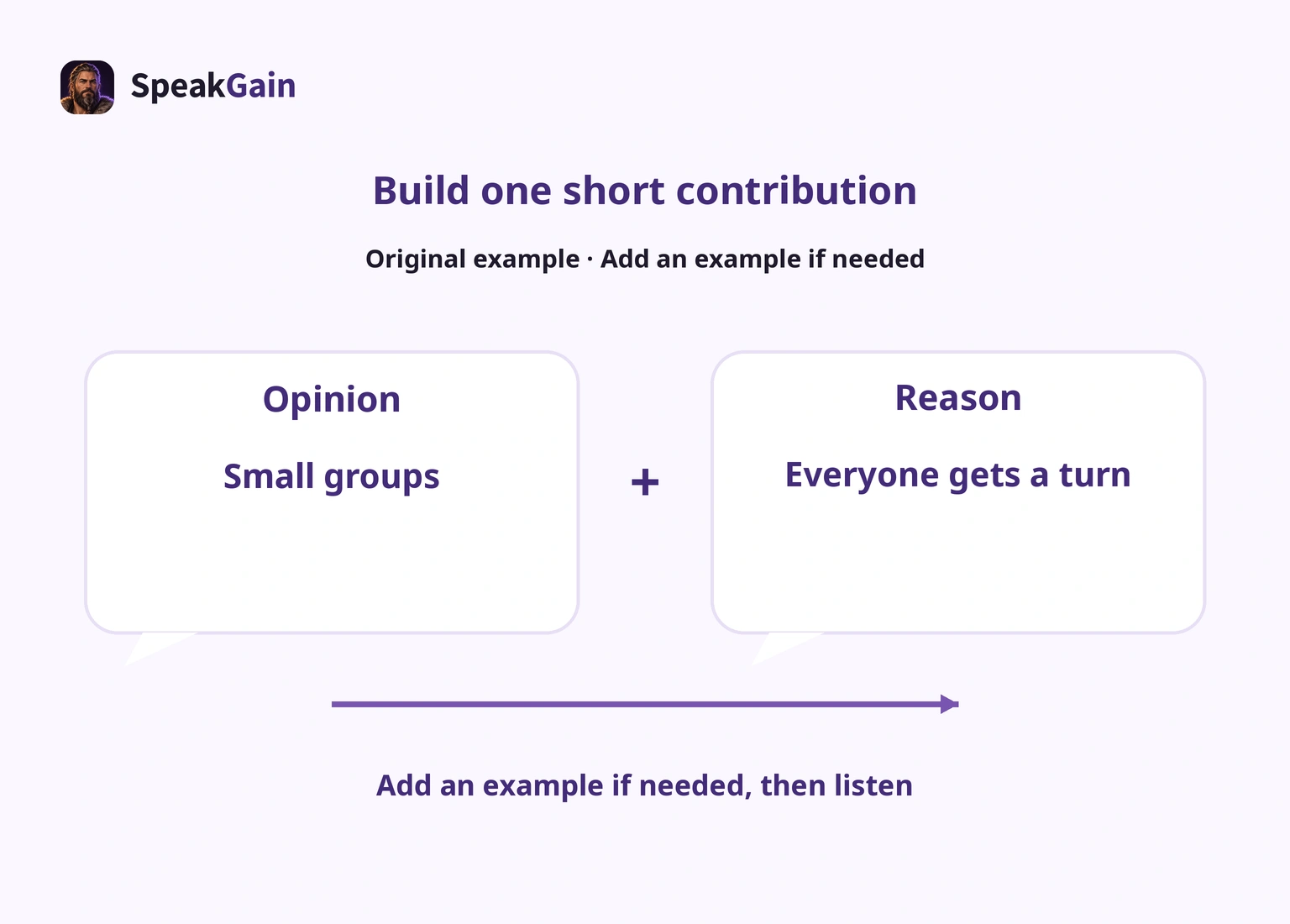
| State an opinion and a reason | I think … because … | I think small groups work well because everyone gets a turn. | One view and one reason |
| Add a concrete example | For example, … | For example, we could discuss one question in pairs. | An example is not proof of a general claim |
| Agree and build on the idea | I agree about … . We could also … | I agree about taking notes. We could also share them afterwards. | Name the point you agree with |
| Disagree politely | I understand …, but … | I understand the need for speed, but some students need more time. | Address the proposal, not the person |
| Ask about a reason or condition | How would … ? | How would this help new students? | Ask one question at a time |
| Ask for a turn | Could I add … ? | Could I add a point about preparation? | Wait for a break in the point |
| Summarise what has been said | So far, … | So far, we have two ideas: smaller groups and more preparation time. | Separate proposals from agreement |
| Ask someone to repeat | Could you repeat … ? | Could you repeat the part about the schedule? | Specify the part you missed |
British Council advises preparing a view, explaining why and responding to a partner. The eight roles here are our practical organisation of that advice; the examples are original. British Council.
1. State an opinion and a reason
Use this when first introducing your view. The pattern is an opinion followed by a reason. For a class question about group work, choose one useful feature rather than covering every advantage.
Pattern: I think … because …
- I think small groups work well because everyone gets a turn.
- I prefer a short reading before class because it gives us something to discuss.
Make it your own: Replace the group size or preparation method with your actual preference. If you disagree, change the position too. Do not borrow a positive example that you do not believe.
Practice point: Say who benefits and what happens, rather than ending with because it is good. If the sentence is difficult to say, split the opinion and reason into two short sentences.
Common mistake: A long introduction can hide your position. Even a conditional view needs a clear condition: explain what matters to you in this situation.
2. Add a concrete example
Use an example when your idea is abstract or someone asks what you mean in practice. Give one specific action or event after the example marker.
Pattern: For example, …
- For example, we could discuss one question in pairs.
- In our last class, each person explained one picture.
Make it your own: For a proposal, change the activity after could to something possible in your class. For a past event, use something you really experienced. The second example is fictional; do not report it as your own memory.
Practice point: Check that the example supports your reason. If the reason is that everyone can speak, an example about cheap materials belongs to a different point.
Common mistake: One experience does not establish that a method works for everyone. Keep your illustration separate from evidence about a general trend.
3. Agree and build on the idea
Use this to support a proposal while adding a condition or next step. Specify what you agree with, then add something connected to it.
Pattern: I agree about … . We could also …
- I agree about taking notes. We could also share them afterwards.
- I agree that pairs are a good start. We could change partners later.
Make it your own: Pick a point the other speaker actually made. If you have no extra suggestion, explain why you agree instead.
Practice point: Read one imaginary partner’s contribution, hide it and state the point you support. Check whether you understood it, not whether you delivered your prepared line.
Common mistake: Repeated agreement without a reason adds little. You can acknowledge understanding without pretending to share a view you do not hold.
Understanding and agreement are different. See English backchannel responses for short ways to show that you are following.
4. Disagree politely
Use this when you have another view or a concern about part of a proposal. Acknowledge the priority you understood, then explain your concern. You do not have to pretend to agree.
Pattern: I understand …, but …
- I understand the need for speed, but some students need more time.
- I’m not sure one speaker per group is enough. Could everyone share one idea?
Make it your own: Name the priority the speaker mentioned, such as speed, cost or fairness. Restrict your concern to a relevant condition rather than saying the idea is always bad.
Practice point: After disagreeing, add one reason or alternative. Briefly check the other person’s idea and keep a steady, audible voice.
Common mistake: Judging someone’s ability does not answer their argument. If an assumption is unclear, ask about it before preparing a rebuttal.
5. Ask about a reason or condition
Ask a question when you need to understand a proposal or have not yet formed a view. Ask how it would work or what a particular term means.
Pattern: How would … ?
- How would this help new students?
- What do you mean by flexible deadlines?
Make it your own: If this is ambiguous, name the proposal. The second example checks the meaning or scope of words you heard; use repetition if you did not hear them.
Practice point: Choose one missing detail: the reason, who it affects or when it applies. After the answer, try saying whether your view changed.
Common mistake: Three questions at once are hard to answer. Avoid disguising criticism as a question; identify the information you need.
6. Ask for a turn
Use this when you have a relevant addition but no turn arrives naturally. Name the topic of your addition and prepare the sentence that follows the request.
Pattern: Could I add … ?
- Could I add a point about preparation?
- Before we move on, could we hear another view?
Make it your own: Replace preparation with the issue currently being discussed. The second example makes room for another view; address the group rather than forcing a quiet participant to answer.
Practice point: Listen to the end of an imaginary speaker’s point, say the entry line, then immediately add your short view. Follow a class’s hand-raising or turn-taking rules first.
Common mistake: Talking over a reason can interrupt the substance of a point. Asking for a turn and then staying silent for a long time also makes participation difficult.
TeachingEnglish recommends practising when an interruption is appropriate as well as the language used for it. TeachingEnglish.
7. Summarise what has been said
Summarise when ideas have become scattered or before time runs out. You can organise the discussion once without taking the permanent role of chair.
Pattern: So far, …
- So far, we have two ideas: smaller groups and more preparation time.
- We agree on shorter tasks, but we haven’t decided how to form groups.
Make it your own: Include only ideas that were actually raised. If agreement has not been established, report a proposal rather than saying We agree.
Practice point: Read two different contributions and note what is shared and what remains undecided. Say one sentence for each, without strengthening the original claims.
Common mistake: Do not turn your own preference into the group’s conclusion. Check your summary with the participants and revise it if they disagree.
8. Ask someone to repeat
Use a request for repetition when you missed part of the sound or wording and cannot base a response on it. Specify the missing section.
Pattern: Could you repeat … ?
- Could you repeat the part about the schedule?
- Did you say we should change groups every week?
Make it your own: Replace the schedule with the part you missed. The second example checks your interpretation; it does not announce that your guess is a fact.
Practice point: Practise naming a specific part, then follow the repeated information with one question or opinion. Important negatives, numbers and dates deserve confirmation.
Common mistake: Nodding without understanding may lead you to respond to the opposite condition. Clarification aligns the content; it is a useful contribution, not a failure.
Prepare one position and one reason per likely topic
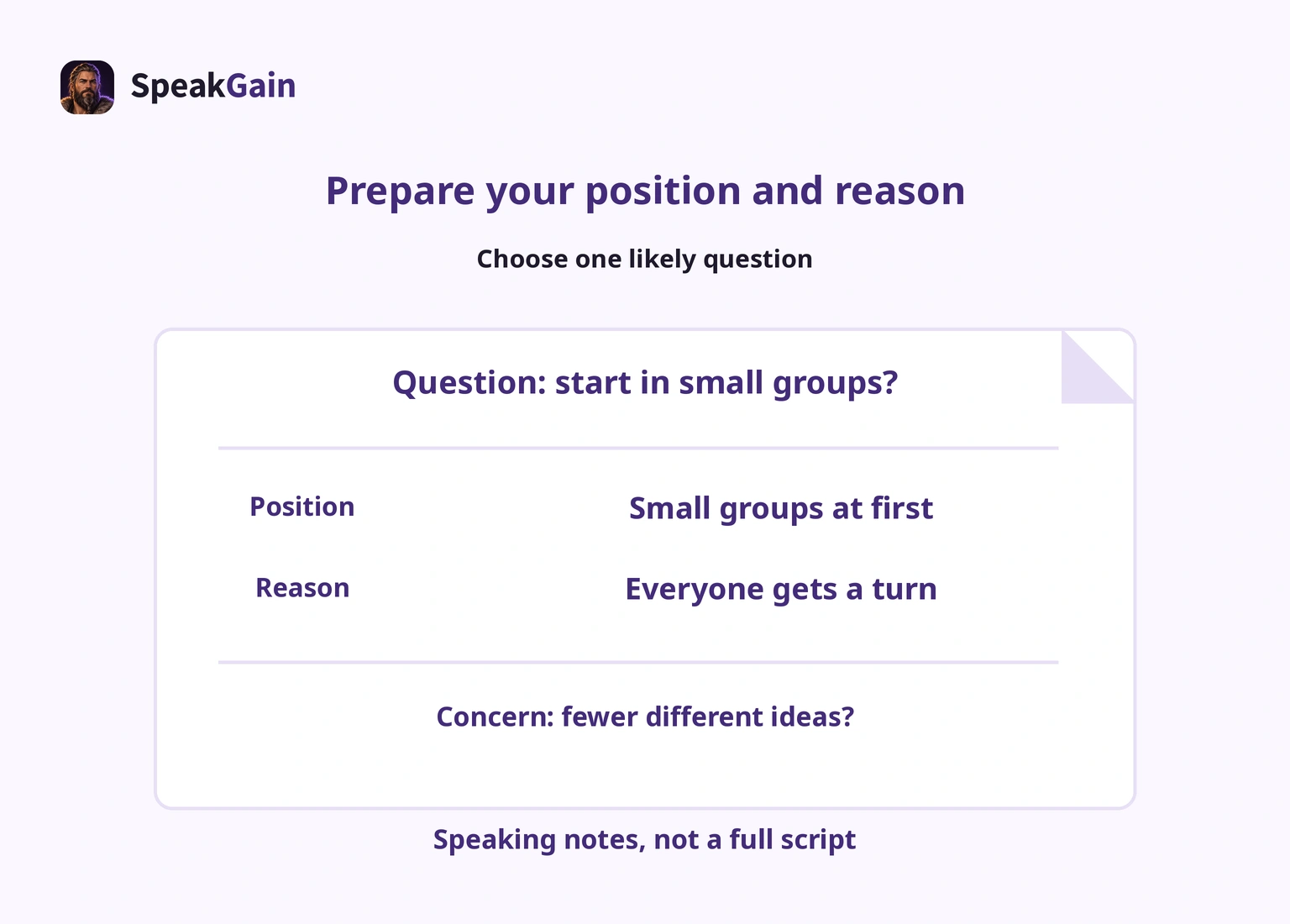
We would prepare a three-part note: question, position, reason. Check the assigned reading or task in a class or training session. If an informal conversation has no announced topic, practise a familiar choice or something you recently learned.
| Likely question | Your position | One reason |
|---|---|---|
| Are small-group activities useful? | Start in small groups | Everyone gets a turn |
| Should we read before class? | Use a short reading | It gives us material to discuss |
| Should groups change every time? | Change sometimes | We hear other views |
These are practice examples. A conditional position is fine: a short reading, or small groups at the start. If the discussion changes your mind, explain why instead of defending your note at all costs.
Check a few words needed for your own view, such as small groups or take turns. Try explaining with familiar language before collecting difficult synonyms. If sentence construction itself blocks you, see instant sentence-building practice.
Prepare one concern the other side might raise. If small groups limit the range of ideas, changing partners later may address that concern. This is preparation for understanding another priority, not a plan to defeat every objection.
Solo practice: record a short opinion and change one thing
On your own, practise starting and organising a short contribution. Unexpected responses and negotiating turns still need real interaction. A device that records audio and one prompt are enough for this editorial routine.
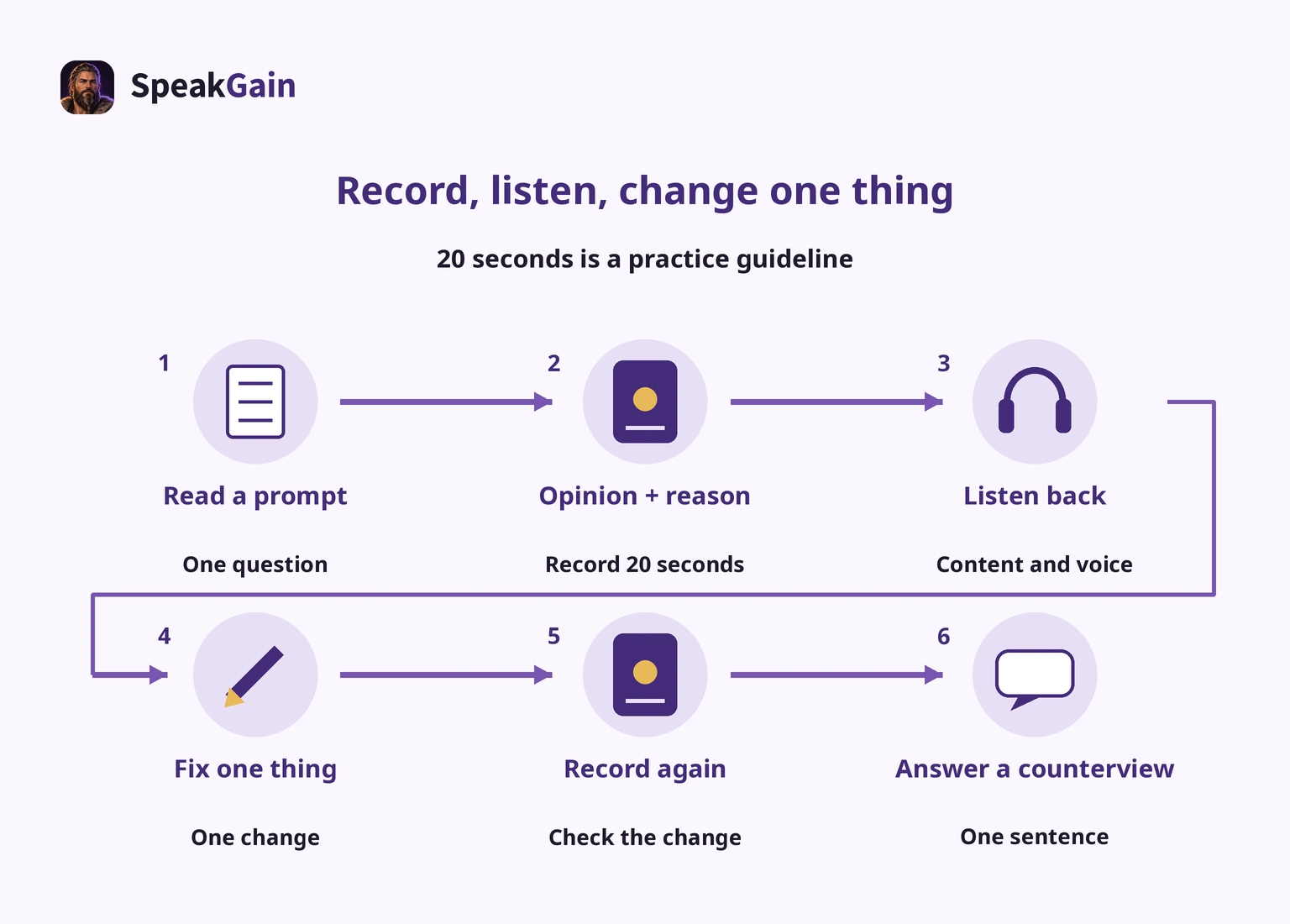
- Read a prompt, such as Should we start class discussions in small groups? On your first attempt, make a position-and-reason note before speaking.
- Record an opinion and one reason for roughly 20 seconds. Add an example if useful; do not repeat yourself just to fill the time.
- Listen back: can you identify the position, does the reason support it, and can you hear the ending?
- Choose one change: make a vague reason concrete, split a long sentence or make a quiet ending audible.
- Record the same prompt again and compare the changed point. Matching a model’s speed is not the goal.
- Read the counter-opinion Small groups limit the range of ideas. Answer in one line, for example We could change partners to hear different views.
You can also change your position: perhaps whole-class sharing is needed afterwards. A scripted counter-opinion cannot replace a real discussion, but it keeps your practice from ending with only your opening argument.
A small plan for repeated practice
Use one prompt per session. Start with an opinion and reason, then add agreement, polite disagreement and repetition in later sessions. Finally, try an unfamiliar prompt. Record one observation, such as speaking through the reason without notes, rather than just counting sessions.
If you can answer only a familiar question, change the position and build a new reason. Swapping nouns in a memorised example is not enough. After class, bring one thought you could not express into your next practice.
Save one short pattern with audio
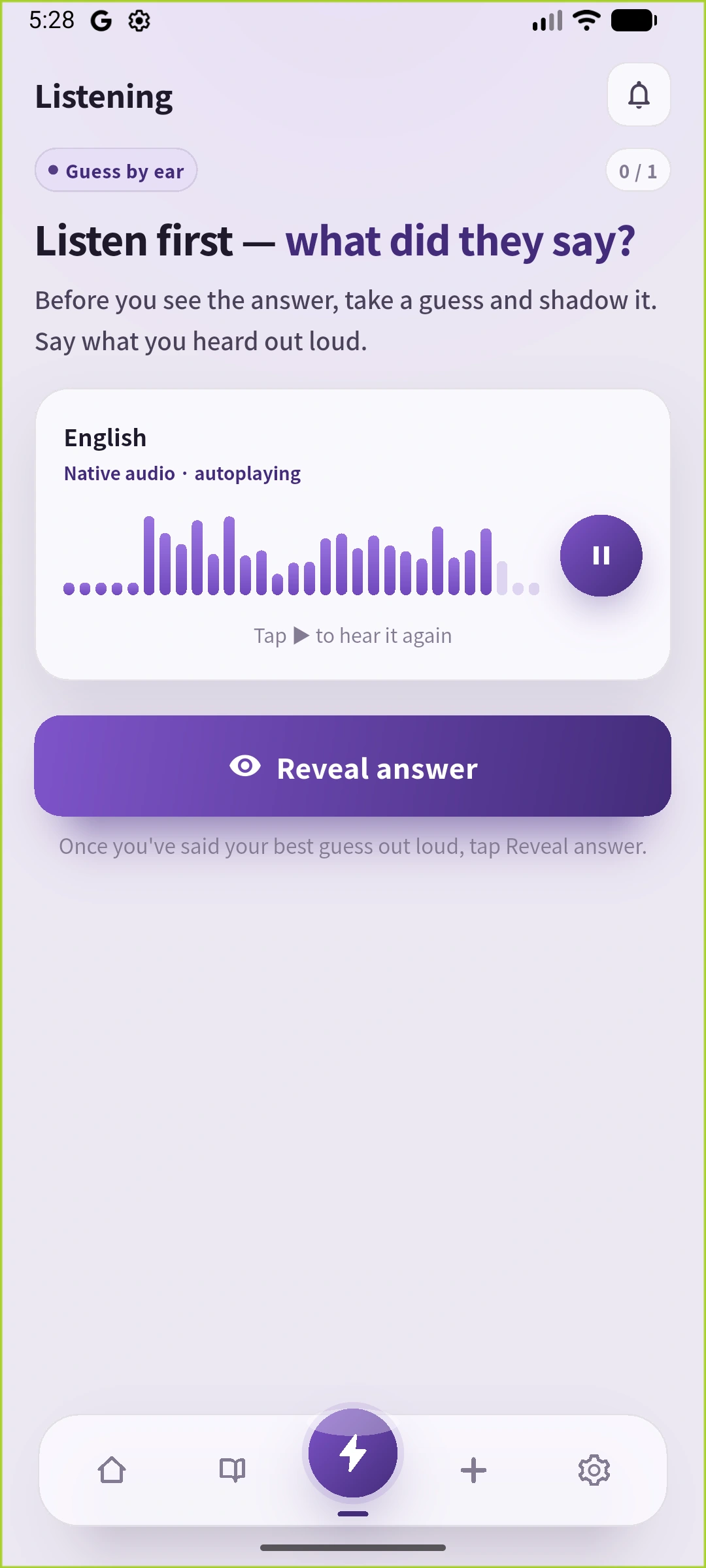
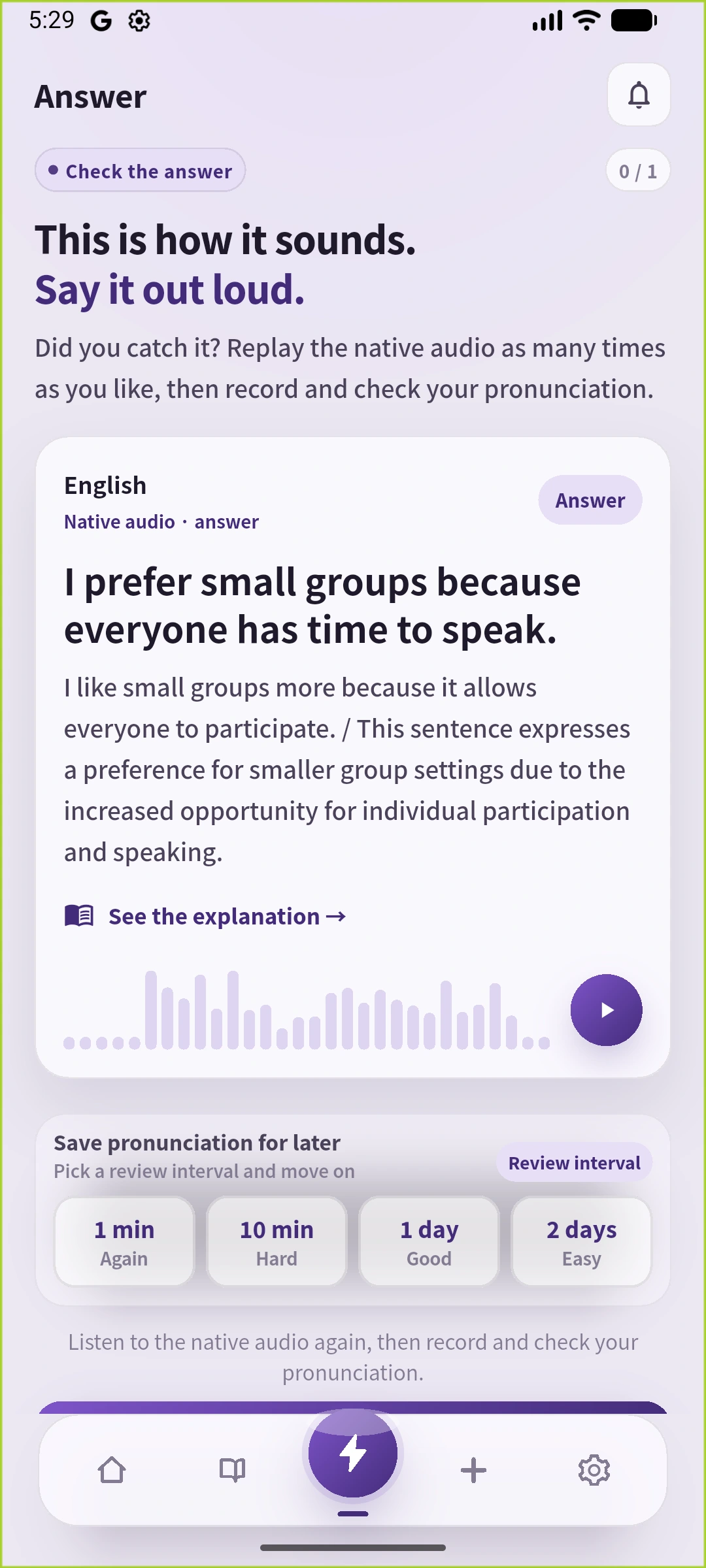
If you want to keep and listen to an opinion-and-reason sentence you use often, create a practice card in SpeakGain. We saved this original line through normal Add, then followed card library → Knowledge → Learn this card → Listening.
I prefer small groups because everyone has time to speak.
Listening presented the reference audio with the English line hidden; Reveal answer displayed the saved sentence and its English explanation. Answer provides playback and review-interval choices. Say the line yourself, then check whether you reached the reason.
This section demonstrates audio and saved-text review. Use the ordinary device recorder for the 20-second recording routine above, and test responses to another person in real dialogue.
AI-generated Viking audio for this practice sentence
This clip practises one sentence. Change the opinion and reason to your own content.
What to do when you freeze during a discussion
Separate three problems: choosing an idea, forming the English and understanding the other speaker. Treating all of them as a lack of English gives you no specific next action.
To organise your thoughts, say Let me think about that for a moment. Choose a position or reason first. If your sentence becomes too long, return to My main point is … and state the centre briefly. Use simple words or an example for a missing term. See what to do when English words will not come out for further practice.
If you did not understand the other speaker, ask for repetition or meaning before delivering your prepared view. If challenged, check which reason they question: add a condition, acknowledge a missing fact or explain why your view changed. Do not invent information to defend it.
How is a discussion different from a debate?
This article uses discussion for exchanging views and jointly developing understanding or proposals. A formal school debate may assign opposing sides, speaking times and a sequence of rebuttals. Check the rules of your class. Ordinary discussion practice need not aim to defeat the other person; preparing for a debate competition is outside this guide.
Common mistakes and the next change to make
| Habit that stalls you | Next change |
|---|---|
| Wait for perfect English | State one view, then one short reason |
| Memorise a huge phrase list | Choose a role and write two relevant sentences |
| Practise only an entry line | Continue into the point and reason |
| Read your whole prepared script | Listen and select the relevant note |
| Use a backchannel as agreement | Separate understanding from support |
| Declare a conclusion in your summary | Check agreement, proposals and undecided points |
We would not begin with long introductions or large phrase lists. They delay the substance and can weaken its connection to the current conversation. Use a small number of patterns as entrances for your own content.
Frequently asked questions
What if I have no opinion?
Ask about one reason or condition. Listen, then identify what matters to you. Asking for information needed to decide is a contribution too.
What if I cannot get a turn?
Wait for a break in the point and briefly name your relevant addition. Prepare the next sentence as well. Follow the class’s turn-taking rules.
How should I answer an objection?
Check the concern and give one reason or condition. Accept a useful point and revise your idea if needed. Do not fabricate facts.
Can I ask for repetition more than once?
Confirm important details. Specify the part you missed; if the same wording remains unclear, ask for an explanation in other words.
Should I be the summariser in a selection exercise?
Do not make a role your objective. Follow the task, give reasons and respond to others. Selection criteria vary, so no role guarantees success.
Is solo practice enough?
It helps you organise a turn and check your voice. Responses, turn-taking and changing views also need dialogue. Test one improvement in your next class.
Is going beyond 20 seconds a failure?
No. It is our short-practice guideline. Remove repetition, but do not force an understandable reason into an exact timing. Follow any assigned limit.
Should I use strong debate rebuttals?
In ordinary classes and training, begin by checking the other view and answering its point with a reason. A formal debate requires preparation for its own rules.
Our editorial verdict: prepare your next contribution
We would prepare one position and one reason for the next class topic, record a short answer and improve one point. Then read an opposing concern and respond in one sentence. Preparing an opening and one response with your own content is more useful than trying to memorise all eight patterns at once.
In the actual discussion, listen and choose the opinion, reason or question that is useful now. You do not need to deliver every prepared sentence. Bring back both what you could say and where you stopped; that gives the next practice a concrete purpose.
References
- British Council — Advice on preparation, reasons, responses, questions and summaries.
- TeachingEnglish — Teacher guidance on discussion roles, planning, interruption timing and reflection. The 20-second routine is our editorial proposal.