
Learn English with TED: choose a talk, use transcripts and give your opinion
Published
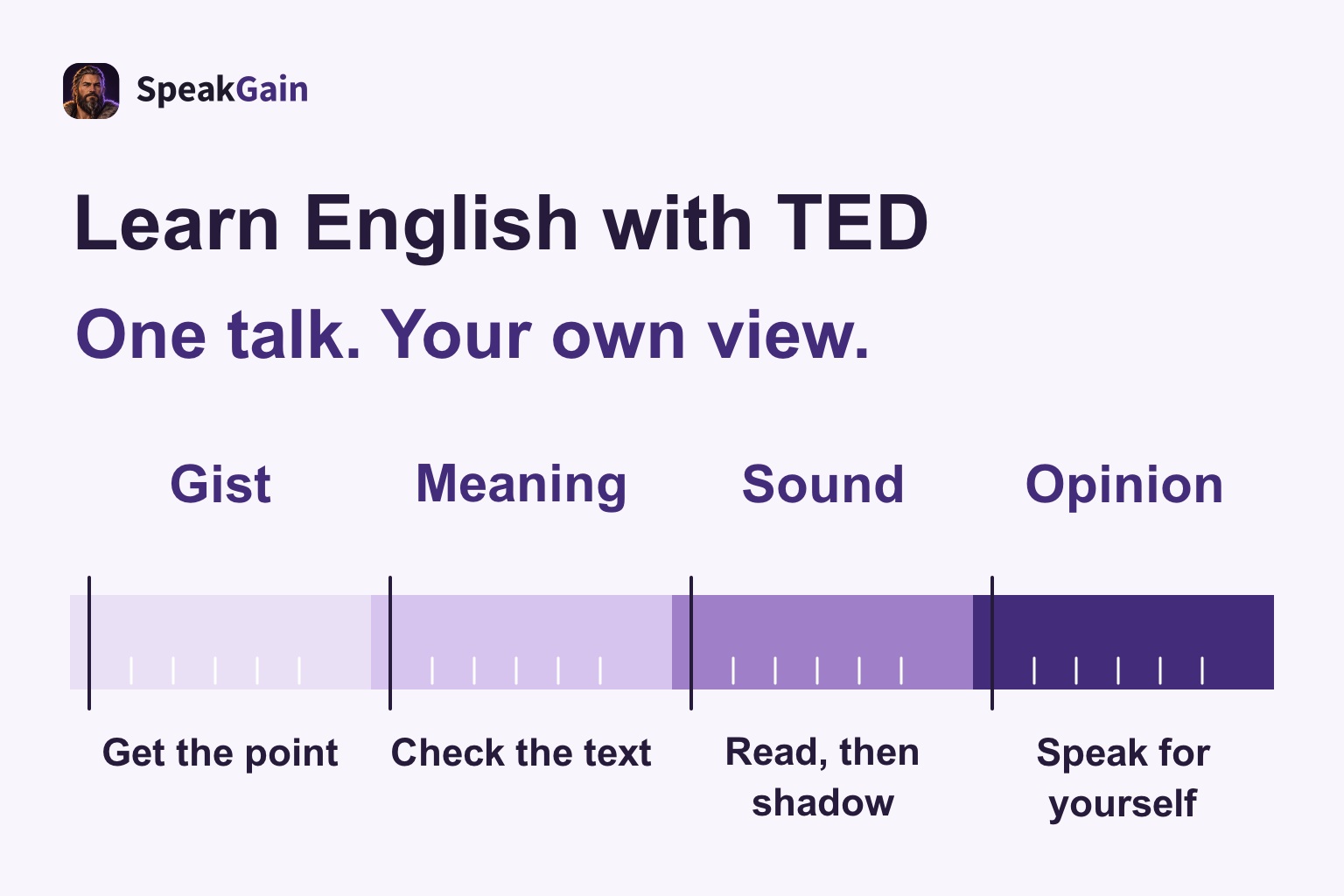
To learn English with TED, choose one short talk on a familiar subject with English subtitles and a transcript, then work through gist → meaning → reading along → shadowing → your own summary and opinion. Listening to a talk and producing your own explanation are different tasks, so finish by saying what you think aloud. Our editorial starting point is a 3–6-minute talk, with sound practice limited to a passage of about 15–30 seconds that you understand.
This guide is for university students and working adults preparing for classes, meetings or presentations. Times and repetition counts are editorial suggestions, not TED recommendations or proven optimal doses. We did not watch or listen to talks for this article: our screening advice uses official descriptions, displayed durations and subtitle/transcript availability. We do not rate individual speakers’ pace, accents or beginner suitability.
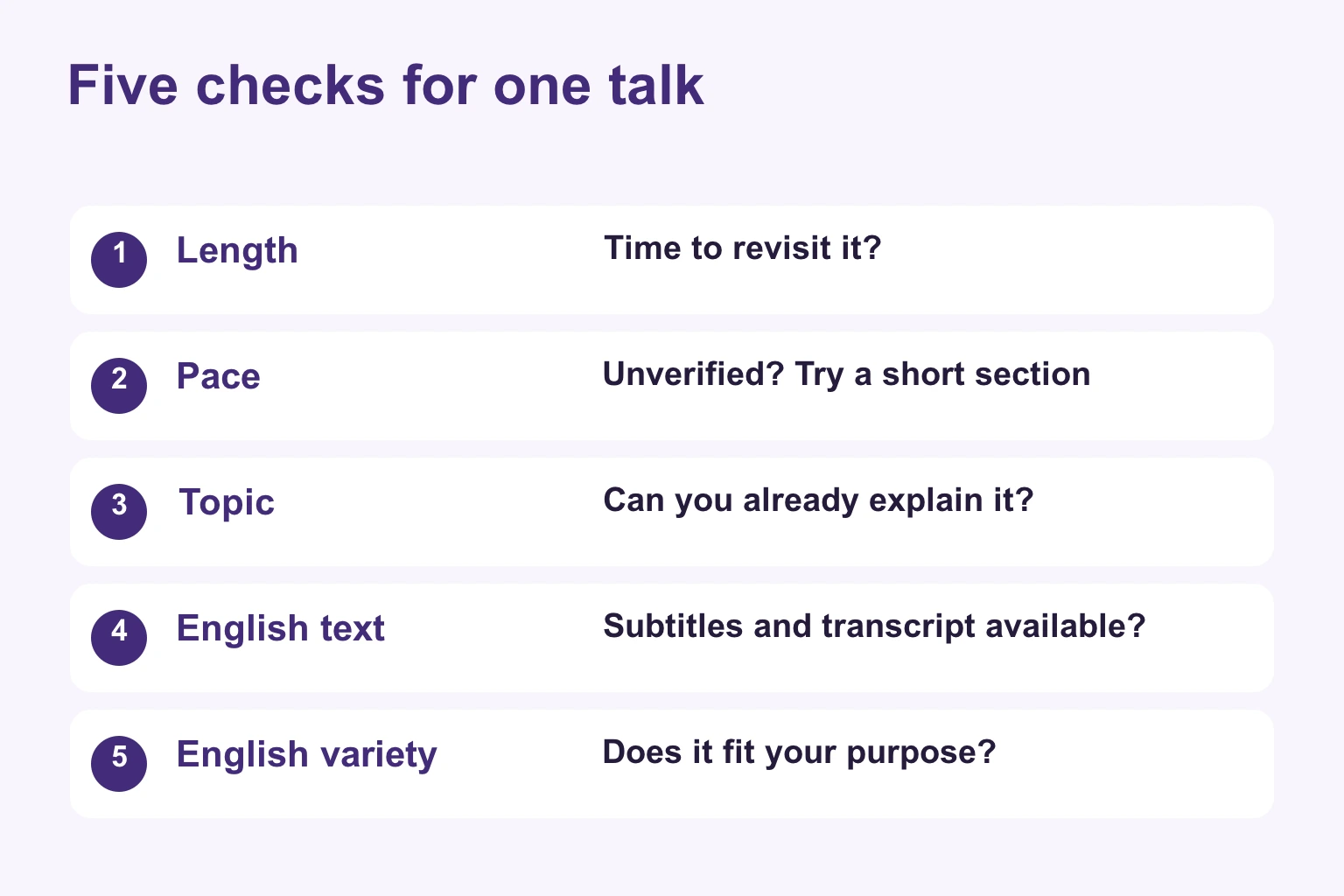
Choose your first talk using five checks
Choose something you can understand, check and practise aloud, rather than something famous. Start with the description and duration in the official TED library, then check the available languages.
| Check | A manageable starting point | Watch out for |
|---|---|---|
| Length | Our starting suggestion is 3–6 minutes, leaving time to revisit it | Short does not necessarily mean easy; split longer material across sessions |
| Speaking speed | Use an official pace description if provided; otherwise mark it unverified and try a short section yourself | Duration alone does not reveal words per minute; do not assume every talk is slow |
| Familiarity | A subject you could already explain, such as a study habit or a work routine | Unfamiliar background knowledge adds another difficulty alongside English |
| Subtitles/transcript | English text for checking sound and meaning; a familiar-language translation if needed | Availability varies by talk; a translated title does not guarantee matching subtitles |
| Variety of English | Speech that fits your purpose and whose meaning you can check | Do not infer an accent from a name or nationality, or treat unfamiliar English as incorrect |
For example, a student preparing for a seminar could look for a topic connected to their study routine. Someone proposing a new process at work could choose a subject they can connect to a real task. These are invented selection situations, not descriptions of particular talks.
Try one candidate and ask: What is it about? Can I leave time to revisit it? Can I check the English text? If you still understand almost nothing after checking the text, choose a more familiar subject. A common mistake is starting with a long specialist talk and spending the entire session looking up vocabulary. We would not begin there when the day’s goal is speaking. For alternatives, see how to choose shadowing materials.
Use one talk in five stages
Separate understanding the whole talk from practising a short passage. This is our suggested plan for a 3–6-minute talk; spread it over several days if necessary.
| Stage | Action | Suggested time | If you get stuck |
|---|---|---|---|
| Gist | Identify the topic and one main claim | Talk length + 1 minute | Use a familiar-language subtitle once, or choose an easier topic |
| Meaning | Check important passages in English and select a practice section | 5–10 minutes | Focus on what the claim depends on, rather than translating everything |
| Read along | Speak with the audio while looking at the text | 3–5 minutes | Shorten the passage or return to reading aloud |
| Shadow | Hide the text and follow slightly behind the audio | 3–5 minutes | Check one missing word, then read along again |
| Summary/opinion | Close the material and explain the idea and your position | 3–5 minutes | Use keywords for the topic, reason and your example |
Suppose you followed the overall point but missed one reason. Revisit that reason instead of replaying everything an arbitrary number of times. Before practising, write your target: explain one claim and give my opinion. The common mistake is counting views or repetitions without checking meaning or independent speech. Our YouTube study guide covers the broader video-learning routine.
First pass: identify the topic and claim
Listen for what the talk is about and what the speaker wants to say. Use no subtitles if you can follow the gist, English subtitles if useful, and a translation in a language you understand when English text alone is insufficient.
An invented note might be: “topic: testing a new approach / position: check it before a full rollout.” This is not a summary of a real talk. Record only what you understood; mark an uncertain reason as uncertain rather than filling it in from your expectations.
Afterwards, explain the gist in one sentence, initially in a familiar language if needed, then try a short English version. Identify one place to check next. A common mistake is stopping at the first unknown word. Continue if the main point remains clear; if almost nothing makes sense, choose easier material instead of enduring the whole talk.
Use subtitles for sound and transcripts for meaning
Subtitles help match sound to text; a transcript helps you inspect the surrounding argument. TED’s official subtitle help says to open the gear in the TED.com player, choose a language, and use the disable-subtitles option to turn them off. Check the menu for the individual talk; your language may not be available.
TED’s transcript guide describes opening Read Transcript below the video, choosing an available language, and selecting text to jump to that point. On mobile web, the transcript may cover the video; subtitles may be easier to follow alongside it. These instructions come from official help checked on October 15, 2026, not our own device test of TED.
For example, when you are unsure whether a point is one person’s experience or a general recommendation, inspect the surrounding meaning. In our original sentence, “I like this idea, but we need time to test it,” the first part expresses approval and the second adds a concern. It is not a quotation from a talk.
Check the subject, action, negation and conditions in an important passage. Use a translation to resolve meaning if needed, then return to the English. Hide the text and explain the meaning yourself. We do not recommend spending the whole session reading translated subtitles: that leaves out matching English sound and text and composing your own response. Nor do we recommend banning all subtitles before you understand the content.
Read along before shadowing
Choose a short passage you understand. Speak simultaneously while reading, then hide the text and follow slightly behind. The first task is overlapping or reading along; the second is shadowing.
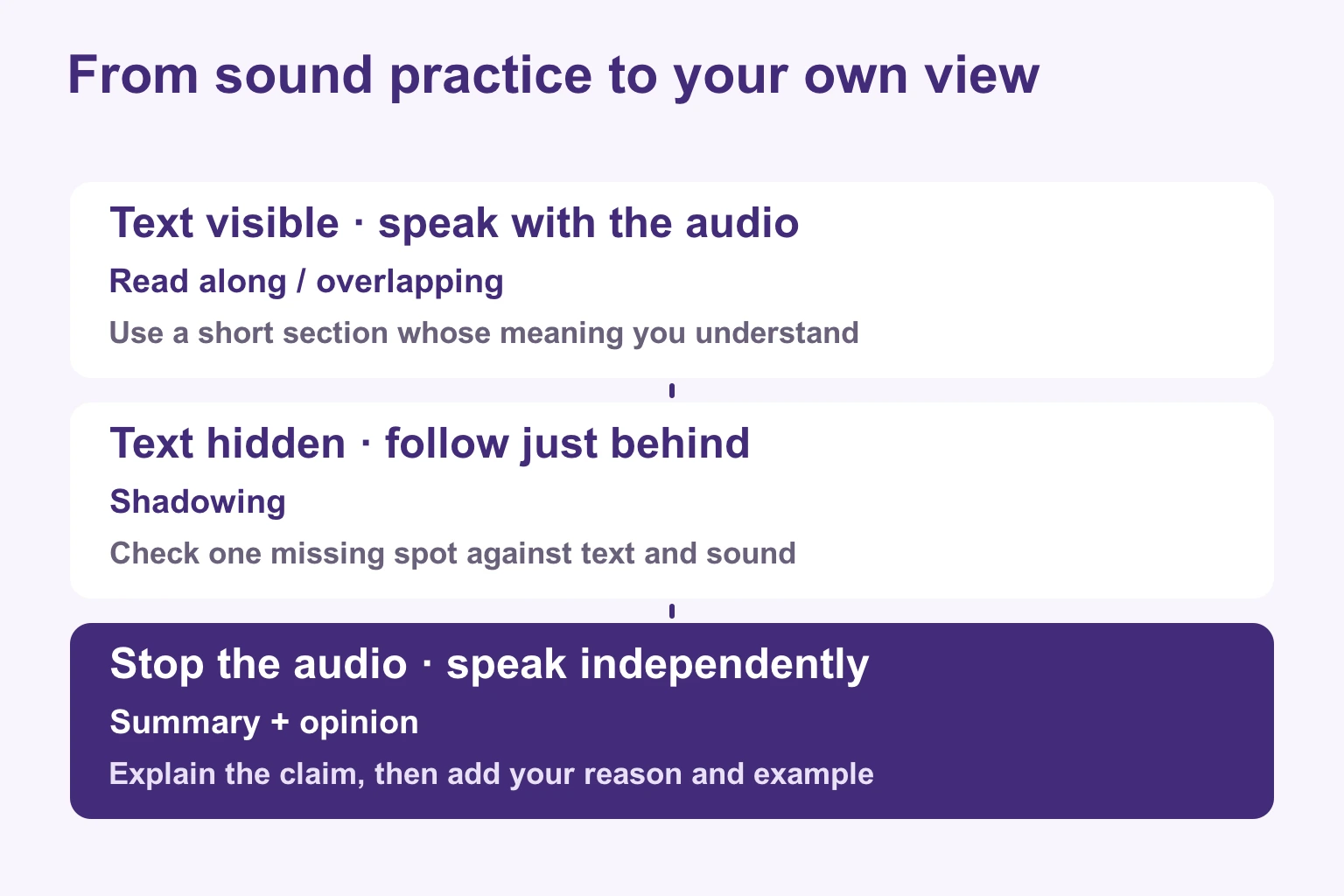
To illustrate the operation with our own sentence, read “I like this idea, but we need time to test it” with its audio, try following without text, then stop playback and add your reason. In a TED session, use the official player and text; our example is not part of a TED talk.
Start with one reading aloud and two or three attempts to read along. If words repeatedly disappear during shadowing, check one troublesome spot and shorten the section, even to one sentence. Common mistakes are moving your mouth without understanding, forcing yourself through the whole talk, and treating matched speed as completion. See the read-along method and shadowing step by step for the detailed drills.
Turn the idea into your own speech
Close the talk, explain its claim in your own words, then add your position, reason and example. Make clear whose idea you are describing. Do not transfer memorable lines into your speech or present someone else’s idea as your own discovery.
Our original worked sentence is:
I like this idea, but we need time to test it.
It expresses qualified support: you like an idea but want time to test it. Imagine discussing a new approach for a university group or a work team; this is an invented situation, not our response to a particular talk. An original reason is “Our team is busy this month.” A possible action is “We can try it on one task first.” Change the details to match your actual circumstances.
Practise with only the keywords idea / time / one task, initially aiming at about 30 seconds. Record yourself and check whether your position and reason are understandable. Return to official material to check that your summary represents the speaker accurately. The common mistake is either giving only a summary or mixing your view into the speaker’s claim. Keep those notes separate. Use short-speech preparation for a talk without slides, or presentation preparation for a class or workplace presentation.
TED-Ed is a different format, not an easier level
Choose between a spoken talk and an explanatory lesson based on your purpose. TED-Ed’s official introduction describes its educational initiative, short original animations, and lessons with questions and resources. It is not simply a collection of shorter conference talks.
For example, a seminar response to a viewpoint could start with a talk, while explaining how something works could start with a TED-Ed lesson description. This is our editorial distinction, not a guarantee of easier English. A short explanation can still require specialist vocabulary.
TED’s TED-Ed help says transcripts are not directly available on ed.ted.com lesson pages. Open the original YouTube video through the video title and find Show Transcript in its description, or use Read Transcript for a version in TED.com’s library. Check whether the text is labelled auto-generated rather than assuming it is fully accurate.
Practise explaining the mechanism and giving an everyday example in your own English. A common mistake is treating answers to lesson questions as completion of sound practice. Answering questions, checking the English and speaking your explanation are separate actions.
A three-session plan for a busy week
Give the same talk a session for meaning, one for sound, and one for your own response. Our editorial plan leaves room to practise instead of searching for a new video every day.
| Session | Work | Keep |
|---|---|---|
| 1: about 15–20 minutes | Choose, get the gist, check important meaning | Topic/claim notes and a short passage |
| 2: about 10–15 minutes | Read aloud, read along, shadow | One word or place to revisit |
| 3: about 10–15 minutes | Summarise and record your opinion, reason and example | Your sentence and one change for next time |
For example, choose on Monday, practise sound on Wednesday and speak on Saturday. At the start of the next week, try the same position and reason without notes. If you forget, check the necessary meaning rather than memorising the entire transcript. Record understanding, following the sound and independent speaking separately. If you keep abandoning candidates, change one thing: shorten the passage, choose a familiar topic or reduce your response to one sentence. Our English-study guide helps place this activity in a broader plan.
Save your own sentence and respect the source material
Write your own opinion instead of reproducing TED text as a new learning resource. Our sentence is “I like this idea, but we need time to test it.” It was not imported from a talk or converted from a transcript into another voice.
On October 15, 2026, we saved this original sentence as one card through SpeakGain’s normal Add screen. From Library → Knowledge → Learn this card, Listening hid the English and prompted listening and speaking aloud. We operated replay, used Reveal answer to show the exact sentence and its English explanation, and replayed the same audio on Answer. The authentic screenshot below uses this card and the English interface.
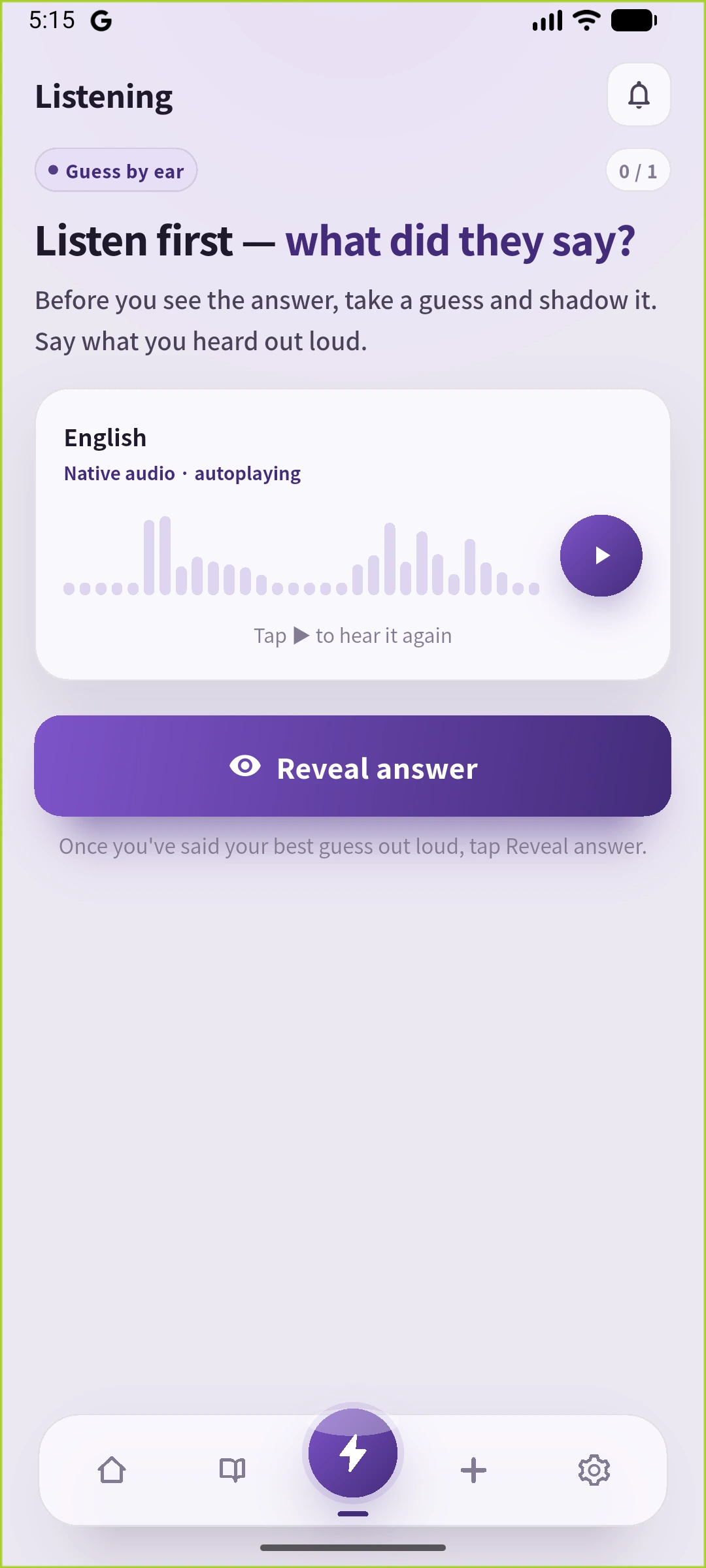
This is the same card’s Viking AI-generated audio created through the app, not a recording of a human native speaker.
I like this idea, but we need time to test it. — You support the idea while asking for time to test it.
Listen, reveal the sentence to check its meaning, and say it aloud yourself. After this verified one-sentence practice, leave the screen and add your own reason and example to deliver the whole opinion.
TED’s Usage Policy and Terms of Use place conditions on reuse. Do not assume that an educational purpose permits unrestricted distribution; consult the applicable official conditions for classroom sharing, ongoing courses or corporate training. TED-Ed material does not necessarily have the same licence. This article reproduces no video, photograph, subtitle or transcript.
Before saving a sentence, check that it is your own writing, and separate the speaker’s idea from your response. A common mistake is assuming that minor edits make a copied transcript available for redistribution. Link readers to the official material and check the current policy before reusing it.
Frequently asked questions
Is TED too difficult for beginners?
It may be too difficult if you cannot establish meaning even with English text. Try a short familiar-topic section first; use learner-oriented material if necessary. Continuing with TED is not the goal in itself.
Which subtitle language should I use?
Use a familiar language to clarify meaning and English to check sound and form. Then close the text and explain the idea. Check which languages the individual talk actually offers.
How long should the first talk be?
Our starting suggestion is 3–6 minutes, with a 15–30-second practice passage. These are editorial limits, not proven optimal durations; understanding and time to revisit matter more.
Can I shadow TED talks?
A short section you understand and can check in English is a possible practice source. Return to reading aloud and reading along if you cannot follow it. Difficulty varies.
Is TED-Ed easier?
Not automatically. Topic and vocabulary matter. Distinguish an explanatory lesson from a spoken talk and locate the transcript before committing to it.
Can TED help with speeches and presentations?
It can provide an idea to summarise and respond to in your own words. Attribute the idea, add your own experience, and plan your actual presentation around your audience and time limit.
What if I cannot find a transcript?
Check Read Transcript and its language menu on TED.com. For TED-Ed, check the original video or TED.com version. Choose another source if you cannot check the English.
Will watching alone make me speak English?
Do not treat watching as a substitute for producing your own response. Close the video and say a short summary and opinion; notice where you stop.
Editorial verdict: leave one talk with your own sentence
We would begin with one short, familiar-topic talk with English text, establish the gist and meaning, practise a manageable section, and finish with an original spoken opinion. We do not recommend translated subtitles as the whole practice or a long specialist lecture as the first speaking exercise.
Today, choose one candidate, identify one main point and write what you think. Judge the session by whether you can give one reason yourself, as well as whether you could follow the speaker.
Official sources
Subtitle settings · TED/TEDx transcripts · TED-Ed transcripts · About TED-Ed · Usage Policy · Terms of Use. Checked October 15, 2026. English examples and practice times, counts and plans are our original editorial suggestions; no talk speech or transcript is quoted.