
Yoroshiku onegaishimasu in English: choose what you mean
Published
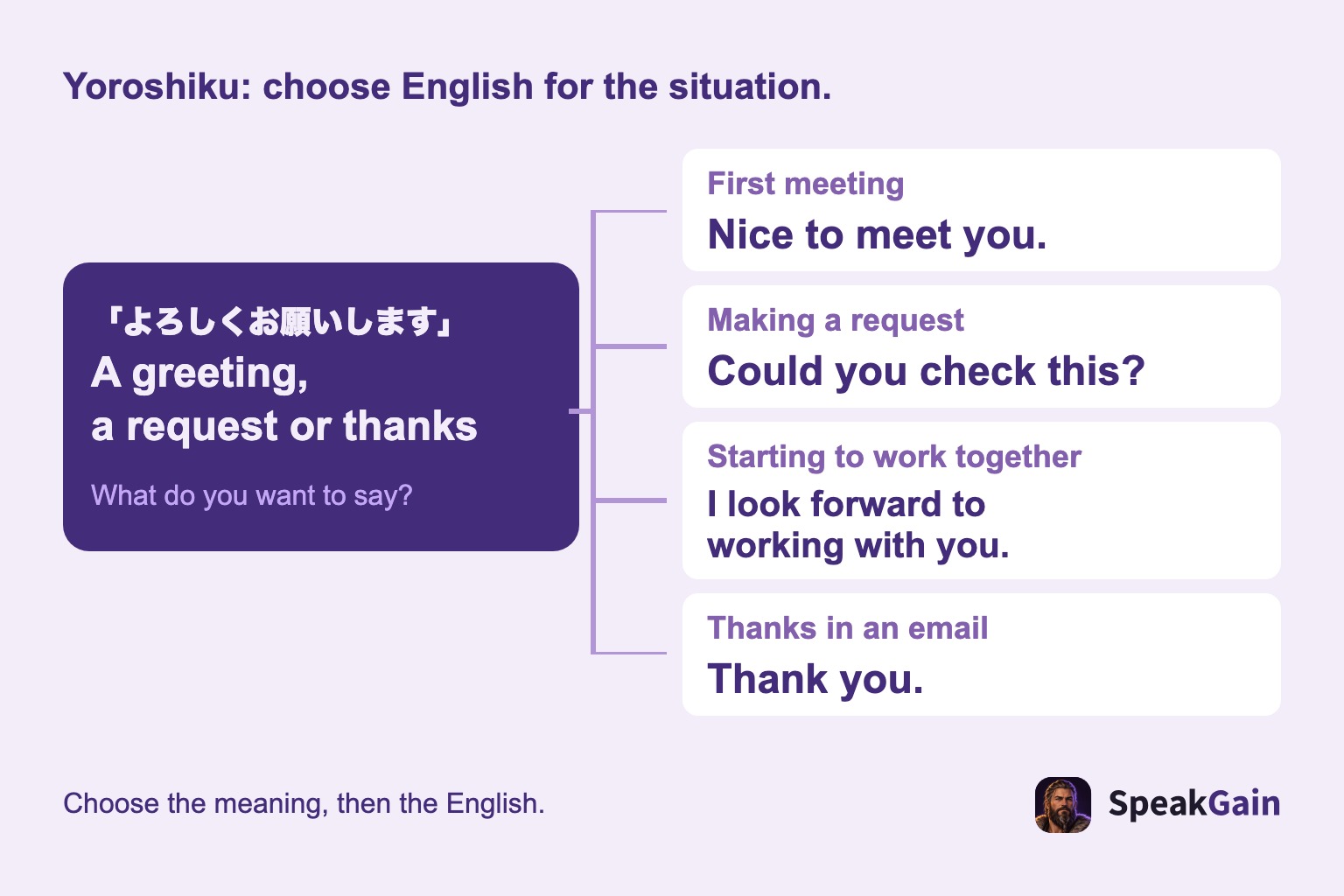
There is no single English word or fixed sentence that translates Japanese よろしくお願いします in every situation. Choose what you mean: “glad to meet you,” a specific request, “looking forward to working together,” or thanks for someone’s time. Start with these four lines.
| Situation | English to start with | What it communicates |
|---|---|---|
| A first meeting | Nice to meet you. | You are glad to meet this person. |
| Asking for a draft review | Could you check this draft? I’d really appreciate it. | A specific request, followed by appreciation if they can help. |
| Joining a team | I look forward to working with you. | Positive anticipation of working together. |
| Ending an email | Thank you for your time. | Thanks for the reader’s time. |
Our editorial recommendation is to learn these four before collecting more alternatives. Yoroshiku can do several jobs in Japanese; English often makes the job explicit. These are practical choices, not four interchangeable dictionary equivalents. A sign-off such as Best regards does not itself ask someone to check a file.
1. Find the intention inside yoroshiku
Ask what the other person should understand or do next. “I’ve attached the document. Yoroshiku” might mean read it, correct it or approve it by Friday. Those are different requests. Translate the intended action before worrying about a polite ending.
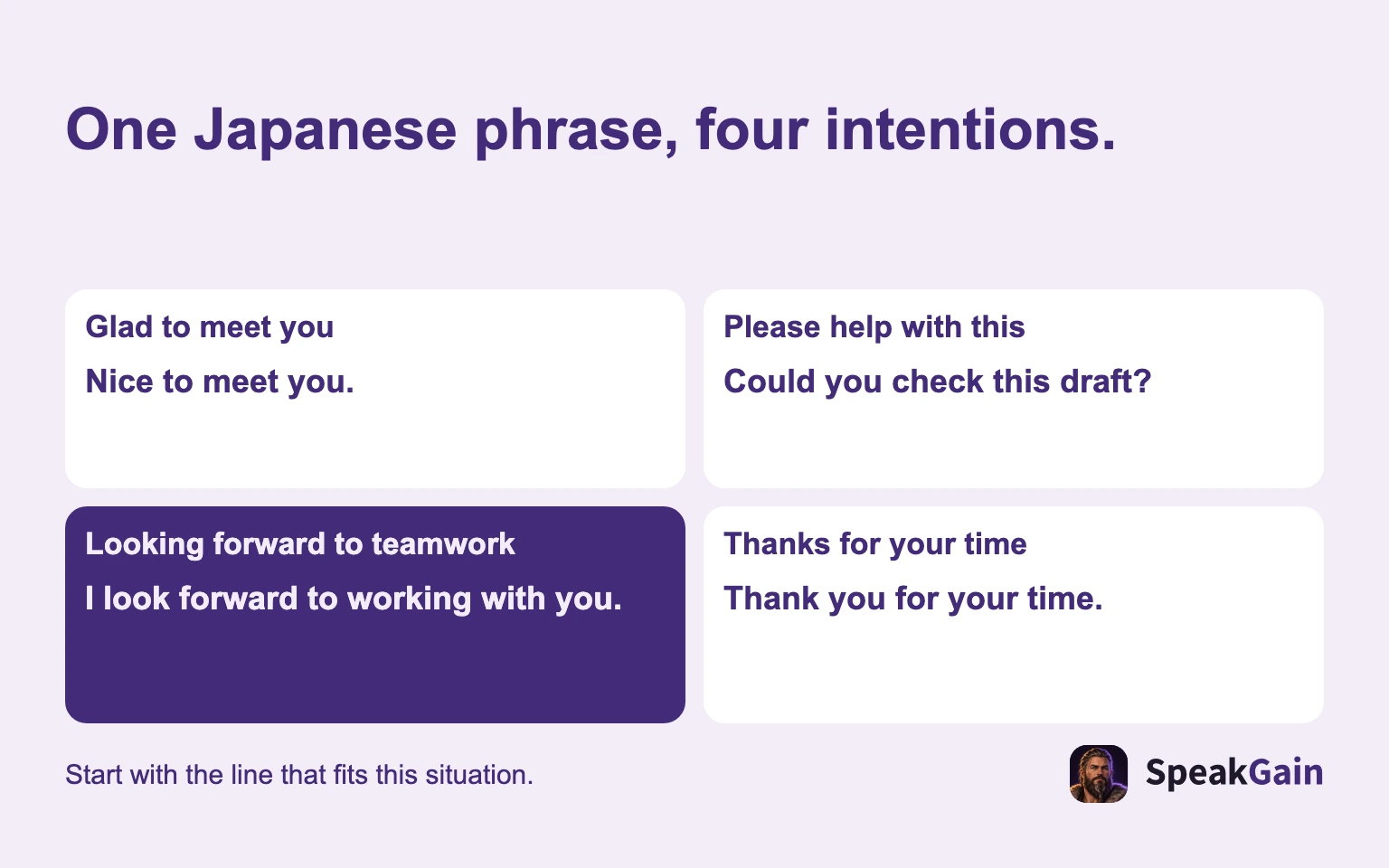
English has greetings, requests and sign-offs, but they do not combine into one phrase with exactly the same range as Japanese yoroshiku onegaishimasu. Nor does the Japanese phrase mean “please be nice to me” in every setting. Choose the line for this relationship and this moment; you do not need all four together.
2. End a first introduction with a meeting greeting
Hi, I’m Misaki. I work in the design team. Nice to meet you.
Nice to meet you can cover the greeting function of both hajimemashite and yoroshiku. You do not need a separate English sentence for each Japanese expression. For someone you will actually work with, you can add I look forward to working with you. At a networking event where no collaboration is planned, that addition may promise more than you mean.
After the meeting, It was nice meeting you looks back on the encounter. Before a first meeting next week, I look forward to meeting you next week anticipates it. With someone you already know, Good to see you again is a useful return greeting. Build the introduction itself with our self-introduction guide, or practise the first hello and response with English greetings.
3. Make the request specific
British Council’s request lesson presents Could you and Would you as polite request forms. Put the action after Could you, and identify the document, section or deadline when needed.
Could you check this draft? I’d really appreciate it.
The first sentence asks for a review. The second says you would appreciate the help; I’d means I would. It needs a clear antecedent for it. A longer alternative is I would appreciate it if you could review the proposal. A deadline belongs in the request: Could you check this draft by Friday? If you are checking availability, Would you be able to check this draft by Friday? keeps that question explicit.
Please check this draft is not universally rude. An agreed task or instruction can call for different wording. For a new request when you do not know the person’s availability, we recommend starting with Could you rather than making the ending ever more elaborate.
4. Separate email content, thanks and the sign-off
Thank you can be a short ending once the request is clear. Thanks again refers back to help or a reply already received. Best regards, goes before your name; it is a sign-off, not “please confirm.” In a short work chat you usually need neither a formal sign-off nor a repeated signature.
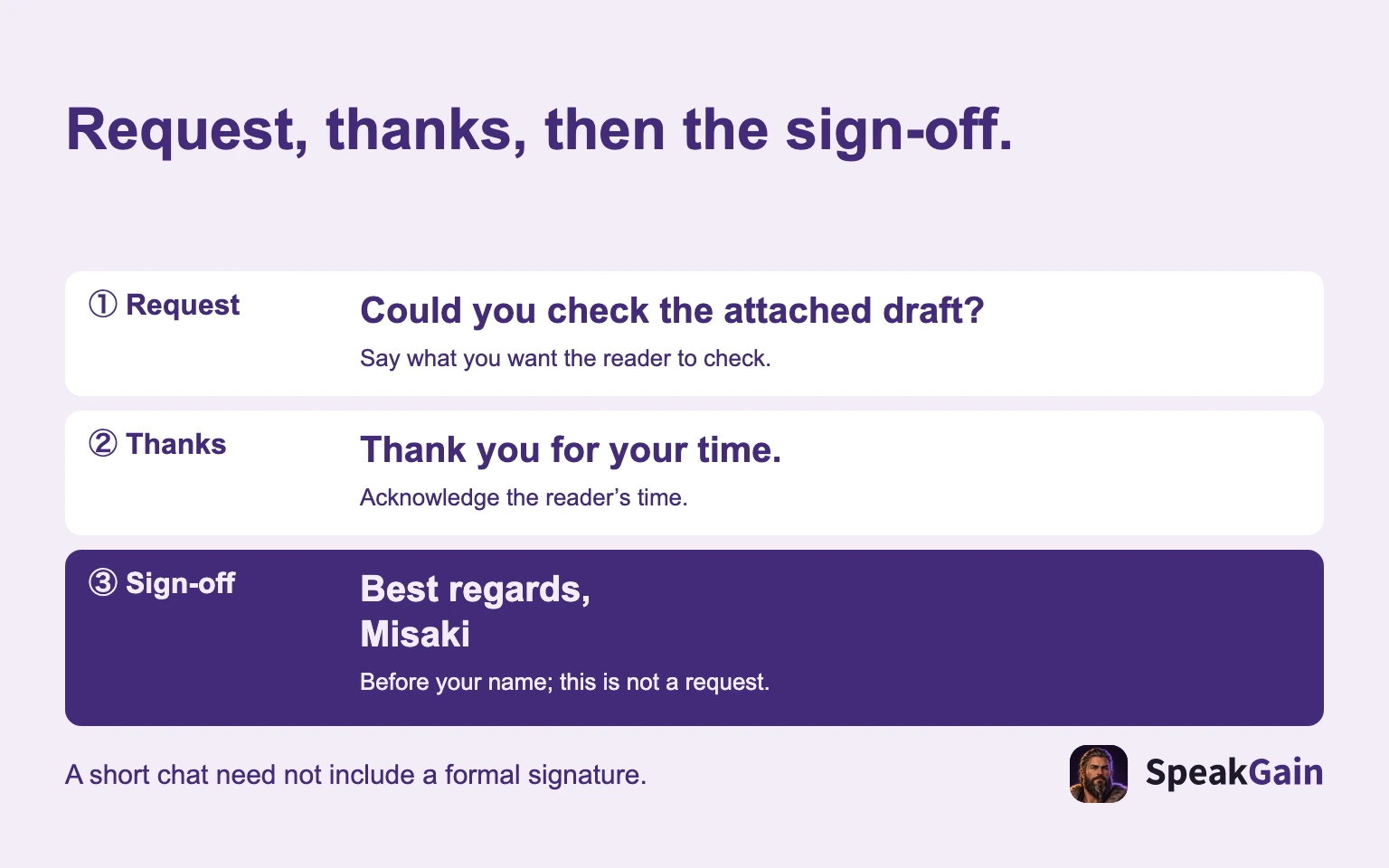
Hi Alex,
I’ve attached the updated proposal. Could you let me know if the schedule works for you?
Thank you for your time.
Best regards,
Misaki
The question carries the task. The last two lines acknowledge time and close the email. British Council’s email lesson explains choosing a style for the relationship and writing the name after the closing. This example does not require an extra sentence about continuing a business relationship just because a Japanese email might end with hikitsuzuki yoroshiku.
What about Thank you in advance?
British Council’s formal request example uses Thank you in advance after explaining an unresolved request. It therefore is not a forbidden phrase or a form reserved only for tasks already accepted. That example does not establish how every recipient feels about it. Our first choice for an unaccepted request is Could you …? I’d really appreciate it: ask clearly, then express appreciation without treating agreement as settled. In either case, say what you want done. For thanking someone after help arrives, see saying thank you in English.
5. Start a collaboration, or say less
I look forward to working with you fits a new team or business relationship. Use We when speaking for the team. Cambridge’s grammar explanation treats to here as a preposition: follow it with a noun or an -ing form, hence working, not work.
We look forward to working with you on this project.
I look forward to continuing to work with you can express anticipation of an ongoing collaboration. We recommend it when continuation itself matters, such as a renewed agreement, not as a mandatory line in every email.
When the message is complete, English can add nothing. See you at ten can finish a meeting arrangement. Could you send me the file? can stop at the question while you wait for an answer. Here’s the file can accompany an already agreed task. If no review was agreed, add the request rather than expecting silence or a sign-off to supply it. If you caused a mistake, distinguish the apology from the new request; our apology guide explains that separate job.
6. Begin an online lesson with today’s goal
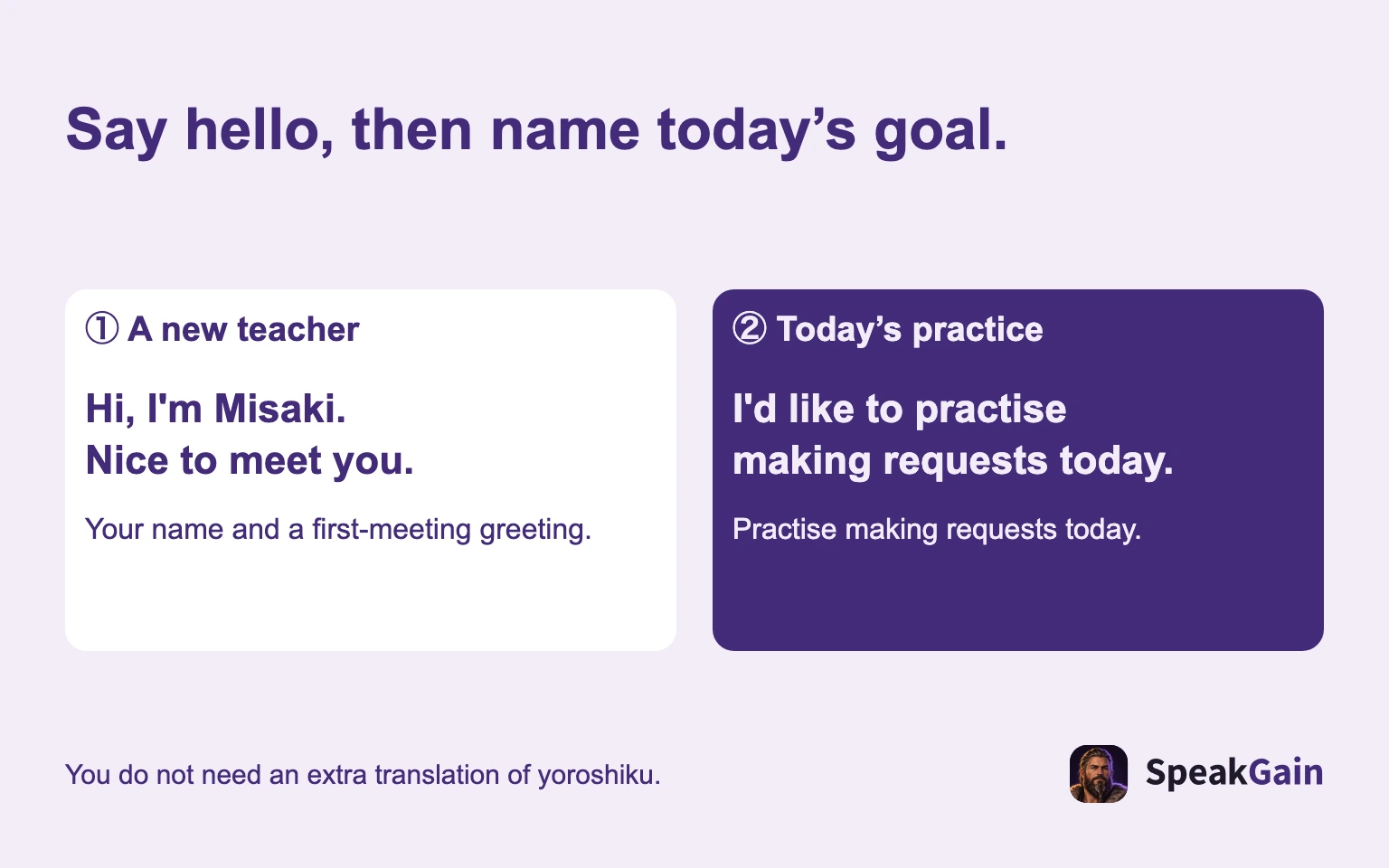
Hi, I’m Misaki. Nice to meet you. I’d like to practise making requests today.
For a new teacher, give your name and greet them, then say what you want to practise. Could you help me with my pronunciation? names another possible goal. For a returning teacher, Good to see you again works as a greeting. Our recommendation for beginners is a greeting plus a learning goal, rather than treating I look forward to working with you as a fixed lesson opener.
7. Hear and say the lines in Misaki’s day
Misaki is a fictional learner, not a testimonial. A colleague says Welcome to the team, Misaki. She answers Thank you. I look forward to working with you. The welcome makes teamwork the relevant intention.
Misaki: Could you check this draft? I’d really appreciate it.
Colleague: Sure. I can take a look after lunch.
Misaki: Thank you. I’ll send you the file now.
She hears after lunch and sends the file; she does not treat the check as already complete. Later a client asks for an updated schedule. She writes I’ve attached the updated schedule. Could you let me know if it works for you? Thank you for your time. Reading that email aloud is practice, not a claim that email arrives as spoken conversation.
Save three useful lines
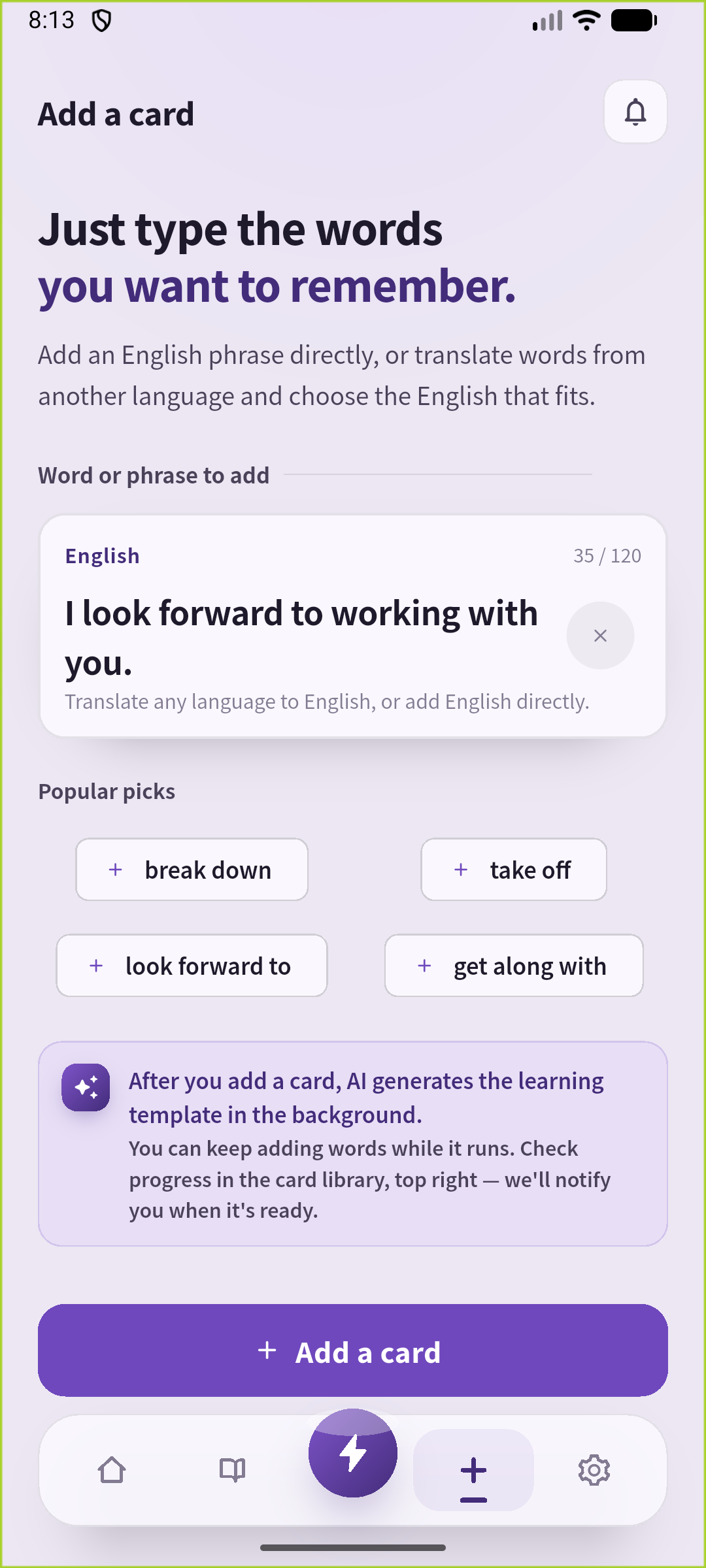
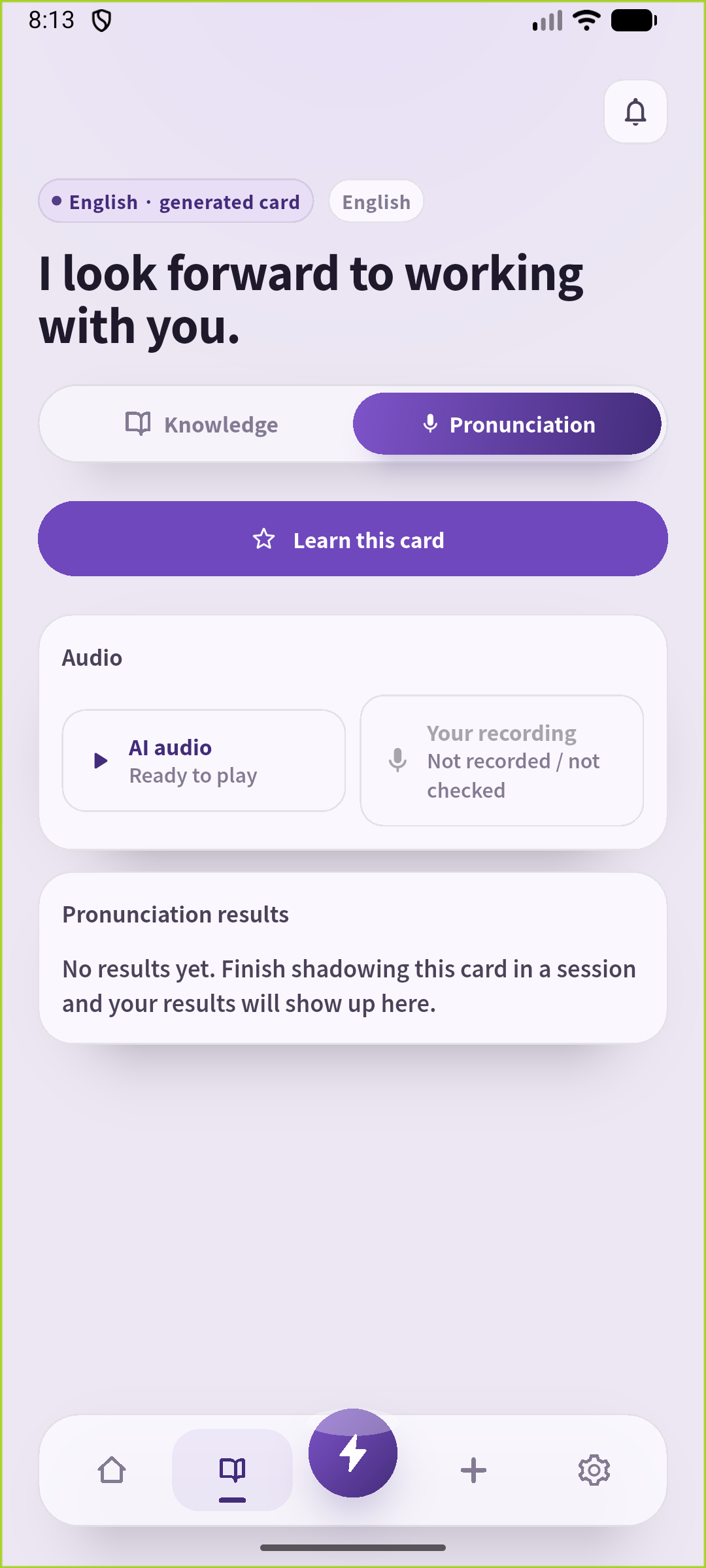
SpeakGain’s Add screen lets you enter an English sentence and create a practice card. We saved the teamwork line, the draft request and the thanks for time. Use phrases you intend to say; What is SpeakGain? explains the app.
Listen, pause, then speak in your role
These three clips use SpeakGain’s AI voice Deep-voiced Viking. Each is audio for a saved sentence. The app is not automatically continuing a role-play conversation. Imagine the welcome, show the draft in your mind, or finish the email; listen to one clip and then say the relevant line yourself.
I look forward to working with you.
I look forward to working with you.
Could you check this draft? I'd really appreciate it.
Could you check this draft? I would really appreciate your help.
Download audio — Could you check this draft? I would really appreciate your help.
Thank you for your time.
Thank you for giving me your time.
Hide the wording and retrieve it from the situation
Think only “new team,” “draft review” or “email ending.” Say a line without reading, check what you missed and hide it again. Karpicke and Roediger’s 2008 study tested university students learning Swahili–English word pairs. Continued retrieval after an initial correct answer improved recall a week later. It did not test yoroshiku conversations or SpeakGain. Our practical interpretation is to add situation-based recall to listening and reading, without promising a measured conversation benefit.
Tomorrow change draft review to Could you send me the updated file? Change a first meeting to a reunion and choose Good to see you again. Make one change at a time. Our English study guide helps combine listening, speaking and review.
Questions readers ask
Is Please be nice to me the translation? It asks for kindness, which may not be the message you need. For introductions, start with Nice to meet you; for planned teamwork, use the teamwork line.
Does Best regards ask for a reply? No. Put the reply request in the body.
Must I always translate yoroshiku at the end? No. If the greeting or request has done its job, let the other person answer. Choose an intention, not a matching number of sentences.
For a colleague in the hallway or at the end of work, our guide to otsukaresama in English helps you choose between a greeting, a goodbye and thanks.
References
For a specific favor, making requests in English helps you choose the wording, reason and room to say no.
For a phrase that can reassure someone or decline an offer, daijoubu in English shows how to choose a line for checking, reassuring, declining, or asking permission.