
How to say thank you in English: situations, reasons and replies
Published
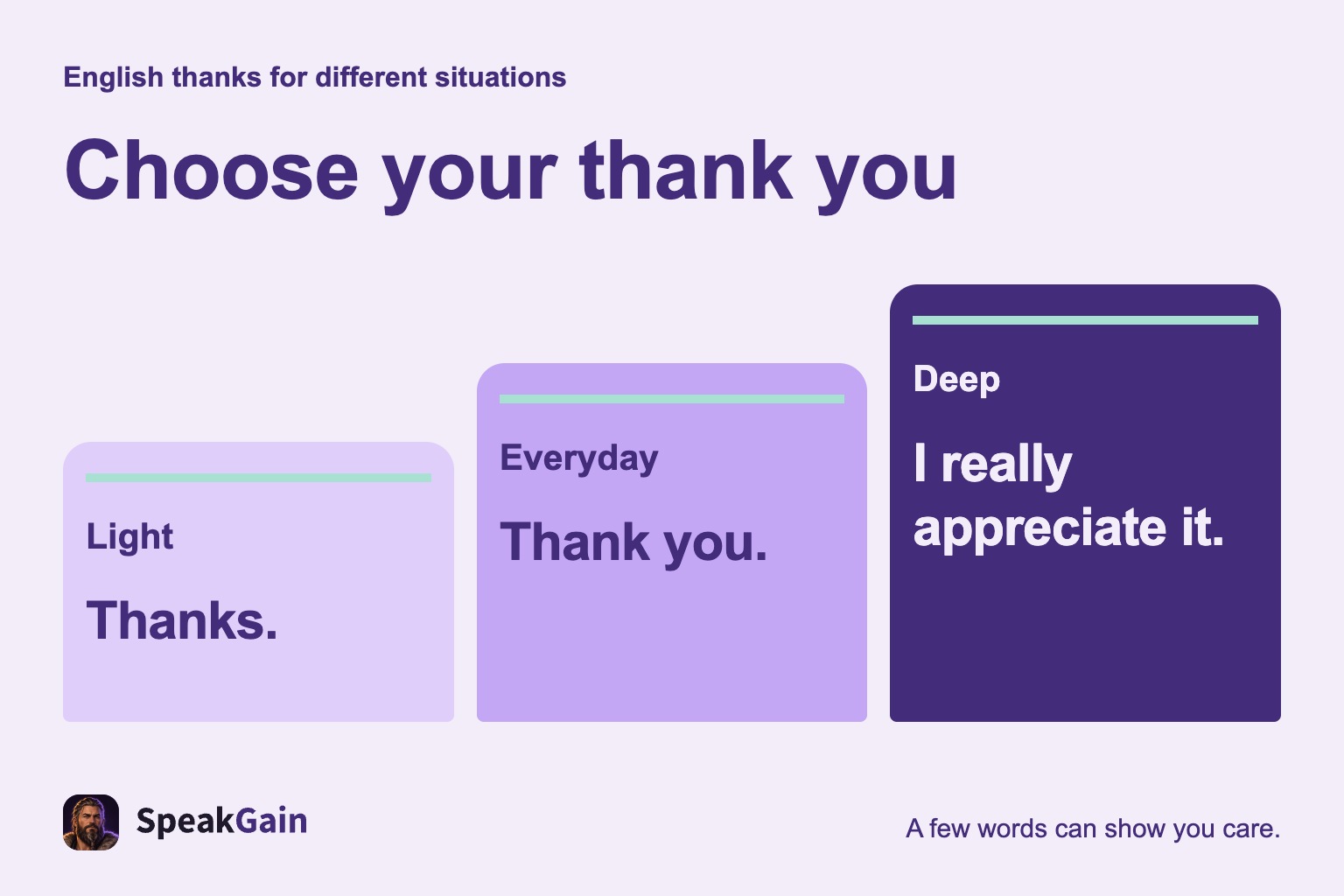
“Thank you.” is the basic way to express thanks in English. Use “Thanks.” for a casual, brief thank you, “Thank you so much.” to emphasize your gratitude, and “I really appreciate it.” to recognize help you received. Add a reason with “Thank you for your help.” When someone thanks you, “You’re welcome.” is a useful starting point.
Our editorial recommendation is to start with three moves: a short thank you, a reason, and a reply. Learn Thanks, Thank you for your help, and You’re welcome before collecting dozens of alternatives. Saying something when help arrives matters more than finding a new phrase every time.
1. Choose light, everyday or deep thanks
Receiving your purchase and receiving a colleague’s substantial help are different situations. Thank you can work in both. With a bigger favor, naming the help makes your message more specific.
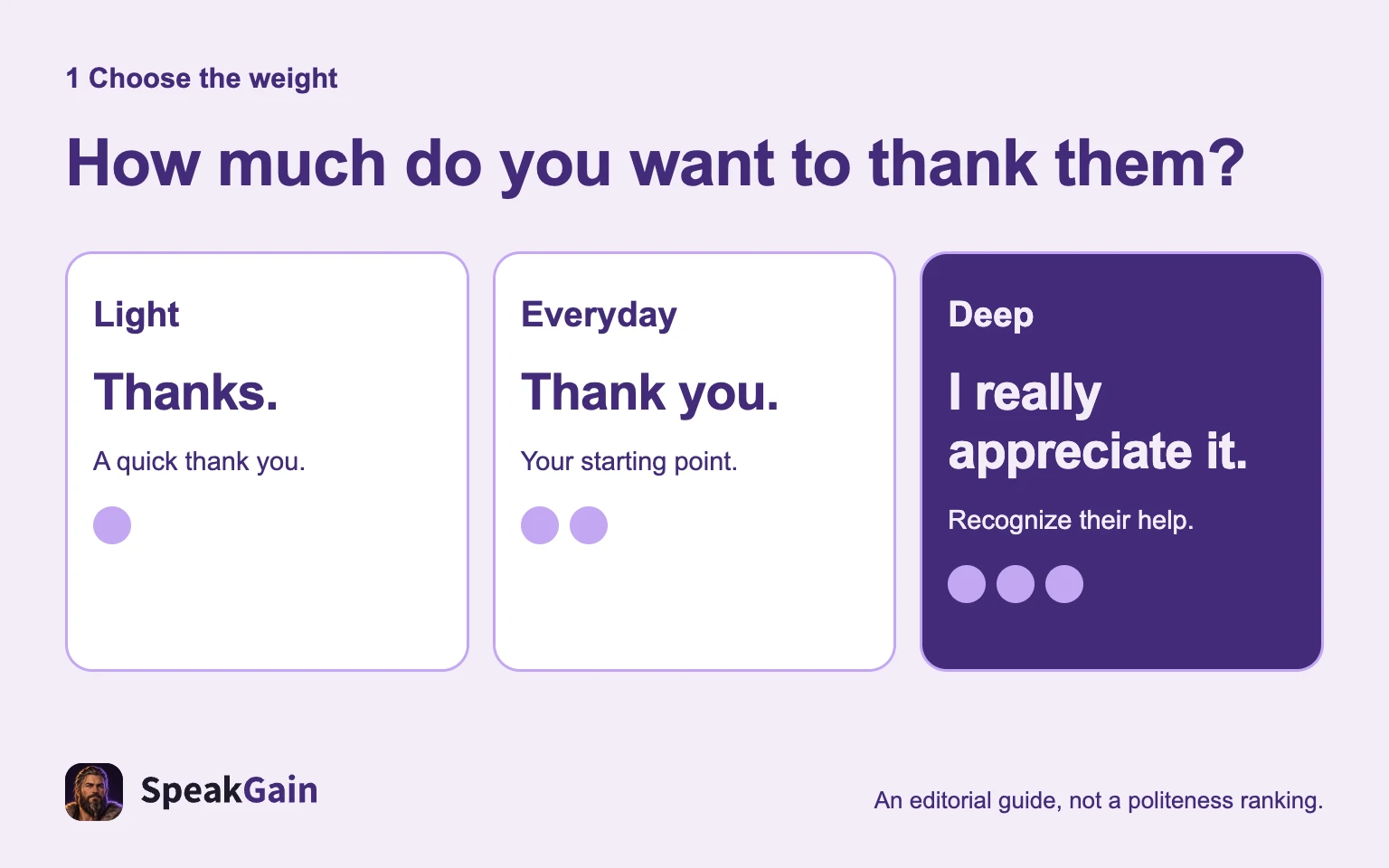
These three levels are our learning guide, not a scale defined by dictionaries. A stronger expression is not automatically more polite in every situation. Tone, context and the reason you give also matter.
| Weight | English | Meaning and register |
|---|---|---|
| Light | Thanks. | A brief, informal thank you to a friend or familiar colleague |
| Light | Cheers. | Informal British thanks; learn to recognize it first |
| Everyday | Thank you. | A standard starting point at work or in a shop |
| Everyday, emphatic | Thank you so much. | Adds emphasis to your thanks |
| Deep | I really appreciate it. | Recognizes the help; it refers to what was done |
| Deep, exceptional | I can’t thank you enough. | Expresses very strong gratitude for substantial support |
Cambridge labels thanks informal, and its cheers entry labels the thanking sense UK informal. Cheers can also be a toast or a farewell. We do not claim it has the same frequency throughout the English-speaking world. Kaplan’s material explains I can’t thank you enough as strong gratitude. Saving it for significant help is our practice advice, not a grammatical prohibition at the checkout.
A friend can hear I really appreciate it without the conversation becoming a formal business ceremony. Conversely, Thank you for your help can be considerate without difficult vocabulary. If both people already know the reason—someone hands you a drink, for example—Thank you alone is enough. A longer conversation or email may benefit more from naming what helped.
2. Add what you are thankful for
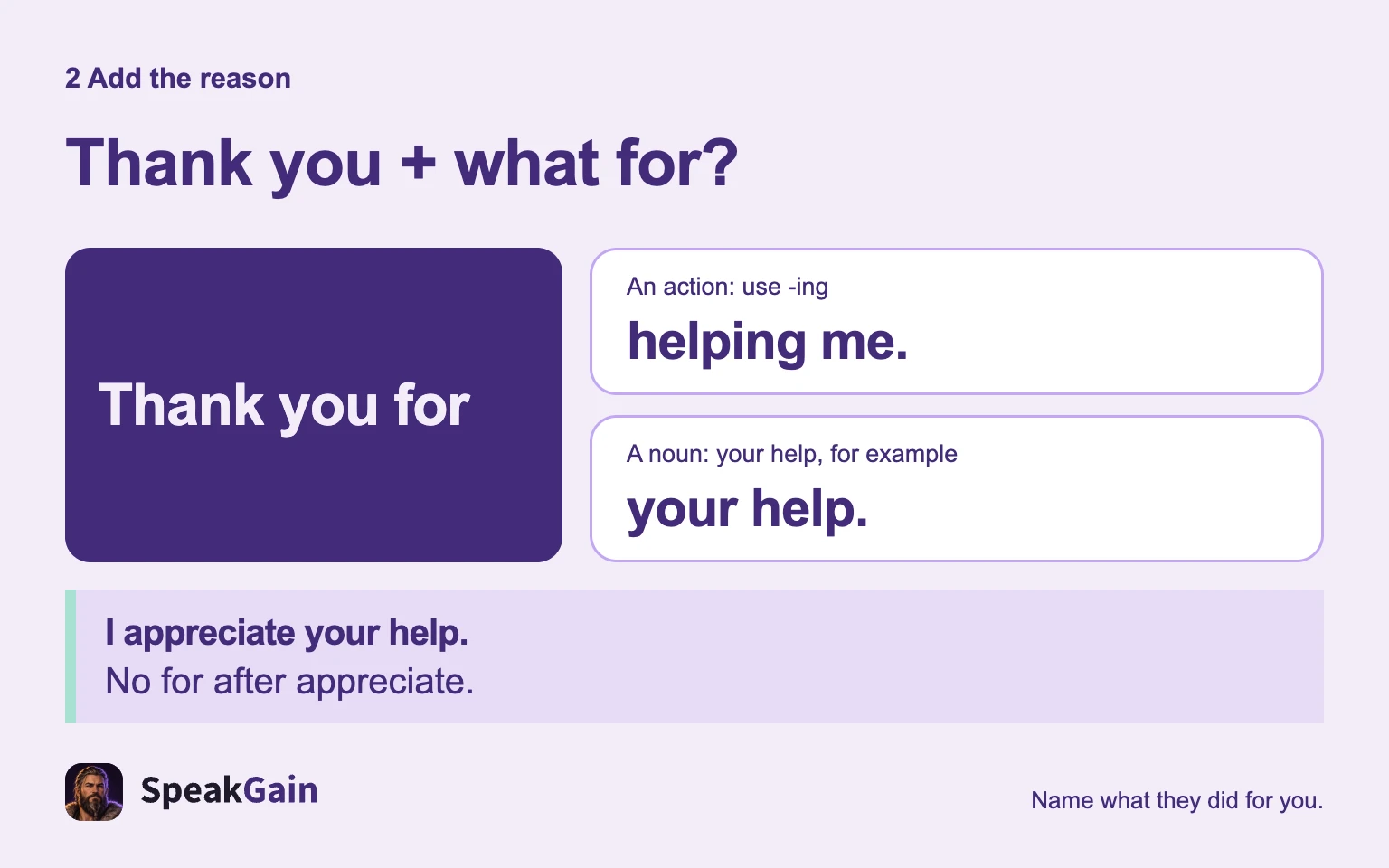
The pattern is Thank you for + an action in -ing, or a noun phrase. Think about what the person actually did rather than making the opening more elaborate.
| Pattern | Example | What it names |
|---|---|---|
| for + -ing | Thank you for helping me. | Their action of helping |
| for + -ing | Thank you for letting me know. | Information they gave you |
| for your + noun | Thank you for your help. | The help you received |
| for your + noun | Thank you for your quick reply. | A reply that really was quick |
| appreciate + object | I appreciate your help. | The help, directly after appreciate |
Cambridge’s grammar guide shows Thank you for followed by an -ing form. Say Thank you for helping me, rather than Thank you for help me. You can make it specific: Thank you for helping me with the report, or Thank you for your help with the report. Begin with one pattern and substitute a real task.
For this thanking pattern, make the act or help the object of appreciate: I appreciate your help, not I appreciate for your help. We do not recommend I appreciate you as a universal replacement for thanking someone for an action. It is not ungrammatical in every sense: Cambridge also records recognizing the value of a person or thing. Naming your help or your time makes the target clear. In I really appreciate it, it can refer to help both speakers already understand.
3. Adapt the information to the situation
| Situation | English | How to choose |
|---|---|---|
| A familiar colleague checks something | Thanks for checking this. | Casual; this must be clear to both of you |
| Help with work | Thank you for your help with the report. | Standard; names the task |
| Significant support | I really appreciate your support. | Expresses deeper gratitude |
| Receiving a purchase | Thank you. | A brief, standard thank you |
| A shop assistant searches for you | Thank you for your help. | Names the extra help |
| A friend listens | Thanks for listening. | Casual and specific |
| A friend gives major help | I can’t thank you enough. | Use when you mean strong gratitude |
| A prompt email reply | Thank you for your quick reply. | Standard; only call it quick when it was |
| A short chat update | Thanks for letting me know. | Casual acknowledgment |
Do not decide that Thanks is always rude to a manager, or that every colleague requires casual language. Relationships and workplace habits vary. When unsure, we recommend Thank you for your help. At a shop, Thank you can finish an ordinary handover; add the reason when an assistant searches for a size. Keep ordering and thanking as separate practice moves; see ordering in English.
In email, follow thanks with the next useful information: Thank you for your quick reply. I’ll check the document this afternoon. The second sentence moves the task forward; it does not intensify the thanks. Do not claim you already checked something if you have not. Thank you in advance concerns a future request, not completed help. Our recommendation is to learn thanks for completed actions first and state any request separately, without assuming consent.
4. Receive thanks with a reply
| Reply | Meaning and register |
|---|---|
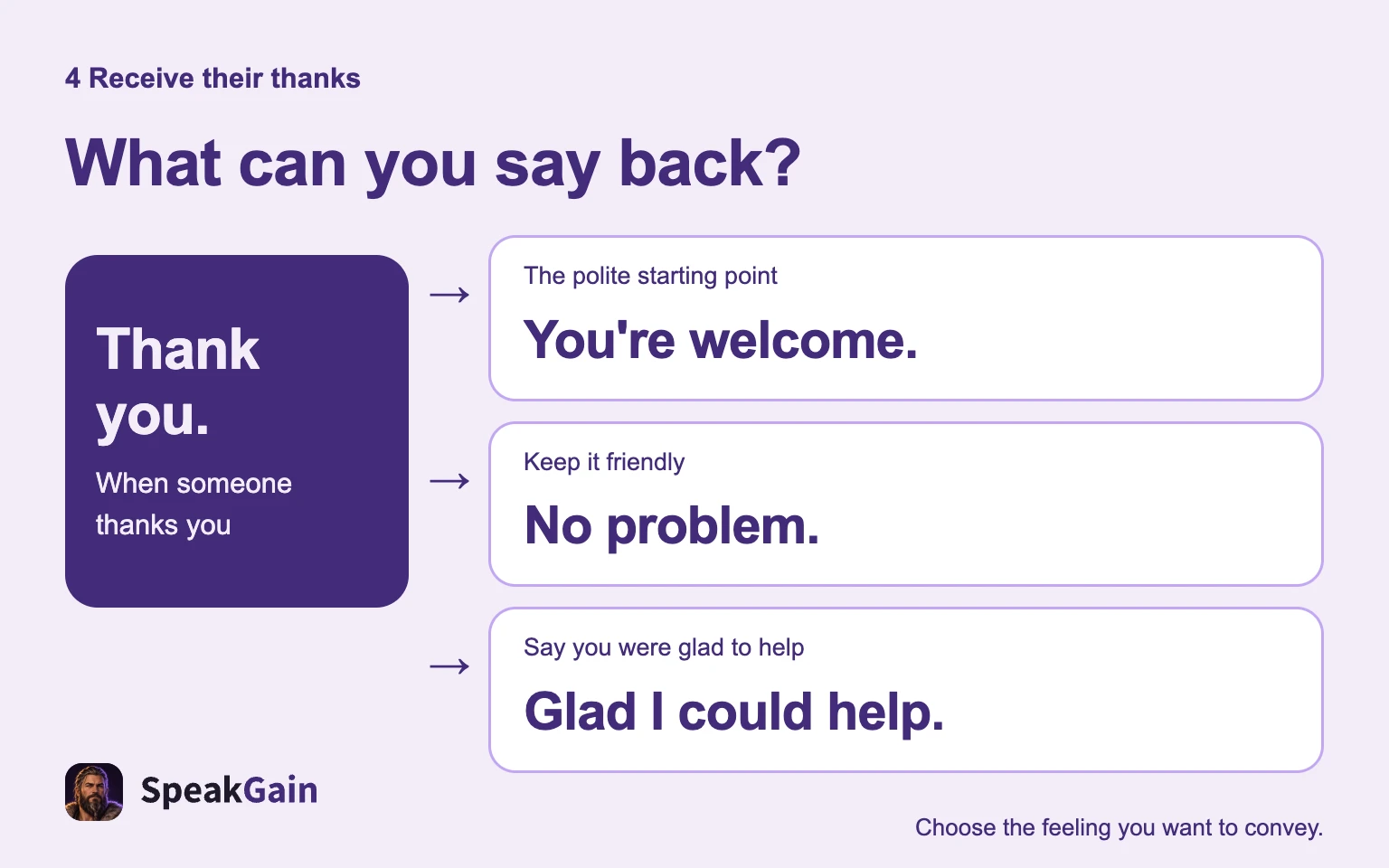
| You’re welcome. | A polite, basic acknowledgment |
| No problem. | Informal and friendly; accepts the thanks lightly |
| No worries. | Friendly reassurance that they need not worry |
| My pleasure. | A polite reply expressing that you were happy to do it |
| Anytime. | Casual; suggests willingness to help again |
| Glad I could help. | Says you are pleased you were helpful |
Cambridge describes You’re welcome as polite and No problem as informal and friendly. Do not assume problem always labels the favor a burden. No worries can answer thanks as well as other situations; My pleasure is a polite response. These entries do not establish that every workplace prefers the same wording.
UsingEnglish’s teaching material includes Anytime. We recommend it with someone you are willing to help again. Glad I could help is a shortened I’m glad I could help. It adds your feeling, not another rank of politeness. Accepting thanks once is enough; you do not have to repeatedly deny that your help mattered. Avoid an automatic You too when handing something over—it is clearer to say You’re welcome unless reciprocal thanks actually fit.
5. Separate thanks from an apology
In Japanese, sumimasen can accompany gratitude when someone picks up an item or gives directions. If your intention is thanks, choose Thank you instead of translating it mechanically as Sorry. If you were late, you can distinguish the two: I’m sorry I’m late. Thank you for waiting. This does not mean gratitude replaces every necessary apology. See apologizing in English.
| Mixed pattern | Return to | Check |
|---|---|---|
| Thank you for help me. | Thank you for helping me. | An action after for needs -ing here |
| I appreciate for your help. | I appreciate your help. | Put the object directly after appreciate |
| Sorry alone when you mean thanks | Thank you for your help. | Are you thanking or apologizing? |
6. Follow Misaki through three situations
Misaki is a fictional learner, not a customer testimonial. At work, a colleague says, I checked the numbers in your report. Misaki says, Thank you for your help. The colleague answers, No problem. Glad I could help. She finishes with I’ll send it this afternoon. Both know the report is the topic; after hearing the reply, she can move to the next action.
At a shop, an assistant finds the requested size: Here it is. This is the size you asked for. Misaki says the same Thank you for your help. The assistant answers My pleasure. She recognizes a response to her thanks, rather than a new question. An ordinary handover could simply receive Thank you.
In email she receives I’ve attached the updated document. It arrived promptly, so she writes Thank you for your quick reply. I’ll check the document this afternoon. Reading her email aloud is speaking practice, not a claim that email arrives as audio.
Save only the three sentences you need
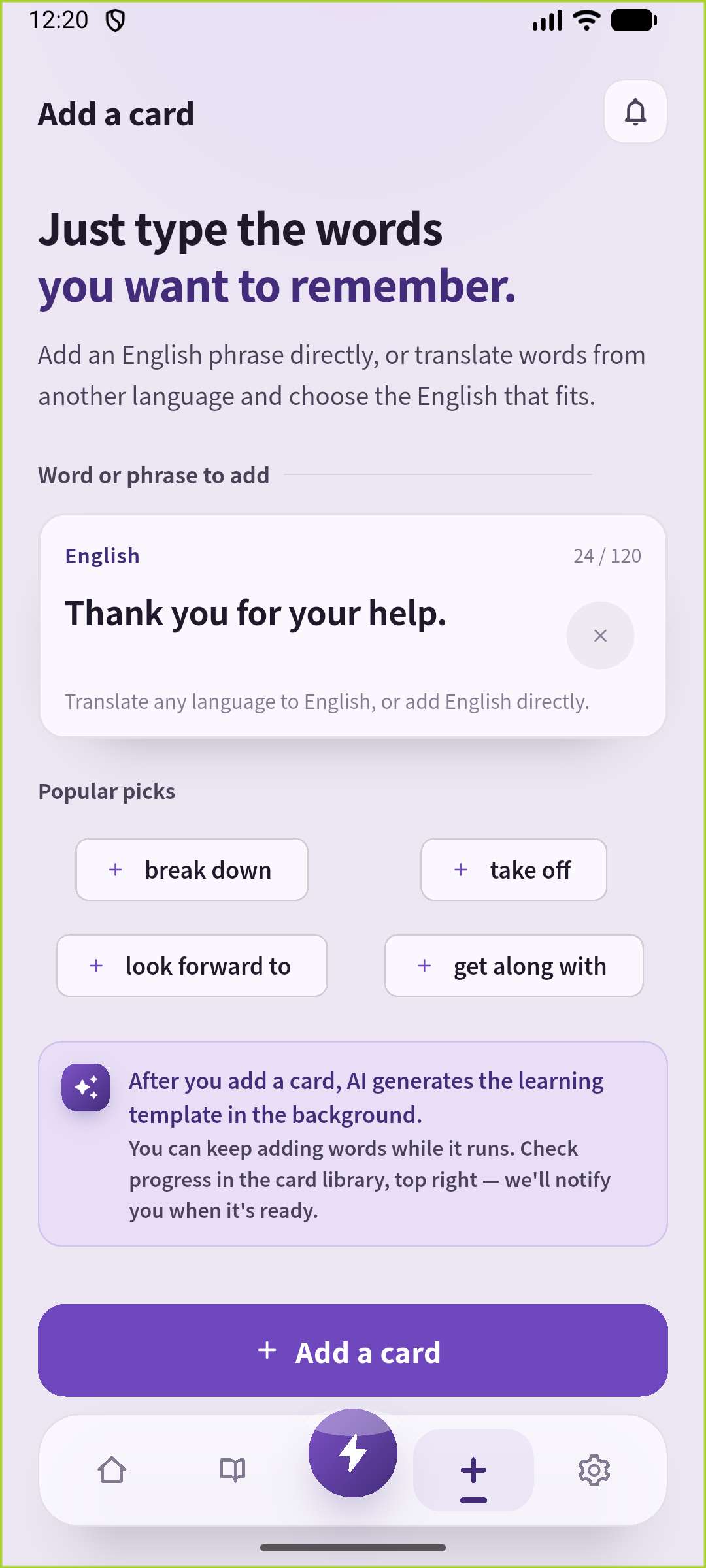
Enter a practice sentence in SpeakGain’s Add screen and create a card. For this practice we saved one thank you, one colleague’s reply and one email sentence. Choose tomorrow’s likely sentence rather than saving every row in the tables. See what SpeakGain is.
Listen, pause and say your own line
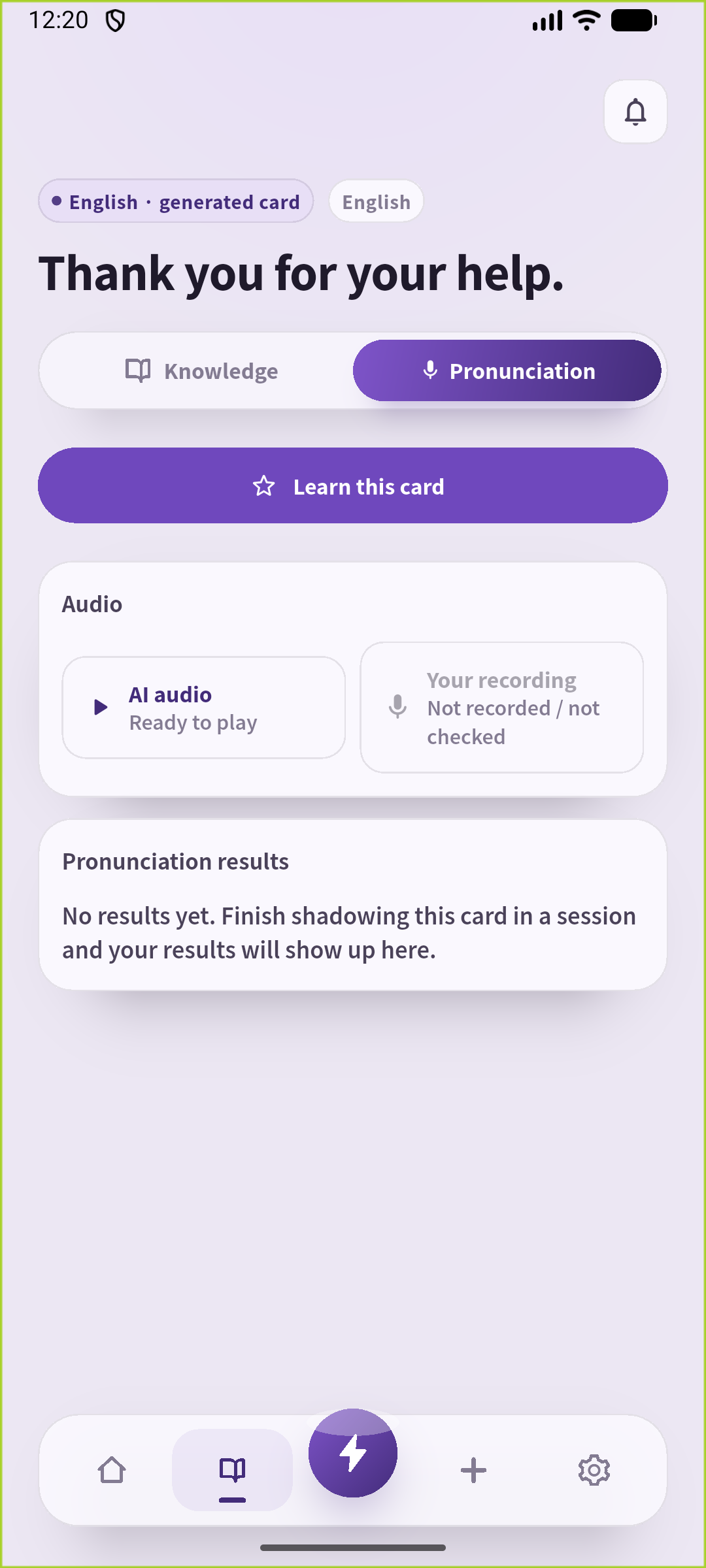
These three recordings use SpeakGain’s Deep-voiced Viking AI voice. Both sides use the same voice. They play saved sentences; the app is not automatically continuing a role-play conversation. Imagine the help, say your thanks, then compare it with the first recording. After the second, switch roles and answer You’re welcome. For the third, imagine receiving a prompt reply.
Misaki: Thank you for your help.
Thanks for the help you received.
Colleague: No problem. Glad I could help.
A friendly reply and pleasure at helping.
Misaki: Thank you for your quick reply.
Thanks for a prompt email reply.
Recall the sentence without looking
Hide the English and think only: “My colleague checked the report,” then “The assistant found my size,” then “They replied quickly.” Say a line, check only where you got stuck, and hide it again. The original 2008 Karpicke and Roediger study found benefits for recall a week later when university students continued retrieval after a first correct answer in a foreign-language word-pair task. It did not test thanking conversations or SpeakGain. We use it as a basis for our editorial practice suggestion, not a product efficacy claim. Tomorrow, change just the reason; see studying English for a broader routine.
Common questions
Emphasis, shops, email and replies
Thank you very much or Thank you so much?
Both emphasize thanks. We use so much as the first practice option; neither establishes an absolute politeness hierarchy. Thank you very much for your help can also suit a considered workplace message.
Is Thanks forbidden in a shop?
No universal ban follows from its informal label. When unsure of the relationship, Thank you is our recommendation.
Must I use appreciate in email?
No. Thank you for your quick reply can clearly name the reason. Accurate information matters more than a harder word.
Does No problem mean I caused trouble?
Not by itself. It has an established friendly reply-to-thanks use. Listen to the surrounding conversation too.
For your next thank you, choose its weight and one real reason. Accept a reply, then continue the conversation. Practise one sentence from a situation without looking at the English.
For thanks to a cook or someone who paid, English meal phrases and the meaning of itadakimasu helps you choose by timing and by whom you are thanking.
Related practice
For a colleague in the hallway or at the end of work, our guide to otsukaresama in English helps you choose between a greeting, a goodbye and thanks.
Sources
- Cambridge Dictionary — thank you
- Cambridge Dictionary — cheers
- Cambridge Dictionary — appreciate
- Cambridge English Grammar Today — Please and thank you
- Cambridge Dictionary — you’re welcome
- Cambridge Dictionary — no problem
- Cambridge Dictionary — no worries
- Cambridge Learner’s Dictionary — pleasure
- UsingEnglish — Thanking in English
- Kaplan International — Other ways to say thank you
- Karpicke & Roediger (2008) — The Critical Importance of Retrieval for Learning
Practice thanking someone for praise and giving a compliment yourself with the guide to compliments in English.
For the Japanese phrase yoroshiku onegaishimasu, choose an English line by what you mean: a greeting, a request, future teamwork or thanks.
Before thanking someone for help, practise asking with English request patterns, including a reason and an easy out.
To practise receiving good wishes, how to say congratulations in English includes a short exchange ending with Thank you.