
Compliments in English: choose what to praise, add a detail, accept praise
Published
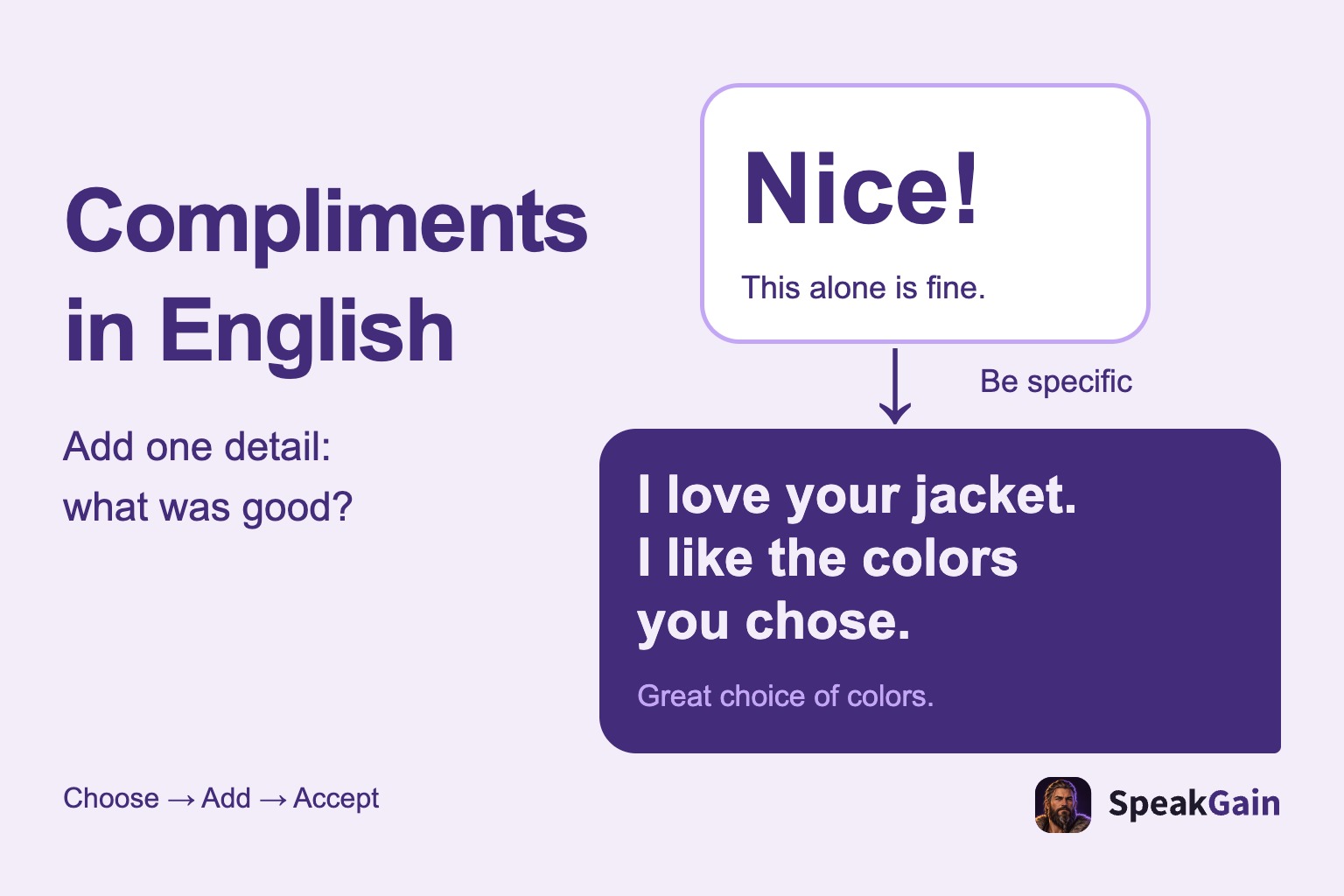
To give a compliment in English, start with “I love your jacket” for something someone chose, “You did a great job on the presentation” for work, or “That was really helpful because the examples were clear” for useful help. After Nice or Great, add one thing you actually liked. When someone compliments you, “Thank you” is a good first response.
Our editorial recommendation is to begin with I love your…, You did a great job on…, and Thank you. You need a usable exchange more than a list of 80 adjectives. Choose what you are praising and consider the relationship. When you are unsure at work, start with the work, a choice or the help someone gave you.
For a baby, a small item or a thoughtful gesture, choose between cute, adorable and lovely by what you want to praise.
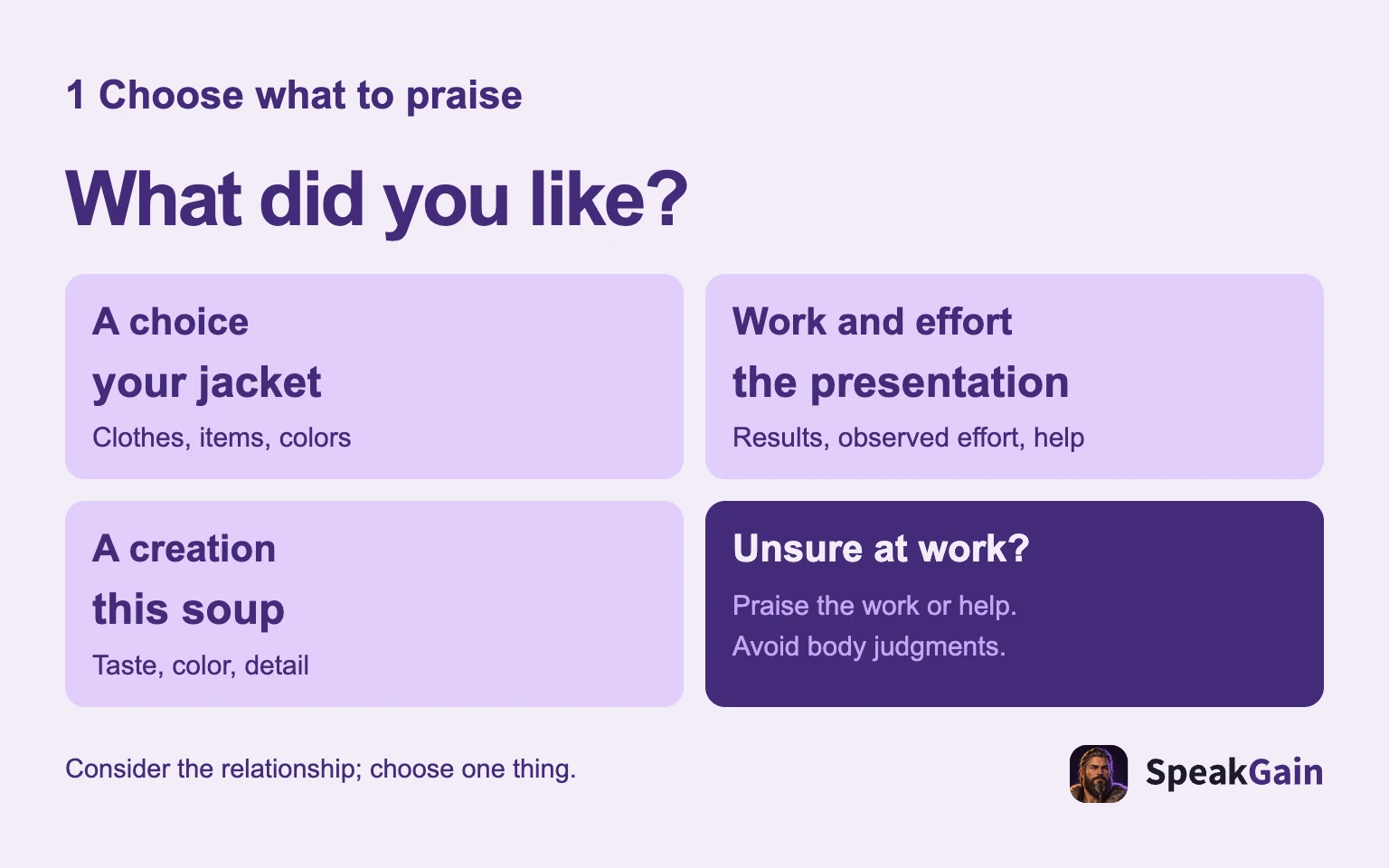
1. Choose what you want to praise
Was it a jacket they selected, a clear presentation, or soup they cooked? Choose that object first: your jacket, the presentation, this soup. This gives you something concrete to say instead of searching for a stronger word than “great.”
| Object | English | What you are conveying | Starting context |
|---|---|---|---|
| Clothes or possessions | I love your jacket. | You really like their choice. | Warm, conversational; consider the relationship |
| A choice | I like the colors you chose. | You noticed the colors. | Friends, design or a creative task |
| Work or a result | You did a great job on the presentation. | The presentation went well. | A colleague; add the useful detail |
| An explanation | Your explanation was very clear. | You understood because it was clear. | A manager or teacher, too |
| Food | This soup is delicious. | You enjoyed what you tasted. | An ordinary friendly compliment |
| A creation | I love the detail in this drawing. | You appreciate a particular feature. | Someone’s artwork |
| Appearance | You look great. | They look good to you. | An appropriate personal setting; not a workplace default |
In “I love your jacket,” love expresses how much you like the jacket; it is not the same message as “I love you.” You can substitute bag or shoes. That does not mean a remark about a possession is always welcome. Think about what the other person has chosen to discuss.
If you are describing the act of complimenting, use compliment someone on something: “I complimented her on her presentation.” Cambridge’s explanation of praising illustrates the on pattern. Praise is another useful verb: “The teacher praised his effort.” To speak to the person, simply say what you liked; you do not need to announce “I compliment you.”
2. Add one specific detail
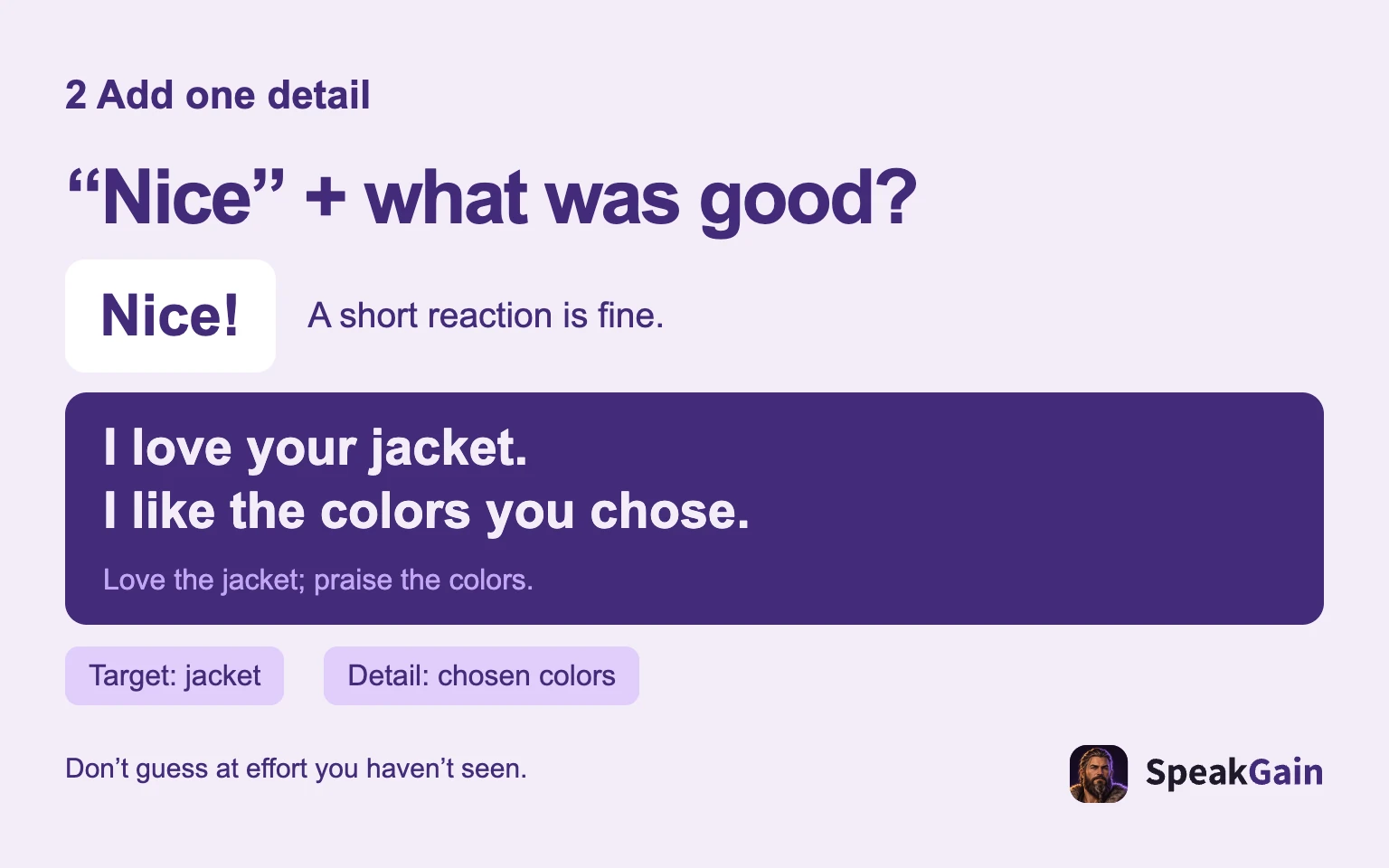
“Nice!” can be enough for a quick shared reaction. If you want to say more, add an observation: “Great presentation. The chart made the main point clear.” The useful addition is the chart’s effect, not another superlative.
| Pattern | Example | Specific point |
|---|---|---|
| I love your + object | I love your jacket. I like the colors you chose. | The item and its colors |
| You did a great job on + task | You did a great job on the presentation. The chart made the main point clear. | The presentation and the clear chart |
| That was really helpful because + reason | That was really helpful because the examples were clear. | What helped you understand |
After your, use a noun: your explanation, not your explain. After because, give the reason as a clause: the examples were clear. If that feels long, say two short sentences: “That was helpful. Your examples were clear.”
Specific does not mean speculative. You may have seen a clear chart without knowing whether someone worked all night on it. Describe what you observed instead of inventing effort. We recommend one truthful detail, not more words for their own sake.
3. Choose the strength: nice, great or amazing
Use nice for a positive reaction, great for stronger approval, and amazing when you feel impressed or surprised. This is our practice guide, not a universal rating scale. Tone, context and relationships also affect the meaning.
| Feeling | Example | Starting meaning |
|---|---|---|
| Positive | Nice jacket! | I like it. |
| Strong approval | Great presentation! | That went very well. |
| Impressed or surprised | That was amazing! | That was remarkably good. |
An ordinary clear explanation does not need amazing every time. “Your explanation was clear” can communicate more than several intense adjectives. For informal options such as awesome, see everyday English slang; first learn to connect your approval to the right thing.
4. Adjust for the person
Politeness does not depend on a difficult adjective. Think about whether you are in a position to evaluate someone and whether a personal comment fits the relationship. These are practical starting points, not bans that apply to every workplace.
| Person | Example | How to approach it |
|---|---|---|
| Colleague | You did a great job on the presentation. | Warm, ordinary approval; add what was clear |
| Manager | Your explanation helped me understand the priorities. | Describe the value you received |
| Teacher | Your examples made the difference clear. | Name the part that helped you learn |
| Friend | I love your jacket. I like the colors you chose. | Praise a choice they have shown you |
| Child | You tried a different way when it got tricky. | Recognize an approach you actually observed |
“Good job!” is not automatically rude to a manager. Still, if you do not know the relationship well, we recommend saying what helped you instead of sounding like you are grading their performance. The same approach works with a teacher: say which examples clarified a difference rather than trying to rank them as the best teacher in the world.
When unsure at work: praise the work, a choice or useful help.
Acas’s workplace guidance includes sexual remarks about someone’s body, clothing or appearance among examples of unwanted sexual behavior. It also explains that the effect can matter even without an intention to cause it. This is UK employment guidance; it does not establish one worldwide legal rule or mean every comment about clothes is harassment.
Our practical recommendation is to avoid judging bodies or body shape at work and to choose the work or help as your starting point. Calling the object “clothing” does not make a sexual remark appropriate. With a friend who shows you a new jacket, you can respond to that choice. If someone seems uncomfortable or changes the subject, take that response seriously.
5. With children, notice effort and the process
We recommend naming a strategy you actually saw rather than relying only on a label about ability. You can say “Good job” and then add what the child did.
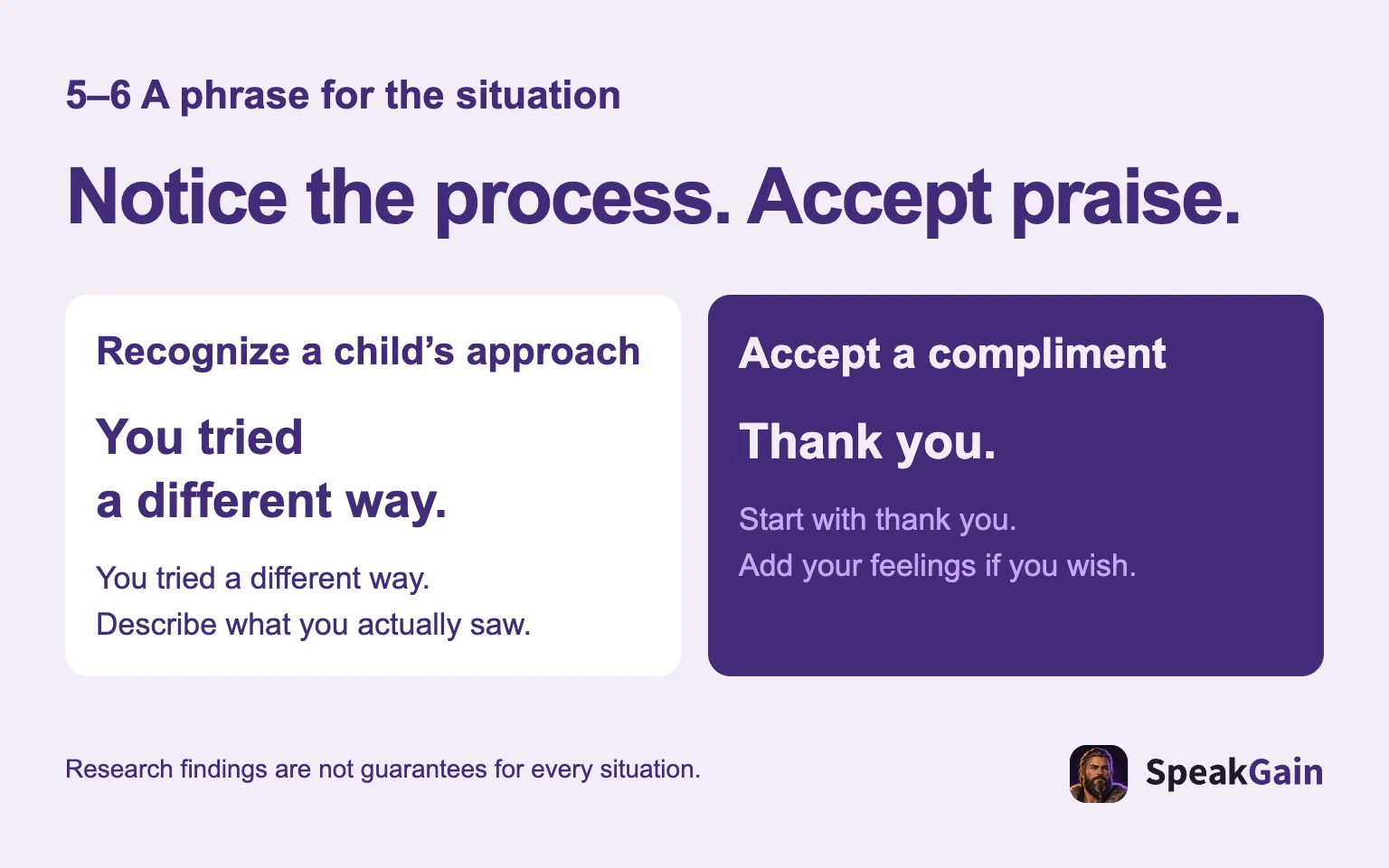
A different approach: You tried a different way when it got tricky.
Careful checking: You checked your work carefully.
Mueller and Dweck’s 1998 paper reports six experiments with fifth graders. After failure, children praised for intelligence showed less persistence, enjoyment and task performance than children praised for effort, among the reported differences. This does not mean saying “You’re smart” once inevitably harms a child, or that effort praise guarantees better grades.
The study did not test every age, home situation or English-learning outcome. Our examples are editorial applications, not scripts proven effective by that paper. Describe a real attempt, strategy or check; do not invent effort. A child who is upset may also need you to listen rather than immediately replacing that feeling with “Great!”
6. Accept a welcome compliment
Start with thanks, then add how you feel if you wish. If your first reaction is modest denial, “No, it wasn’t good” can also sound like you are rejecting the other person’s assessment. You do not have to abandon modesty; you can acknowledge the kind remark first.
| Response | What it conveys | When to start with it |
|---|---|---|
| Thank you. | You acknowledge the compliment. | An ordinary, polite response |
| Thanks, I’m glad you like it. | You are happy they enjoyed it. | Clothes, food or something you made |
| That means a lot. | Their words matter to you. | A particularly meaningful compliment |
You do not need to return a compliment immediately. If it was a team effort, try “Thank you. The team helped a lot.” Receive the praise, then credit others truthfully. For more about the thank-you itself, see saying thank you in English. These responses are for praise you want to receive; you are not obliged to thank someone for an unwanted comment about your body.
7. Practice Misaki’s day: say it and hear the response
Misaki is a fictional learner, not a customer testimonial. She hears a colleague’s presentation, attends a lesson, then meets a friend. The goal is to choose an object, add a detail and switch into the receiving role.
Colleague: What did you think of the presentation?
Misaki: You did a great job on the presentation. The chart made the main point clear.
Colleague: Thank you. I worked hard on that chart.
She praised what she saw; only the reply tells her about the effort. Next, the teacher asks whether the difference makes sense:
Teacher: Does the difference make sense now?
Misaki: Yes. That was really helpful because the examples were clear.
That refers to the explanation they have just shared. If she is still confused, she should ask again rather than hide it with a compliment. Later, her friend shows a new jacket, then compliments the soup Misaki made:
Friend: I bought this jacket yesterday.
Misaki: I love your jacket. I like the colors you chose.
Friend: Thanks! And this soup is delicious.
Misaki: Thanks, I’m glad you like it.
Save three sentences you expect to use
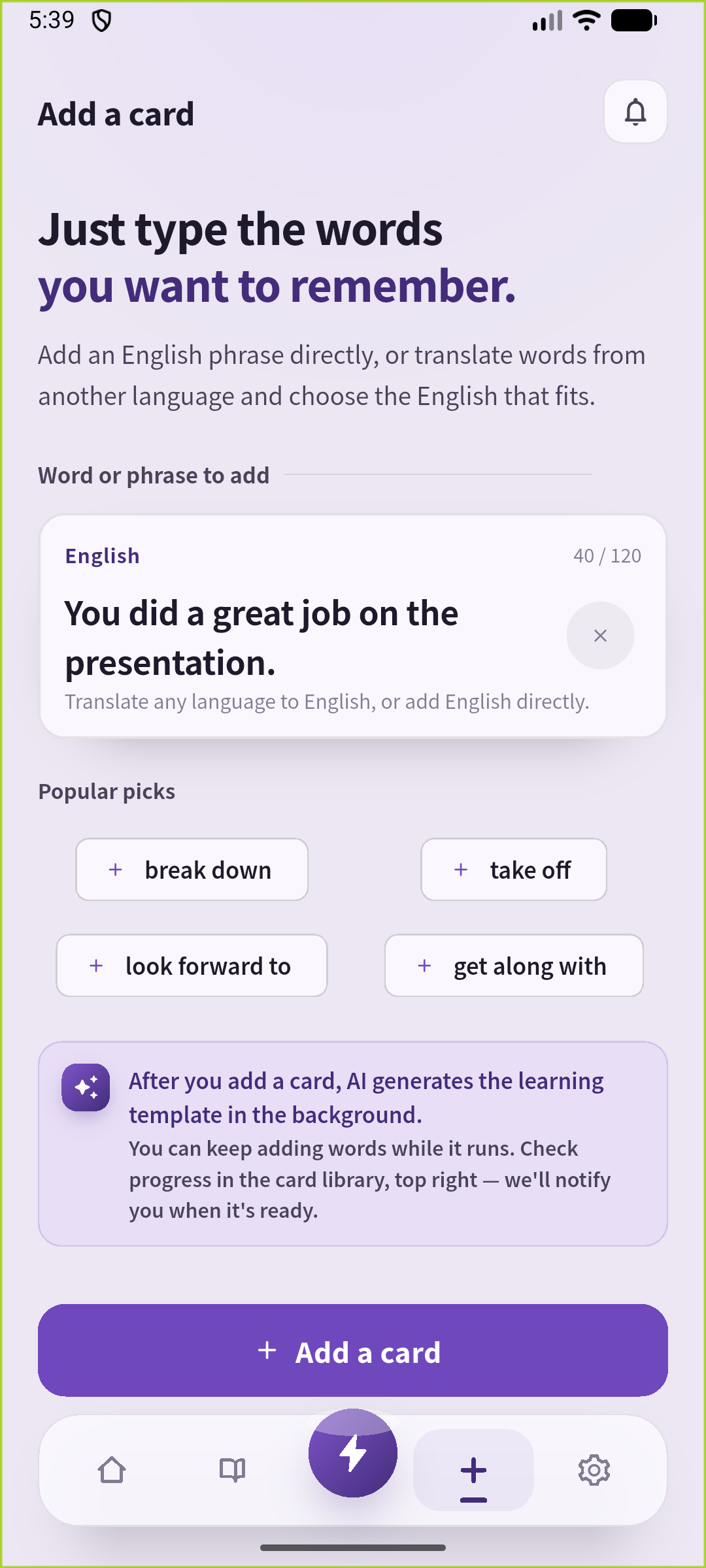
In SpeakGain’s Add screen, enter an English sentence to make a card. Here we saved the presentation compliment, the reason the explanation helped, and the accepting response. If your next situation is only a friend’s clothes, you can choose that sentence instead. Learn the basic workflow in what SpeakGain does.
Listen, pause, then say your line
These three clips were generated in SpeakGain with the AI voice “Deep-voiced Viking.” They read saved sentences in one voice; they are not recordings of the fictional people or an automatically continuing AI conversation. Picture the situation, try your line, then listen.
You did a great job on the presentation.
You praise your colleague’s presentation.
That was really helpful because the examples were clear.
You explain why the teacher’s examples helped.
Thanks, I'm glad you like it.
You accept praise for something you made.
After the first clip, add “The chart made the main point clear” yourself. For the second, listen for the reason after because. For the third, imagine receiving praise for your soup. Decide whether you are giving or receiving praise each time.
Hide the English and speak from the situation
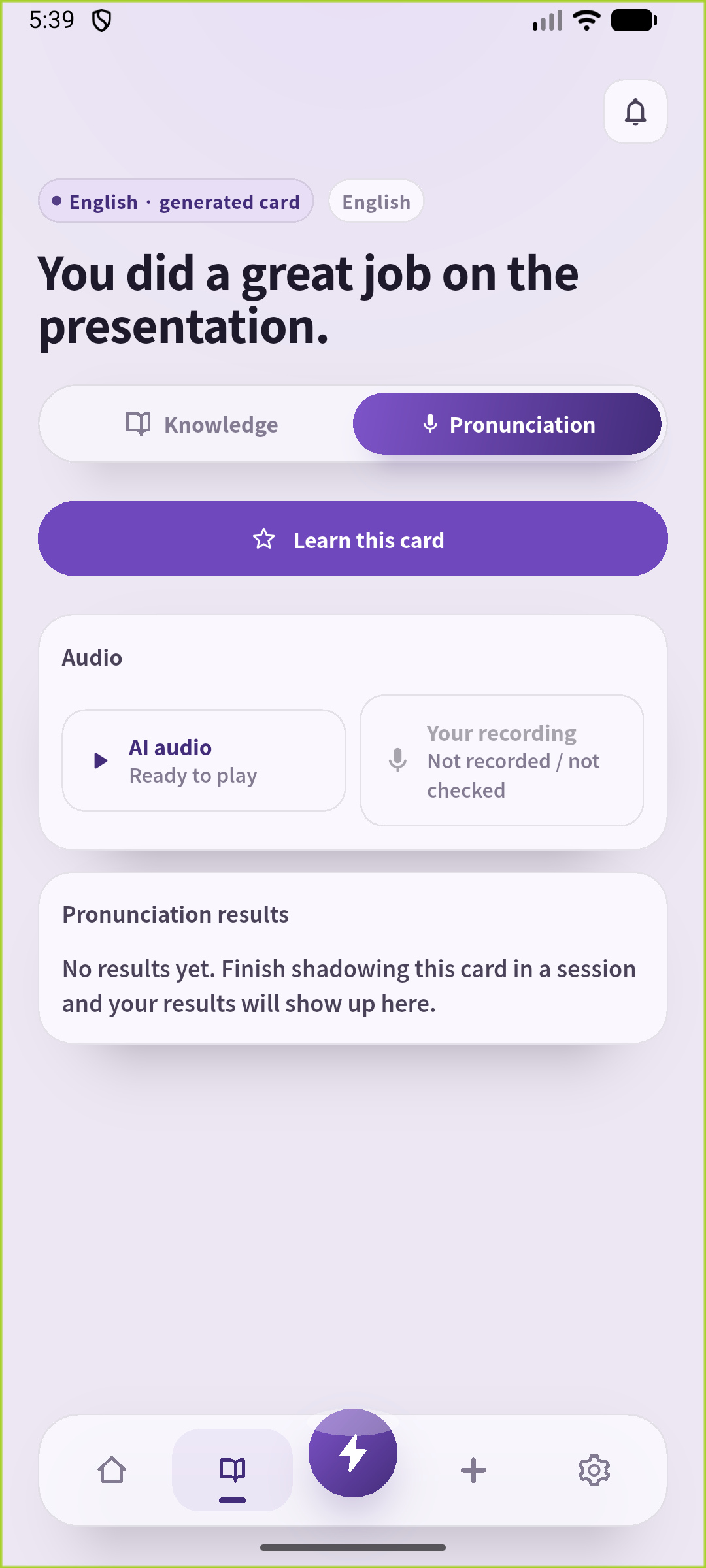
Think “my colleague’s chart was clear,” then speak without reading. If the longer pattern will not come, “Your chart was clear” is a useful start. Try the teacher’s examples and the soup next. Check only the line you need, then hide it again. This is our practice suggestion, not a claim that SpeakGain has experimentally proven a conversation benefit. See how to study English for a daily practice routine, English backchannel responses for listening responses, and English greetings for starting an exchange.
Four common questions
Is Nice! alone rude?
Not automatically. A shared quick reaction may need nothing else. Add an observation when you want to give fuller feedback.
Must I use formal vocabulary with a manager?
No. “Your explanation was very clear” can be useful and respectful. Consider the relationship instead of replacing every ordinary word with a difficult one.
Must I never tell a child they are smart?
The cited experiments do not show that one remark inevitably causes harm. We recommend also recognizing observed strategies and effort rather than repeating ability labels alone.
Must I compliment someone back?
No. Thank you is enough. Add a genuine compliment when you have one, not as an automatic debt.
Choose one person and something you actually appreciated today. Say what it was, add one detail, and accept a welcome compliment with Thank you.
Sources
When the good news calls for celebration, how to say congratulations in English separates Happy from Congratulations and adds a line about the person.
For a friend facing an exam or presentation, choose an encouragement line by timing—and a reply for your own effort—in how to say ganbatte in English.
For replies to plans, photos and news, positive reactions in English explains how to respond to something you hear or see alongside your practice giving compliments.