
English slang: what to understand and what to use
Published
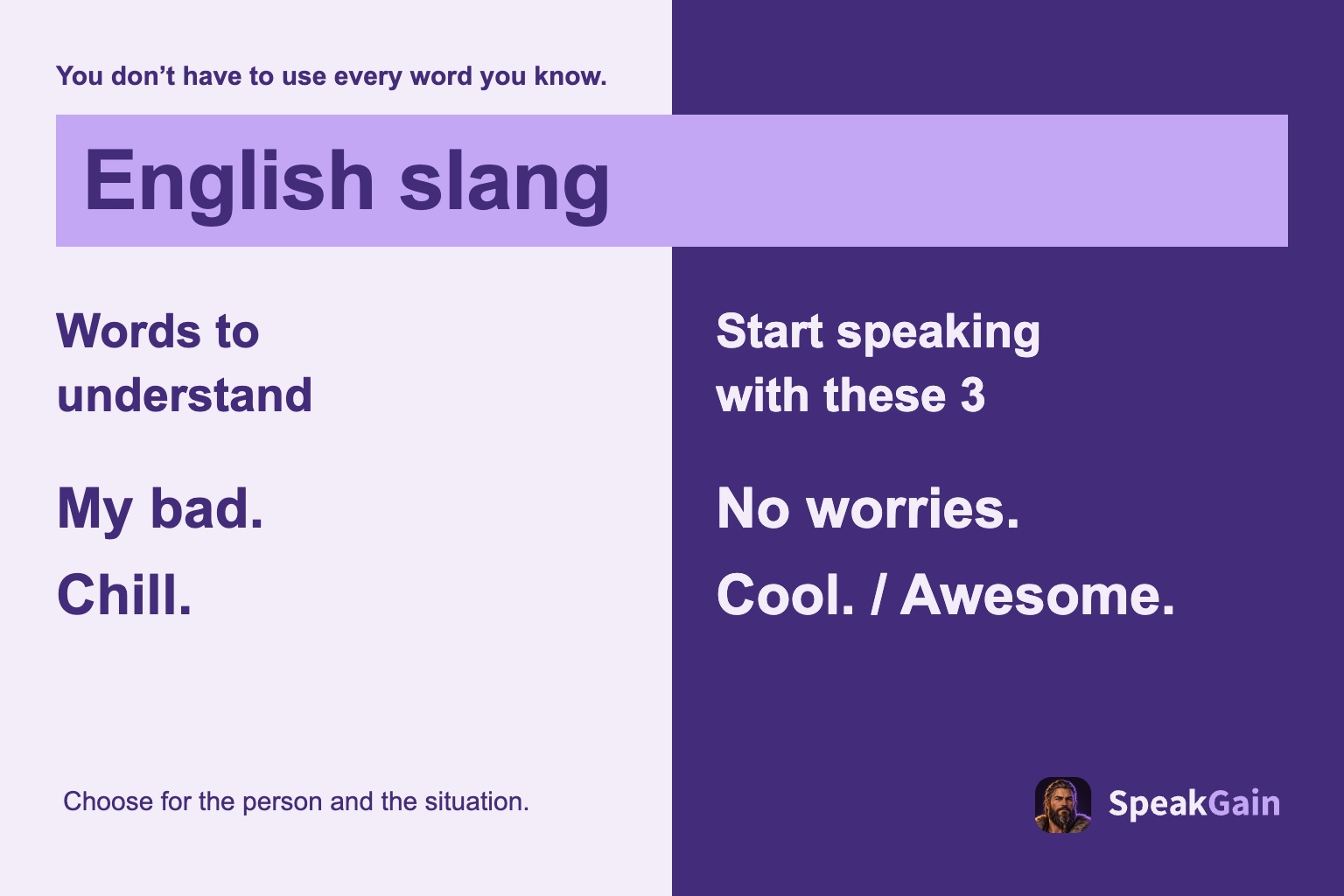
English slang is very informal language used within particular groups. Learn to understand “I’m down for that,” “My bad” and “Chill” before trying to use them. For your own first replies, we recommend “No worries,” “Cool” and “Awesome” in friendly, low-stakes exchanges. No slang expression is suitable for every listener. Use ordinary English for a serious apology or a formal work message.
Our editorial position: understand more than you actively use. Recognizing a character’s words does not oblige you to repeat them to your manager. Knowing a casual expression and choosing a different reply is a useful skill.
For a baby, a small item or a thoughtful gesture, choose between cute, adorable and lovely by what you want to praise.
1. Separate understanding from speaking
Before collecting a new expression, record who said it to whom and what happened just before. A joke between friends, a message from a colleague and an argument in a show are different situations, even when the words are identical.
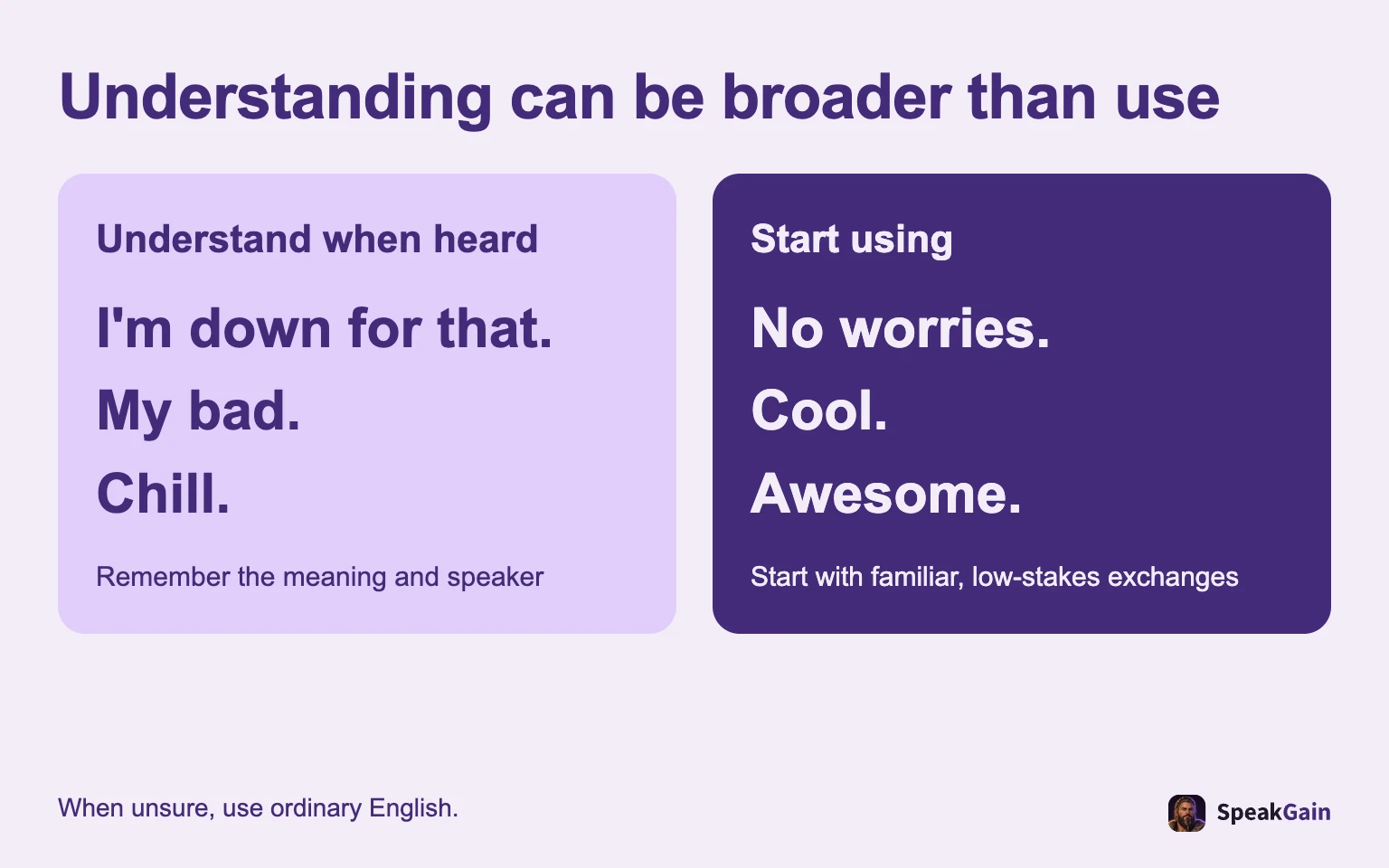
Cambridge defines slang as very informal language used by particular groups. Its grammar guide notes that use outside the group may offend and that slang changes quickly. This article also covers everyday informal expressions and internet abbreviations that learners search for as “slang”; not every entry below is classified as slang in a dictionary.
Ask three questions before using a phrase: are you familiar with the listener, is the exchange casual, and could ordinary English communicate the same thing? If you are unsure, understand the phrase and answer “That sounds good.” Our scene recommendations are editorial practice choices, not dictionary permission for every workplace or lesson.
2. Six spoken expressions to recognize
The translations below describe these particular uses. Cool also concerns temperature; chill can mean to cool something. Do not apply one gloss to every sentence.
| Expression and meaning | Tone | Friends | Workplace chat | Online English lesson |
|---|---|---|---|---|
| I’m down for that: willing to join | Casual participation | Recognize it after a clear invitation | Prefer “That works for me” for a work agreement | Explain what you would join; ask about usage |
| My bad: admitting your mistake | Informal, brief apology | Understand it for a small error | For a serious mistake, apologize and explain the fix | Practice a minor-mistake role-play, not a major apology |
| No worries: reassurance or a reply to thanks | Friendly | A useful reply to a light apology or thanks | With a familiar colleague over a small matter; use standard wording with clients | Try it in a light thanks/apology exchange |
| Cool: positive reaction | Informal approval | React to a plan or something you like | Fine for casual talk; record an actual approval clearly | Try it in hobby or plan discussions |
| Awesome: very good | Strong informal enthusiasm | For a genuinely happy proposal or news | React to happy news; make formal evaluations specific | Try it when a suggestion sounds fun |
| chill / chill out: relax or become calm | Informal; an order needs care | Recognize relaxing at home; be careful commanding a friend | Avoid telling a distressed colleague “Chill” | Ask about the different meanings; understand first |
No worries, my bad, chill and the positive senses of cool/awesome are supported by Cambridge. Our recommendations about seriousness and relationships are editorial judgments.
Keep down attached to its context
BBC Learning English teaches “down for something” as interest in participating. Bare “I’m down” can also describe feeling sad. Was the previous line “Want to join?” or “What’s wrong?” Save the exchange, not just the word down. If speaking feels uncertain, “I’d like to join” is enough.
“My bad” after picking up the wrong pen is different from missing a deadline. We recommend “I’m sorry. I’ll send the correct file” when you need to show a repair. Likewise, understanding “I just want to chill at home” does not make “Chill” a considerate response to someone’s distress.
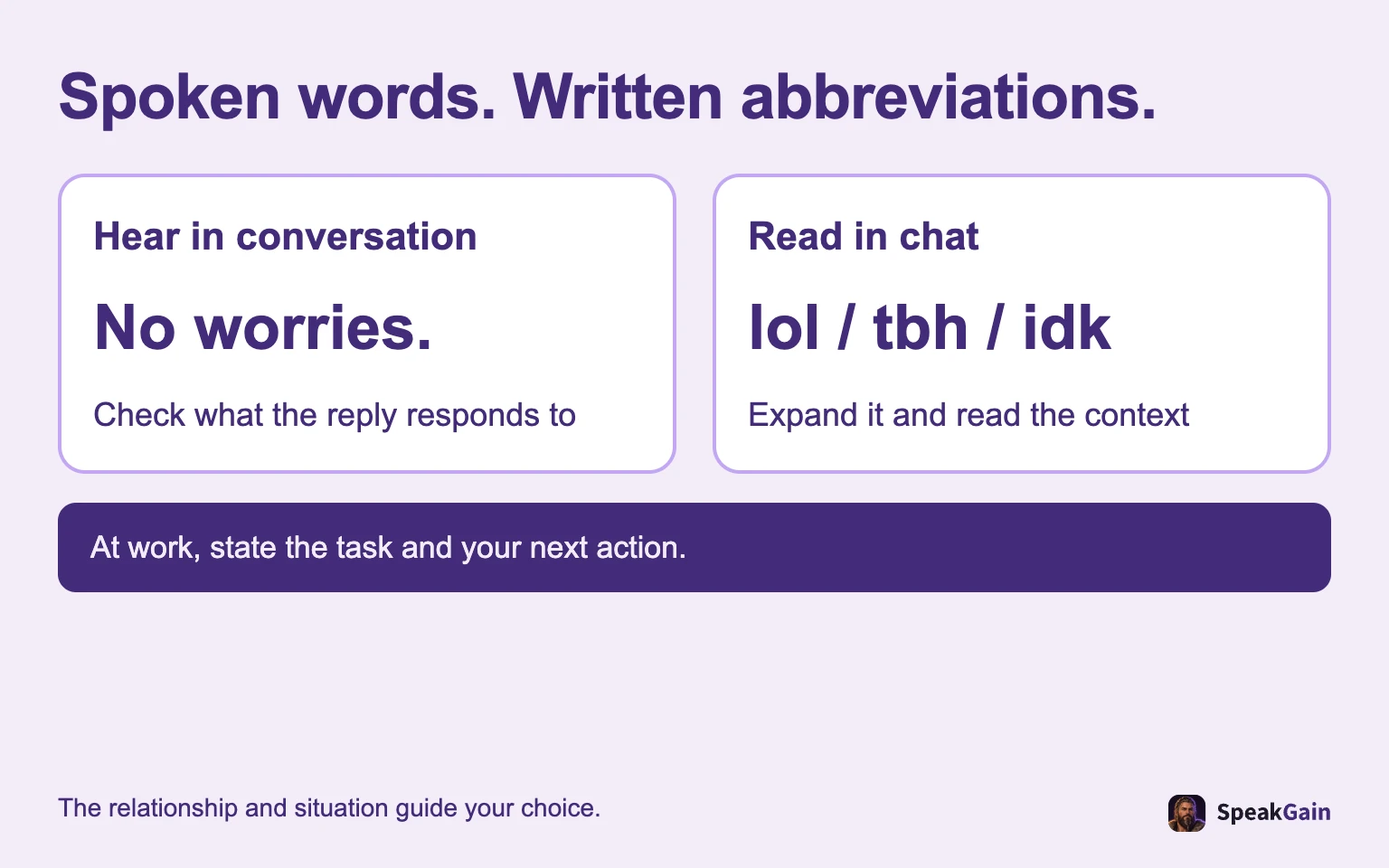
3. Read chat abbreviations as written language
Expand an abbreviation before interpreting it. A familiar equivalent such as “haha” is a guide to meaning, not proof of the writer’s precise emotion.
| Abbreviation | Meaning and tone | Friends | Workplace chat | Online lesson |
|---|---|---|---|---|
| lol — laughing out loud | Informal sign of amusement or a joke | Read in the joking context; take care around mistakes | Do not add to serious messages; recognize first | Ask what it means; you need not use it |
| tbh — to be honest | Introduces an opinion | Read the actual opinion | Spell out your point and reason | Practice saying “To be honest” |
| ngl — not gonna lie | Introduces an admission, criticism or complaint | Read the rest of the sentence | Does not guarantee a polite complaint | Discuss the meaning and what follows |
| idk — I don’t know | Brief internet spelling | Understand that the writer does not know | Prefer “I’m not sure. I’ll check” with a next action | Say the complete “I don’t know” |
| btw — by the way | Adds information or changes the topic | Useful for an extra point | Follow team habits; write important points clearly | Recognize an additional point in the chat box |
Definitions: Cambridge lol, tbh, ngl, idk, btw. Ngl may attempt to soften criticism; that is not a promise that the criticism will land gently.
Understanding a colleague’s idk is one task; replying with your plan to check is another. Lol after an apology is not automatically appropriate. BBC’s online-learning discussion distinguishes casual peer exchanges from communication with a tutor. Knowing an abbreviation does not require sending an abbreviation-only message to your teacher.
4. Gonna, wanna, gotta and kinda: listen for familiar words
These forms are a listening entry point: known English may sound shorter in speech. Restore the underlying form, then listen again. Your first goal is recognition, not making all your speech faster.
| Spoken spelling | Form in this example | Example and meaning | For formal writing |
|---|---|---|---|
| gonna | going to | I’m gonna call you: a planned call | I’m going to call you |
| wanna | want to | I wanna go: a wish to go | I want to go |
| gotta | have got to | I gotta go: needing to leave | I’ve got to go / I have to go |
| kinda | kind of | I’m kinda tired: somewhat tired | I’m kind of tired |
Cambridge entries for gonna, wanna, gotta and kinda support these spoken forms. Wanna also represents want a. This is not a rule for mechanically replacing every going to or want to in any sentence. Look at what follows and confirm the whole meaning.
With friends, recognize the short form; in formal writing, use the underlying spelling; in a lesson, ask your tutor to read both. For linking and weak sounds, see why movie English is hard to understand.
5. Region and age are clues, not guarantees
Country, age and community all matter. Cambridge marks the thanks/goodbye senses of cheers UK informal and gonna mainly US. That does not mean gonna is absent from British speech. Check whether Cheers is a toast, thanks or a goodbye in the scene.
If you hear No worries in an Australian conversation, decide what it answers. The Cambridge entry we inspected does not restrict it to Australia; it cannot establish Australian exclusivity or frequency.
| Clue | What to check | Before speaking |
|---|---|---|
| Cheers in a British show | Thanks, goodbye or a toast? | Use an ordinary thank you if unsure |
| Gonna with a US label | Underlying form and sentence meaning | Recognize it; write the full form formally |
| No worries in Australia | A reply to an apology or thanks? | Also consider the relationship |
Youth slang can age quickly. Cambridge’s slang guide notes that words can fall out of use. Check when an example was published and who used it. We do not offer an unverifiable “latest 2026” list. If a meaning cannot be checked, save the source and wait before using it. Some words are vulgar or discriminatory; copying stronger language is not our recommended way to become closer to someone.
6. Misaki’s day: understand their words, choose yours
Misaki is a fictional learner with English-speaking coworkers, friends and a show to watch at night. Her aim is to understand intent and choose a useful reply, not repeat every expression she encounters.
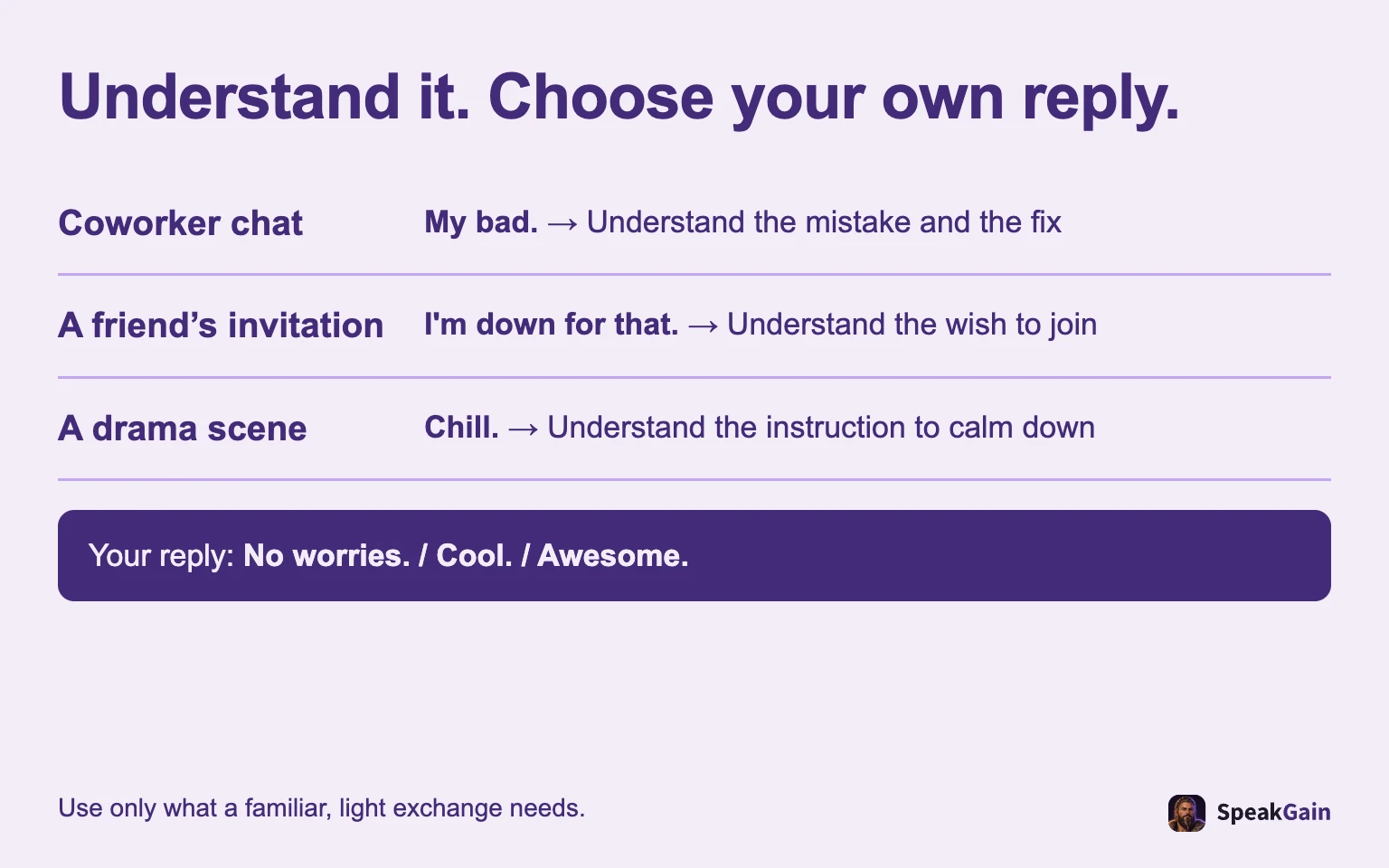
Morning, coworker chat: “My bad. I sent the old file. I’ll send the new one.” Misaki understands the error and the promised fix. It is a small mistake from a familiar colleague, so she replies:
No worries. Thanks for letting me know.
1. Reply to a small update
If the problem is serious, she asks about the needed action instead of dismissing it. If she caused it, she prepares an apology and repair rather than copying my bad.
Evening, a friend: she hears “I’m down for that” and understands that her friend wants to join. She does not need to use down herself.
Cool. See you at six.
2. Respond to a friend's plan
A further weekend suggestion sounds genuinely fun:
Awesome. That sounds fun.
3. Welcome an enjoyable suggestion
Night, fictional drama: a character says “Chill” during an argument. Misaki understands the command, but does not borrow it for a worried coworker tomorrow. If a subtitle shows gonna, she checks going to and listens again. For more scene selection, see Friends phrases, learning with movies and learning with TikTok.
7. Save three usable sentences with their situations
Misaki saves the three sentences above. In her next lesson she asks “Can I say this to a coworker?” and specifies the familiar colleague, small file error and quick correction. “At work” alone is too vague: compare that situation with a first-time client or a serious failure.
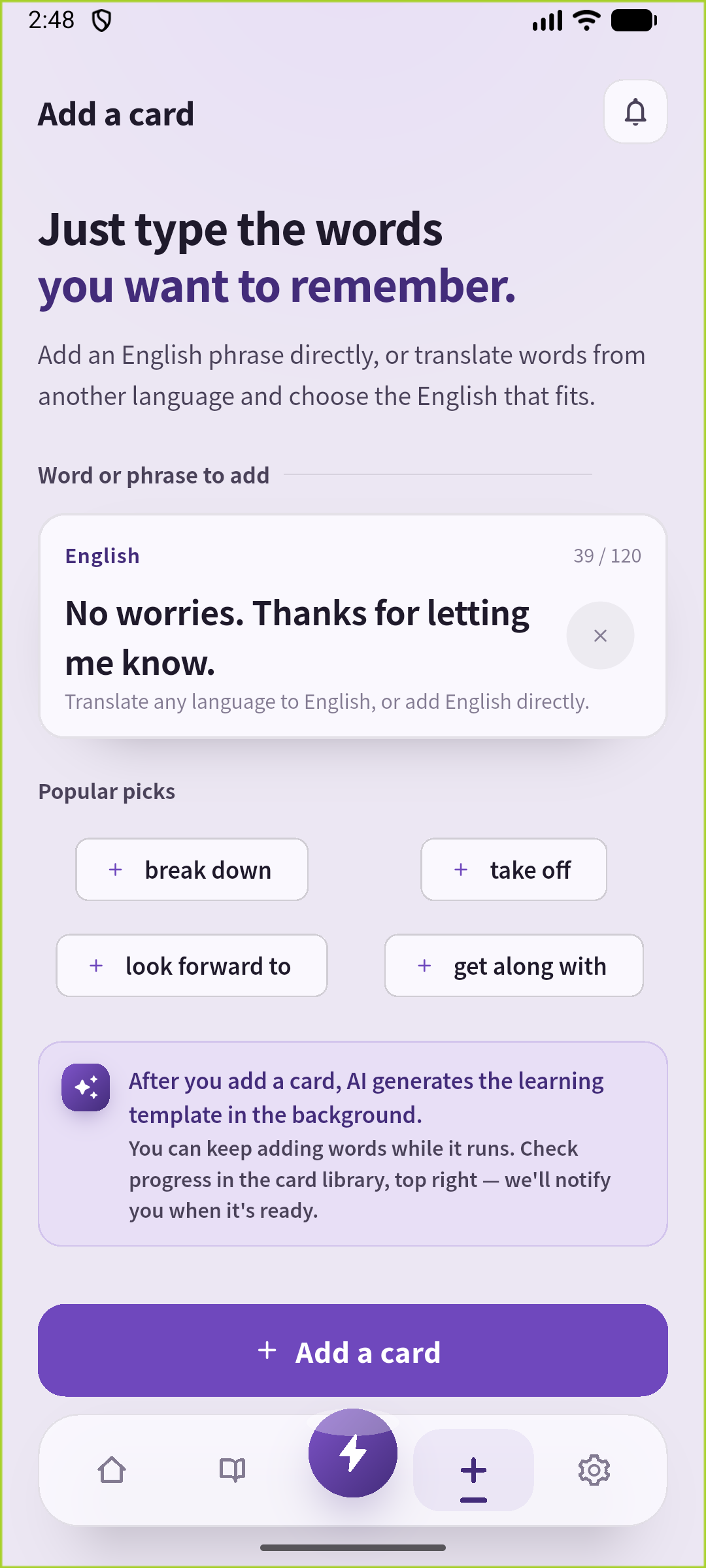
Step 1: save a sentence you expect to use. In SpeakGain’s Create screen, enter “No worries. Thanks for letting me know.” A notebook also works: pair the sentence with the situation rather than adding a hundred words you will not say.
Step 2: listen, recall the situation and say the sentence. Try remembering who it answers before looking at the words, then check and speak. Pronouncing No worries correctly and judging its suitability are separate tasks.
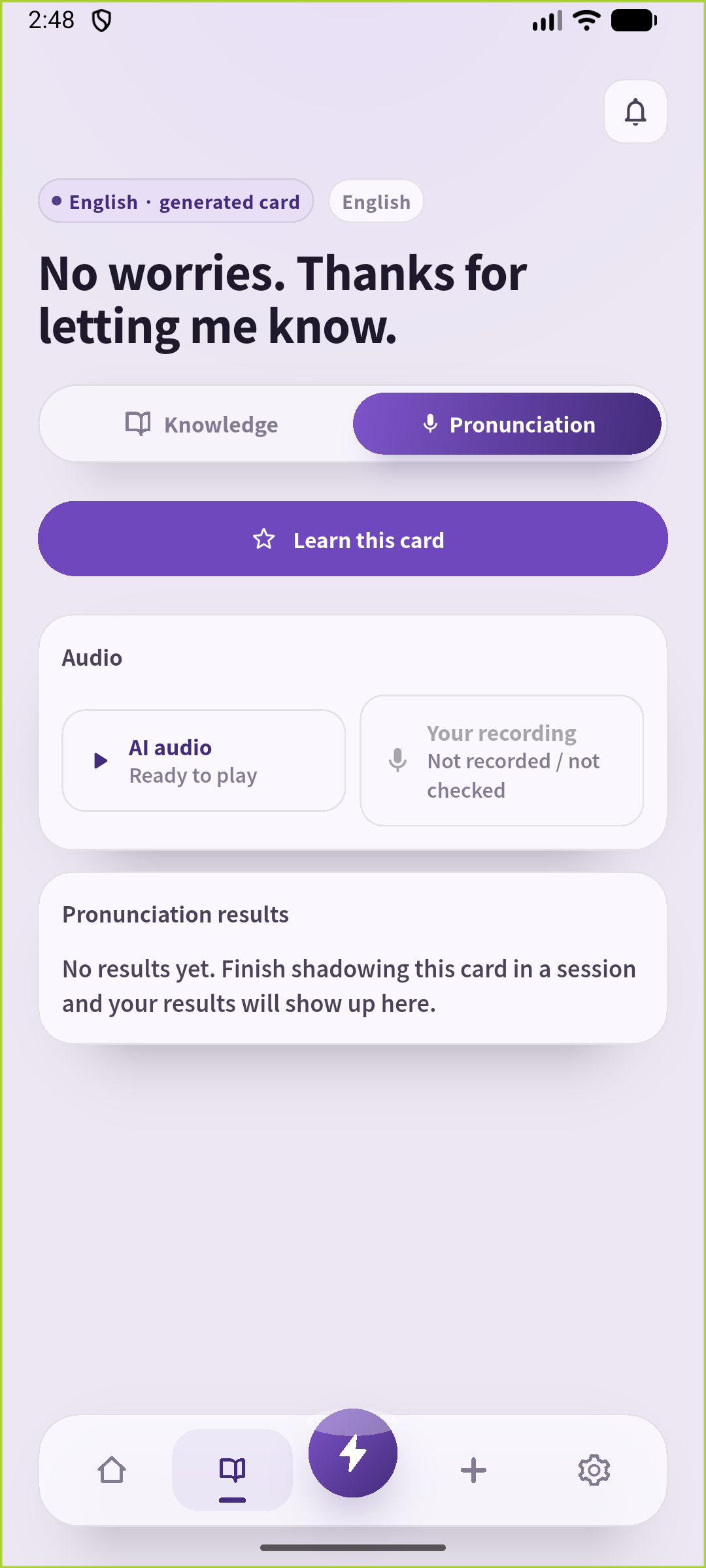
Step 3: recall it on another day. Tomorrow, start from “a familiar coworker reports a small correction” or “a friend chooses a meeting time.” Check the words and audio if needed. At the weekend, try again and consider a more formal listener. This schedule is an editorial example, not a research-established optimal interval for everyone.
Dunlosky and colleagues’ review rates practice testing and distributed practice highly; the author’s practical explanation recommends both. We apply that to recalling a sentence from a situation. It is not evidence for slang politeness, conversational fluency or SpeakGain’s specific effectiveness. See what SpeakGain does, short listening responses and planning English study.
Questions learners ask
Will I sound unnatural without slang? You can communicate without it. We recommend clear ordinary English first, broader understanding next. Recognizing I’m down for that and replying I’d like to join is fine.
Can I use lol or idk at work? Team habits differ. Start by reading them, and write full replies for tasks and formal messages. Include what you will check, not just what you do not know.
Are gonna and wanna mistakes? Dictionaries record them as informal spoken spellings. Learn them for listening; use the full forms for formal writing.
Understand broadly, speak selectively. Keep spoken expressions, chat abbreviations and reduced forms separate; start with three friendly replies and retain ordinary English for important matters.
Sources
- Cambridge Dictionary: slang
- Cambridge Dictionary: slang (grammar)
- BBC Learning English: Down/up for something (2021)
- BBC Learning English: Acronyms (2017)
- Dunlosky et al. (2013)
- Dunlosky: American Educator
Before adding stronger slang, try naming what was good with the guide to compliments in English.
Before adding more slang, try positive reactions in English and choose a short reply based on the plan, post or experience you are reacting to.