
How to say ganbatte in English: encouragement by timing and “I’ll do my best”
Published
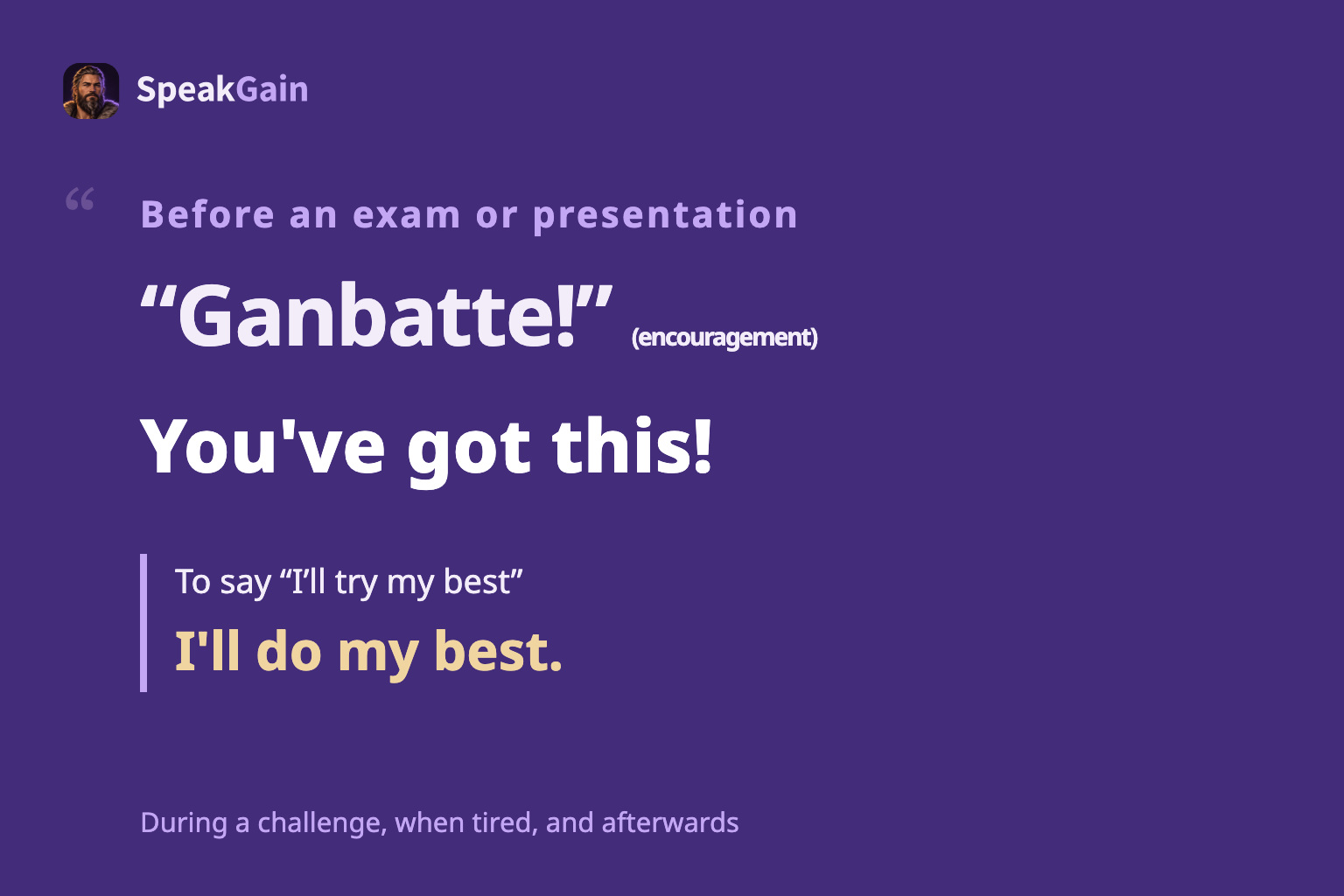
Before a challenge, say Good luck! or You’ve got this!; during it, Keep going!; when someone is tired, Take it easy.; afterwards, You did great! For your own “I’ll try my best,” say I’ll do my best. Japanese ganbatte can cover several of these jobs. English separates wishing someone success, encouraging persistence, easing pressure and recognising completed work.
| Timing or role | First choice | What you mean |
|---|---|---|
| Before an exam or presentation | Good luck! / You’ve got this! | I hope it goes well / I believe in you. |
| During a challenge | Keep going! / You’re doing great. | Continue / your effort looks good now. |
| Tired or overworking | Don’t push yourself too hard. / Take it easy. | Ease the pressure and rest. |
| Afterwards | You did great! / Well done. | Recognise what they did. |
| Your own intention | I’ll do my best. | I intend to make my best effort. |
| Reply to encouragement | Thanks, I’ll do my best. | Thank them and state your intention. |
Our editorial recommendation: when a friend has prepared and needs confidence, start with You’ve got this! When they clearly need rest, choose Take it easy. This is a practical recommendation, not a rule that Good luck! ignores effort.
1. Choose the timing, then check whether rest matters more
A friend heading into an exam, a runner midway through a race and a colleague finishing a presentation need different messages. Ganbatte is not a single English instruction. Ask whether the task is ahead, happening now or finished. Then check fatigue at any of those stages. Being in the middle of work does not automatically make Keep going! the right choice.
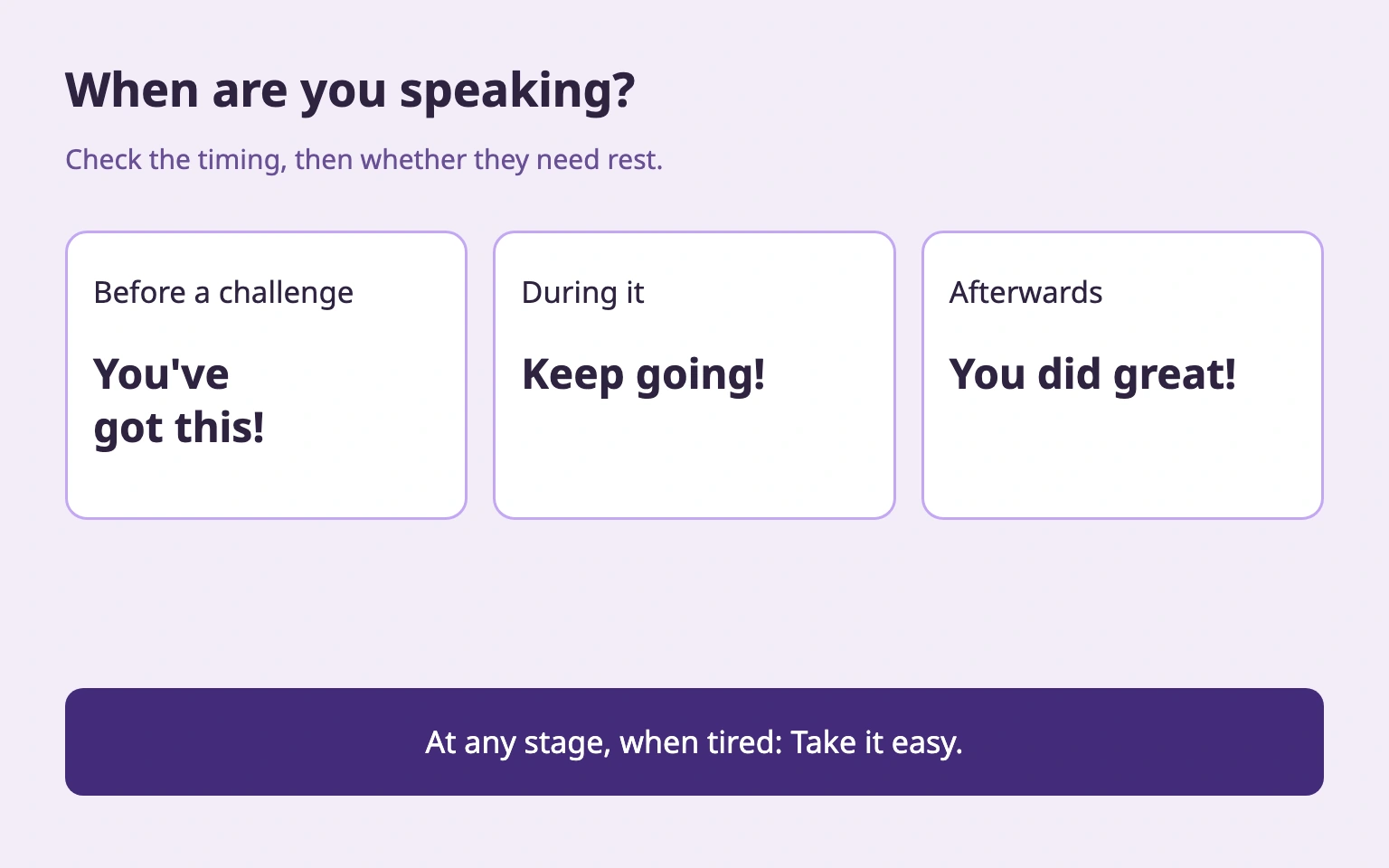
Also separate encouraging someone from promising your own effort. You’ve got this! addresses the other person. I’ll do my best. expresses your intention. For a more formal professional relationship, I hope your presentation goes well. states the wish directly; adding please to an imperative does not recreate a Japanese politeness ending.
2. Before: wish them success or express your belief
Good luck on your exam! and Good luck with your presentation! name the coming event. Luck does not automatically imply that preparation is worthless. Cambridge’s root for entry even combines a good-luck wish with support. If you have seen their preparation, you can mention it separately.
You’ve got this! says you believe they can handle the situation. Cambridge labels it mainly US and informal. We recommend it for friends and close colleagues whose preparation you know, rather than as a promise of a particular result.
Alex: I’m nervous about my exam.
Misaki: You’ve prepared well. You’ve got this!
I’m rooting for you. makes your support explicit. Cambridge describes root for as informal support for someone doing something difficult, and also for a team or player. For a formal client message, our first choice is I hope everything goes well. Choose the relationship as well as the timing. The reassuring use of Japanese daijoubu is covered in how to say daijoubu in English.
3. During: keep going or recognise progress
Keep going! encourages continuation. You’re doing great. acknowledges how the person is doing now. While listening to a colleague rehearse, you might say You’re doing great. Your explanation is clear. Point to something you have actually noticed.
Alex: I keep forgetting this part.
Misaki: You’re doing great. Let’s try that part again.
Hang in there. encourages persistence through difficulty. Collins COBUILD describes continuing and not giving up despite difficulty, and labels it informal. It still points towards carrying on: do not treat it as a request to rest. Listen to what the person needs before choosing it.
4. Tired: reduce pressure instead of asking for more
Don’t push yourself too hard. directly expresses concern about overdoing things. Take it easy. encourages rest or less exertion; Cambridge explains this sense. Take care of yourself. focuses on the person’s wellbeing beyond one task.
Alex: I’ve been working late all week.
Misaki: Don’t push yourself too hard. Take care of yourself.
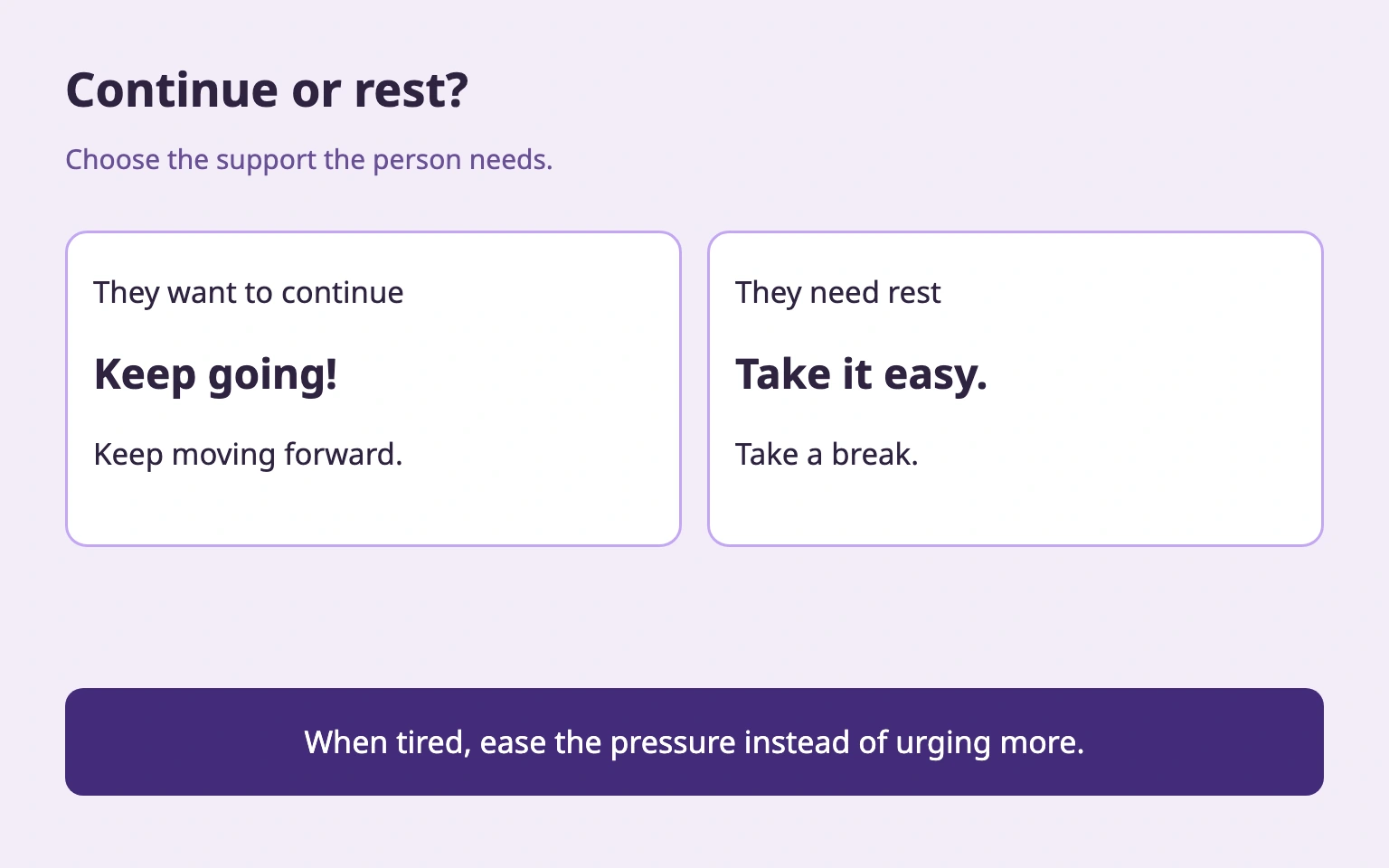
Our recommendation is Take it easy. when someone needs a break. Acknowledge their situation first, and offer practical help if you can: Can I help with anything? Words do not remove a deadline. If you control the workload, connect care with something that actually reduces it.
5. Afterwards: recognise what happened
You’re doing great. becomes You did great! when the task is finished. Well done. is another short acknowledgement; Cambridge identifies its praise and approval sense. You did great! Your examples were clear. is useful after a presentation you heard.
I’m proud of you. expresses a more personal feeling. We recommend it for a child or someone close whose effort you have followed. That is an editorial relationship choice, not a ban on using it with colleagues. With a less close colleague, start with the specific work you appreciated.
| Your purpose afterwards | Line |
|---|---|
| Recognise a presentation you heard | You did great! |
| Express personal pride | I’m proud of you. |
| Encourage rest after tiring work | Take it easy. |
Celebrate a result in how to say congratulations, add a specific compliment with English compliments, and distinguish workday acknowledgement from praise in how to say otsukaresama. If someone says their exam went badly, do not invent a successful result to reassure them.
6. Your intention: “I’ll do my best” at work or in an interview
I’ll do my best. is a commitment to effort. Thank you for the opportunity. I’ll do my best. separates gratitude from intention. If a manager asks for a delivery date, though, effort is not the answer to the date question.
Manager: When can you send the draft?
Misaki: I’ll send it by Friday.
I’ll give it my best shot. expresses doing a task as well as you can; Cambridge labels the idiom informal. We suggest it for a new challenge with someone you know. I’ll give it a shot. without best simply points towards trying it.
I’ll work hard. states your working effort. In an interview, I’ll work hard to learn the role. adds a target, but it does not replace evidence of experience. Explain what you can contribute. For study, change the verb: I’ll study hard. Keep hard, not hardly, in this expression.
7. When encouraged: thank them, then reply for yourself
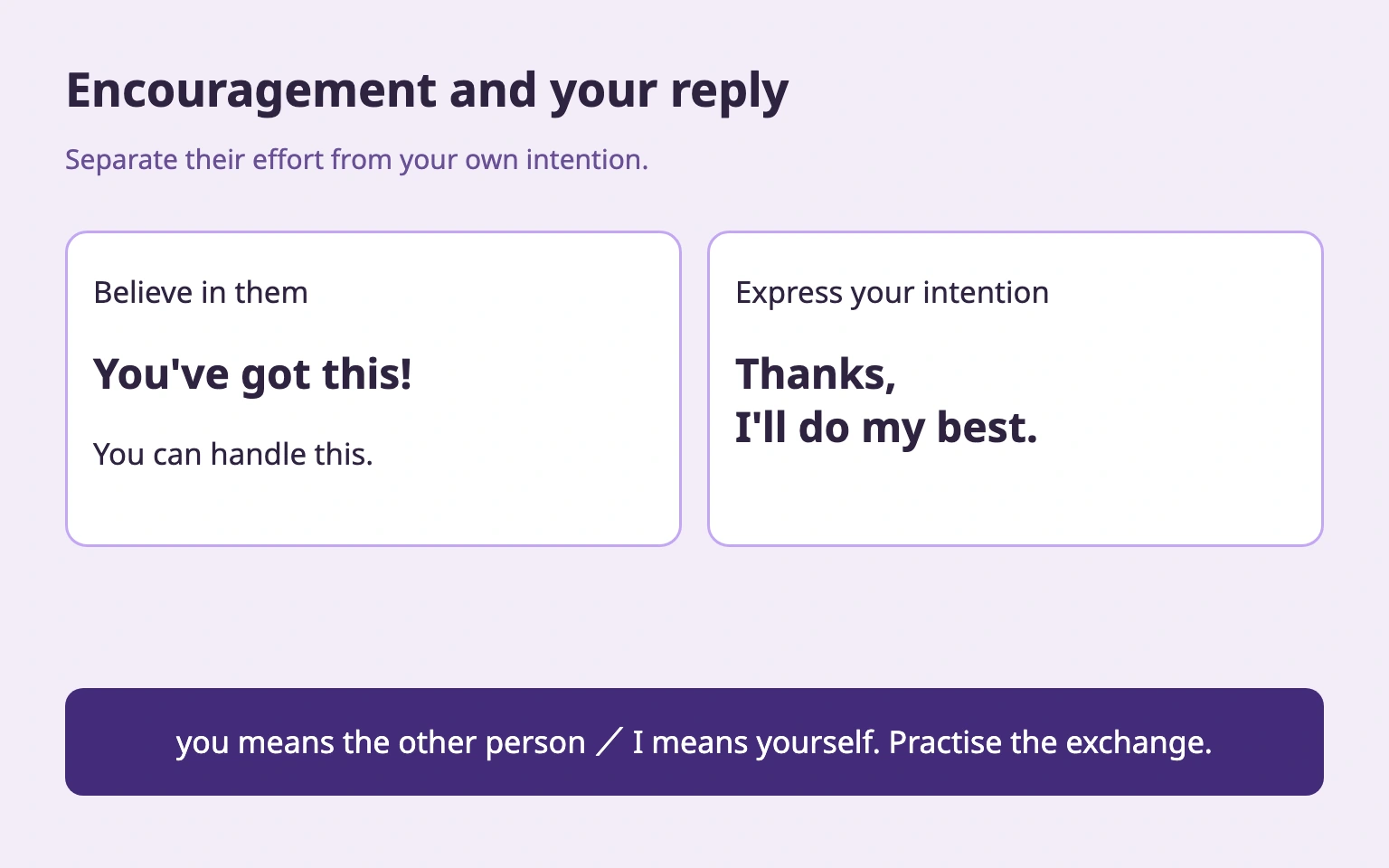
Thanks! or Thank you. is enough. To include your intention, use Thanks, I’ll do my best. If their words were just what you needed, Thank you, I needed that. acknowledges the encouragement itself. You do not have to return Good luck! when you are the one facing the challenge.
Alex: You’ve got this!
Misaki: Thank you, I needed that.
Let’s do our best. includes both people. It differs from I’ll do my best. when only you are taking the exam. Check who is acting before choosing a short reply.
8. Is “Do your best” rude? What about “Fighting!”?
Do your best. is not universally rude. Cambridge defines best effort and includes a reassuring example that allows failure. Still, an instruction to make effort may add pressure in some contexts. That possibility is our editorial reason to prefer You’ve got this! for a prepared friend, and Take it easy. for someone exhausted; the dictionary does not measure every listener’s reaction.
| Who is making the effort? | Line |
|---|---|
| You are encouraging the other person | Do your best. |
| You are stating your intention | I’ll do my best. |
Fighting! should not be dismissed as a nonexistent expression. Korea.net’s language card explains Korean 파이팅/화이팅 as encouragement, and its official report confirms fighting among Korean-derived OED additions in 2021. This does not establish a universal default for every English listener. In this practice set we choose lines whose purpose is explicit without that shared cultural context; we make no unsupported origin claim.
9. Misaki’s three scenes: listen, then take your turn
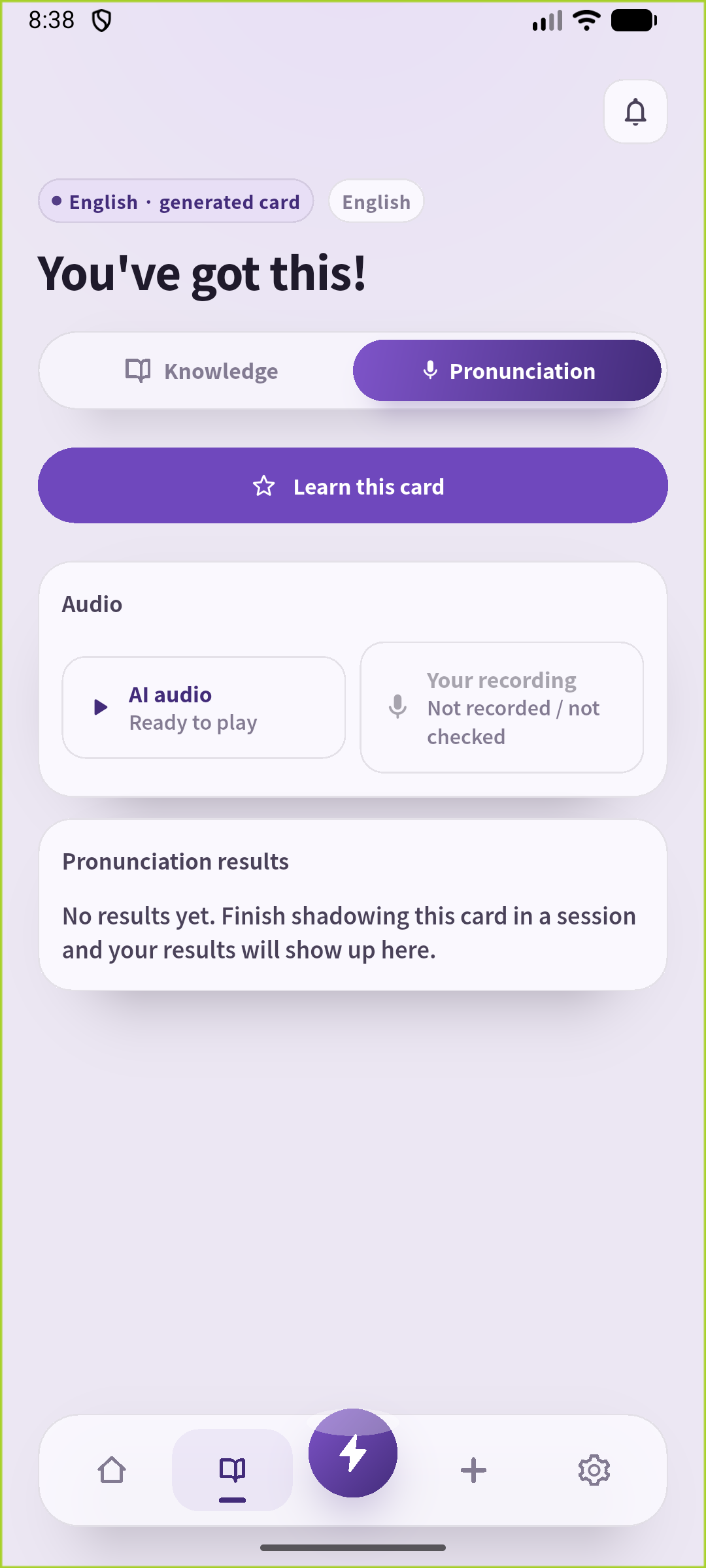
Save You’ve got this!, I’ll do my best. and You did great! as three separate SpeakGain cards. Our suggestion is one usable sentence per card, not a long list of translations for ganbatte.
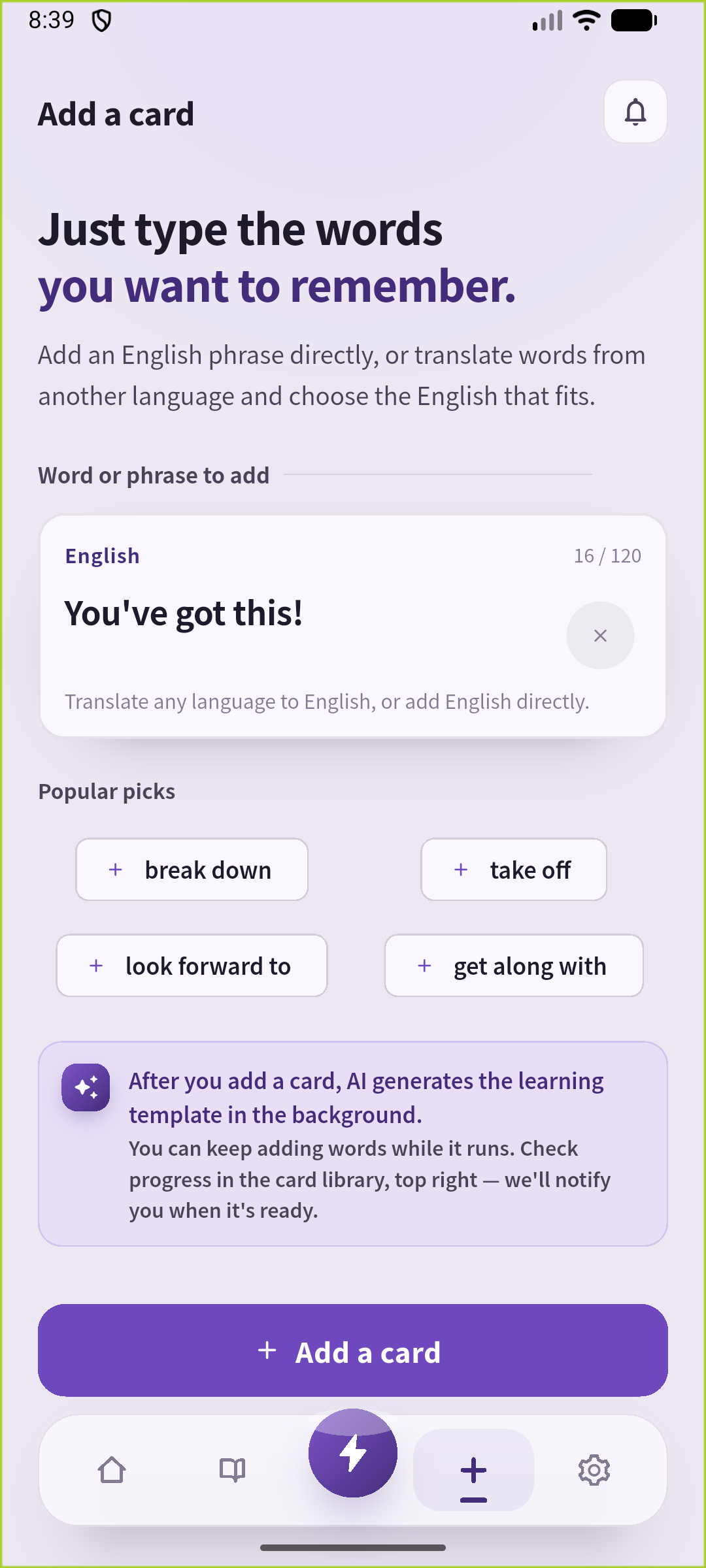
Morning: a friend before an exam. Alex says I’m nervous about my exam. Listen, then say You’ve got this! as Misaki. Imagine speaking to a real friend, not just reading a translation.
You've got this!
You can handle this!
The model is SpeakGain’s Deep-voiced Viking AI voice. Aim to hear the whole line and say it with your intended meaning; matching a low voice is not the goal.
Noon: your presentation. A colleague says Good luck with your presentation! Listen to I’ll do my best., then practise the complete reply Thanks, I’ll do my best.
I'll do my best.
I’ll make my best effort.
Afternoon: a colleague finishes. You heard the presentation and liked the examples. Say You did great!, then add Your examples were clear. Switch from a future challenge to something completed.
You did great!
You did very well!
Hide the sentences and use only “friend before an exam,” “my reply,” and “colleague afterwards” as cues. Check the line if needed, hide it again and retrieve it. Karpicke and Roediger’s 2008 experiment tested college students learning Swahili–English word pairs: continued retrieval after an initial correct answer helped recall a week later. It did not test these conversations or SpeakGain. Using a situation to recall a sentence is our practical interpretation.
Tomorrow change one condition: the colleague is rehearsing, or is tired and needs rest. Choose You’re doing great. or Take it easy. rather than adding an endless list. For a sustainable routine, see how to study English.
Common questions
Before a challenge, formal wishes, your effort and replies
Can I always use Good luck!?
Use it to wish success before a challenge. For progress, rest or completed work, choose a line that fits that purpose.
What is a more formal wish?
I hope your presentation goes well. names the event and expresses your wish without an instruction to work harder.
Is I’ll do my best. enough in an interview?
It expresses intention. Add relevant experience, the role you want to learn and concrete actions; it does not replace those answers.
How do I reply to encouragement?
Thanks! is enough. Thanks, I’ll do my best. adds resolve; Thank you, I needed that. acknowledges the helpful words.
Before, during, tired or afterwards: choose the purpose before choosing the line. Then say one sentence for the next person you will actually speak to.
Sources consulted
- Cambridge Dictionary — You/you've got this
- Cambridge Dictionary — Root for someone
- Collins COBUILD — Hang in there
- Cambridge Dictionary — Take it/things easy
- Cambridge Dictionary — Well done
- Cambridge Dictionary — Do/try your best
- Cambridge Dictionary — Give something your best shot
- Korea.net — Korean Language Card of July
- Korea.net — Oxford English Dictionary adds 26 Korean words
- Karpicke & Roediger (2008) — The Critical Importance of Retrieval for Learning
For caring replies and your own sick-day notice, practice the short examples in get-well wishes and talking about feeling sick.