
Otsukaresama in English: choose by the situation and what you mean
Published
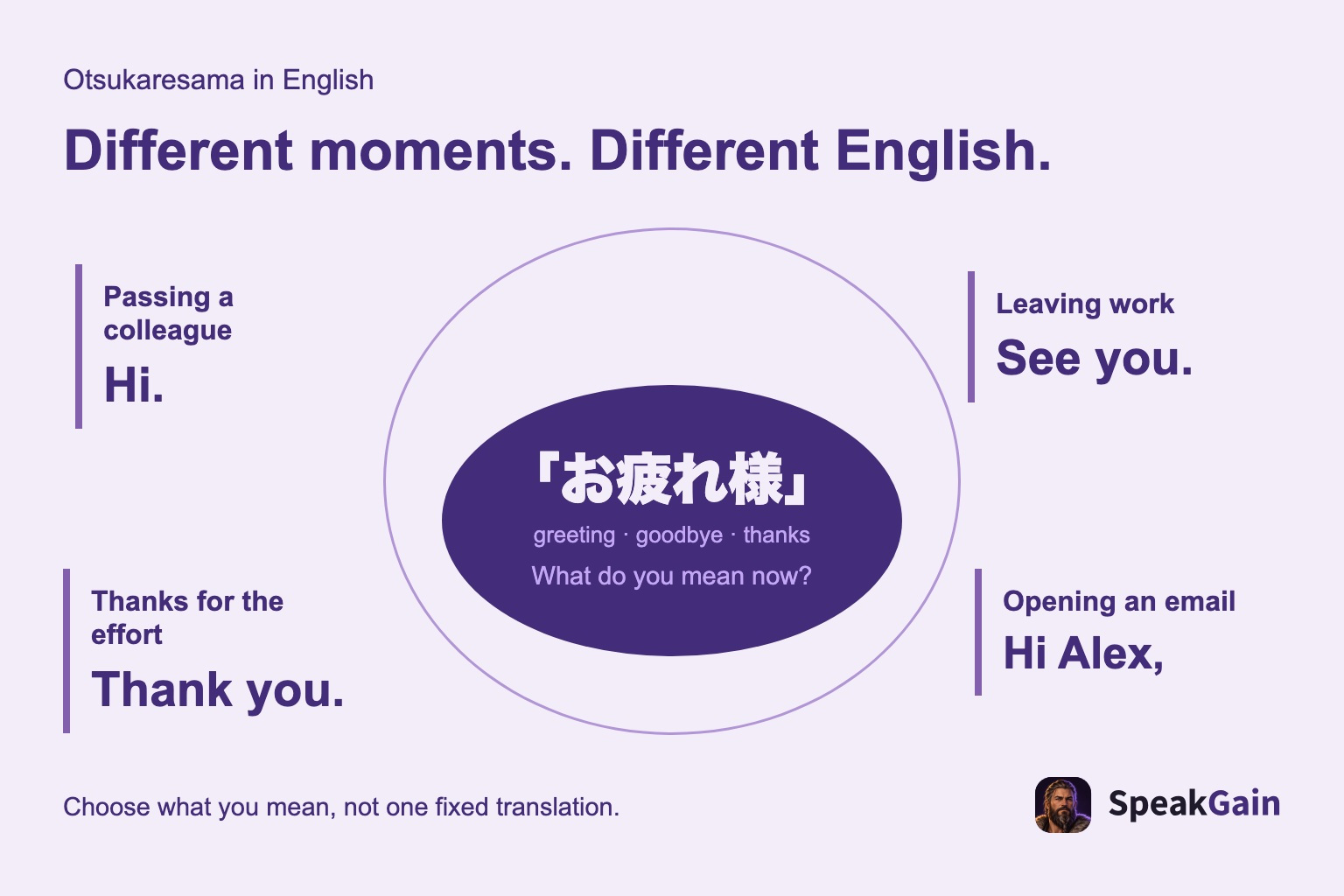
There is no single English translation of お疲れ様 (otsukaresama) that works in every situation. Choose what you are doing: saying hello, saying goodbye, acknowledging effort or giving thanks. These five rows are a useful starting point.
| Moment | A first English choice | What it communicates |
|---|---|---|
| Passing a colleague | Hi. / Hey, how’s it going? | A greeting, or a casual invitation to respond. |
| Leaving work | See you tomorrow. / Have a good evening. | Goodbye and a wish for the evening. |
| After a meeting or project | Good job today. / Thanks for all your hard work. | Praise, or thanks for the effort. |
| Opening an internal email | Hi Alex, followed by the purpose | No separate translation of otsukaresama is needed. |
| A friend or family member after a demanding day | You must be tired. | Sympathy based on the situation. |
Our editorial recommendation is to start with four choices: Hi, See you tomorrow, Thanks for all your hard work, and Hi + name in an email. Add Good job when you mean praise, and You must be tired when you really are talking about fatigue. English has each of these functions, but no one line carries the whole daily range of the Japanese phrase.
1. Separate the four jobs of otsukaresama
In a Japanese workplace, the same expression can open a hallway exchange, acknowledge someone after a meeting or close the working day. Translating its reference to tiredness every time misses the action the speaker is performing. A morning greeting need not say anything about how hard the colleague has worked.
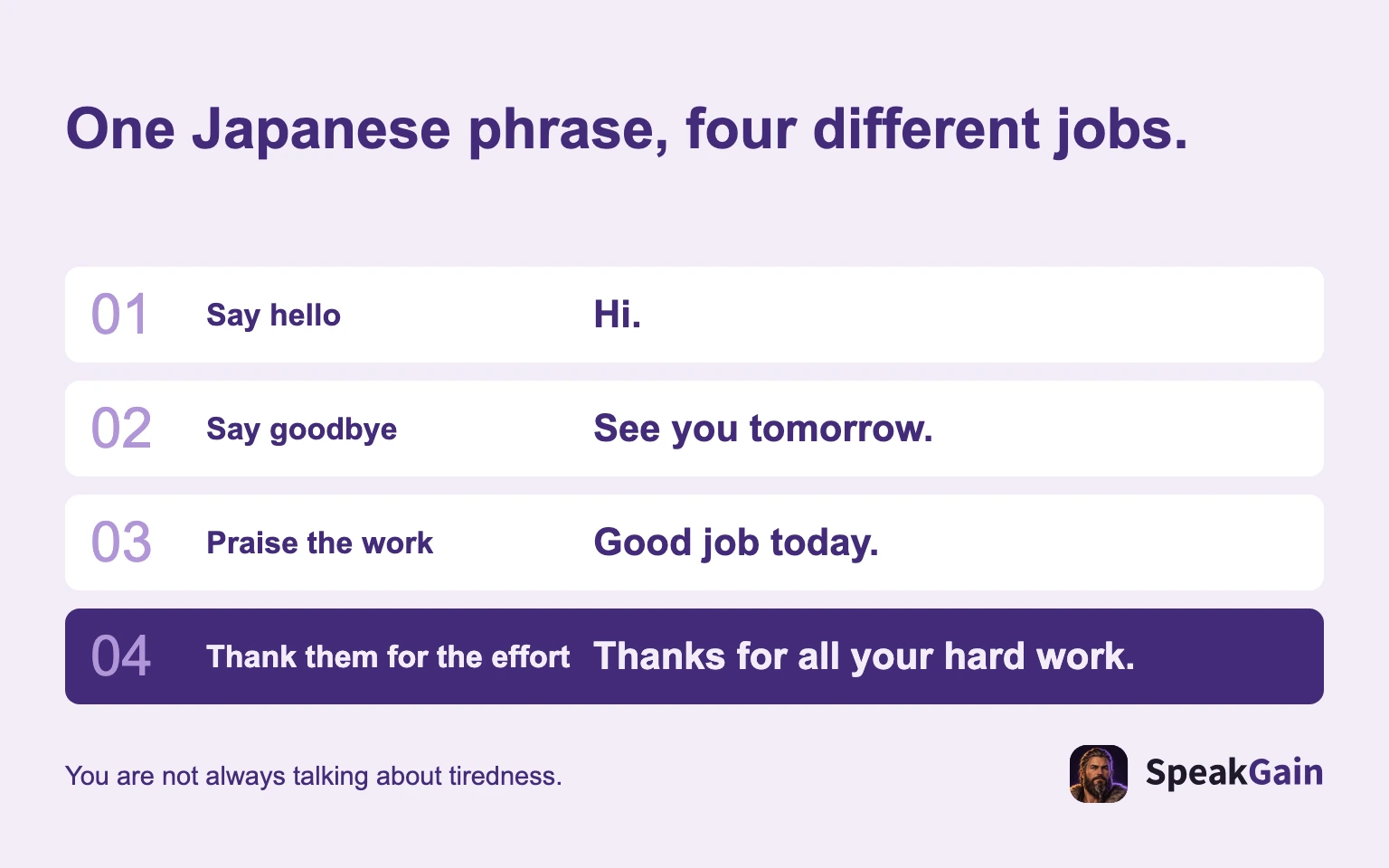
Ask yourself what you want the other person to receive. Hi opens contact. See you tomorrow closes it and mentions the next meeting. Good job today praises the work. Thanks for all your hard work appreciates the effort. You do not have to combine all four into one greeting.
Nor does deshita automatically require an English past-tense sentence. A Japanese farewell after work can become See you tomorrow, a line about the future. Thanks for your help today focuses on help already received. Choose the communicative job before choosing a tense.
This is a practical starting point, not a universal rule about every English-speaking office. Relationships and workplace conventions differ. The same approach helps with yoroshiku onegaishimasu in English: identify what you mean instead of finding one fixed substitute.
2. In the hallway, start with Hi
When you notice a colleague in the hallway or kitchen, Hi, Alex. can do the job. In the morning, Good morning works too. With a colleague you know well, Hey, how’s it going? is a casual way to open a brief exchange.
Misaki: Hi, Alex.
Alex: Hi, Misaki.
That may be the whole exchange. If you have time to talk, Alex might answer Good, thanks. How about you? Do not treat a passing greeting as a demand for a detailed report. If you want to thank them for yesterday’s help, you can add Thanks for your help yesterday, but that conveys something beyond hello.
Our first choice for a passing greeting is Hi. Use Hello or Good morning when you prefer a less casual start, and match names or titles to the workplace. We are not saying that Hi is always forbidden with a manager, or that Hey suits every client. For more replies, see English greetings and How are you.
3. When leaving, say goodbye and mention the next time
See you tomorrow. and Have a good evening. let you close the exchange without assessing anyone’s work. You can use both together.
Misaki: I’m heading home. See you tomorrow.
Alex: See you. Have a good evening.
I’m heading home makes your departure explicit. You do not need a separate apology simply to reproduce the Japanese expression for leaving first. If a handover is necessary, however, say where the updated file is or what the colleague still needs to do before the farewell. A shorter greeting is not a substitute for essential information.
Change tomorrow when the schedule changes. On Friday, Have a good weekend may fit; if you will next meet on Monday, use See you on Monday. If you do not know the day, See you is enough. Good evening greets someone in the evening; Have a good evening wishes them a pleasant evening as you part. The added Have a changes the function.
4. After a meeting, choose praise or thanks
Good job today. praises the work. Thanks for all your hard work. makes gratitude central. The Cambridge entry for Good job! defines it as praise for something done well; it is not simply hello or goodbye.
Good job today. The examples were really clear.
The second sentence explains what you liked. If you merely want to acknowledge attendance, Thanks for joining the meeting fits a different purpose. If a colleague prepared your slides, Thank you for preparing the slides names that help.
| Intention | Example |
|---|---|
| Praise today’s work | Good job today. |
| Thank someone for sustained effort | Thanks for all your hard work. |
| Appreciate attendance | Thanks for joining the meeting. |
| Thank someone for a particular task | Thank you for preparing the slides. |
Our recommendation is to save all your hard work for effort you really want to acknowledge, rather than attach it to every routine message. For a small check, Thanks for checking this may be more specific. After a disappointing result, you can appreciate the time invested without pretending the outcome was a success. For more detail, see giving compliments and saying thank you.
5. With a manager, name what you are grateful for
Before saying Good job to a manager or senior colleague, ask whether you mean to praise their performance or thank them for help. As a praise expression, it can come across as an evaluation depending on your relationship and delivery. It is not a fixed English equivalent of the Japanese hierarchy associated with gokurousama.
The dictionary definition does not establish a blanket ban on using Good job with a boss. We do not claim that it is invariably rude. Our beginner recommendation is Thank you for + the actual contribution, because it makes gratitude easier to express clearly.
Thank you for your guidance today.
Thank you for leading the meeting.
Thank you for taking the time to explain this.
Use leading or taking when an action follows for; your guidance is a noun phrase. Do not choose guidance simply because it sounds formal if you did not receive guidance. And if you are just leaving, Have a good evening may be all you want to say.
6. In an email, do not add a separate translation
For an everyday internal email, Hi Alex, followed by the purpose is our first choice. There is no need to insert an extra sentence translating otsukaresama between the greeting and the message.
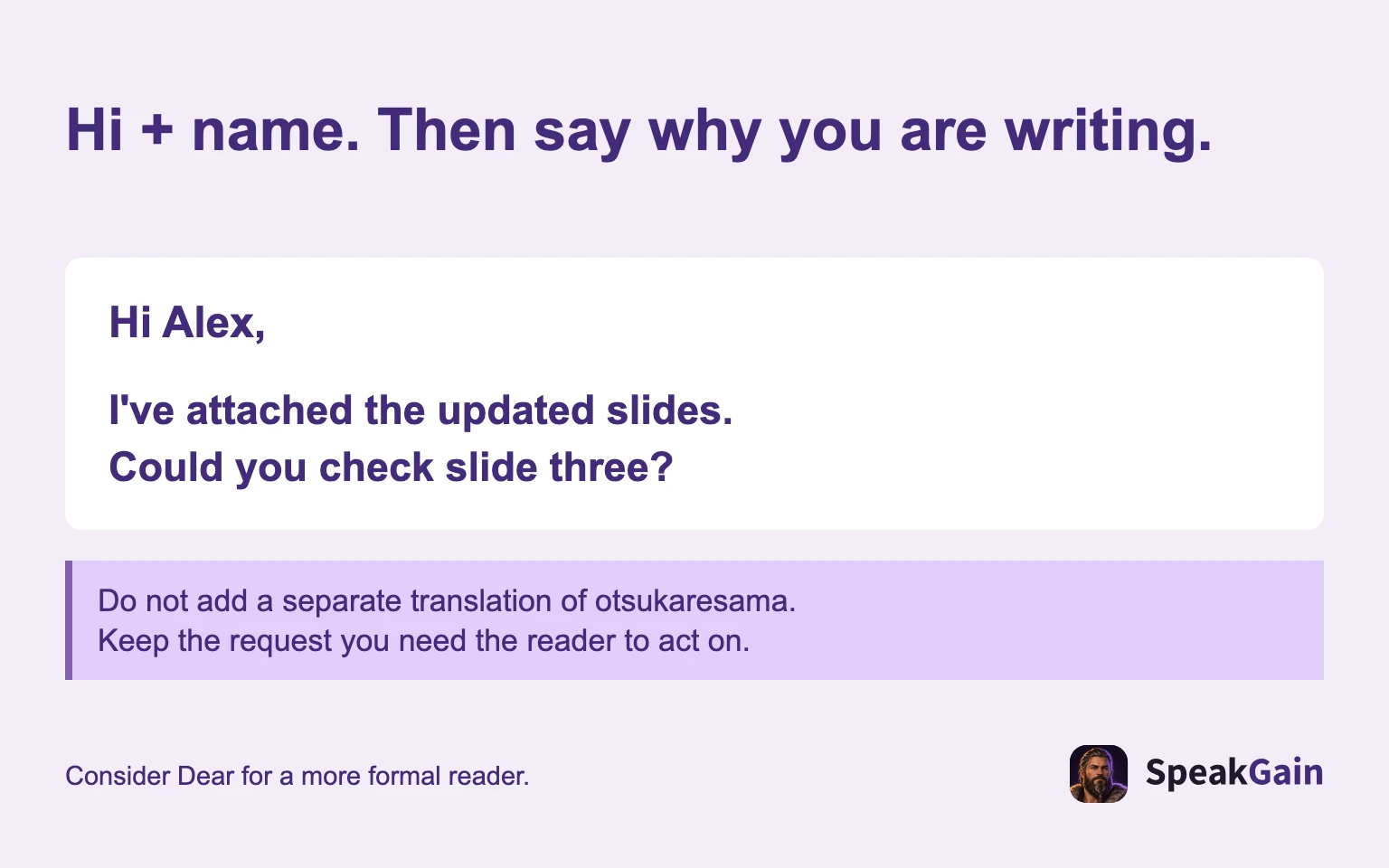
Hi Alex,
I’ve attached the updated slides. Could you check slide three before our meeting?
Thanks,
Misaki
The name addresses the reader, the first sentence supplies the file, and the question asks for the check. Keep that request; omitting a Japanese formula does not mean omitting the task. The British Council email guide distinguishes formal and informal readers and illustrates Hi and Dear. A new client or a formal recipient may call for Dear Ms Lee instead.
In an ongoing chat, The slides are ready can stand alone as a response. If you genuinely want to thank someone for the report, write Thank you for your work on the report. That is a real thank-you, not a mandatory opening decoration.
7. With friends and family, sympathy can mention tiredness
You must be tired. fits a situation where you infer that someone is tired: a long trip or a day of moving furniture, for example.
You must be tired after that long trip. Would you like some tea?
Must here expresses a conclusion, not an obligation to feel tired. The Cambridge entry for must illustrates this use with tiredness after a long day of driving. It does not support a rule that English speakers never mention fatigue.
A colleague whose day you know nothing about may just need Hi. A friend who helped you move might receive Thank you for helping me move. You look tired comments on appearance; if you prefer to ask rather than assume, How are you feeling? is another choice. Our advice is to thank someone for the help first and ask about their state when that matters.
8. Sometimes, add nothing
After Hi Alex in an email, go to the purpose. After See you tomorrow, let the other person reply. After answering a chat question with Yes, it’s in the shared folder, you do not have to attach a translated otsukaresama.
You are leaving out a duplicated formula, not needed gratitude or work information. If there is a real reason to thank someone, say it. If a meeting has a next step, explain it. The useful question is whether the greeting, purpose and farewell are already doing their jobs.
9. Practise through Misaki’s one working day
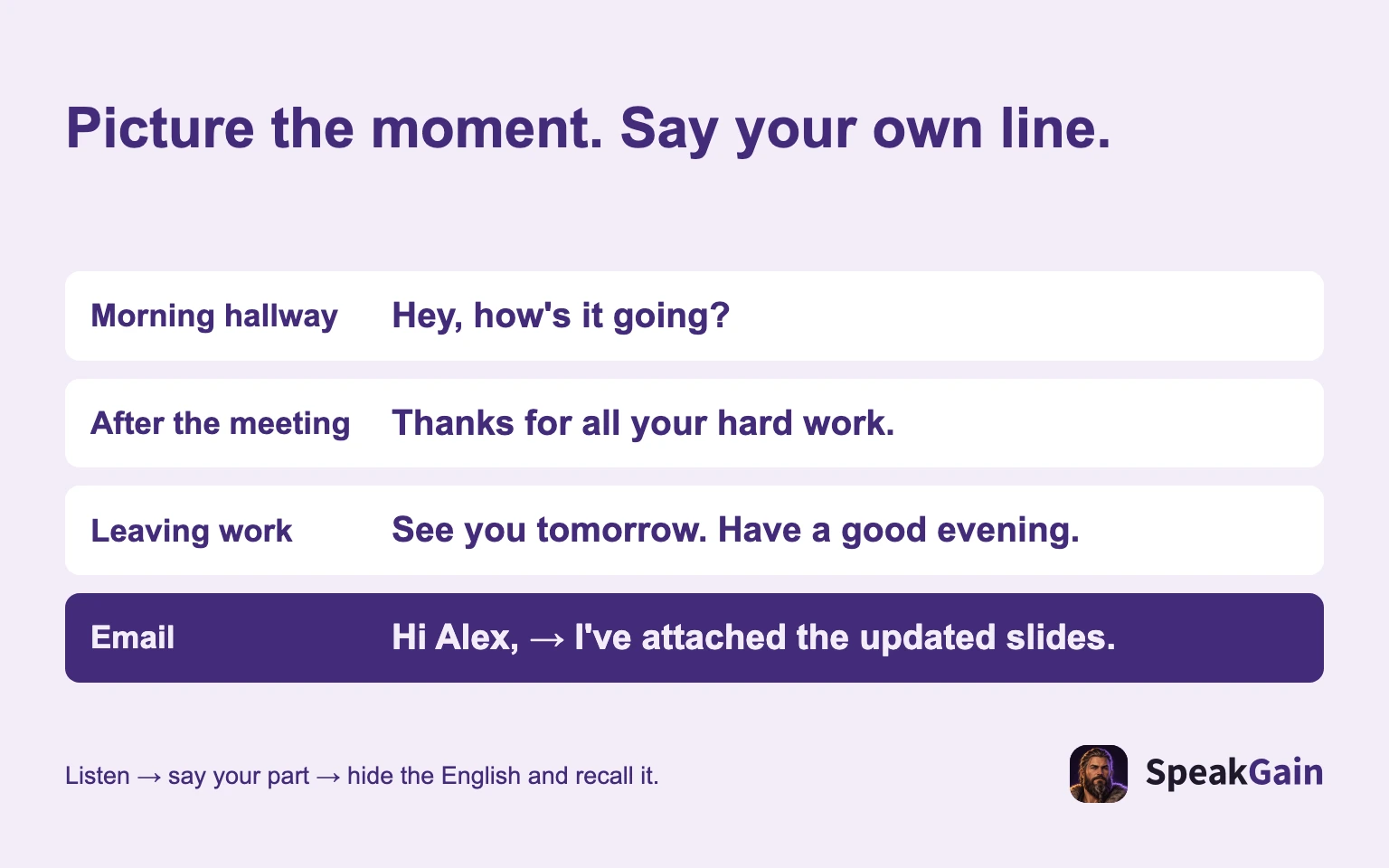
Misaki is a fictional employee. She meets Alex in the morning, receives help preparing meeting slides, leaves in the evening and writes an email before the meeting. Imagine being Misaki and choosing one line in each moment.
Save a sentence for a moment you will actually use
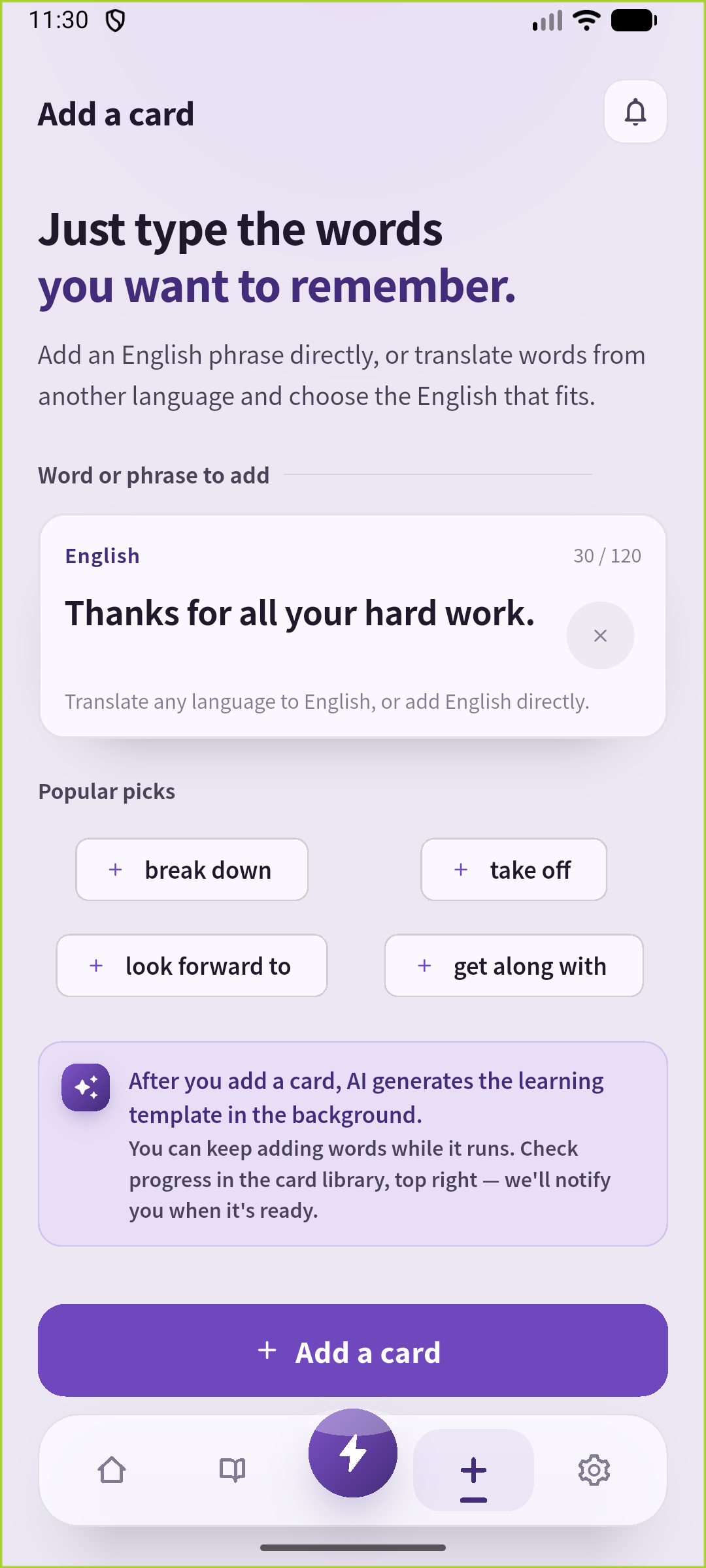
In SpeakGain, enter an English sentence on Add and save it as a card. We saved three shared practice sentences for this day. Decide where you will say each line before collecting more. The feature overview is in What is SpeakGain?.
Listen, then say your part
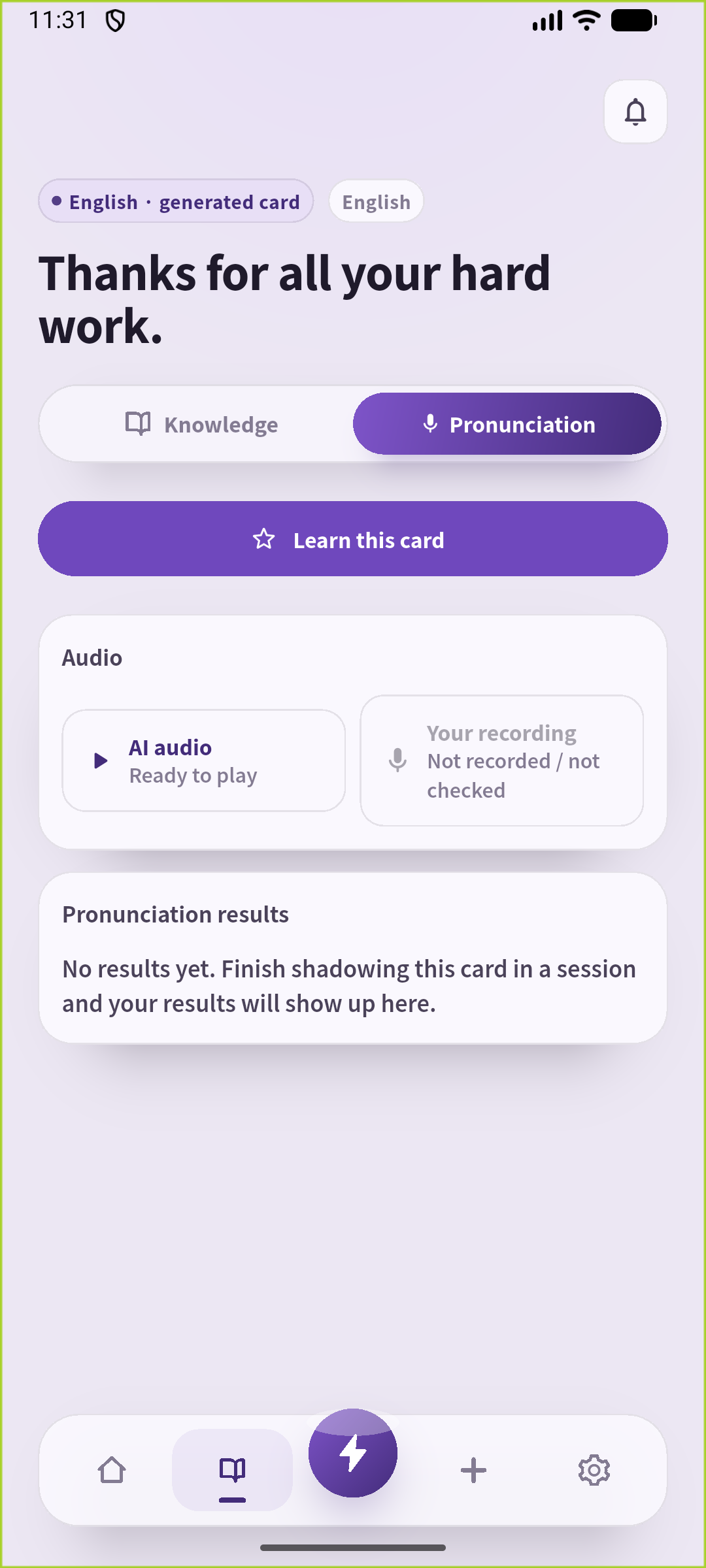
These recordings were generated with SpeakGain’s Deep-voiced Viking AI voice. They read the saved lines; this is not an automatically continuing conversation. Read Alex’s cue yourself, then say Misaki’s reply.
Morning: imagine Alex says Morning, Misaki. You have time for a brief chat. Listen, then greet him.
Hey, how's it going?
Hey, how is everything going?
After the meeting: Alex says The slides are all updated now. Thank him for the preparation rather than grading his work.
Thanks for all your hard work.
Thank you for all the effort you put in.
Leaving: Alex says I’m heading home. You will meet again tomorrow. Reply with the farewell.
See you tomorrow. Have a good evening.
See you the next day. Enjoy your evening.
Email: write Hi Alex, then I’ve attached the updated slides. Add the specific request if you need slide three checked. No fourth audio card is needed for the written exercise.
Hide the English and recall it from the scene
Look only at “morning hallway”, “help after the meeting” or “leaving before meeting tomorrow”. Say a line without looking. Check a forgotten line, hide it and try again. Test whether you choose thanks or goodbye correctly, as well as how you pronounce it.
In Karpicke and Roediger’s 2008 study, university students learned Swahili–English word pairs. Continuing retrieval after an initial correct answer improved recall one week later. This did not test workplace conversation, otsukaresama or SpeakGain. Our scene-cued exercise is an editorial application of retrieval practice, not a claim of measured app effectiveness.
Tomorrow, change one condition: you will not meet the next day, or Alex explained a document instead of making slides. Choose the new farewell or Thank you for explaining this. See how to study English for a broader practice routine.
Common questions
Translation, managers, emails and replies
Can I always use Thank you for your hard work?
Use it for gratitude for the work. A hallway greeting may only need Hi, and leaving may call for See you tomorrow. Do not fix the translation from the Japanese wording alone.
Is Good job always rude to a manager?
No universal ban is established by the dictionary. Because it is praise, its evaluative tone depends on context. If you mean thanks, name the help with Thank you for leading the meeting.
Can I omit otsukaresama in an English email?
Yes. Start an everyday internal email with Hi + name and move to the purpose. Choose a more formal opening when the reader and relationship call for it.
Should I repeat the same line back?
Respond to what was said: Hi to Hi, You too to Have a good evening, or You’re welcome to Thanks for your help. Appreciation and goodbye ask for different responses.
For words to use at a workplace lunch, English meal phrases and the meaning of itadakimasu helps you choose by timing and by whom you are thanking.
For everyday conversations at home, see what to say when leaving and coming home, with short exchanges and an explanation of the Japanese greetings tadaima and okaeri.
Choose the job before choosing the English
Hi for contact, See you tomorrow for parting, thanks for effort, and Hi + name before an email’s purpose. When fatigue really is the subject, You must be tired can express sympathy. Picture your next moment and say one line that does that job.