
How to say congratulations in English: Happy, occasions and a personal line
Published
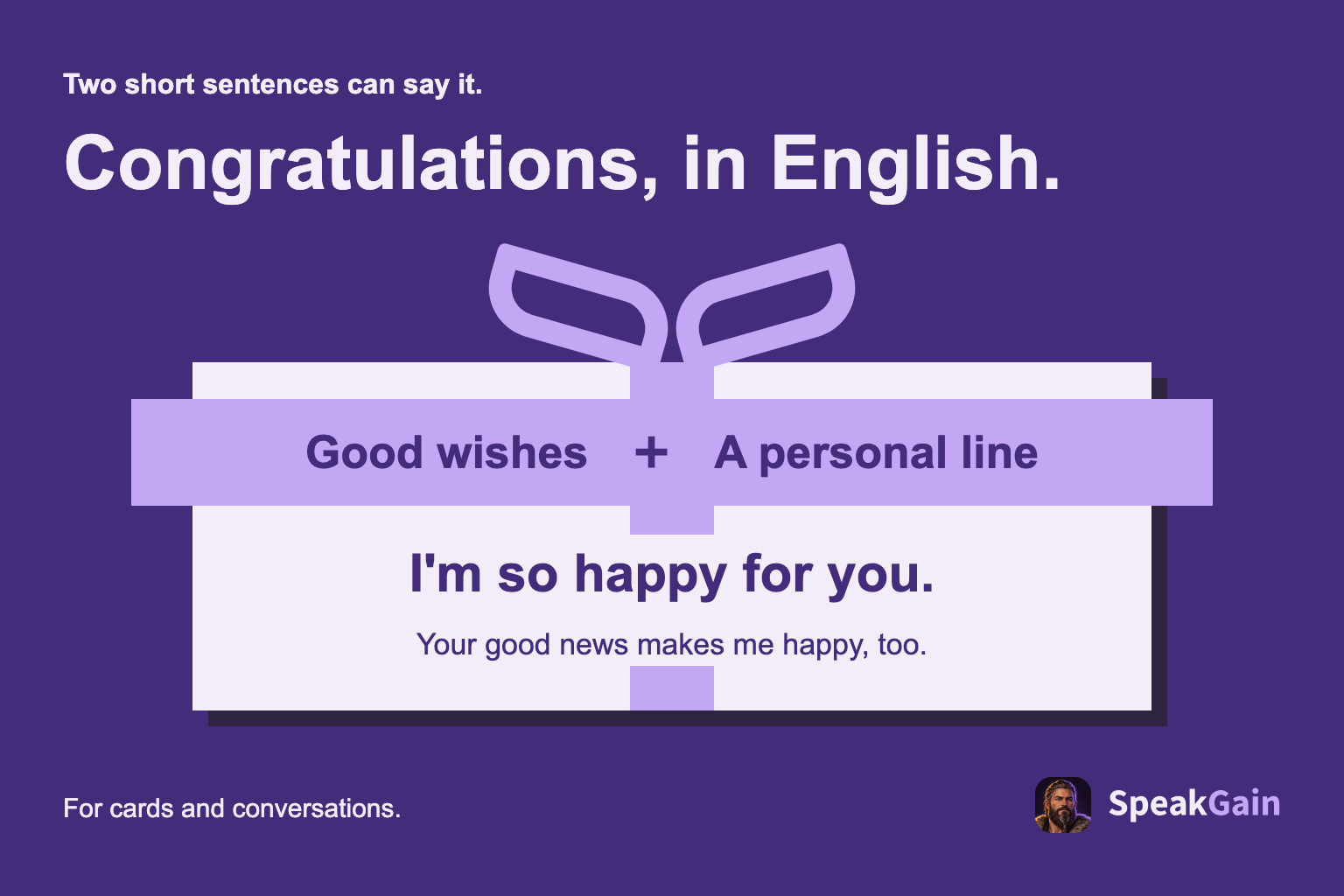
For birthdays, New Year and holidays, start with Happy birthday!, Happy New Year! or Happy holidays!. For an achievement or happy life event, use Congratulations!, adding the occasion with on: Congratulations on your promotion! Weddings and new babies also fit: Congratulations on your wedding! and Congratulations on your new baby!.
Our recommendation: learn these two starting patterns before collecting alternatives, then add one honest sentence about the person. You worked so hard for this. recognizes effort you have seen; I’m so happy for you. shares their joy. You do not need a long speech to make good wishes personal.
1. Choose Happy or Congratulations by occasion
If you are looking for another way to say congratulations, first ask whether congratulations is the right greeting. A birthday calls for a wish for the day; a promotion calls for a response to good news. Use the table to choose before worrying about synonyms.
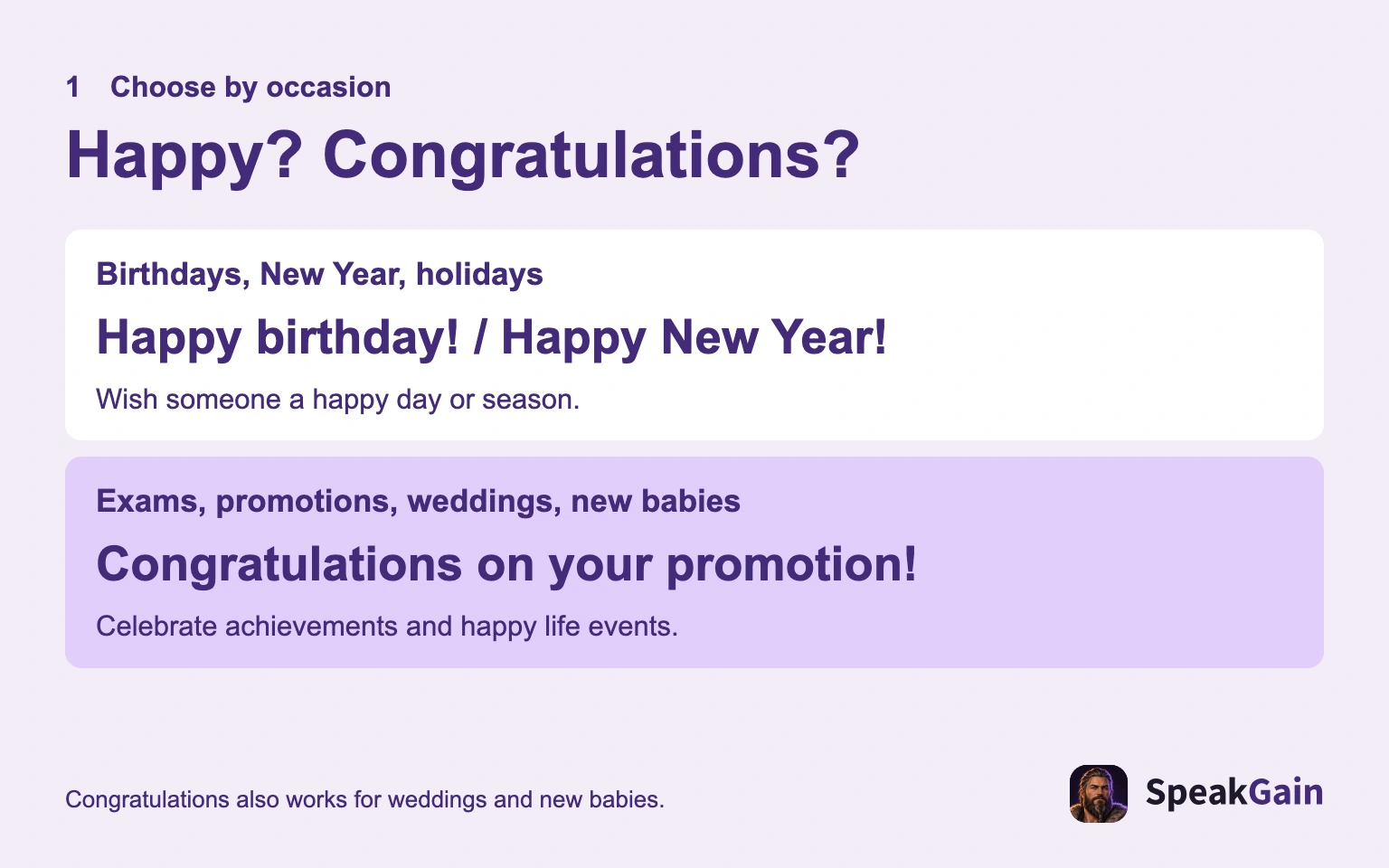
| Occasion | English example | Meaning |
|---|---|---|
| Birthday | Happy birthday! | Happy birthday! |
| New Year | Happy New Year! | Happy New Year! |
| Holiday season | Happy holidays! | Have a happy holiday season! |
| Wedding | Congratulations on your wedding! | Congratulations on your wedding! |
| New baby | Congratulations on your new baby! | Congratulations on the birth of your baby! |
| Passing an exam | Congratulations on passing the exam! | Congratulations on passing the exam! |
| Graduation | Congratulations on your graduation! | Congratulations on graduating! |
| Promotion | Congratulations on your promotion! | Congratulations on being promoted! |
| New job | Congratulations on your new job! | Congratulations on your new job! |
| Award | Congratulations on winning the award! | Congratulations on winning the award! |
Collins records happy as a good-wish greeting, including birthdays. Oxford includes both achievements and family events under congratulations. It is not limited to success earned through effort. These two patterns are an editorial starting point, not a complete inventory of celebrations; Merry Christmas! is another familiar greeting.
2. Birthdays and New Year: add a wish
Happy birthday, Alex! is already a complete birthday greeting. Add I hope you have a wonderful day. if you want a second sentence. A longer phrase does not automatically show more respect.
More examples and details
For family: Happy birthday, Mom! I’m so glad we can celebrate together. Use that only if you can actually celebrate together. From a distance, I hope you have a lovely day. is enough. To a colleague: Happy birthday! I hope you have a great day. You do not need to mention age or private plans.
For a work contact: Happy New Year! I look forward to working with you again this year. Leave out again if this is a new working relationship. Happy holidays! can cover the holiday season; it is not a rule for every holiday everywhere. Our advice is to choose a broad seasonal greeting when you do not know the recipient’s traditions, and a specific greeting when you do.
3. Weddings and new babies: celebrate their news
To a friend: Congratulations on your wedding! I’m so happy for you. To both partners: Congratulations to you both! For an engagement announcement, change the occasion to your engagement. Respond to the event they have actually shared.
More examples and details
A card can say Congratulations on your wedding. Wishing you both a wonderful life together. We do not impose a universal ban on congratulating a bride: Oxford includes congratulations as a response to news of marriage. Follow the couple’s preferences and the event’s customs when relevant.
For a birth: Congratulations on your new baby! You can celebrate without specifying the baby’s sex. I’m so happy for you and your family. adds shared joy. Distinguish pregnancy news from a birth announcement. Our editorial advice is to celebrate the news without adding questions about future children. In a social comment, do not disclose an event the person has not made public.
4. Put the occasion after on; keep the s
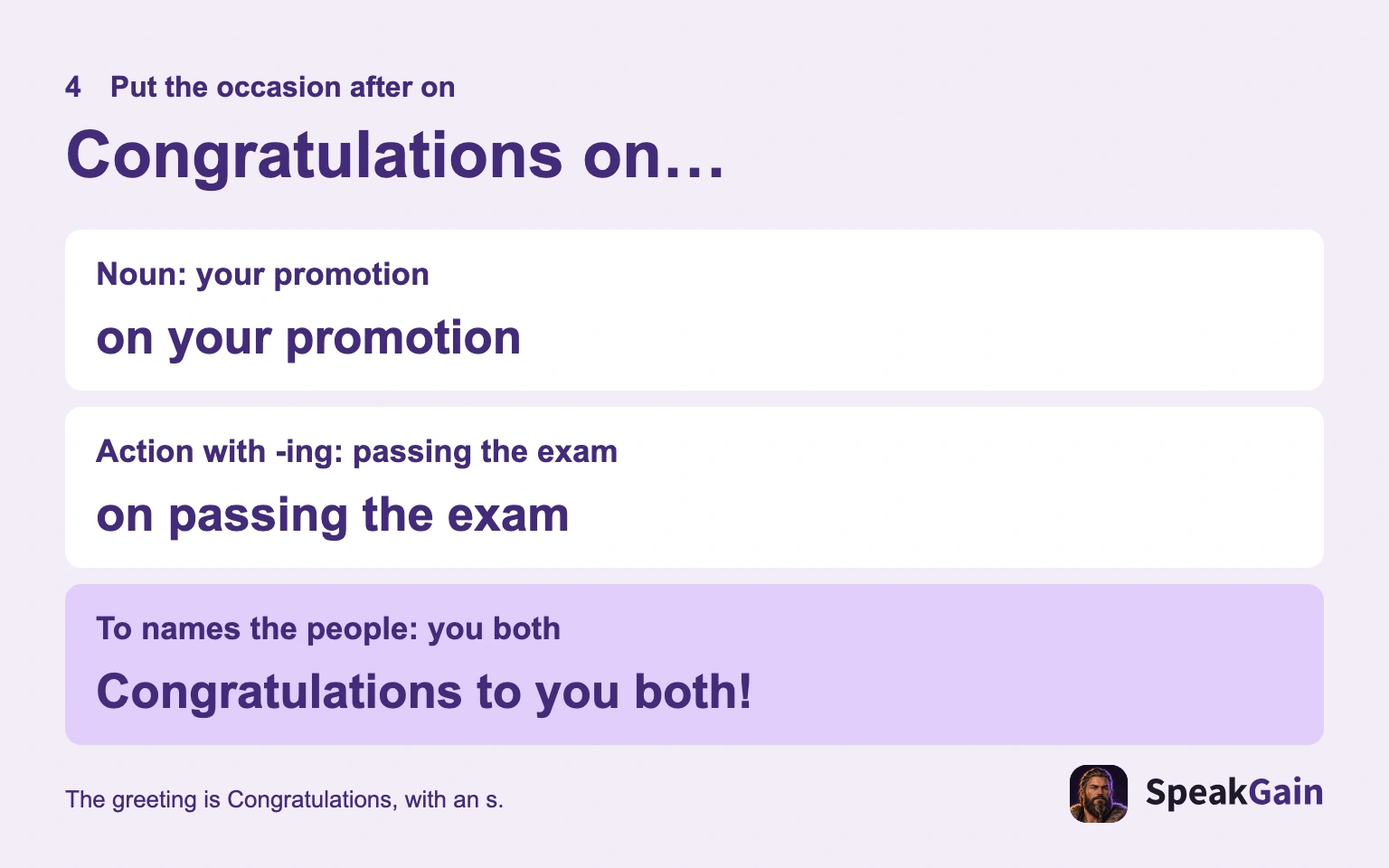
Congratulations! works alone. To name the occasion, use Congratulations on plus a noun or an -ing form: your graduation, your promotion, passing the exam or winning the award. Cambridge gives examples with on passing. Practise on passing the exam, rather than on pass the exam or on you passed the exam.
More examples and details
To names the people, while on names the occasion: Congratulations to you both on your wedding! You can also stop at Congratulations to you both! rather than making every spoken greeting long.
Why the s? Oxford treats the message of good wishes as plural and gives Congratulations! as the greeting. Use that established plural form even when one person congratulates one other person. Do not invent a story about “many happy feelings.” The noun also has another use for the act of congratulating, as in a letter of congratulation; it is not always plural in every context.
Congrats! is an informal abbreviation. Keep the full form for a formal card or a work contact you do not know well. For a new job, use Congratulations on your new job! I hope you enjoy your new role. For a contract win, Congratulations on winning the contract! Celebrating a milestone differs from evaluating everyday work: Great work on the presentation. is praise.
5. Make it personal, at the right distance
Use the following relationship guide as an editorial starting point, not a universal politeness ranking. A boss does not automatically require a different congratulatory word. Your usual relationship, choice of name, abbreviation and next sentence matter.
| Person | English example | Suggested line and distance |
|---|---|---|
| Friend | Congrats on your new job! I’m so happy for you. | Casual; share your happiness about the new job. |
| Colleague | Congratulations on your promotion! You worked so hard for this. | Full form; mention effort only if you saw it. |
| Boss | Congratulations on your promotion. I wish you all the best in your new role. | Offer wishes for the new role without grading their effort. |
| Client | Please accept our congratulations on your promotion. We wish you continued success. | A formal message; our represents your organization. |
You worked so hard for this. suits a colleague or friend whose effort you have seen. With a distant boss or client, do not pretend to have watched their journey or position yourself as their evaluator. I wish you all the best in your new role. offers a wish instead. I’m so happy for you. expresses your joy for them. Write our for an organization and my for yourself when using a formal message.
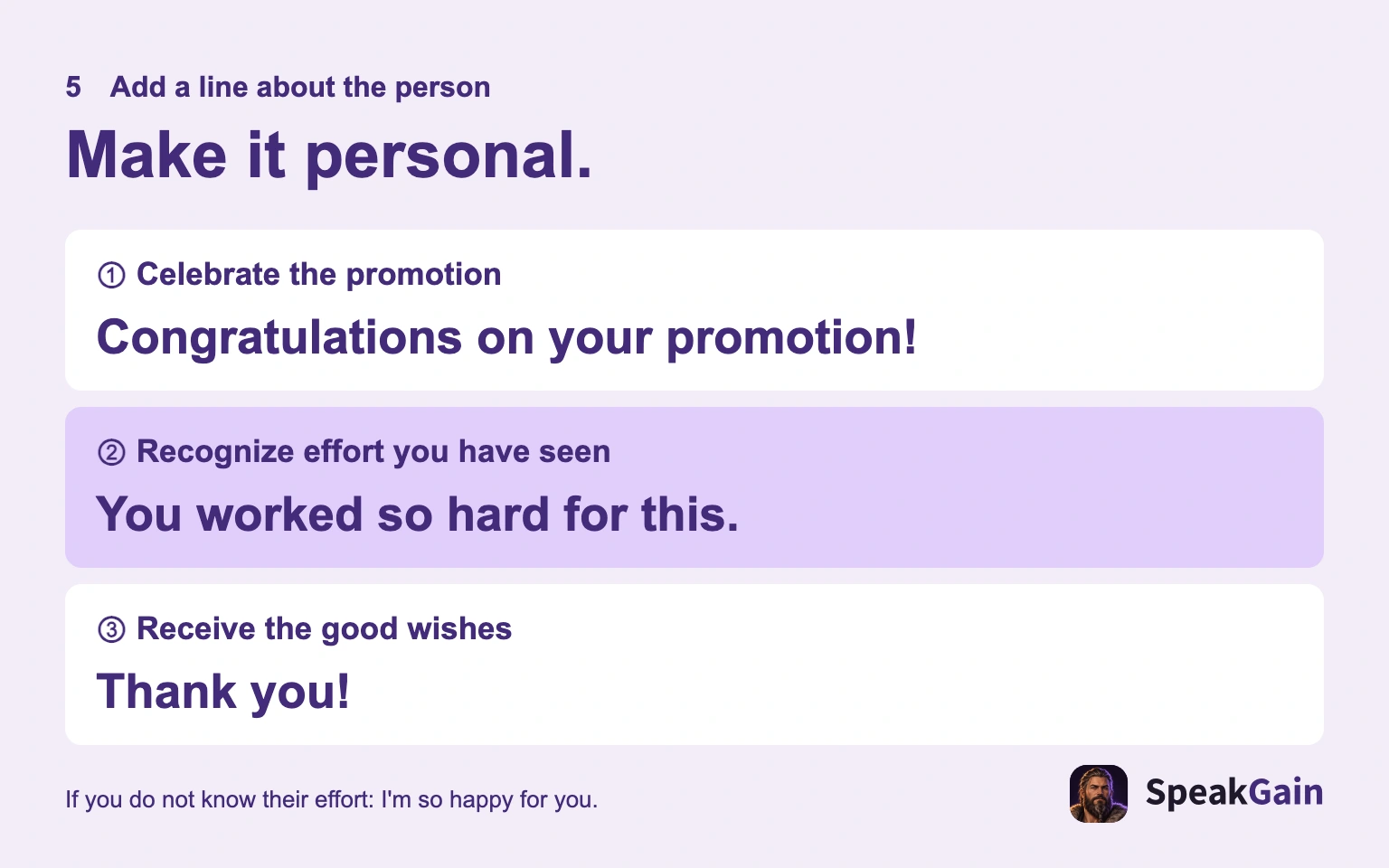
Our view: one true personal sentence beats a grand claim about someone’s lifelong dream. If you know little about the circumstances, good wishes alone are enough.
6. Cards, messages and social comments
For a card, use a greeting, congratulations, one personal sentence, then a closing and your name. A chat or public comment can simply use the two sentences. These original examples keep the occasion clear.
More examples and details
A wedding card for close friends
Dear Alex and Sam,
Congratulations on your wedding!
I’m so happy for you both.
With love,
Kenta
A promotion email for work
Dear Alex,
Congratulations on your promotion.
I wish you all the best in your new role.
Best regards,
Kenta
With love suits close relationships; it is not the default for a client. Best regards is a work-email option. British Council advises choosing the closing for the relationship and context, also noticing the other person’s usual style.
For a public wedding post: Congratulations! I’m so happy for you both. For a friend’s exam result: Congrats! You worked so hard for this. For a birthday message: Happy birthday! Have a wonderful day. A short social comment does not need Dear and Best regards. Our recommendation is to finish two suitable sentences before searching for a quotation to fill the card.
7. When congratulated, start with thanks
Start with Thank you! You can add Thanks, I’m really excited. for a new job or promotion, or Thank you! I’m excited and a little nervous. if that matches your feelings.
More examples and details
At work, Thank you very much. is a simple fuller reply. Say Thank you for your support. to someone who has actually supported you. For a team award: Thank you! It was a team effort. Receive the good wishes first, then acknowledge others. Oxford also gives thanks as replies to congratulations. There is no need to reject the celebration with a self-deprecating speech. For your birthday, Thank you works; You too is not needed unless it is their birthday as well.
8. Kenta practises a colleague’s promotion
Kenta hears that his colleague Alex has been promoted. He has seen Alex prepare for the role, so he chooses a greeting followed by a line about that effort. Kenta is a fictional example, not a customer testimonial. The short exchange uses the same three English practice sentences in every language.
Kenta: Congratulations on your promotion! You worked so hard for this.
Alex: Thank you!
1. Save a sentence you will say
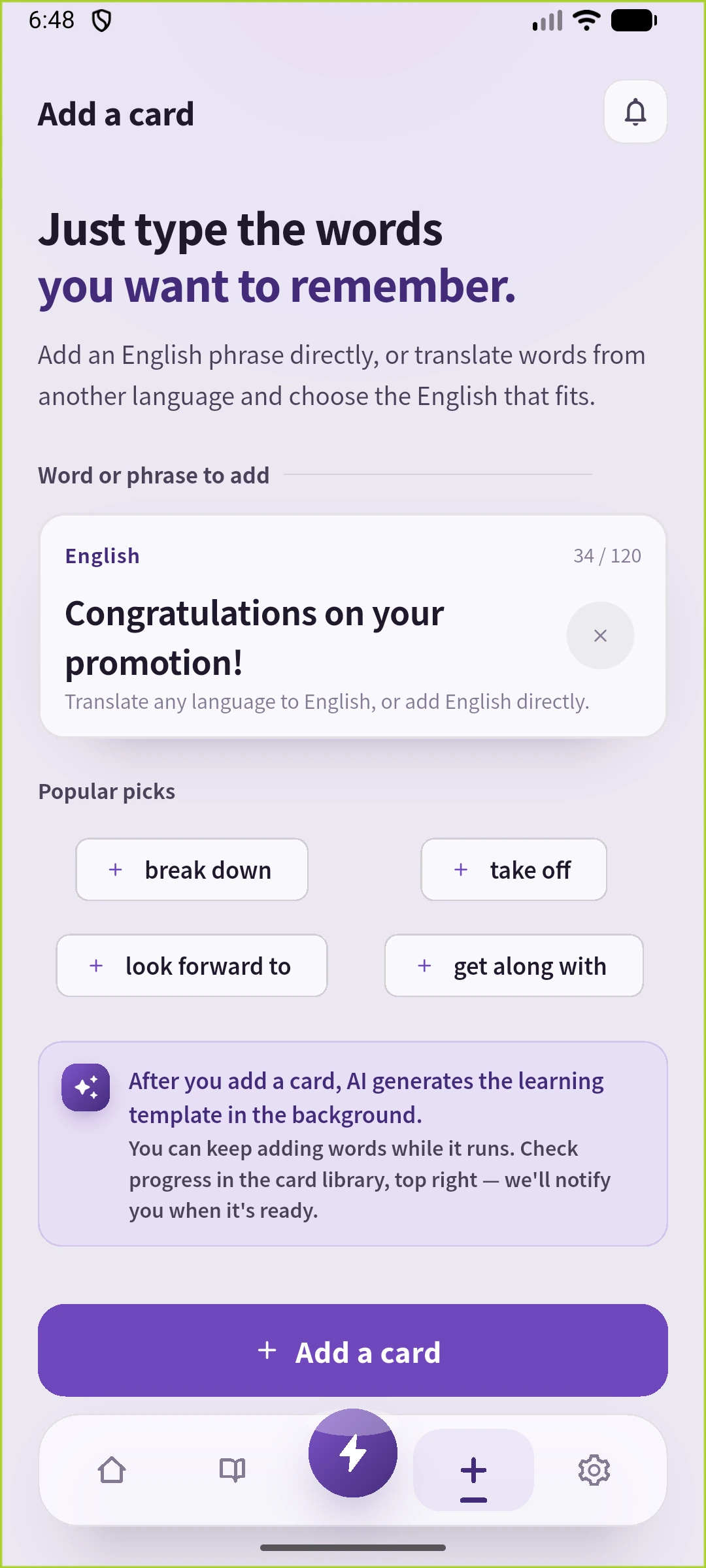
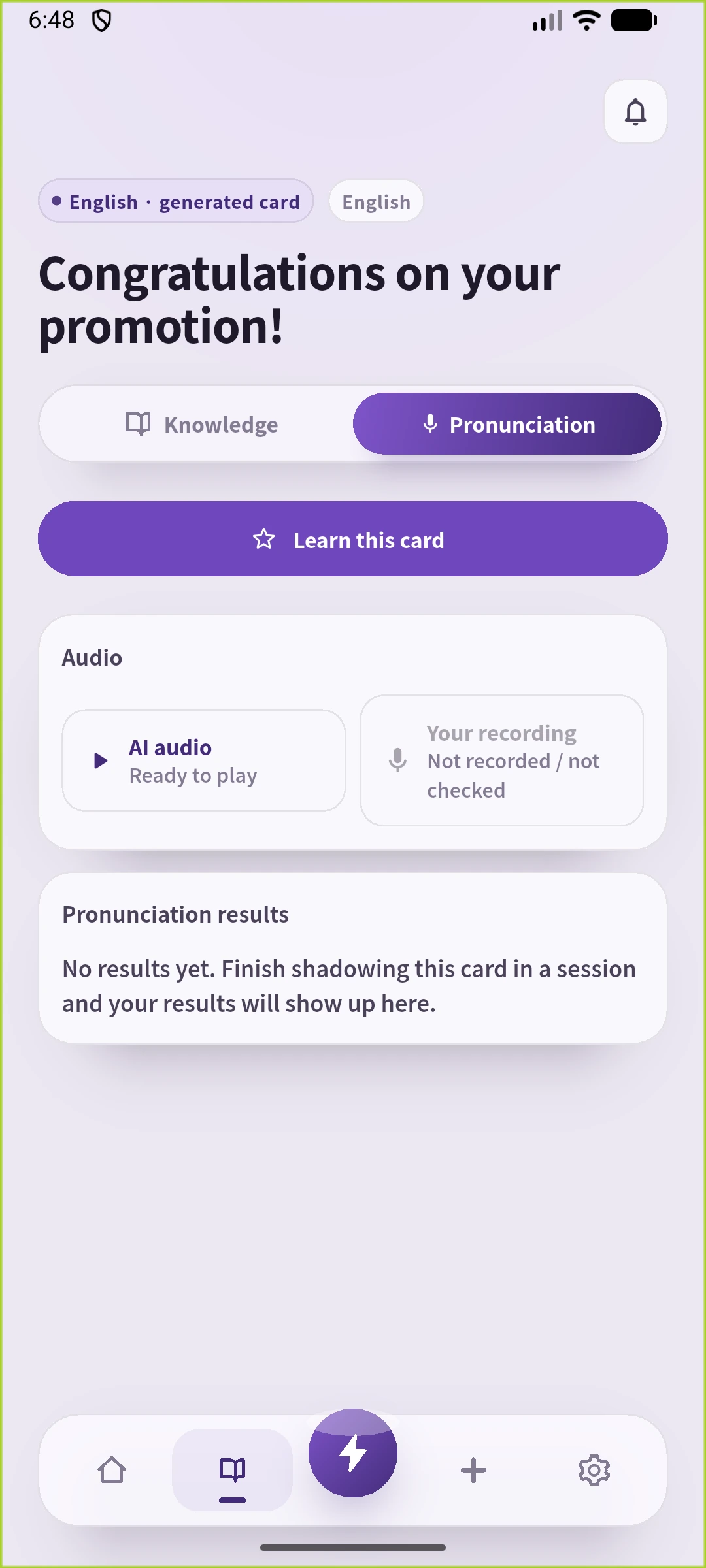
Save the first sentence through SpeakGain’s normal Add flow, then listen to it and say it aloud. The authentic screenshots use English UI and show the saved promotion sentence, rather than a translated explanation screen. Choose the sentence you will actually need instead of saving the entire table at once. what is SpeakGain
2. Listen, then say each sentence
The three clips below were generated with SpeakGain’s Deep-voiced Viking. Listen once, stop the clip and say one sentence. If Congratulations feels long, say that word first and then join on your promotion. Your first goal is to finish the sentence, not to match the voice’s exact speed.
Congratulations on your promotion! — Congratulations on your promotion!
You worked so hard for this. — You worked so hard for this.
Thank you! — Thank you!
3. Recall it from the scene
Hide the English and recall it from “a colleague’s promotion,” “effort I saw” and “their reply.” Check only the missing part, then try again from the scene. At a later review, attempt recall before rereading. Karpicke and Roediger’s 2008 study used college students learning Swahili–English word pairs; continued retrieval after a correct answer helped one-week recall. It did not measure congratulatory conversations or SpeakGain. We use it as a basis for recommending recall, not as proof of an app effect.
After practising, change the scene to a new job and replace your promotion with your new job. For a birthday, switch the starting pattern to Happy birthday. Add new occasions gradually.
9. Choose two sentences for one person
Our advice is to choose two sentences for the next person you want to celebrate. Use Happy for the day or season; Congratulations for achievements and happy life events. Name the occasion with on plus a noun or -ing form, keep the s in the greeting, and add a personal line you can honestly say. When receiving good wishes, start with thanks.
Listen once, then say your chosen lines without looking. The point is a useful greeting for a real person, not a collection of impressive phrases.
For detailed feedback on good work, see English compliments.
For more ways to respond with thanks, see saying thank you in English.
For opening a conversation, see English greetings and How are you.
For planning your review, see how to study English.
References
- Collins: happy
- Oxford: congratulation
- Cambridge: congratulate
- Oxford: congrats
- British Council: How to sign off an email in English
- Karpicke & Roediger (2008), The Critical Importance of Retrieval for Learning
For a friend facing an exam or presentation, choose an encouragement line by timing—and a reply for your own effort—in how to say ganbatte in English.