
How to order food in English: short phrases and replies for every stage
Published Updated
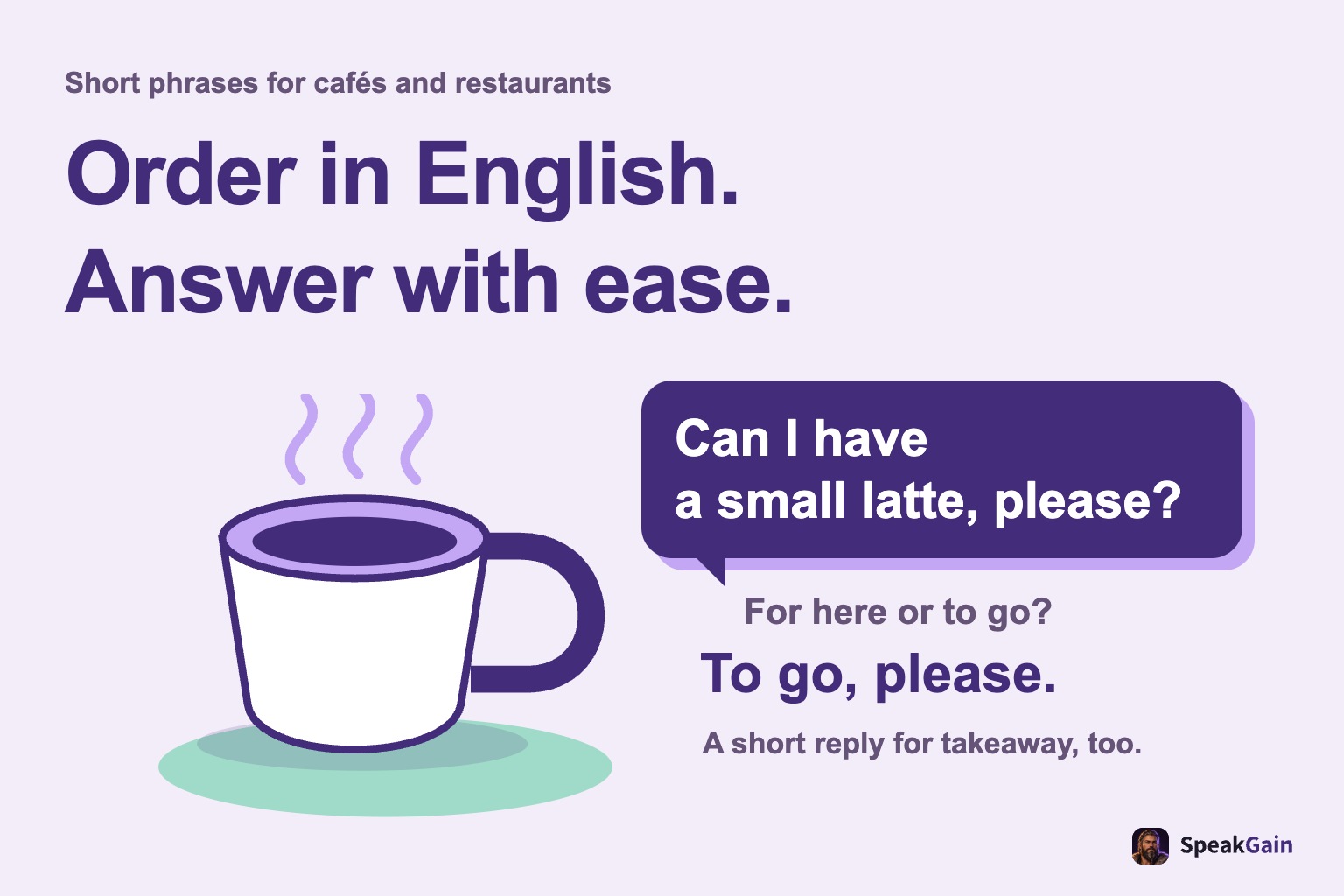
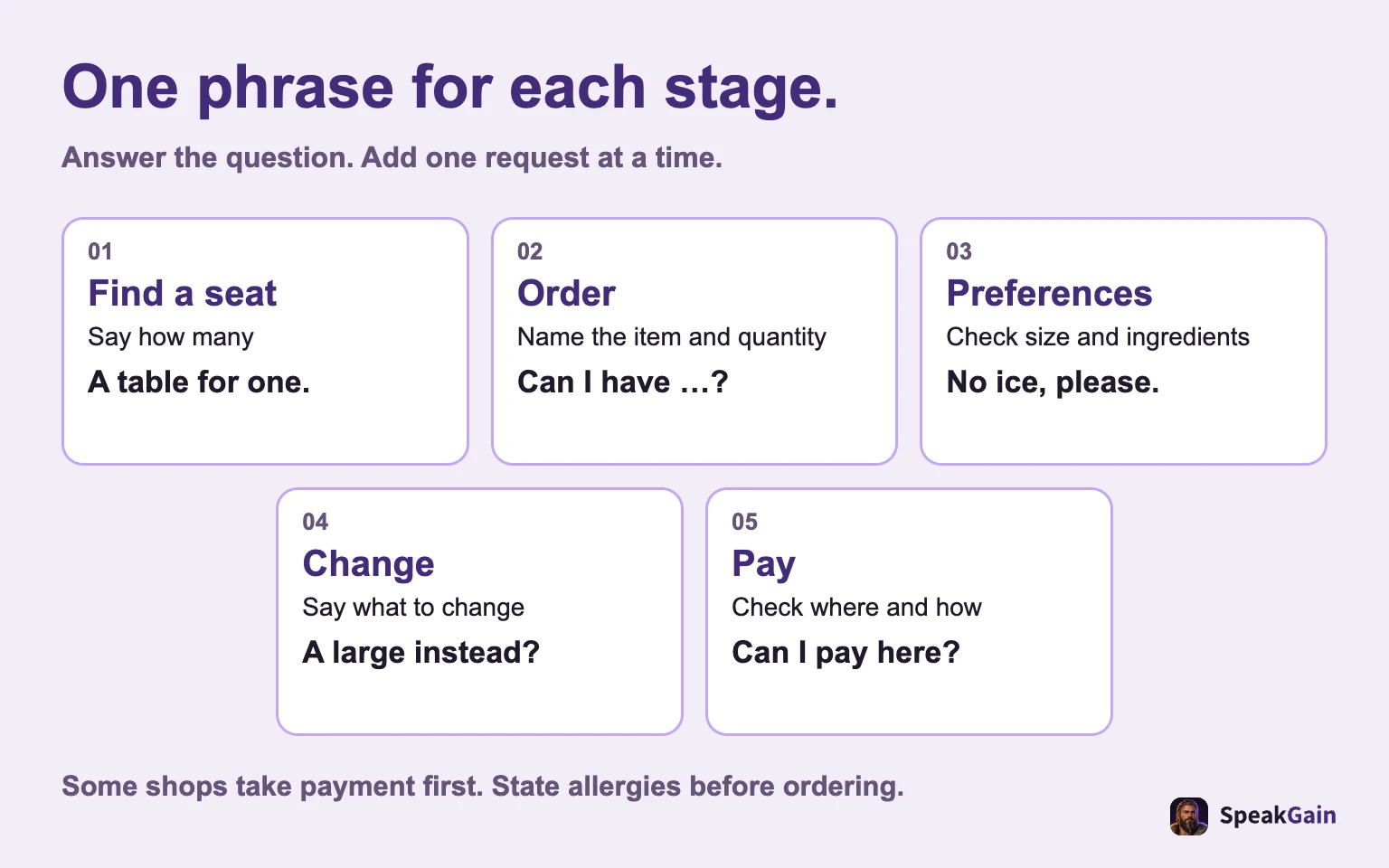
Start with Can I have a small latte, please? Then answer the question staff actually ask: Small, please for size or To go, please for takeaway. Think in stages—seat, order, preferences and allergies, changes, payment—but follow the shop’s procedure; a counter-service café may take payment before you sit down.
Prepare beyond the meal with travel English for eight scenes, adapting airport, hotel and trouble lines to your itinerary.
For the staff side of taking an order, practise customer-service phrases for choosing and confirming with your actual products, quantities and sizes.
Our editorial recommendation is to learn five functions first: ordering, choosing eat-in/takeaway, finishing the order, asking for repetition and asking for the bill. This is an editorial starting point, not a scientifically established optimum. Practising a reply matters as much as memorising the opening request.
For food that looks tempting, tastes good or made a great meal, choose a food compliment in English by timing and add one detail you liked.
1. Get a seat and answer the reservation question
At a restaurant entrance, try A table for one, please or A table for two, please. If the seating procedure is unclear, ask Can I sit here? rather than assume every café uses the same system. Use the real name on your booking, not a newly invented English name.
Staff: Do you have a reservation?
Customer: Yes, under Morgan.
No booking: No, I don’t. A table for one, please.
Seating questions and replies
| Staff | Customer | Meaning |
|---|---|---|
| How many people? | Just one, please. | One guest |
| Inside or outside? | Inside, please. | Choose the seating area |
| There’s a twenty-minute wait. | That’s fine. | Accept the wait |
| There’s a twenty-minute wait. | Thank you, but we’ll try somewhere else. | Decline |
| Is this table OK? | Yes, thank you. | Accept the table |
Ask Could we have a moment? if you need to discuss the wait. Could we sit outside? is a request; correct English does not guarantee an available table. In a counter-service venue, go straight to the order when directed. The British Council restaurant lesson includes asking for a table.
2. Name the item and quantity, then choose an answer
Put the menu name into Can I have …, please? Other useful options are I’ll have the soup, please and I’d like a sandwich, please. Could I have two teas, please? asks for two servings. Oxford’s coffee entry also illustrates counting cups as coffees. You can say two cups of coffee to make the unit explicit.
We recommend one dependable request rather than ten competing openings. If a dish name is difficult, indicate the menu entry and say This one, please, then check that staff identified the same item. This is practical advice, not a claim that pointing has identical cultural meaning everywhere. British Council describes can/could requests; could can make a request more tentative. Longer is not automatically more polite.
The follow-up questions to practise
| Staff | Customer | What the reply does |
|---|---|---|
| Are you ready to order? | Yes. I’ll have the soup, please. | Starts the order |
| Are you ready to order? | Not yet. Could we have a little more time? | Requests time |
| What can I get you? | A small latte, please. | Names the item |
| Small or large? | Small, please. | Chooses a size |
| Hot or iced? | Iced, please. | Chooses temperature |
| For here or to go? | To go, please. | Chooses takeaway |
| Anything else? | No, that’s all, thank you. | Nothing to add |
| Is that everything? | Yes, that’s all, thank you. | Confirms the complete order |
Yes does not select between small and large. Also notice the opposite yes/no orientation of Anything else? and Is that everything? When unsure, say the content: That’s all, thank you. To add something, use And a bottle of water, please. Decline an offer with No, thank you; you need not give a long reason. The British Council café dialogue covers size, takeaway and changing a drink.
3. Separate preferences, dietary restrictions and allergies
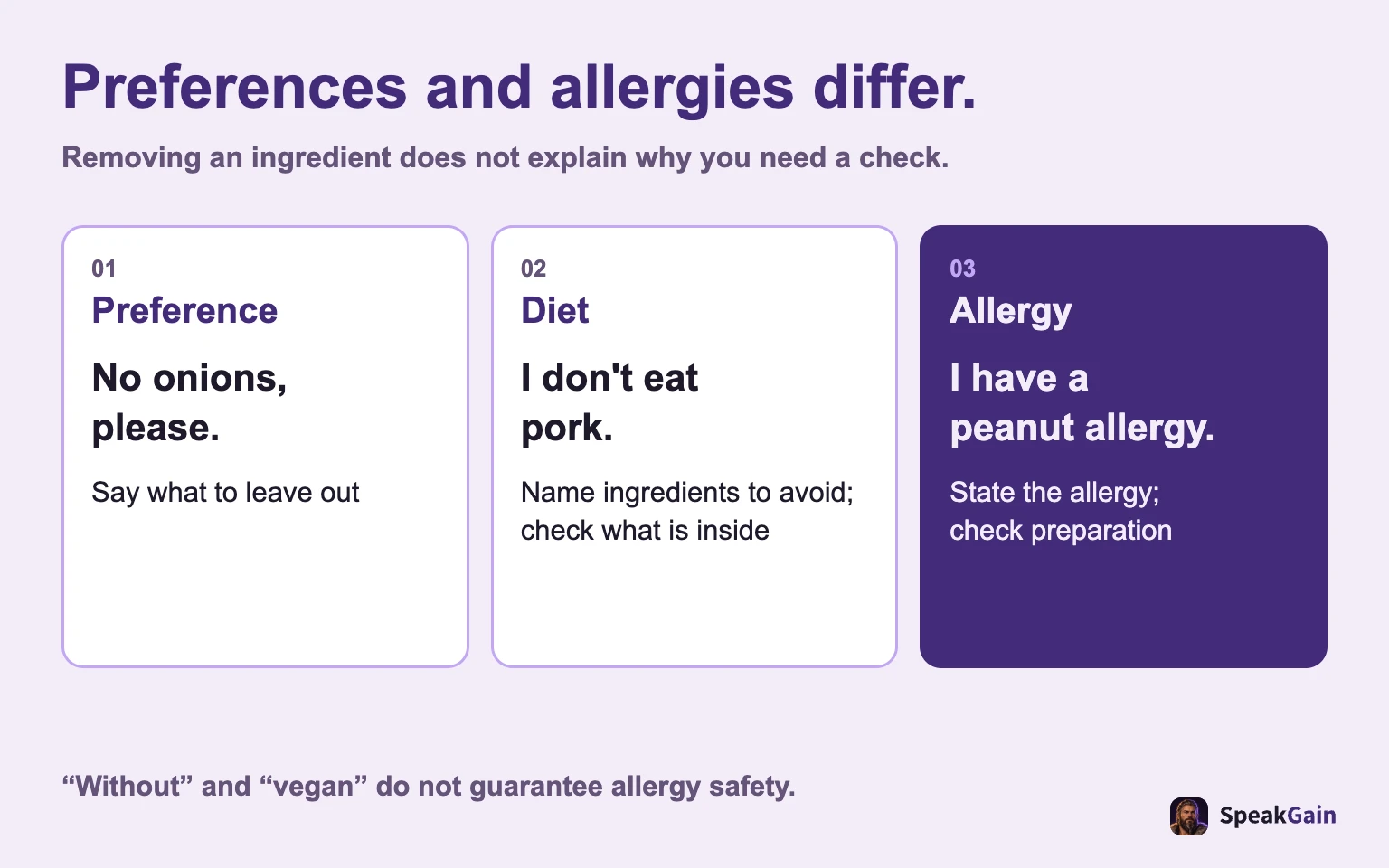
No ice, please states a preference. Could I have the sauce on the side? asks for separate sauce. I don’t eat pork. Does the broth contain pork? states a dietary restriction and checks an ingredient. If a halal requirement matters to you, ask about your actual requirements and preparation; a pork-free description alone is not certification.
For an allergy, say I have a peanut allergy. Could you check the ingredients and how it’s prepared? A milk allergy needs explicit disclosure, not just Oat milk, please. UK Food Standards Agency guidance recommends clear disclosure and checking cross-contact. Vegan labelling is not an allergy-safety guarantee; if understanding remains inadequate or you are unsure, ask a responsible staff member and do not eat there if doubts remain. These phrases communicate needs; they cannot make a dish safe.
Requests and ingredient checks
| Need | Phrase |
|---|---|
| Remove onions | Could I have it without onions? |
| Check spice | Is this spicy? |
| Change milk | Could you use oat milk? |
| Avoid meat | I don’t eat meat. Does this contain any meat? |
| Egg allergy | I’m allergic to eggs. |
| Check an extra cost | Is there an extra charge? |
Answer Any allergies? with the actual allergen, for example Yes, I’m allergic to eggs. Answer Without onions? with Yes, please, and a sauce-location choice with On the side, please. Our editorial position is to keep preference and health-related need distinct, and never infer availability of substitutes.
4. Change one detail or ask to hear it again
Actually, could I have a large instead? requests a size change. Could I change my order to a tea? names a replacement. Preparation may already have started; ask whether a change is possible. Reply Yes, please to A large instead? if that is the change you want.
Corrections, additions and repetition
| Phrase | Use |
|---|---|
| Could I have another glass of water? | Add another serving |
| Excuse me, I ordered a hot latte, but this is iced. | Explain a mismatch |
| Could you say that again, please? | Ask for repetition |
| Could you speak a little more slowly, please? | Ask for slower speech |
| Did you say small or large? | Check the options you heard |
| How much is another coffee? | Check the price of another serving |
Do not repeatedly say yes to something you did not understand. Iced? can confirm a word, but one recognised word is not enough to settle an allergy discussion. Describe what you ordered and received without assuming blame. Another serving is not necessarily a free refill.
5. Ask where and how to pay
Could I have the bill, please? asks for the bill; check is also used for a restaurant bill in American English (Cambridge). Do I pay here? checks the location. At a counter, follow the total and payment instructions.
Payment questions and replies
| Staff or need | Reply or request |
|---|---|
| Cash or card? | Card, please. |
| Together or separately? | Separately, please. |
| Would you like a receipt? | Yes, please. |
| Card acceptance | Can I pay by card? |
| Separate payments | Could we pay separately? |
| Equal split | Could we split the bill equally? |
| Service charge | Is the service charge included? |
| Unclear item | What is this charge for? |
Separate payments and an equal split are different requests. Check before ordering when necessary; restaurants may not support every arrangement. Examine taxes and service charges instead of immediately declaring an error. Ask Could you explain this charge? before selecting unfamiliar payment-terminal options.
Brand USA gives 15–20% as guidance for sit-down dining and notes automatic gratuity/service charges for some large parties. Do not apply that figure indiscriminately to every counter order. Visit London’s 2026 guide suggests 10–15% in restaurants without a service charge; an included charge usually removes the need for another tip. That is London guidance, not a global rule. We recommend checking the bill and destination guidance rather than memorising a universal percentage.
6. Choose the venue’s vocabulary and fix usage, not just words
Cafés may ask about size, milk, temperature and takeaway. Restaurants may start with a reservation and ask separately about drinks and food. Fast-food menus may offer a meal or combo: ask What comes with the meal? or reply Just the burger, please. Use the actual menu wording; do not assume every venue has table service or a staffed counter.
US to go and UK take away are distinguished in BBC material; neither is the only phrase understood in its country. To To eat in or take away?, answer Take away, please if that is your choice. Collins defines the takeaway sense of to go.
Four useful usage fixes
| Starting point | Better for this task | Why |
|---|---|---|
| I eat a sandwich. | Can I have a sandwich, please? | A request, not a statement about eating |
| Can I have latte? | Can I have a latte, please? | One serving |
| Yes, to Small or large? | Small, please. | An actual choice |
| I want the soup. | I’d like the soup, please. | A more tentative ordering pattern |
Have includes eating/drinking senses (Cambridge, British Council). Do not ban eat: I don’t eat meat and eat in have valid uses. I want is not a grammatical error, and Can I get …? is also used for orders. We choose have as one flexible starting pattern, not the only correct form.
7. Staff: take the order and check it back
When serving English-speaking guests, ask one menu-relevant question at a time. Do not assume visitors know your dish names or local payment procedure. Show a menu description or photograph when helpful, and explain where payment actually happens.
| Phrase | Purpose |
|---|---|
| Are you ready to order? | Start |
| Take your time. I’ll come back in a moment. | Give time |
| What size would you like? | Check size |
| For here or to go? | Check service format |
| So, one small latte to go? | Confirm the whole order |
| Anything else? | Ask about additions |
| I’ll check with the kitchen. | Verify ingredients/preparation |
| Please pay at the counter. | Explain the actual payment location |
Use the last instruction only if it matches your venue. Do not memorise No problem as an allergy response to an unchecked dish. Our position is to promise a check, follow the venue’s procedure and confirm unfamiliar ingredient names before passing the request on.
8. Alex orders a latte and answers the follow-up
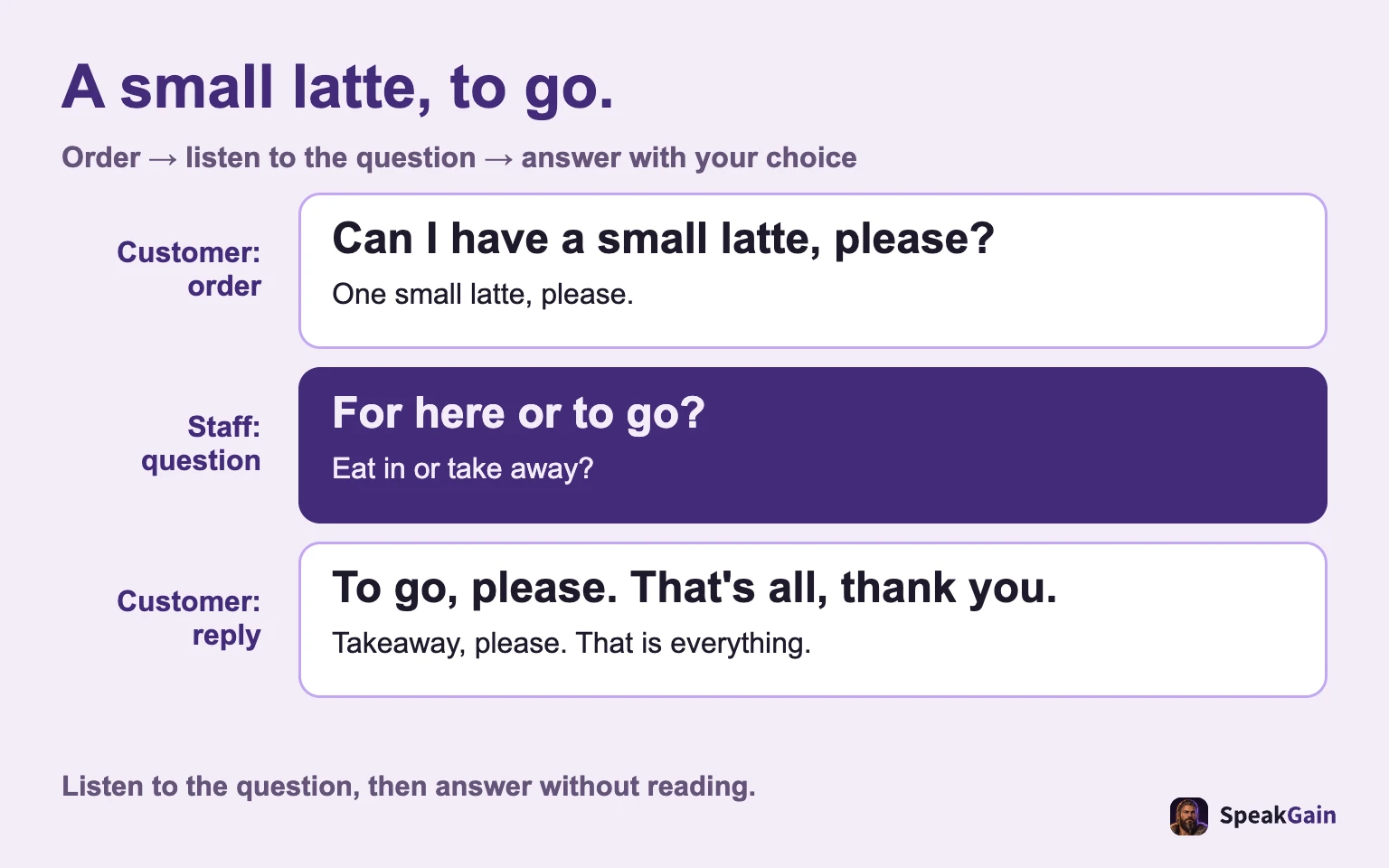
Alex is a fictional learner visiting a café, ordering one small latte to take away. The three English practice sentences remain identical in every language edition. Alex orders, hears For here or to go?, and answers To go, please. That’s all, thank you. If payment is by card in this scenario, the next answer is Card, please, not the whole order repeated.
Save just the sentences you need
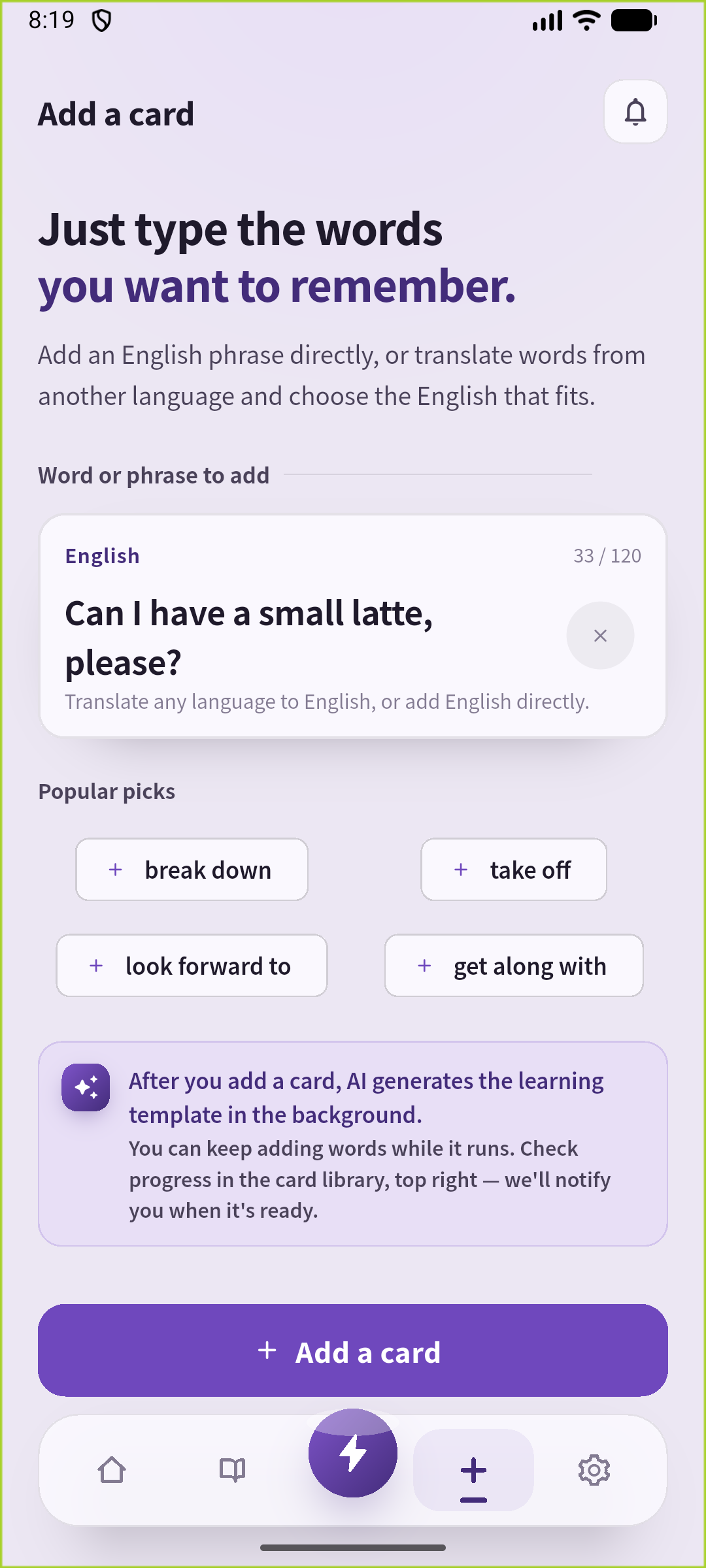
Create a card in SpeakGain’s Add screen with the sentence you want to practise. We saved these three sentences separately. We recommend starting with one item you would order and its likely follow-up, rather than importing a whole phrase list.
Listen, pause and answer
The three clips use SpeakGain’s Deep-voiced Viking AI voice. Staff and customer use the same voice here. This is separate sentence playback, not an automatic role-play partner. Real voices and speaking speeds vary; one voice cannot prepare you to understand everyone.
Customer: order: Can I have a small latte, please?
One small latte, please.
Staff: question: For here or to go?
Eat in or take away?
Customer: reply: To go, please. That's all, thank you.
Takeaway, please. That is everything.
Say the order, then play the question. Answer yourself before playing the reply. Pause after To go, please if you need to, then add That’s all, thank you. Getting the choice across matters more than speed.
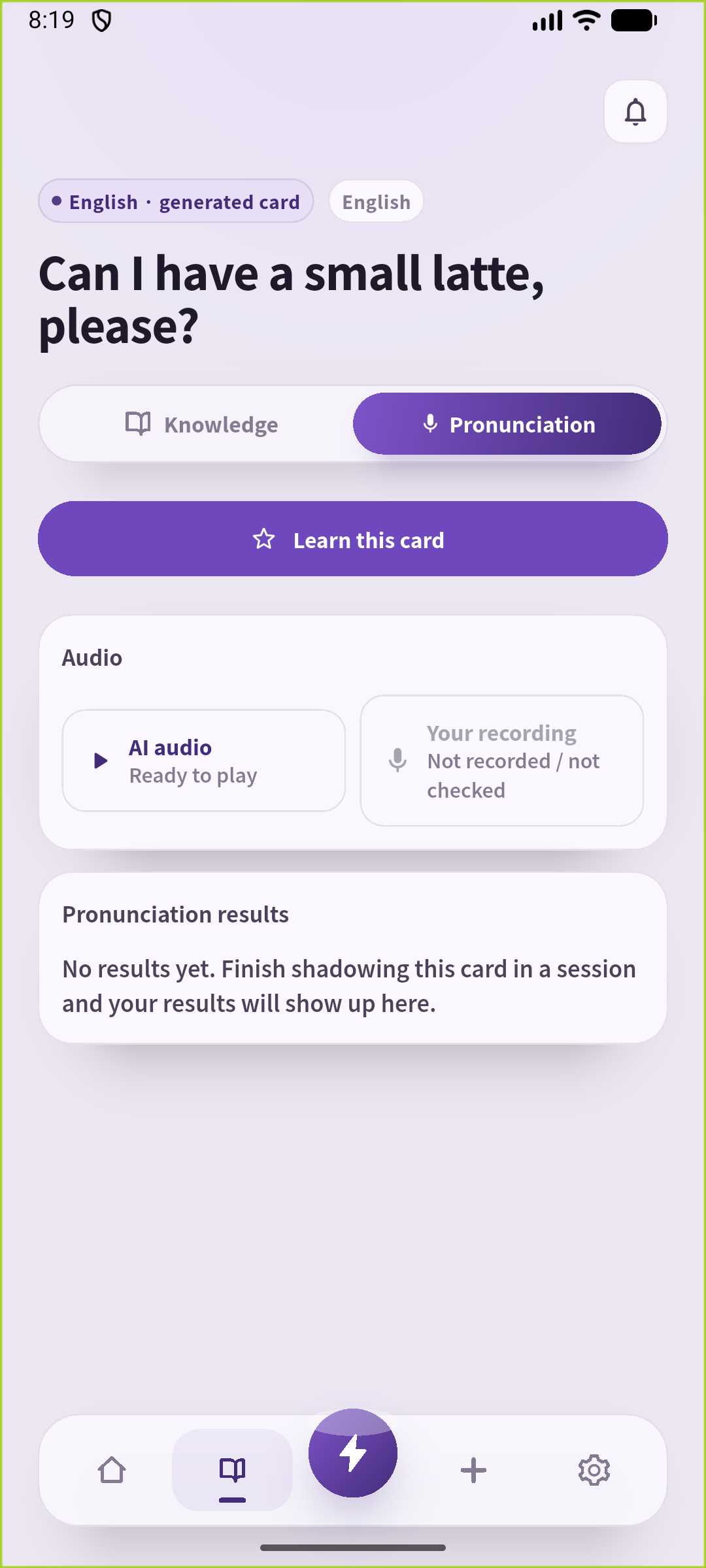
Hide the text and retrieve the reply
Use the situation “a small latte to take away” as your cue. If you hesitate, look once and hide the text again. Change the situation to eat-in and answer For here, please. Karpicke and Roediger’s original 2008 study found a benefit of continued retrieval after correct answers for university students learning foreign-language word pairs, tested a week later. It did not test café conversations or SpeakGain. Our practice proposal draws on that finding; neither three cards nor conversation improvement from this exercise alone was established by the study.
Tomorrow, swap the menu item and add one size or temperature question. Check quantity and articles when changing items. Build from the conversation you actually want to have.
Common questions
Four questions about ordering
Can I have or I’ll have?
Start with Can I have …, please? for a reusable request. I’ll have … states a choice. Both work; practise the next question too.
What if I cannot hear staff?
Ask Could you say that again, please? Then answer the choice you understood. Do not guess allergy-related explanations.
Is takeaway always to go?
No. Take away is useful with UK wording. Match the staff member’s options rather than insist on one phrase.
Is No peanuts enough for an allergy?
It may sound like a preference. State I have a peanut allergy and request ingredient/preparation checks. Removing a topping or a vegan label is not a guarantee.
Practise the next cup from request to reply
Try the three-line café scene once without looking. Before adding more phrases, connect your order to the staff member’s question and your own short answer.
For what to say once the food arrives, English meal phrases and the meaning of itadakimasu helps you choose by timing and by whom you are thanking.
Related reading
- How to study English: choose by your goal and what stops you
- How to give directions in English: short phrases and clear landmarks
- 54 English phone-call phrases: each stage, spelling and asking again
- How to apologize in English: Sorry, Excuse me and Thank you
- What Is SpeakGain? Learn English Phrases with a Character Voice
For choosing a thank you, adding a reason and receiving thanks, practise thanking in English by situation.
Sources
- British Council — Ordering in a café
- British Council — Eating out
- British Council — can and could
- British Council — have / take / make / give / go / do
- Cambridge Dictionary — have
- Cambridge Dictionary — check
- Oxford Learner’s Dictionaries — coffee
- BBC Learning English — takeaway
- Collins Dictionary — to go
- Food Standards Agency — Food allergy and intolerance advice for consumers
- Brand USA — Dining and Tipping
- Visit London — Tipping guide 2026
- Karpicke & Roediger (2008) — The Critical Importance of Retrieval for Learning
When you need staff to help with something, choose a suitable phrase from requests in English.