
How to give directions in English: short phrases and clear landmarks
Published Updated
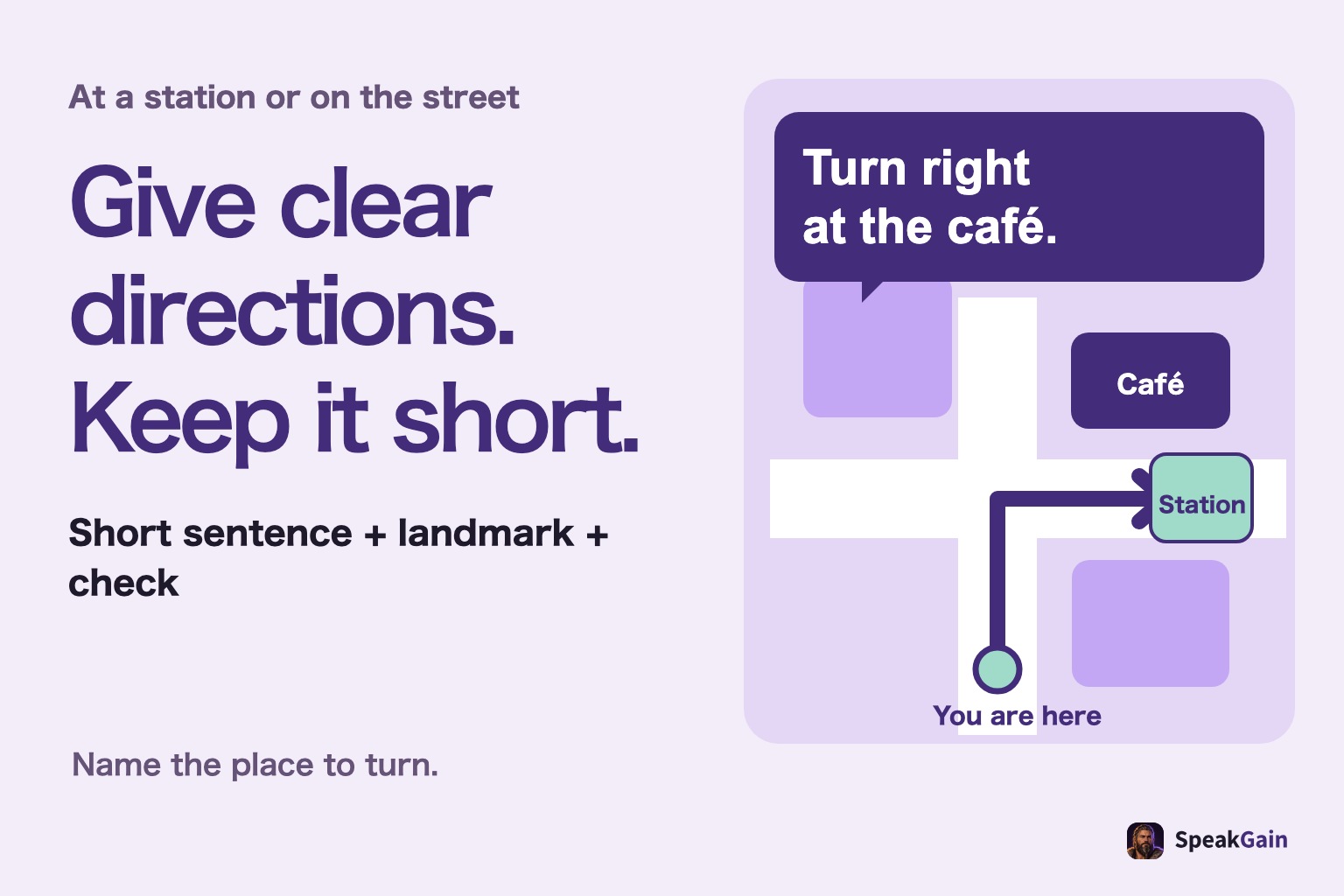
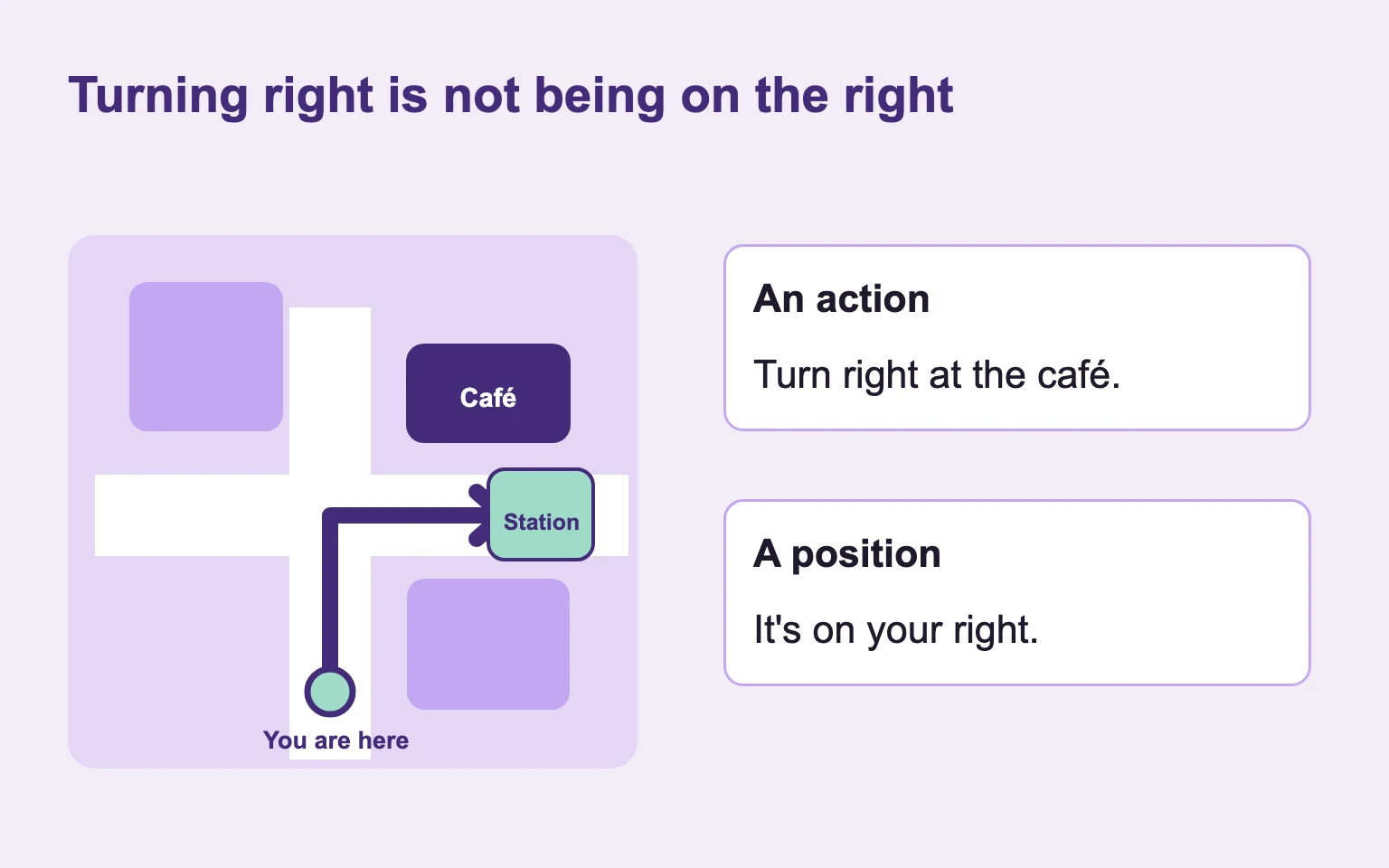
Give directions in English with a short sentence, a landmark and a check. Start with “Go straight.” Add “Turn right at the café.” If the café is visible, ask “Can you see the café?” Give the person one next action rather than an entire route in one breath.
Before departure, practise your directions question alongside transport and hotel lines in our travel English guide.
When guiding people inside your workplace, add customer-service lines for directions, waiting and clarification to practise what the customer should do next.
Our editorial recommendation is to learn five functions first: going straight, turning right, turning left, naming the side, and checking. “Go straight.” “Turn right.” “Turn left.” “It’s on your right.” “Can you see it?” are a useful starting set. Five functions and the three-part template are practical editorial choices, not experimentally established optimum quantities.
1. Check the destination, then give one action
Someone asking for the ticket gates may need neither the platforms nor the ticket machines yet. If you missed the destination, repeat “The ticket gates?” before giving instructions. If they ask for a station, establish whether they are walking there or asking which train to take. “Are you walking?” can settle the difference.
Go straight.
Turn right at the café.
Can you see the café?
The check can come first. Point to the visible café, ask whether they see it, and then say “Turn right there.” If it is beyond the next corner, say “You’ll see a café on your left” instead of asking whether they can see it now. A landmark only helps when both people can identify it.
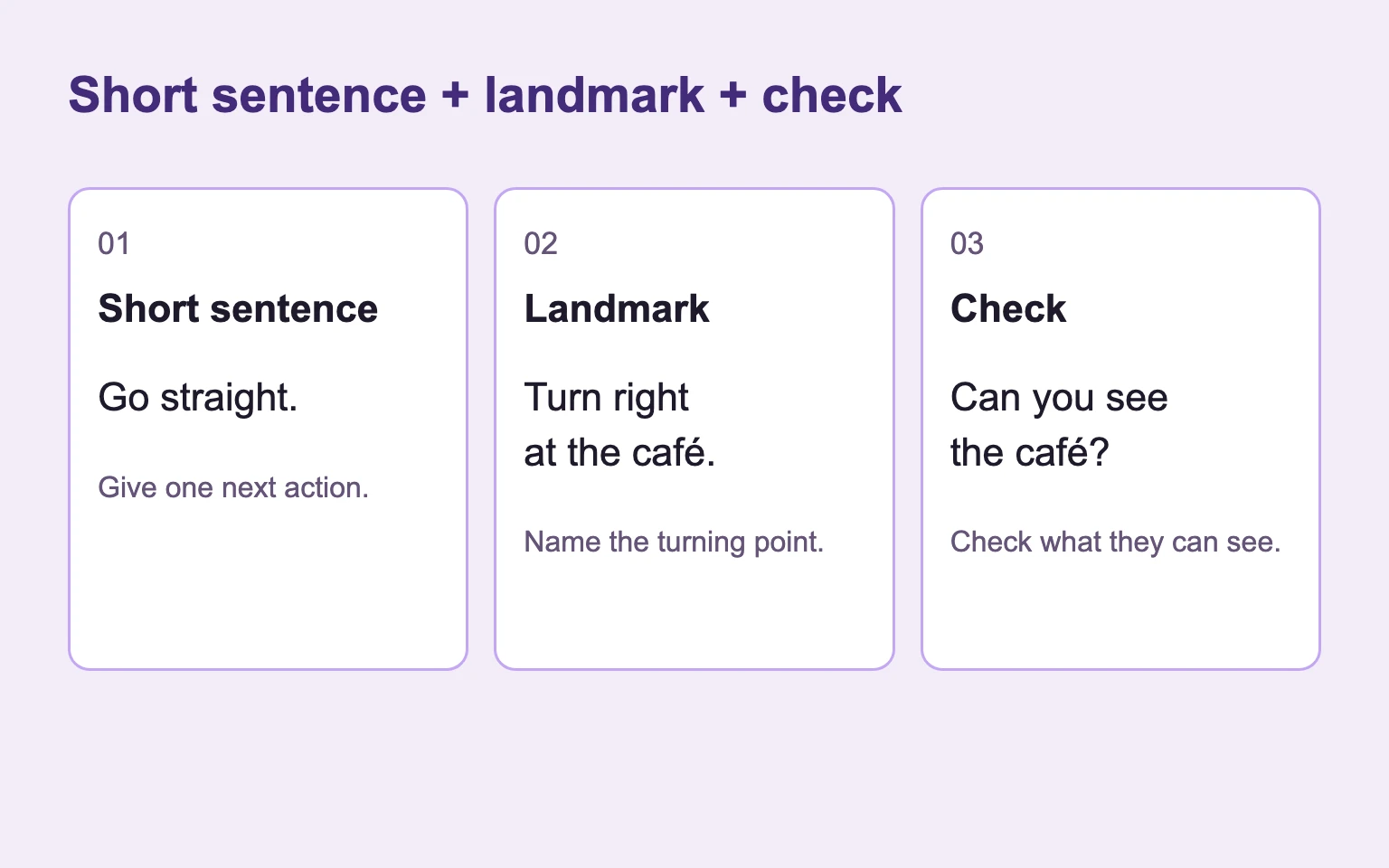
Left and right refer to the traveller’s direction of travel. If you are facing each other, your right is their left. Turn to face the same way when practical, and use “on your right”. We recommend a reliable crossing or building before a chain of three tiny side streets. If the route is complicated, a shared map or a member of staff may help more than extra words.
2. Separate movement, distance and position
“Turn right” tells someone to move; “It’s on your right” says where something is. Don’t instruct a turn merely because a building is on that side. The British Council guide provides examples of these different functions.
Direction and distance phrases to keep handy
| English | Meaning / use |
|---|---|
| Go straight. | Continue without turning. |
| Go straight ahead. / Go straight on. | Alternative forms for continuing straight. |
| Turn right at the traffic lights. | Turn at the lights. |
| Turn left at the next corner. | Turn at the next corner. |
| Take the second right. | Turn at the second road on the right. |
| Walk past the bank. | Continue beyond the bank. |
| Cross the street at the crossing. | Use the crossing to reach the other side. |
| Follow the signs for the exit. | Use the exit signs. |
| It’s about a five-minute walk. | Approximate walking time. |
| It’s about 200 metres from here. | Approximate distance. |
| It’s two blocks away. | Distance in city blocks. |
| It’s just around the corner. | Nearby after a turn. |
“Go straight”, “Go straight ahead” and “Go straight on” describe continuing without turning; the longer forms are not automatically more polite. Metres is British spelling; meters is American spelling. A block is a city block, not a fixed distance. In a winding neighbourhood, a visible junction or an honest walking estimate may be more useful. Add “about” when the time or distance is approximate, and don’t invent a number.
Landmarks and transfers
| English | Meaning / use |
|---|---|
| It’s on your left. | A position on the traveller’s left. |
| It’s next to the convenience store. | Beside the convenience store. |
| It’s opposite the bank. | Facing the bank across a space or street. |
| It’s across the street from the hotel. | On the hotel’s other side of the street. |
| You’ll see a café on your right. | A café will become visible on the right. |
| English | Meaning / use |
|---|---|
| Take the Green Line. | Choose the named line. |
| Take the train to Central Station. | Travel to the named station. |
| Get off at Central Station. | Leave the train there. |
| Change trains at Central Station. | Switch trains there. |
| Transfer to the Green Line. | Switch to the named line. |
| You don’t need to change trains. | Stay on the same train. |
| Take the number 10 bus. | Choose bus route 10. |
| Please ask the station staff about the platform. | Check the platform with staff. |
Central Station and the Green Line are invented language-practice names. For a real journey, check the current signs or ask staff; this is not a transit itinerary. Cambridge’s train guide distinguishes getting on and getting off a train.
3. Choose the first sentence for the setting
At a station
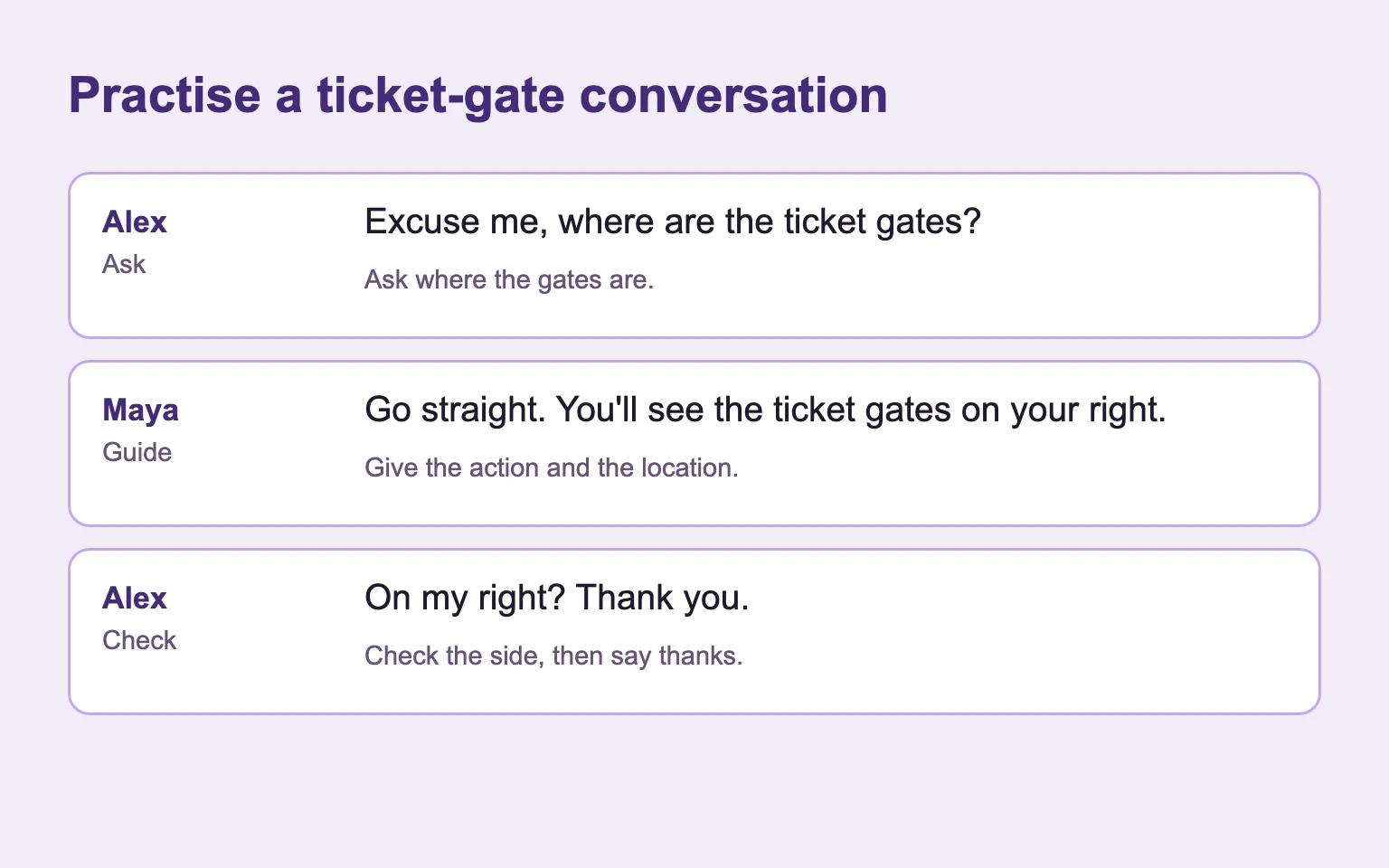
Alex: Excuse me, where are the ticket gates?
Maya: Go straight. You’ll see the ticket gates on your right.
Alex: On my right?
Maya: Yes, that’s right.
Ticket gates and ticket machines are different destinations. For an exit, use the actual sign: “Follow the signs for Exit 2.” Don’t guess an exit number. This fictional concourse is a practice setting, not directions through a named real station.
At a street corner
Imagine a visitor looking for a station in a neighbourhood you know: “Can you see that café? Turn right at the café. The station is on your left.” A café both of you can identify is more useful than a local business name the visitor can’t read. If two cafés are visible, specify “the café next to the bank”. Use a different landmark if the old shop has closed.
Inside a building
“Take the elevator to Level 3. Turn left when you get out. The meeting room is next to the stairs.” Lift is the usual British alternative to elevator. Match the displayed floor label rather than assuming how floors are numbered. If the person needs a step-free route and you don’t know it, ask reception rather than confidently sending them towards the stairs.
Looking at a map together
“We’re here. This is the station. Let’s check the route together.” Establish the current location and destination first. The top of the map may not match the direction you are facing. Ask “May I show you on the map?” before handling someone else’s device, and don’t treat the app’s estimated time as a promise. Confirm the street before adding “Go along this street”.
4. Fix the form, or make the instruction easier to follow
Five useful fixes
| English | Try this instead | Why |
|---|---|---|
| Go to straight. | Go straight. | Use straight as an adverb. |
| It’s in your right. | It’s on your right. | Use on for the side. |
| Get out the train at Central. | Get off the train at Central. | Use get off for a train. |
| Could you tell me where is the station? | Could you tell me where the station is? | Use subject + verb inside the indirect question. |
| Go straight and turn and go over there. | Go straight. Turn left at the bank. | Editorial clarity: name the turn and landmark. |
The forms are supported by Cambridge’s straight entry, its train guide, and the British Council’s examples and indirect-question explanation. “Where is the station?” is a correct direct question. Its word order changes after “Could you tell me”. The last row improves clarity; it is not a claim that the original sentence breaks a grammar rule.
“Turn to the right” is not universally incorrect; we choose the shorter “Turn right” for the starting set. “Go down this street” does not necessarily describe a slope. Avoid declaring that native speakers never use an expression just because it isn’t the version you learned. “You can’t miss it” is also not a substitute for telling someone what to look for. We favour “It’s next to the bank” when the person is already unsure.
5. If you cannot help, be honest and offer what you can do
| English | Meaning / use |
|---|---|
| Sorry, I’m not sure. | Say you’re unsure. |
| I’m not familiar with this area. | Say you don’t know the area well. |
| Let’s check the map together. | Offer to check the route. |
| I can walk with you to the corner. | Offer limited accompaniment. |
| Please ask the station staff. | Refer to station staff. |
| There’s a police officer over there. You can ask them. | Refer to an officer you can actually see. |
| Sorry, I can’t stop right now. | Say you cannot stop. |
“I’m not from here” is fine when true. You don’t need to invent that reason if you simply don’t know a particular alley. “Sorry, I’m not sure” is enough. Offer to walk only as far as you can: “to the corner” needn’t promise the whole journey. In a city with an information desk, station staff or a nearby police officer, point to the person or place you actually know; don’t send someone towards an imagined service.
6. Asking for directions: a short question and a check
Start with “Excuse me”, ask for the place, and thank the person afterwards. See sorry and excuse me for the difference between apologising and getting attention.
Questions, repetition and confirmation
| English | Meaning / use |
|---|---|
| Excuse me, where is the station? | Ask where a station is. |
| How can I get to the museum? | Ask the route to the museum. |
| Is there a pharmacy near here? | Ask for a nearby pharmacy. |
| Could you show me on the map? | Ask someone to point on a map. |
| Is it far from here? | Ask about distance. |
| Could you say that again, please? | Ask for repetition. |
| So I turn left at the bank? | Check the turning point. |
| Is this the right way to the station? | Check the route you’re taking. |
Repeat the part you need: “Left at the bank?” A listening response such as “I see” signals attention, but doesn’t confirm the turn. Our backchannel guide covers short responses, while phone-call phrases cover checking a place or name on the phone.
7. Practise Maya’s ticket-gate conversation
Maya, a fictional commuter, meets Alex outside the ticket gates at a metro station. They face the same direction. The gates are ahead, on Alex’s right. Maya answers the immediate question rather than listing connecting lines. Alex checks the side and says thanks; Maya answers “Yes, that’s right”.
Save one sentence for your next real situation
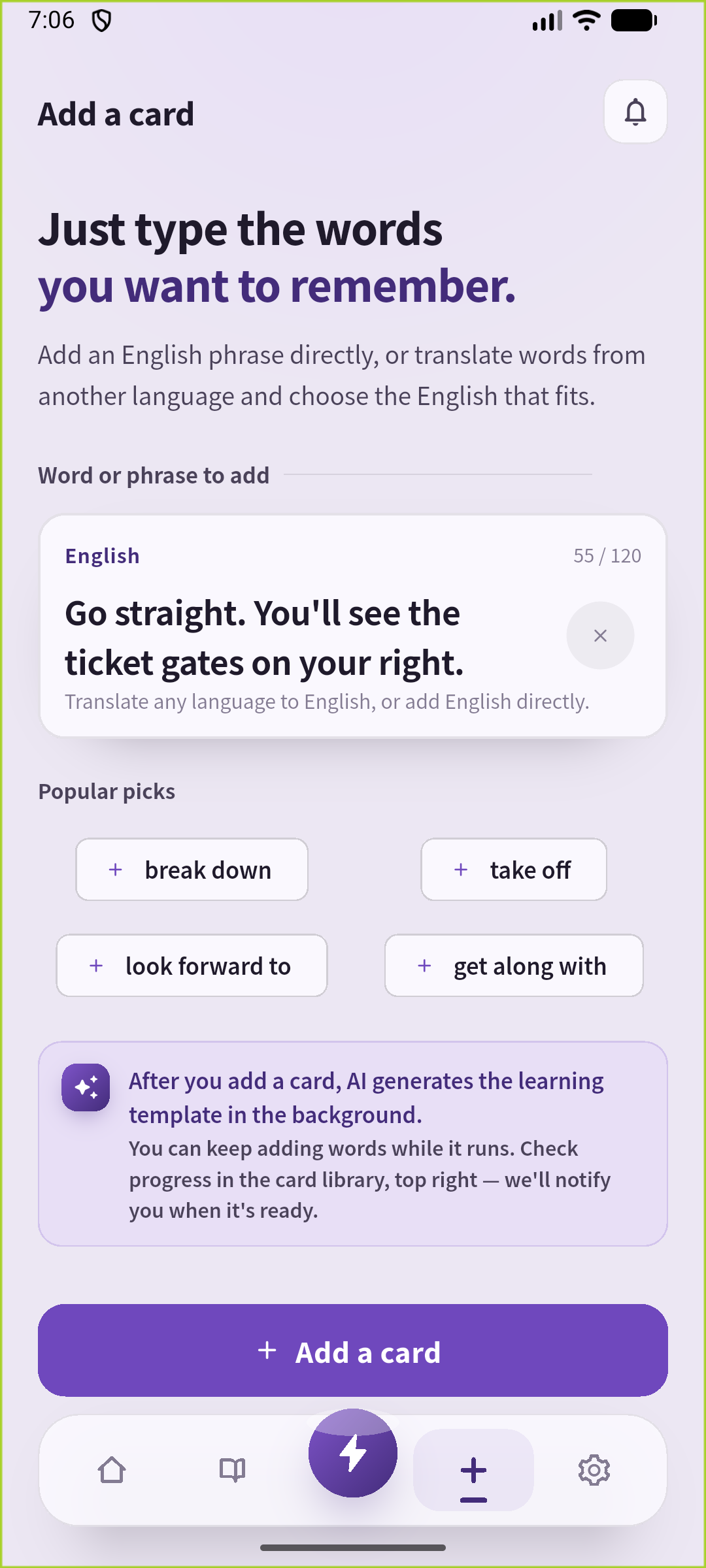
SpeakGain’s Add screen lets you enter an English phrase and create a practice card. We saved the question, directions and check as three separate cards. Start with a sentence you might use at your local station rather than saving the entire phrase list. What is SpeakGain? explains the basic workflow.
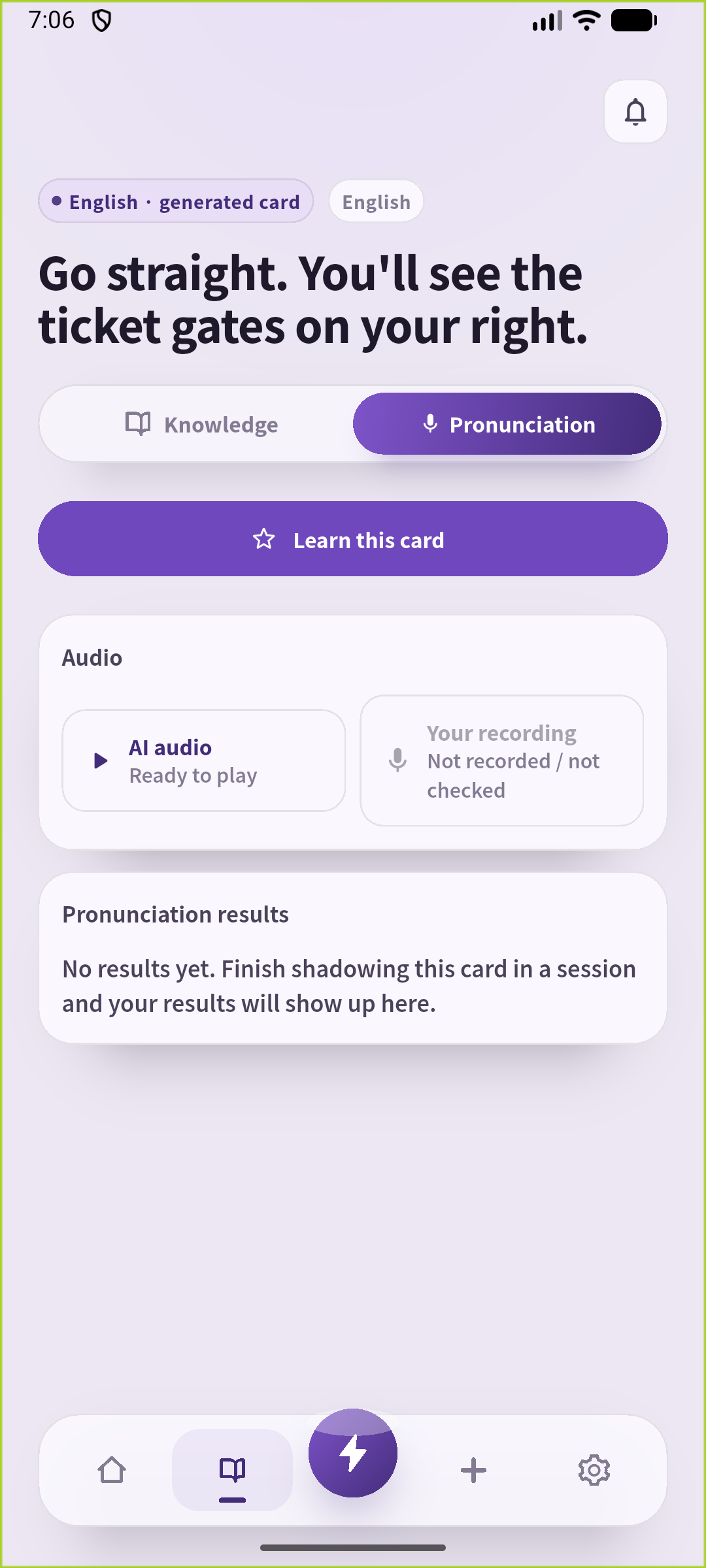
Listen, pause and say it
These recordings were generated in SpeakGain with the AI voice “Deep-voiced Viking”. Both speakers use the same synthetic voice for practice. Real travellers speak with different voices and speeds; these clips don’t represent every accent. Listen for the destination and the side, then say your sentence.
Alex: Excuse me, where are the ticket gates?
Ask where the ticket gates are.
Maya: Go straight. You'll see the ticket gates on your right.
Go straight, then look for the ticket gates on your right.
Alex: On my right? Thank you.
Check that the gates are on your right, then thank the person.
Break the directions after “Go straight” if needed. Finish the second sentence through “on your right” so the essential side isn’t lost. If asked again, “On your right” may answer the uncertainty better than repeating the whole route faster.
Recall the sentence from the situation
Hide Maya’s words. Play Alex’s question and answer from the situation alone. Hear the check, then say “Yes, that’s right”. Look back if you get stuck, correct the line and hide it again. Next time, replace the gates with an exit or elevator whose location you actually know.
In Karpicke and Roediger’s 2008 study, continued retrieval of foreign-language word pairs improved recall a week later. This was not a trial of directions conversations or SpeakGain. Our editorial application is to recall a phrase from a situation rather than only reread it; the study doesn’t prove that three cards or a particular session length is optimal.
Tomorrow, use a map’s arrows as prompts for one action and one location. Revisit the sentence that didn’t come easily. The English study guide connects listening, recall and speaking in a regular routine.
Common questions
Politeness, right turns, unknown routes and floors
Is “Go straight” rude? It is a normal short instruction when someone has asked for help. A friendly “Sure” or “Please” can fit the interaction; you needn’t turn the route into a long sentence.
Are “turn right” and “on your right” interchangeable? No. One is an action, the other a position. A building being on the right doesn’t mean you must turn.
Should I give a route even if I’m unsure? Say you’re unsure. Check a map together or point to staff if you can. Don’t invent a route to avoid saying no.
Can I just say “third floor”? Match the building’s displayed level. Ground-floor conventions differ, so the elevator button or sign is a better shared reference than an assumption.
Prepare one direction you can actually give
Start with “Go straight”, add the landmark where the person should turn, and check the side or landmark when useful. Say honestly when you don’t know. Today, prepare one sentence about the gates at a station you know, listen, hide the words and say it. Short directions work when the next action is clear.