
TOEFL vocabulary books and apps: choosing and learning for the 2026 format
Published
Choose one TOEFL vocabulary book or app that lets you revisit the meanings, examples and sounds you currently struggle with, rather than choosing by score alone. Check the publisher’s own statement about the January 2026 format, then work through meaning → example → sound → your own sentence → spaced review. Check receptive vocabulary in Reading and Listening separately from words you can use in Writing and Speaking.
This guide is for students and adults preparing for study abroad, exchanges or scholarships. Official pages checked: October 16, 2026. Most books below are Japanese learning materials; Magoosh provides English-language flashcards. Facts come from providers’ pages; suitability and practice schedules are editorial judgments. We have not used, read through or tested these third-party products for this comparison, and the order is not a ranking.
Compare official information, then choose a purpose
“Not officially stated” means the inspected page does not provide that information. It does not mean a product is incompatible or ineffective. Entry counts describe the material, not the vocabulary required to achieve a score.
| Name | Provider | Entries: official | Target score: official | Current-format coverage: official | Audio: official | Features: official | Who it suits: editorial | Checked |
|---|---|---|---|---|---|---|---|---|
| Official TOEFL Vocabulary Guide (Japanese) | ETS / ETS Japan; Japan Times Publishing | About 2,000 + about 1,800 derivatives | Not officially stated | ETS Japan says it remains usable after the 2026 update | Included | Corpus-selected vocabulary; English definitions with Japanese translations | Readers wanting official vocabulary material | 2026-10-16 |
| TOEFL Vocabulary 3800, 4th revision (Japanese) | Obunsha | 3,800 | RANK1: around 61 or below; 2: around 80 or below; 3: around 100 or below; 4: over 105 | Publisher explicitly says usable for the new test | Headwords and meanings; CD/MP3 | Four difficulty ranks; subject supplement | Owners continuing useful review | 2026-10-16 |
| TOEFL Vocabulary 3800, 5th revision (Japanese) | Obunsha | 3,800 | RANK1: up to 3.0–3.5; 2: up to 4.0–4.5; 3: around 5.0 or below; 4: over 5.5 | Explicitly covers the January 2026 format | Headwords, meanings, examples; Eigo no Tomo app/download | Complete the Words review; release scheduled October 29 | Readers wanting new-band categories and example audio after release | 2026-10-16 |
| English Vocabulary 4000: From Entrance Exams to TOEFL (Japanese) | Z-KAI | 4,000 | Number not officially stated; intermediate | Not officially stated; page says iBT compatible | CD: 60 Chapter 4 passages | General and subject vocabulary through sentences and passages | Readers moving from entrance-exam English to academic texts | 2026-10-16 |
| TOEFL Vocabulary 3800 (4th revision), in English Words by Monokakido (Japanese) | Monokakido | 3,800 | Number not officially stated; RANK1–4 | Not officially stated; fourth-revision content, iBT/ITP | All headwords and meanings | Examples, subject material, weak-word filters, playback controls; iOS required | Japanese readers reviewing on iOS | 2026-10-16 |
| TOEFL Vocabulary Flashcards (English) | Magoosh | 600 | Number not officially stated; difficulty levels | Not officially stated | Pronunciation button in provider explanation | Definitions, examples, review spacing; Web/iPhone/Android | Readers comfortable with English definitions | 2026-10-16 |
| The Updated TOEFL iBT Overview and Sample Tasks | ETS Japan | Not officially stated as a vocabulary collection | Not officially stated | Updated sections and tasks | Audio and scripts | Japanese translation and example answers; not a vocabulary book | Checking where vocabulary meets current tasks | 2026-10-16 |
Magoosh’s pronunciation, examples and review spacing are described in its provider explanation, which is not evidence of a 2026 update. A publisher’s statement about a printed book also does not establish that another provider has updated its app. ETS Japan’s 2026 announcement says the official vocabulary book remains usable; this is distinct from covering all current tasks.
Five checks for learning a word
| Stage | Action | Check |
|---|---|---|
| 1 Meaning | Identify meaning and part of speech in the sentence | Explain before seeing the translation |
| 2 Example | Inspect surrounding words and sentence structure | Understand a phrase, not an isolated entry |
| 3 Sound | Listen, compare text and speak | Recognize it with text hidden |
| 4 Your sentence | Use a selected word in a short explanation | Check accuracy, then say or write without looking |
| 5 Spaced review | Return the next day, later days and the following week as examples | Recall first; revisit the stage that fails |
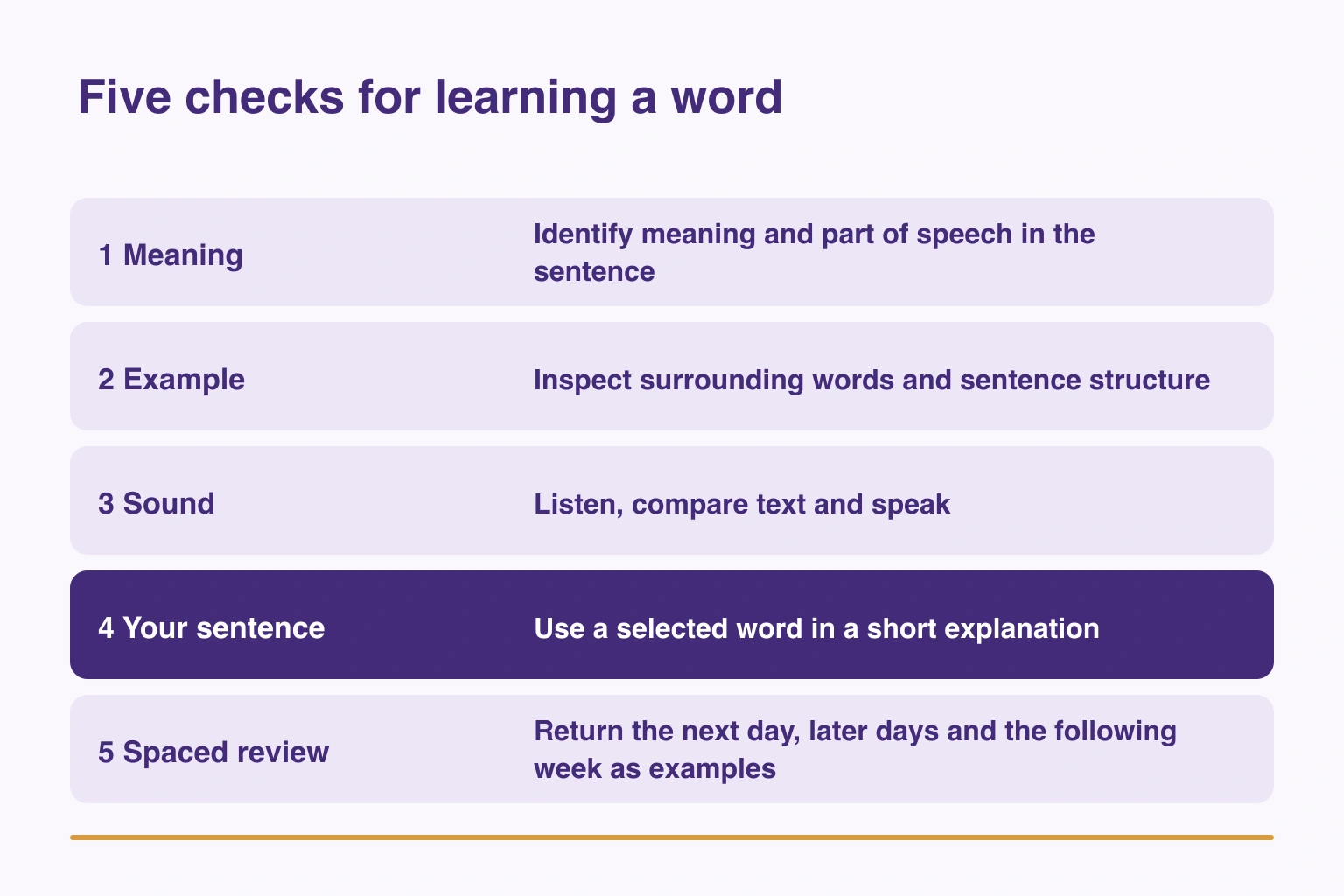
An editorial practice sequence. Review dates are adjustable examples, not a universal optimum or a score guarantee.
Before looking at an answer, try recalling it. If meaning is clear but the sound is unfamiliar, return to the audio rather than simply adding more translation drills. General review techniques belong in how to memorize English words; here we focus on connecting vocabulary to TOEFL tasks.
Does the 2026 redesign make older books unusable?
No blanket conclusion is justified. Obunsha explicitly says its fourth revision can be used for the new test. Its fifth revision announces revised selection, new-format review questions and example-sentence audio, with a release date of October 29, 2026, still in the future at our check date. This is a comparison of official descriptions, not a review of that forthcoming book.
Our advice is to continue reviewing with a fourth revision you already own if it meets your needs. New buyers can compare release timing, example audio and exercises. The inspected Z-KAI, Monokakido and Magoosh pages do not explicitly state January 2026 coverage. “iBT compatible” alone does not identify the current task set; absence of a statement does not prove the vocabulary is obsolete.
The current ETS structure includes everyday reading, academic passages and talks, emails, discussions, repeating sentences and interview responses. Use a vocabulary resource to fill gaps and official current samples to understand the tasks. The overall learning plan stays in the TOEFL study plan.
Choosing toward 60, 80 or 100
Confirm both overall and section requirements with your institution first. ETS’s current score guidance uses a 1–6 scale in half bands, with a comparable overall 0–120 score during a two-year transition. In the correspondence table, 60 falls within 3.5 (58–71), 80 within 4 (72–85), and 100 within 5 (95–106). A band is not identical to one legacy score, and does not automatically satisfy an institution’s old requirement.
| Goal expressed on the old scale | Official book labels as a starting point | Editorial priority | Required total vocabulary |
|---|---|---|---|
| 60 | Fourth revision RANK1: around 61 or below; fifth RANK1: up to 3.0–3.5 | Basic meanings, word order and sound recognition | Not officially stated in the ETS materials inspected |
| 80 | Fourth RANK2: around 80 or below; fifth RANK2: up to 4.0–4.5 | Repair basic gaps; recognize words in passages and audio | Not officially stated |
| 100 | Fourth RANK3: around 100 or below; fifth RANK3: around 5.0 or below | Context for abstract and subject vocabulary; precision when using it | Not officially stated |
These are Obunsha’s learning categories, not score guarantees. Adding the words in two ranks does not give an official number required for 80. Record three different states: recognizable in print, recognizable by sound, and usable in your own explanation. Start with gaps in the basic range rather than skipping straight to harder words.
Book or app: choose the work you need to do
A book can help you inspect nearby examples and a topic as a whole; an app may suit brief audio or difficult-word reviews while travelling. This comparison cannot establish which is faster. Features only help when you actually check meaning, context and sound.
Z-KAI’s CD contains 60 passages from Chapter 4; it is not described as individual audio for every one of its 4,000 entries. Monokakido describes headword and meaning audio plus playback controls. Magoosh describes definitions, examples, pronunciation and review spacing. Choose according to whether you need individual word audio or listening in context. If English definitions are a barrier, Japanese explanations may suit Japanese readers better; these Japanese books will not suit everyone internationally. See English vocabulary apps for the broader app comparison.
Reading and Listening: recognize the word in context
This sentence was written by our editors for this article. It is not an official test question or a citation of a research finding.
The findings indicate that regular breaks improve concentration.
Understand what indicate connects: the findings are the subject, and the clause after “that” states what they indicate. Knowing a translation is insufficient if you reverse the relationship in the sentence. Listen with the text hidden, then compare the sound with the written words and speak a short chunk aloud. Hide the text again to check recognition.
Later, use an unfamiliar passage or recording to check whether you can understand the word in a new context. Remembering this one sentence is progress on that sentence; it is not evidence that you will understand an unseen test passage.
Writing and Speaking: use selected words accurately
You need not turn every recognized word into active vocabulary. Choose words useful for your own explanations, build a short sentence, check its meaning and grammar, then try writing or saying it without looking. An opinion-and-reason example on the same topic is:
I support regular breaks because they help students concentrate.
Both examples are original. The first reports an indicated finding; the second expresses an opinion with a reason. Neither is a complete test response. Decide what you mean before inserting a difficult word.
In current Speaking, Listen and Repeat requires repeating what you hear; do not replace it with a memorized opinion. Take an Interview asks for relevant responses to questions. See TOEFL Speaking preparation for task practice. For Writing, the email’s purpose or discussion question comes first. Consult the Writing and Speaking scoring guides; do not turn a count of difficult words into a predicted score.
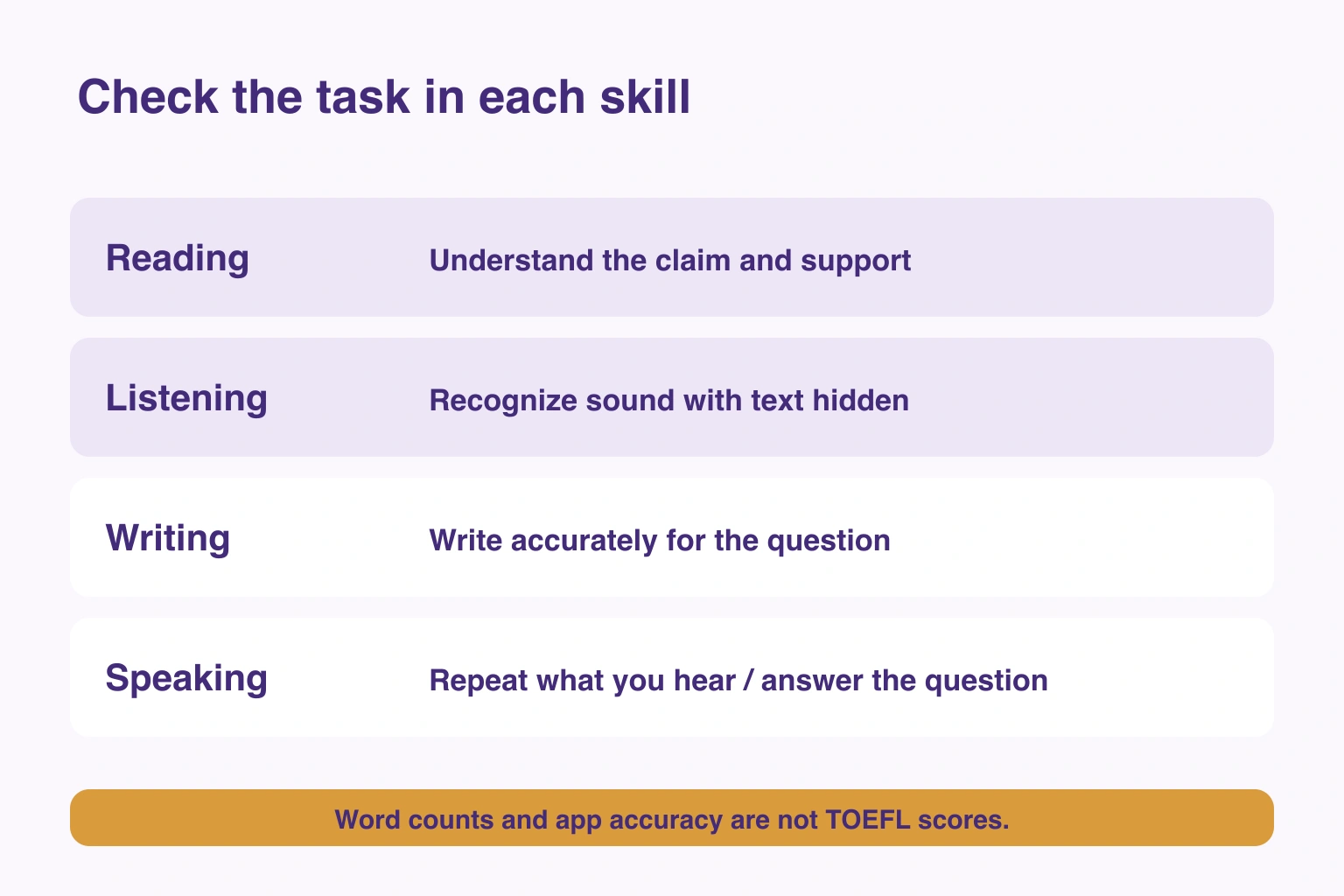
Editorial illustration, not an official test or scoring screen.
Listen to your own sentence with SpeakGain
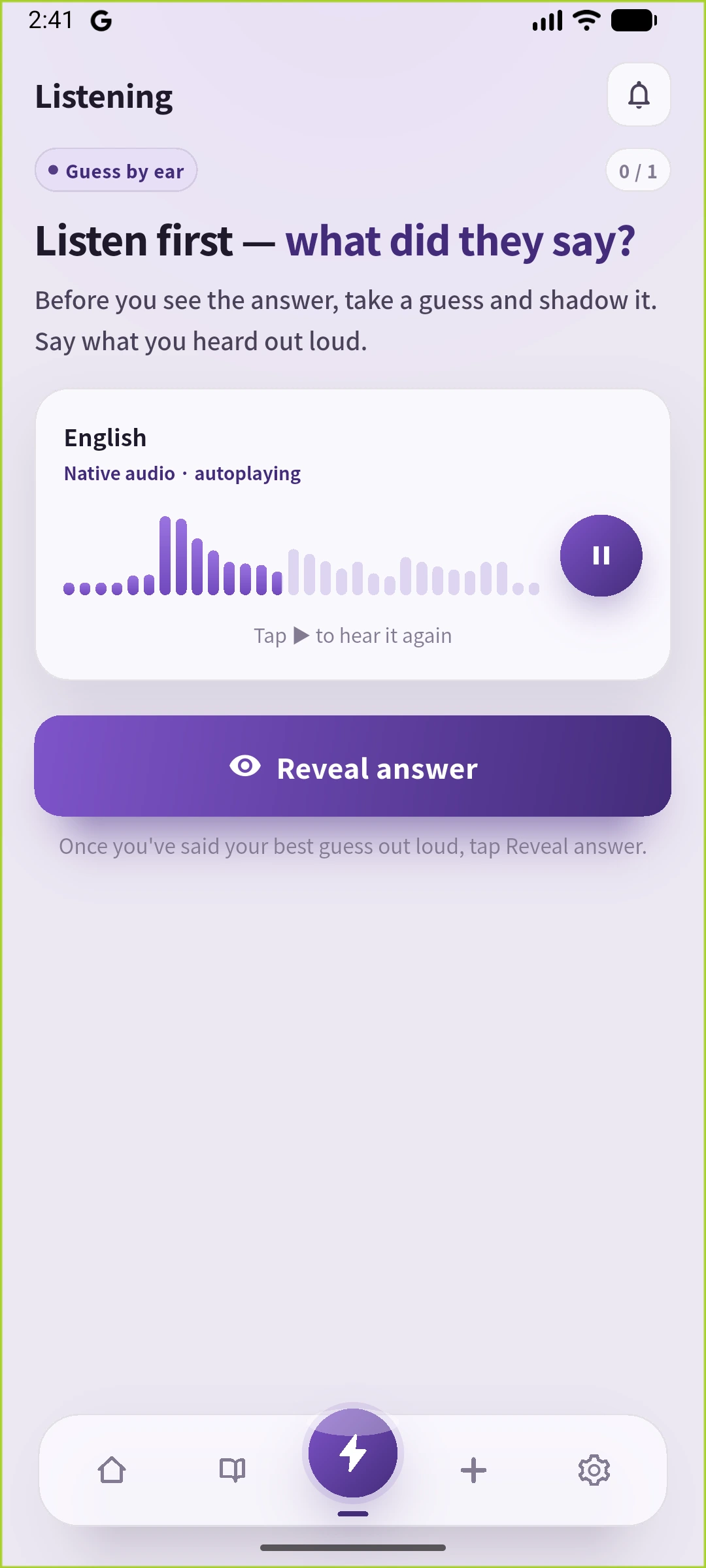
We saved the original sentence “The findings indicate that regular breaks improve concentration.” as one card through the normal Add flow. On the device, Library → View → Knowledge → Learn this card opened Listening, which hid the sentence and instructed us to listen, guess and say it aloud before choosing Reveal answer. Answer displayed the exact sentence we had saved.
Here SpeakGain supports saving a sentence with audio, listening and speaking it aloud. The actual screen below uses English controls; Reveal answer shows the saved sentence. Keep review dates as the separate editorial plan above. This demonstration is not a TOEFL vocabulary test, wordbook, mock test, answer or pronunciation assessment, or score predictor.
Listen to the example sentence
The findings indicate that regular breaks improve concentration. — Viking AI-generated audio reading our original sentence.
Editorial plan: building vocabulary toward 80 over three months
This is our planning opinion, not an ETS timetable or a promise of reaching 80. After checking your starting skills and entry requirements, choose one main resource. Suppose you can devote about 20 minutes a day specifically to vocabulary; keep the rest of your skill work in the overall study plan.
| Period | Vocabulary work: editorial proposal | Check before adjusting |
|---|---|---|
| Month 1 | Find basic gaps; pair meaning, examples and sound | Can you recall yesterday’s words before revealing text or translation? |
| Month 2 | Understand target-range words in context; use a few in explanations | Can you recognize the sound and use the expression accurately? |
| Month 3 | Adjust new-word intake; revisit weak words and unfamiliar current tasks | Which skill still causes difficulty? Use the record to plan the next period. |
Start with seven minutes of review, eight on a few new words with examples and audio, and five on your own sentence and next review. Reduce new words when review is unfinished. These minutes are a starting arrangement, not an optimized prescription. Each weekend distinguish sound problems from meaning or production problems, and adjust the relevant practice. Finishing the book is not the only goal; performance on unfamiliar tasks and actual score reports matter when checking institutional requirements.
Methods we do not recommend
- Large translation-only drills as the entire method. They do not check sound recognition or contextual use. Add examples and audio.
- Starting several books simultaneously. Review can become scattered and repeat the same basics. Add a second resource only when you know the missing role.
- Changing your message to include a hard word. A less relevant sentence is not an improvement. Keep the intended meaning first.
- Always reading the same sequence. Vary the cue with examples, sound or difficult-word review so sequence memory does not hide gaps.
- Calling an app’s accuracy a TOEFL score. A resource’s own checks are not the test’s four-skill evaluation.
Frequently asked questions
How many words do I need for 80 or 100?
Not officially stated in the current ETS materials we inspected. A 3,800- or 600-word product, or a rank total, is not a necessary-and-sufficient vocabulary requirement.
Is TOEFL 3800 fourth revision still usable?
Obunsha says it can be used for the new test. The fifth revision announces additional features and an October 29 release. We would keep useful review going and check current tasks separately with ETS samples.
Should I reject an app without a 2026 label?
Not solely on that basis. Check its vocabulary functions, but do not assume current-format task coverage without the provider saying so.
Which book suits my target score?
Use published score categories where available. We do not invent “for 80” labels for materials without them. Also consider your sound and meaning gaps, reading language and device.
How should I learn academic words?
Check the word’s role and combinations in a sentence, match sound to text, and use selected words in your own short explanation. Separate recognition from production.
Can I substitute IELTS, Eiken or TOEIC vocabulary books?
They can revisit words you already know, but do not establish coverage of current TOEFL tasks. Assess what is missing. our TOEIC vocabulary book comparison covers a different test; do not transfer score or word-count assumptions between them. If IELTS is also an option, compare its materials separately in our IELTS vocabulary book guide.
Can I start with just an app?
Yes, for vocabulary practice, if its definitions, context and audio fit your needs. Use current official samples alongside it; task coverage is a separate question.
Editorial verdict
Start with one resource you can actually review. Compare the provider’s target categories, audio scope and explicit format statement, then check meanings, sound and use separately. Keep edition and app-provider differences visible. Before adding another resource, ask whether today’s word is recognizable tomorrow in a new sentence and whether selected words can support a relevant explanation.
TOEFL and TOEFL iBT are ETS trademarks. This article is not official ETS preparation material. No word lists, official questions or third-party example sentences are reproduced. Official information checked October 16, 2026.