
British vs American English: pronunciation, words, spelling and which model to practise
Published
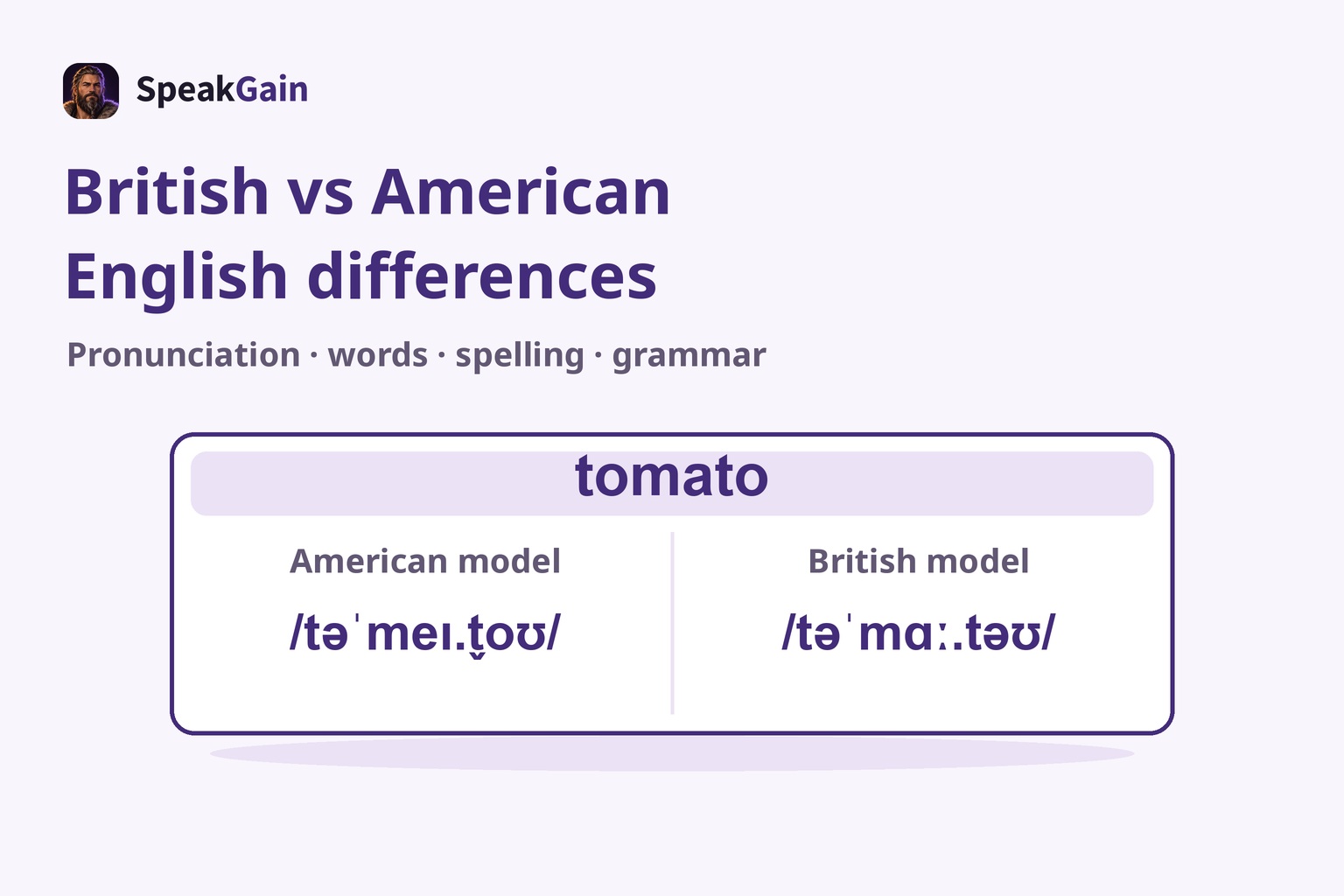
British and American English differ mainly in pronunciation, vocabulary, spelling and how often some grammatical forms are used. Our editorial recommendation is to choose a speaking model that fits the people, place and materials you use; neither variety is inherently more correct or better. Practise one short sentence by listening, imitating and comparing your recording with one chosen model, while gradually widening the range of English you listen to.
Perhaps a British drama makes tomato sound unfamiliar, or you are preparing to study in the UK and wondering about bath. Perhaps your speech combines things learned from American videos and British lessons. The useful question is not how to remove every trace of another variety, but which sounds you need to understand and which recording you want to imitate.
This article compares four areas, then turns the differences into a choice and a practice routine. For general priorities, see how to practise English pronunciation. Here we focus on keeping a clear comparison model.
For the difference between sounding accented and being understood, see English accents and intelligibility and start with actual listener misunderstandings.
British English is not one accent
The British pronunciation examples here use a dictionary-style RP / Standard Southern British English learning model. The American examples represent General American. Neither label describes everyone in a country. Traditional RP and contemporary southern standard speech are not identical; the IPA here follows broad dictionary conventions rather than specifying every present-day phonetic detail.
There is considerable regional variation within the UK. Scottish English, for example, includes accents that pronounce the r in car. Tokyo University of Foreign Studies’ comparison explicitly chooses models; its British recordings are Estuary English, not RP recordings. We use its descriptions of representative phenomena without relabelling that audio. “Standard” names a comparison model, not a ranking of regional speakers.
1. Pronunciation: five representative differences
Start with post-vocalic r, the TRAP–BATH distinction, LOT, realizations of t and the stressed vowel in tomato. Choose one relevant word, rather than trying to change all five features at once.
| Feature | American model | British model | What to watch |
|---|---|---|---|
| Rhoticity | car retains r-colouring at the end | A standalone car normally has no pronounced final r | rain has r in both; UK regions differ |
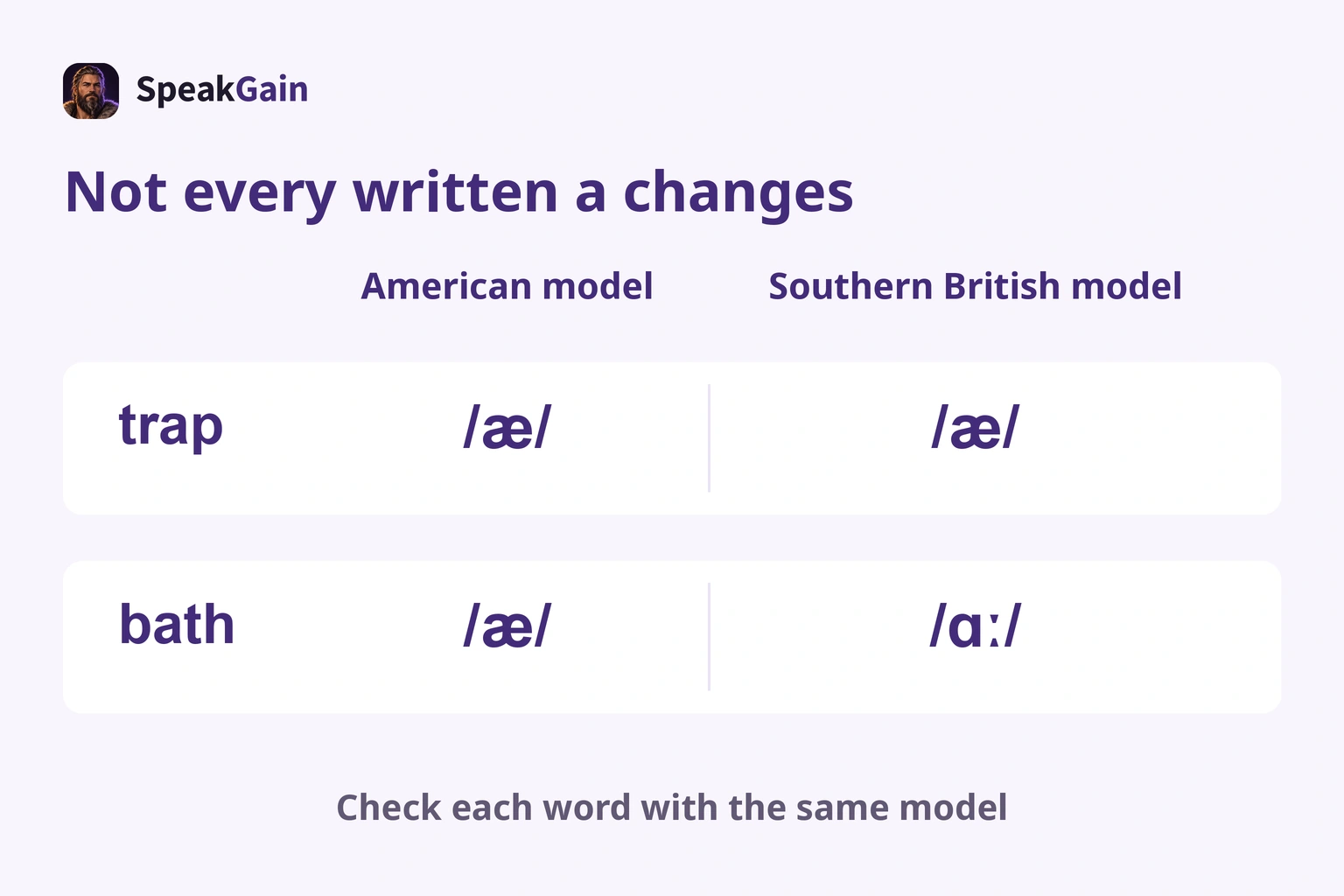
| TRAP–BATH | trap /æ/, bath /æ/ | trap /æ/, bath /ɑː/ | This split is a southern example, not a rule for northern England |
| LOT | lot /lɑːt/, also transcribed /lɑt/ | lot /lɒt/ | Listen to vowel quality, not just length |
| t | better can contain a brief tap [ɾ] | [t], with [ʔ] possible depending on position, speaker and style | Not every American t becomes d; not every British t is carefully released |
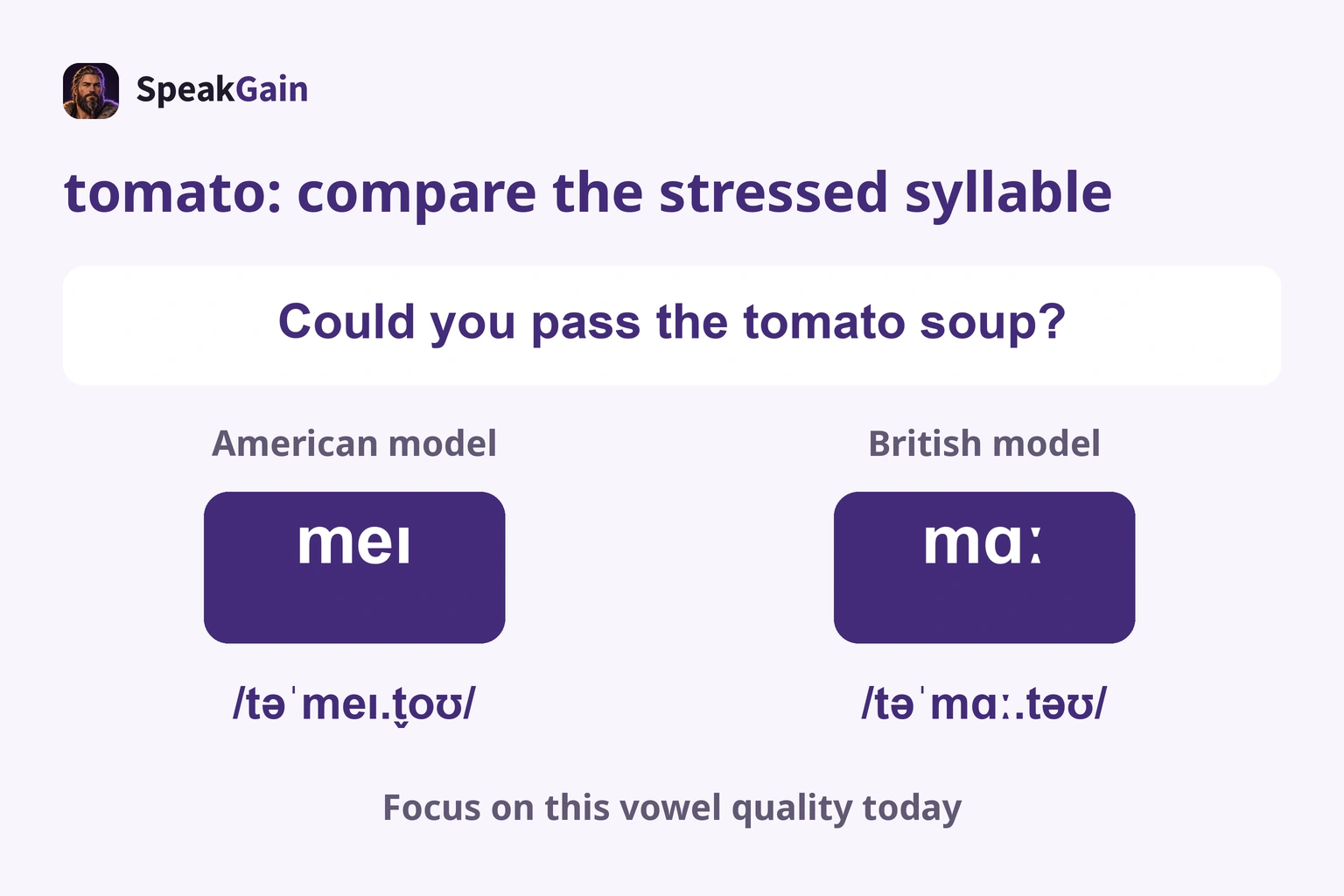
| Individual words | tomato /təˈmeɪ.t̬oʊ/ | tomato /təˈmɑː.təʊ/ | Focus on the stressed second syllable |
Sources: TUFS phonetics, Cambridge bath, lot and tomato. Cambridge’s /t̬/ is its transcription convention. J. A. Maidment’s UCL discussion also shows why glottal replacement cannot be reduced to a simple national identity rule.
r: check the position, rather than deleting the letter
Compare car on its own first. Then return to a recorded phrase containing it. Do not remove the r in rain or red because you have chosen a British model. Speech across word boundaries also needs its own recording as a reference; a dictionary word does not tell you exactly how a whole sentence will connect.
bath: vowel quality matters too
The difference between /æ/ and /ɑː/ is more than stretching a vowel. Listen to the sound quality. TRAP and BATH are names for lexical sets, not instructions to replace every written a. Use the English vowel guide if you need to work on the contrast before returning to your sentence.
t: avoid performing an accent from a slogan
An American tap is not a command to replace every t with your language’s nearest consonant. British casual speech may contain glottal stops, while a careful dictionary-style model may use [t]. Our advice is to copy the t you actually hear in the chosen phrase, rather than exaggerating glottal stops to “sound British”. For basic consonant difficulties, use English consonant practice.
2. Vocabulary: different names and different meanings
Sometimes two words name the same thing; sometimes one word names different things. The table specifies the food or object sense. It does not mean speakers cannot understand the other term.
| Referent | Common American wording | Common British wording | Short example |
|---|---|---|---|
| Fried potato pieces | fries / French fries | chips | I’d like fries. / I’d like chips. |
| Thin potato snacks | chips / potato chips | crisps | A bag of chips, please. / A bag of crisps, please. |
| Passenger lift in a building | elevator | lift | Where’s the elevator? / Where’s the lift? |
See Cambridge chips, crisp and lift. The short practice sentences are our own. With chips, the situation helps: are you ordering fried potatoes on a plate or buying a packet of thin snacks?
Our advice is to learn three expressions you will actually use, in sentences with a situation. A long difference list is less useful than knowing what to request at lunch or how to ask about a lift. If the referent is unclear, point or ask a follow-up question.
3. Spelling: follow one policy in a document
Some words keep the same meaning but have different spellings. Follow your school, employer or publisher’s instructions. If none are given, our recommendation is to choose one policy for your own text. Your spelling setting and your pronunciation model are separate decisions.
| Example pattern | American | British | Short phrase |
|---|---|---|---|
| -or / -our | color | colour | a warm color / a warm colour |
| -er / -re | center | centre | the town center / the town centre |
| -ize / -ise | organize | organise; organize is also used | organize the files / organise the files |
Sources: Cambridge spelling, centre and organize. British English does not prohibit every -ize form. Do not automatically convert unfamiliar words by their endings. Set the document’s spellchecker appropriately and check individual entries.
4. Grammar: shared structures, different preferences
Much of the grammar is shared. Some differences concern frequency or preference, not an exclusive ban. American English has the present perfect too; British English uses learned as well as learnt.
| Situation | Frequent American example | Frequent British example | Qualification |
|---|---|---|---|
| A task is already finished | I already packed. | I’ve already packed. | Past simple/present perfect preferences differ with already and yet |
| Change with get | It’s gotten colder. | It’s got colder. | American English also uses got in other constructions |
| Past of learn | I learned a new word. | I learnt a new word. | learned also occurs in British English |
| Weekend preposition | on the weekend | at the weekend | A typical preference |
Cambridge Grammar Today explains these tendencies. Our examples are short original practice sentences. Context comes first; the table is not a complete tense or get rulebook. Say one useful sentence from your chosen material, then practise recognizing the alternative with the same meaning.
Editorial opinion: choose by use and availability
We would choose in this order: the people and place you use English with, a model you can replay, then personal interest. UK study gives you a reason to increase UK listening. American colleagues give you a reason to become familiar with their speech. If no destination is fixed, use a model with clear audio and a transcript that you can keep practising.
School materials and exams are not all interchangeable. Check the actual course or assessment rather than assuming its accent from your country. Studying in Britain does not require you to discard everything learned from American materials. Your speaking reference and your listening range serve different purposes.
| Goal | Our suggested speaking reference | Additional listening |
|---|---|---|
| Study or live in the UK | One accessible British model | Your university and local area |
| Work with American speakers | One relevant American model | Other speakers you encounter |
| IELTS | A model you can compare consistently with your current speech | A range of accents |
| British dramas | One clear speaker and short line | Differences between characters |
| No specific destination | Replayable audio with a transcript | Other models as you become comfortable |
Does IELTS require British pronunciation?
No. You do not need to switch to a British accent for IELTS. IELTS’s official guidance says any accent is acceptable when pronunciation is intelligible. Our advice is to examine sounds, stress and grouping in your answers rather than make a last-minute accent change. Use IELTS speaking preparation for question-based practice.
Editorial opinion: mixing is not the first problem to fix
We would not interrupt a conversation just to police national consistency. First check which word was misunderstood or which meaning was lost. Using lift with an American pronunciation model is not, by itself, a reason to restart your learning.
For recording practice, however, make the reference explicit. Comparing yesterday’s /ɑː/ goal with today’s /eɪ/ goal changes what you are trying to reproduce. Write “today’s model” next to your recording. Keep three notes separate: unintelligible words, words heard as something else, and differences from the reference. A difference in the third column alone is not proof of communication failure.
Practise one sentence: tomato soup
Our sentence is “Could you pass the tomato soup?” Imagine asking someone to pass the soup at the table. Keep the same English sentence whichever interface language you use. Today, concentrate on the vowel in tomato’s stressed second syllable.
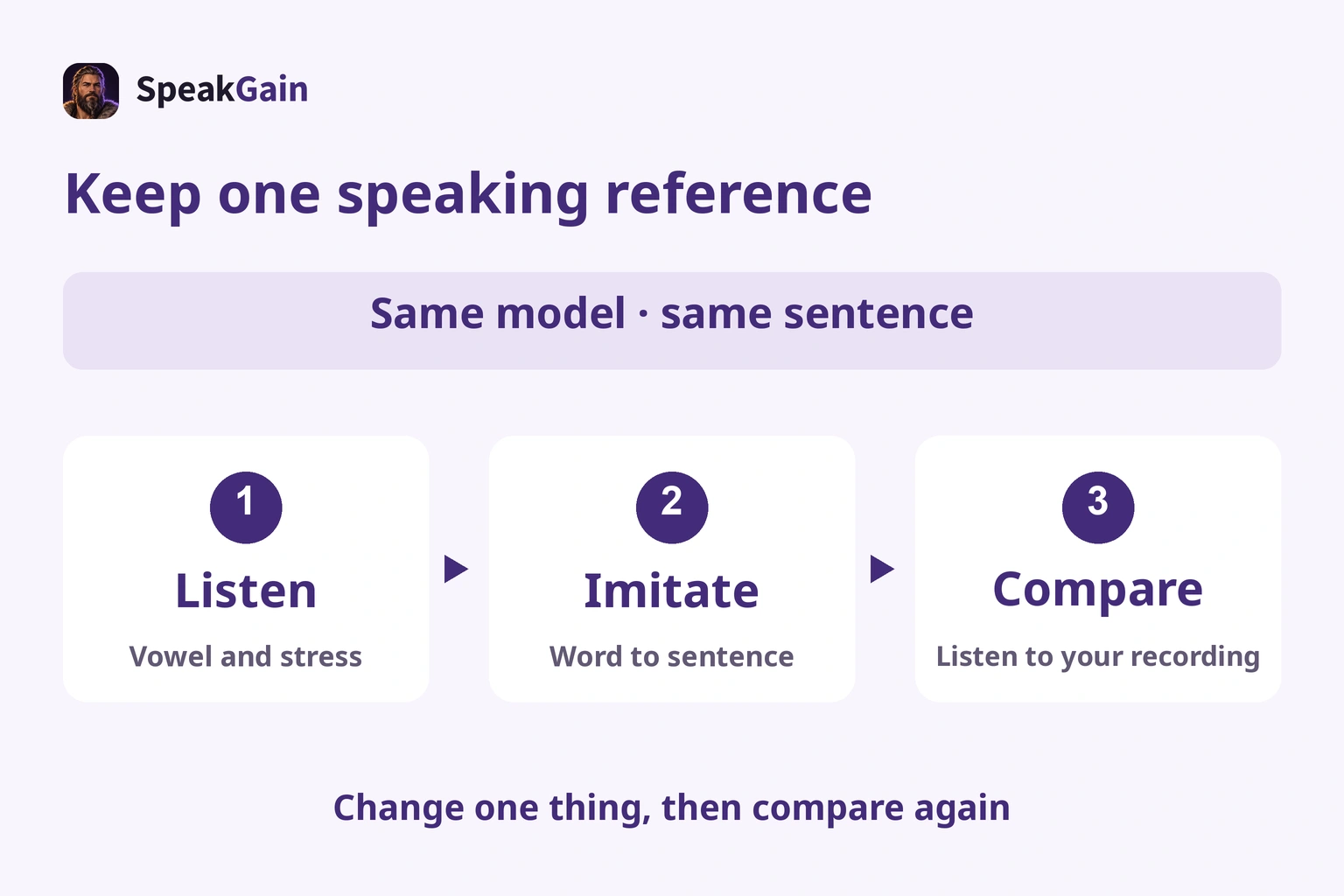
- Choose one model. Use clearly identified UK or US material. A dictionary word recording helps with a word; for whole-sentence comparison, choose a source with the whole sentence recorded.
- Understand, then listen. Locate the stress and its vowel: Cambridge gives /ɑː/ in its UK example and /eɪ/ in its US example. See how to read phonetic symbols if you need help with the marks.
- Imitate the word, then the sentence. Move from tomato to the tomato soup to the complete request. Do not exaggerate length or try to correct every sound simultaneously.
- Record yourself. Use a recorder available to you, at a comfortable pace. Work in a short phrase first and then record the full sentence.
- Listen alternately. Compare vowel quality, stress position and whether the word remains recognizable in context. Separate a difference in pitch or loudness from the sound you are targeting.
- Change one thing and rerecord. Keep the original model for the next comparison. If you cannot hear the distinction reliably, ask a teacher to check that one point.
| Observation | What it suggests checking next |
|---|---|
| My chosen UK target still sounds closer to /eɪ/ | Revisit the stressed vowel, then return to the sentence |
| I emphasize the first syllable most | Listen again for second-syllable stress |
| The word changes inside the sentence | Practise the tomato soup before the full request |
| A listener cannot identify soup | Pause the accent comparison and check that word’s sounds/end |
These are listening notes, not scores or proof that an IPA symbol has been achieved.
Using a SpeakGain voice as a model
SpeakGain’s Viking voice is an American-English example, not a British model. It is AI-generated audio, not a human native-speaker recording. If you choose a British target, keep a British dictionary or course recording as the reference. An American voice cannot be used as if it validates a British vowel target.
We do not present SpeakGain as judging or scoring pronunciation. Recording comparison here means that the learner listens to their own voice and the chosen reference. Use the voice at the listening-and-imitation stage with its variety understood.
On the device we entered this sentence through Add and the normal Add a card flow. In Library, the new card opened through Knowledge → Learn this card. Listening hid the English text and played the reference audio; Reveal answer opened Answer with the same sentence and its English meaning. Playback controls and review-interval choices were visible.
For recording comparison, use a recorder available to you and listen alternately to your voice and this example. The on-screen label Native audio does not establish a human recording: this sample was generated with the AI Viking voice.
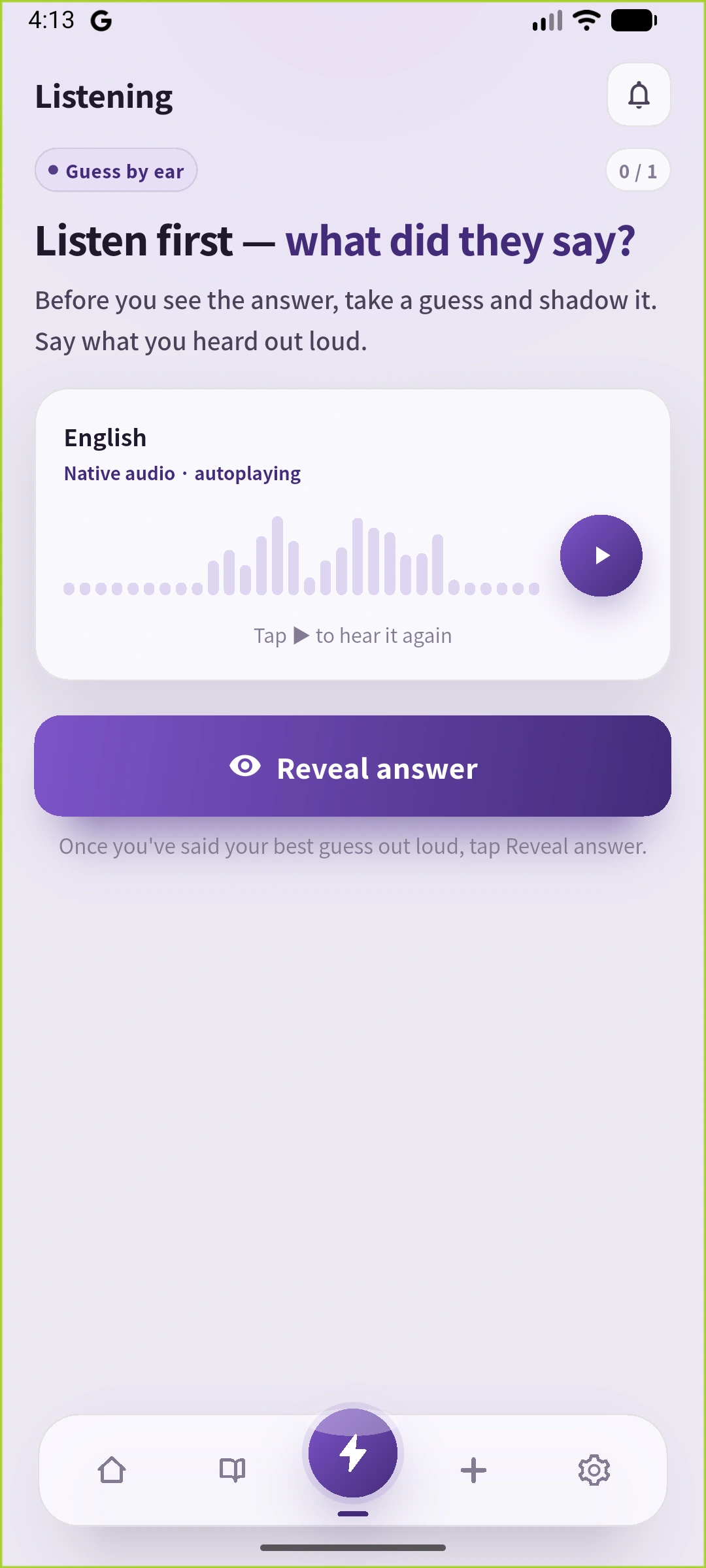
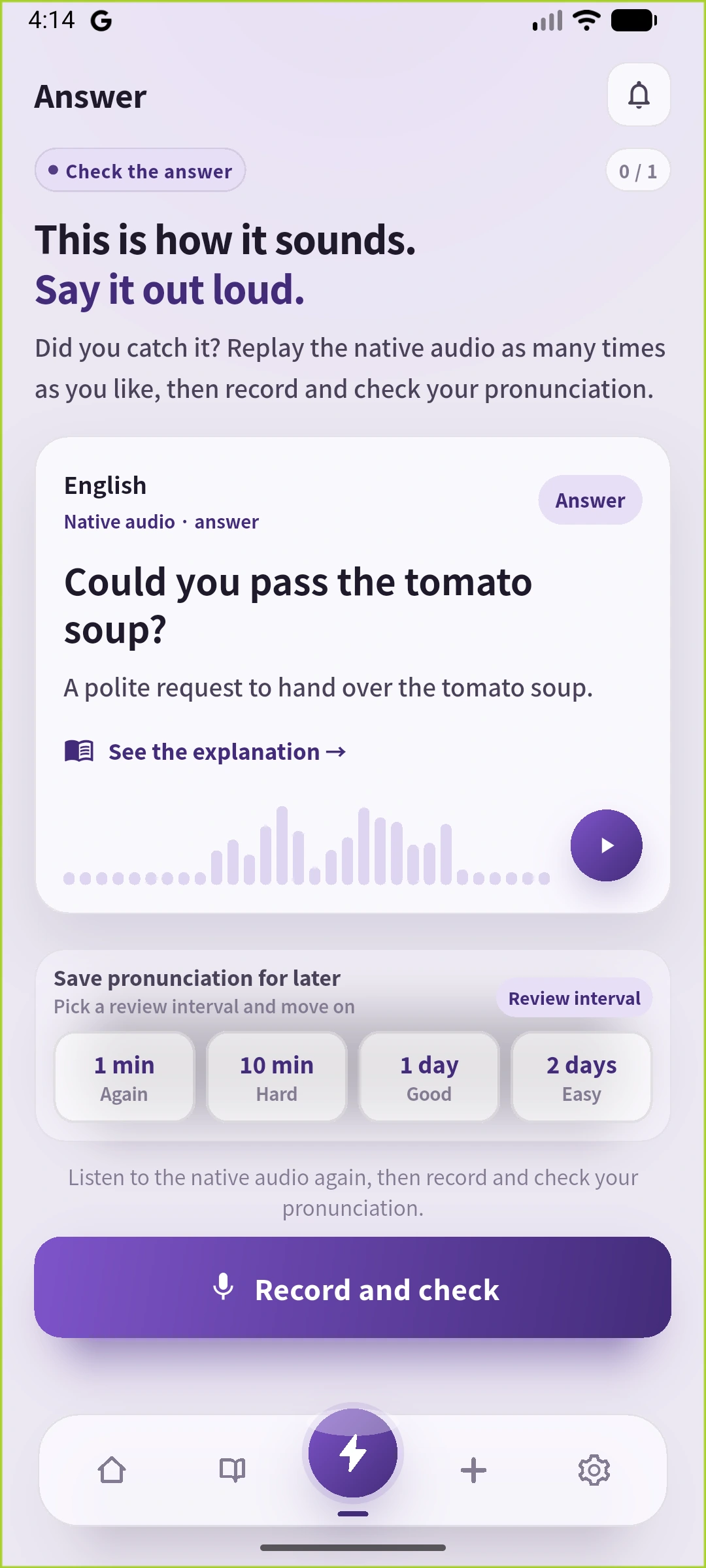
Viking example: AI-generated American English
Could you pass the tomato soup?
Not a British model or a human native-speaker recording.
Editorial three-week plan
Try one model for three weeks, starting with five to ten minutes a day. These are editorial starting points, not a research-established optimum or a promise that pronunciation will be finished in three weeks.
| Week | Activity | Keep | Check before expanding |
|---|---|---|---|
| 1: establish the reference | One model, one sentence; examine vowel and stress separately | First recording, audio source, one focus | Can you name the sound you are targeting? |
| 2: keep it in a sentence | Word → phrase → sentence with the same reference | Sentence recording and brief notes | Can you compare the target in both contexts? |
| 3: widen listening | Retain the speaking reference; add another speaker for comprehension | Unfamiliar words and uncertain passages | Can you understand the alternative, or look it up? |
If the contrast remains unclear, shorten the task rather than adding longer audio. In week three, another speaker is someone to understand, not automatically a replacement model to imitate. After the trial, decide whether the reference is useful and sustainable. Changing it later is possible; keep a new baseline recording when you do.
Methods we do not recommend
Switching models every day for the same target word. You may keep reversing the vowel you are trying to reproduce. Compare varieties for listening, but keep one reference while evaluating your change.
Only memorizing difference lists. Knowing a spelling, term or IPA string does not show what you say in a sentence. Turn one item into a useful sentence and compare a recording. Looking things up prepares practice; it is not the same as speaking practice.
Changing every r or t to perform “Britishness”. Position, speaker and context matter. Listen to the actual sound in the chosen line rather than mechanically altering letters.
Imitating every character in a whole drama episode. A UK production may include varied regions, periods and performances. Start with one speaker’s short, clear line and check unfamiliar words in a dictionary. See TV series for learning English for material-selection ideas.
Frequently asked questions
What are the main differences?
Pronunciation, vocabulary, spelling and some grammatical preferences. Examples include bath, lift/elevator and colour/color. Regional variation prevents a single national pronunciation rule.
Which is easier to understand?
The country label alone cannot decide. The listener’s familiarity, your sounds and stress, word choice and context matter. We recommend practising specific misunderstood words with a relevant model.
Is mixing them okay?
Our view is that mixing alone should not stop a conversation. Investigate real misunderstandings. Keep a reference stable for recording comparisons and follow a spelling policy in a document.
Must I sound British for IELTS?
No. The official guidance accepts any intelligible accent. Practise pronunciation features in your actual answers.
How do I practise British pronunciation?
Specify the model, choose a short recording, imitate and compare. Work on one feature such as bath or tomato rather than changing every r or t.
Are all British r sounds silent?
No. Even the southern model has r in rain; a standalone car behaves differently. Other UK accents can retain post-vocalic r.
Can dramas provide a model?
Yes, one short line from one speaker can be useful. The programme’s nationality does not identify every character’s accent. Check the transcript, meaning and unfamiliar words.
Is Viking a British voice?
No. Treat it as an American-English synthetic example, not a British model, human recording or pronunciation scoring service.
Final editorial verdict
Choose one speaking reference and broaden what you listen to. Neither British nor American English is inherently better. Start by listening to the tomato sentence, imitating it and comparing one point. Familiarity with UK speech for study or drama does not require wholesale accent replacement. Keep speaking, identify actual misunderstandings, and turn a useful difference into a short practice sentence.
Sources checked 15 October 2026. Tables link to TUFS, Cambridge, UCL and IELTS above. Sentences, comparison notes and the three-week plan were written by the editorial team.