
How to read English phonetic symbols: dictionary differences and a practical learning order
Published
You do not need to memorise the entire IPA chart before using an English dictionary. Start with symbols that distinguish sounds you currently confuse, plus /ˈ/ for primary stress; then learn new symbols in words you actually use. Check the dictionary’s accent label, listen to the audio beside that transcription, and use the word in a short sentence you can record.
The symbols are not another spelling alphabet. The /j/ in yes is not the first sound of job, and a familiar-looking letter does not always have the value you expect. This guide helps you read the pronunciation field and use it in practice. For how to produce individual sounds, use English vowel guide and pronunciation practice guide.
For the consonant contrasts, see English consonant guide.
If you are choosing a pronunciation model, British vs American English compares representative differences and shows how to practise with one reference.
Main symbols: a reference, not a memorisation assignment
These are main English dictionary symbols, not the full international chart or a fixed sound inventory shared by every English speaker. The warning column identifies information that a spelling-based or native-language approximation can lose. The table is newly organised from the University of Tokyo’s phonetics material, Oxford’s pronunciation guide and NGL’s UK/US reference.
Main vowels
| Symbol | Example words | Avoid this misreading | Details |
|---|---|---|---|
| /ɪ/ · /iː/ | sit · seat | Not merely a short and long version of one vowel | Vowels |
| /e/ · /ɛ/ | bed · ten | Check the notation system before treating these as a contrast | Vowels |
| /æ/ · /ʌ/ · /ɑː/ | cat · cup · father | Do not merge all three into one familiar a sound | Vowels |
| /ɒ/ · /ɔː/ | UK hot · saw | Check accent as well as symbol | Vowels |
| /ʊ/ · /uː/ | book · food | Length alone does not identify these vowels | Vowels |
| /ə/ | about · banana | Not the name of the letter e; a weak vowel | Vowels |
| /ɜː/ · /ɝ/ · /ɚ/ | UK bird · US bird · US teacher | Do not lose r-colouring or stress differences | Vowels |
| /eɪ/ · /aɪ/ · /ɔɪ/ | day · my · boy | Do not split a diphthong into two equal syllables | Vowels |
| /aʊ/ · /oʊ/ · /əʊ/ | now · US go · UK go | UK/US symbols can reflect different vowel quality | Vowels |
| /ɪə/ · /eə/ · /ʊə/ | UK near · hair · pure | Check the vowel and final-r convention together | Vowels |
| /i/ · /u/ | happy · actual | No length mark does not automatically mean ɪ or ʊ | Vowels |
Main consonants
| Symbol | Example words | Avoid this misreading | Details |
|---|---|---|---|
| /p b t d k ɡ/ | pen · bad · tea · did · cat · get | Do not add an extra vowel to each consonant | English consonant guide |
| /f v/ | fine · very | Do not replace both with f or b | English consonant guide |
| /θ ð/ | think · this | Do not replace both with s or z | English consonant guide |
| /s z/ | see · zoo | No vowel is included in the symbols | English consonant guide |
| /ʃ ʒ/ | she · vision | Consonants, not the syllables she or gee | English consonant guide |
| /tʃ dʒ/ | cheese · job | Read each pair as a consonant unit | English consonant guide |
| /h m n ŋ/ | hat · man · now · sing | Do not automatically add ɡ after ŋ | English consonant guide |
| /l r/ | light · right | Not interchangeable r-like sounds | English consonant guide |
| /j w/ | yes · wet | j is the start of yes, not job | English consonant guide |
Marks and related notation
| Symbol | Example words | Avoid this misreading | Details |
|---|---|---|---|
| ˈ | about /əˈbaʊt/ | Stress is on the following syllable, not a pause | Practice |
| ˌ | retell /ˌriːˈtel/ | Secondary stress is not equal to primary stress | Practice |
| ː | people /ˈpiːpəl/ | No fixed seconds or automatic doubling | Practice |
| . | system /ˈsɪs.təm/ | Syllable boundary, not a compulsory pause | Practice |
| /ɚ/ · /ər/ | US teacher | Not automatically two separate syllables | Practice |
| n̩ · l̩ | button · little | A consonant can form a syllable | Practice |
Look up the symbols in today’s word rather than testing yourself on every row. A written transcription can identify a contrast without describing every detail of the accompanying voice. Sources checked: 2026-10-14. University of Tokyo, Oxford, NGL.
Why dictionaries look different
Separate a different pronunciation model from a different way of writing a sound. A UK/US distinction can reflect vowel quality or r-pronunciation. A different stress convention or a missing length mark may instead belong to the dictionary’s notation system. Read the key before comparing individual characters.
| Dictionary or convention | Verified difference | What to check |
|---|---|---|
| Japanese learner dictionary example: historical Genius 3rd edition | Publisher material uses vowel-top accent marks and forms such as /ou/ | This is an edition-specific example, not a rule for every current Japanese dictionary |
| Cambridge | IPA; UK/US labels; ˈ and ˌ; syllable dots. Some American dictionary series omit ː for certain vowels | Identify the dictionary series and the accent column |
| Oxford Learner’s | Broad phonemic notation; weather UK /ˈweðə(r)/ and US /ˈweðər/ | Read the rule for parenthesised r; do not add a separate syllable |
| Merriam-Webster | Most of its dictionaries use its own pronunciation system; sh represents one sound corresponding to /ʃ/ | Use its pronunciation key rather than applying IPA letter values |
| UK/US vowel examples | hot UK /hɒt/, US /hɑːt/; go-type vowels UK /əʊ/, US /oʊ/ | Listen to the actual accent difference |
| r-colouring | Cambridge uses /ɚ/ in its guide; Oxford can write /ər/ | Character count does not tell you the number of syllables |
Sources checked: 2026-10-14. Taishukan, CASIO, Cambridge, hot, Oxford, weather, Merriam-Webster, Merriam-Webster PDF, NGL.
An English-speaking reader may already know a word but be unfamiliar with IPA or Merriam-Webster respelling. That does not make either key a literal rendering of ordinary spelling. For learners, our editorial advice is to keep one dictionary and one accent column as the first reference. Do not combine a British transcription with American audio and judge every difference as an error.
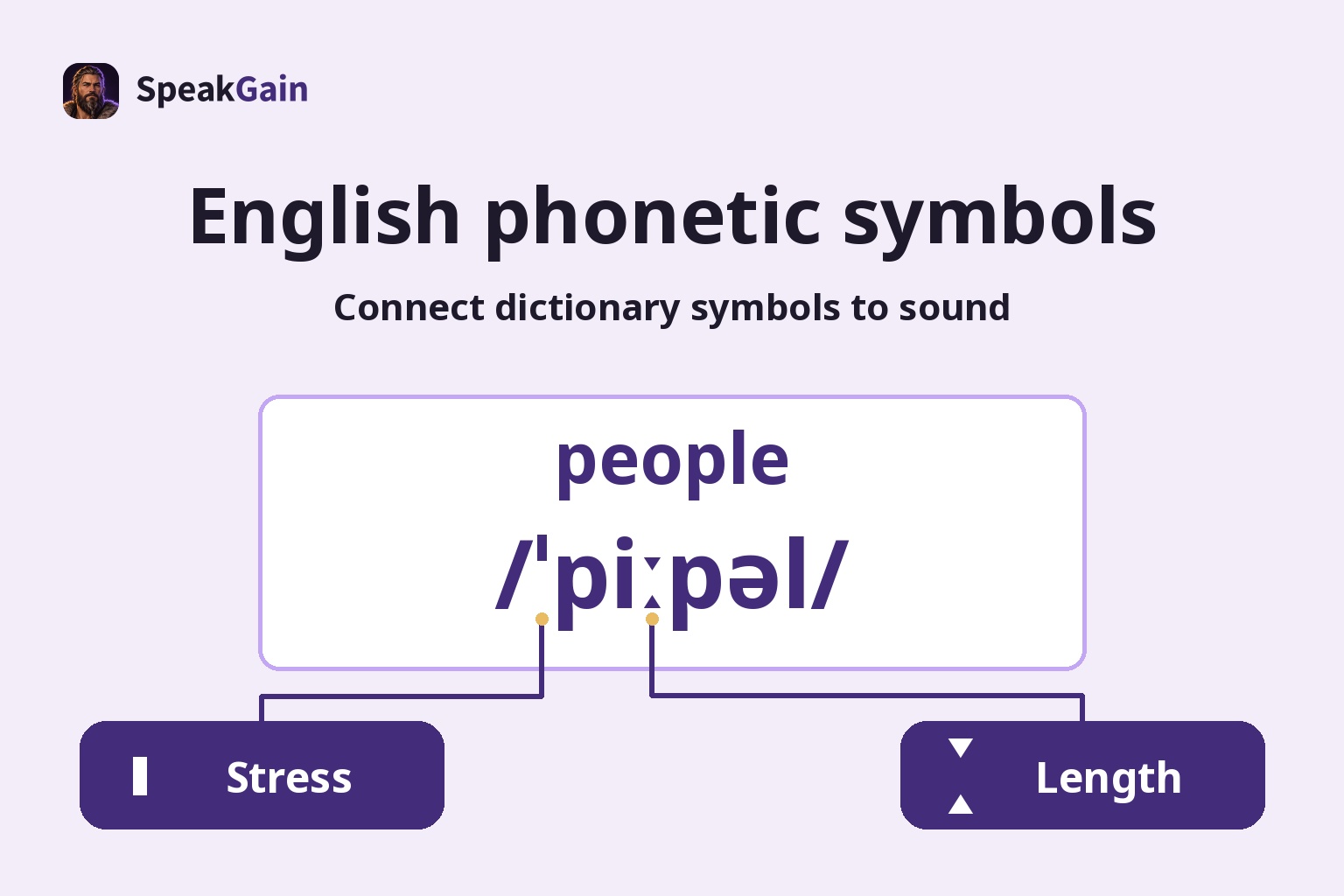
The cover uses people /ˈpiːpəl/. Cambridge’s official pronunciation page gives the same UK and US symbol sequence, with a syllable dot and a small optional schwa in its display. Our generic drawing simplifies those display details; it is not a screenshot. Cambridge: people, checked 14 October 2026.
Read each group in words, then in a sentence
Vowels: /ɪ iː æ ʌ ə/
Symbols → words: sit /sɪt/, seat /siːt/, cat /kæt/, cup /kʌp/ and the first vowel of about /əˈbaʊt/. Typical misreading: reducing sit/seat to one familiar vowel with only a duration change, or treating /ə/ as the letter name e. Dictionary appearance: length marks and weak-vowel conventions can differ; check the key and audio. Practice sentence: Please sit in this seat. Focus on sit and seat rather than assessing every sound at once. English vowel guide explains the actual vowel practice.
Consonants: /θ ð l r j/
Symbols → words: think, this, light, right and yes. Typical misreading: substituting one familiar sound for both th symbols or both l/r, and reading /j/ like job /dʒ/. Dictionary appearance: /laɪt/, /raɪt/ and /jes/ are common learner transcriptions; more detailed IPA material can use [ɹ] for English r. Practice sentence: Yes, I think this is right. Choose the th contrast today and right’s initial sound another day. Use pronunciation practice guide for the production and recording steps.
Diphthongs: /eɪ aɪ ɔɪ aʊ oʊ əʊ/
Symbols → words: day, my, boy, now and go. Typical misreading: making the two written elements two equally separated syllables. Dictionary appearance: /oʊ/, /əʊ/ and a convention such as /ou/ need the appropriate key; the UK/US difference is not just typography. Practice sentence: We can go now. Listen to go and now separately, then return to the sentence. A diphthong changes within a syllable; the detailed exercises belong in English vowel guide.
Stress: /ˈ/ and /ˌ/ refer to what follows
Primary stress /ˈ/ comes before the stressed syllable; /ˌ/ indicates secondary stress. In about /əˈbaʊt/, the mark highlights /baʊt/, not the preceding schwa. It is not a sound or a place to insert a pause. retell /ˌriːˈtel/ provides a secondary-stress example. Oxford’s guide explains these conventions.
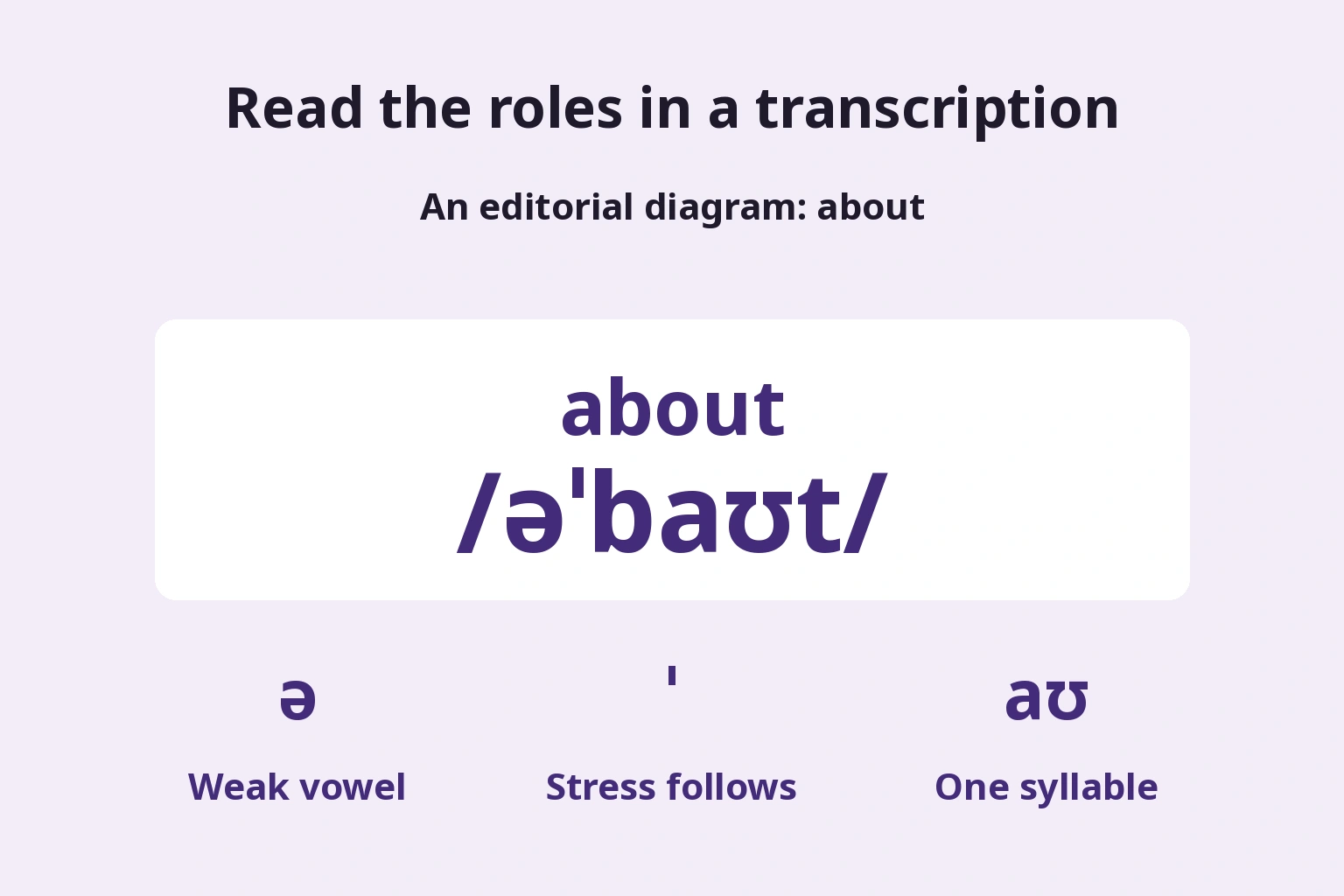
Typical misreading: accenting the preceding syllable or making secondary stress equal to primary stress. Dictionary appearance: distinguish this preceding-mark system from a dictionary that puts an accent above the vowel. Practice sentence: Tell me about your day. Hear which part of about stands out, then hear it in the sentence. Dictionary word stress is not an instruction to emphasise every word equally; sentence emphasis also depends on meaning.
Length /ː/ and schwa /ə/ are different jobs
/ː/ marks length; it does not prescribe seconds or an automatic two-to-one timing ratio. food /fuːd/ is an example. Do not simply stretch a native-language vowel and assume its quality is correct. Some Cambridge American dictionary series omit certain length marks, so their absence alone does not identify a short vowel. Cambridge’s notation guide
/ə/ is a weak vowel, as in about’s first syllable, not an instruction to reduce every unknown vowel to the same sound. Typical misreading: confusing weak /ə/ with stressed /ʌ/ in cup. Dictionary appearance: schwa can correspond to several vowel letters in spelling. Practice sentence: I need some food. Hear food’s vowel without stretching every other word. Use English vowel guide to compare quality as well as length.
r-colouring and syllabic consonants
Symbols → words: teacher and weather illustrate a weak r-coloured ending in the US model. Typical misreading: splitting /ər/ into two full syllables but treating /ɚ/ as an unrelated sound. Dictionary appearance: Oxford’s weather is US /ˈweðər/ and UK /ˈweðə(r)/. Its parenthesised UK r has a following-vowel condition; it is not always pronounced in isolation. Practice sentence: The weather was better than I thought. Keep your chosen accent as the reference. Oxford: weather
Symbols → words: n̩ and l̩ can mark syllabic consonants, relevant to button and little. Typical misreading: inserting a strong extra vowel because none is printed. Dictionary appearance: Oxford writes final /ˈfaɪnl/ and explains syllabic l; Cambridge can use superscript ə for optional vowel sequences. Not every dictionary prints the under-bar. Practice sentence: Press the little button. Check one word’s audio before deciding how its ending sounds. Oxford: syllabic consonants
The learning order we recommend
This is editorial advice, not a proven universal ranking or a promise to master IPA in a set number of days.
- Choose a contrast your familiar sound categories do not preserve: /æ ʌ/, /ɪ iː/, /l r/ or /θ ð/, and notice weak /ə/. Find /ˈ/ too, so you know which syllable to listen for.
- Look up words you will actually say. weather is useful for talking about a trip; your own work vocabulary may be more relevant than a rare chart example.
- Always pair the symbols with the audio in the same accent column. Say the word, then its short sentence.
- Learn unfamiliar notation when you encounter it. Look up the key for /ɚ/, superscript ə or a respelling system rather than memorising the full international chart first.
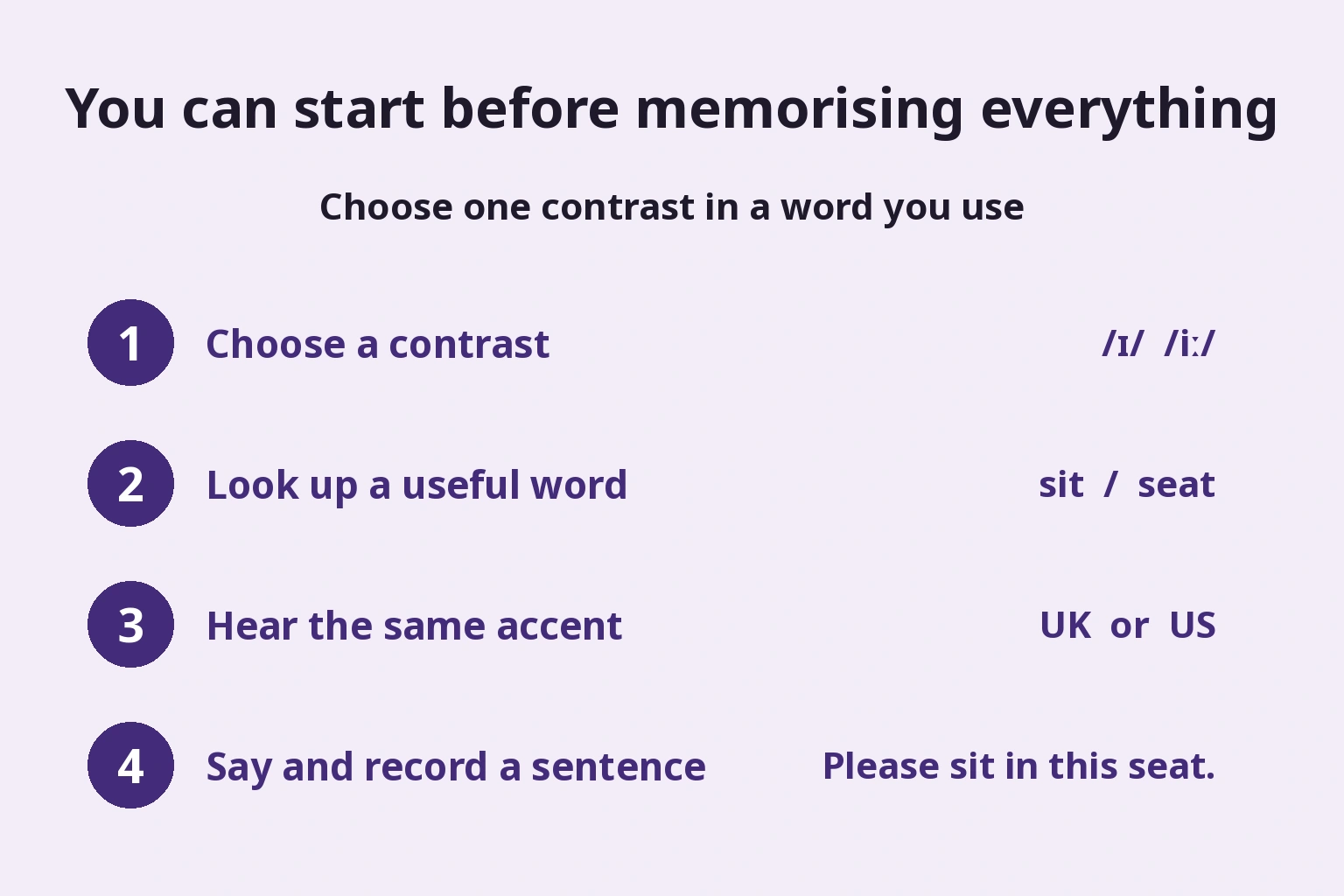
Tomorrow, check whether you can find weather’s stress and understand its ending again. Naming the symbol is useful, but it does not verify the sound you produced. Listening and a recording provide a different kind of check.
Methods we do not recommend
Do not make reciting the entire chart a prerequisite for speaking. It postpones useful word-level listening. We also do not recommend writing a native-script approximation above every word and treating that as the final pronunciation; Japanese katakana, for example, can collapse distinctions the dictionary deliberately shows. Meaning notes are fine. Replace pronunciation respellings with a note such as “stress on the next syllable” or “check the ending”, then return to the original audio.
Use a dictionary lookup in a short practice sentence
The weather was better than I thought. means the weather exceeded your expectations. It is our original sentence, shared across all locales, not a copied dictionary example. Look up weather, choose UK or US, and identify primary stress, /ð/ and the weak ending. Pick just one of those as today’s observation.
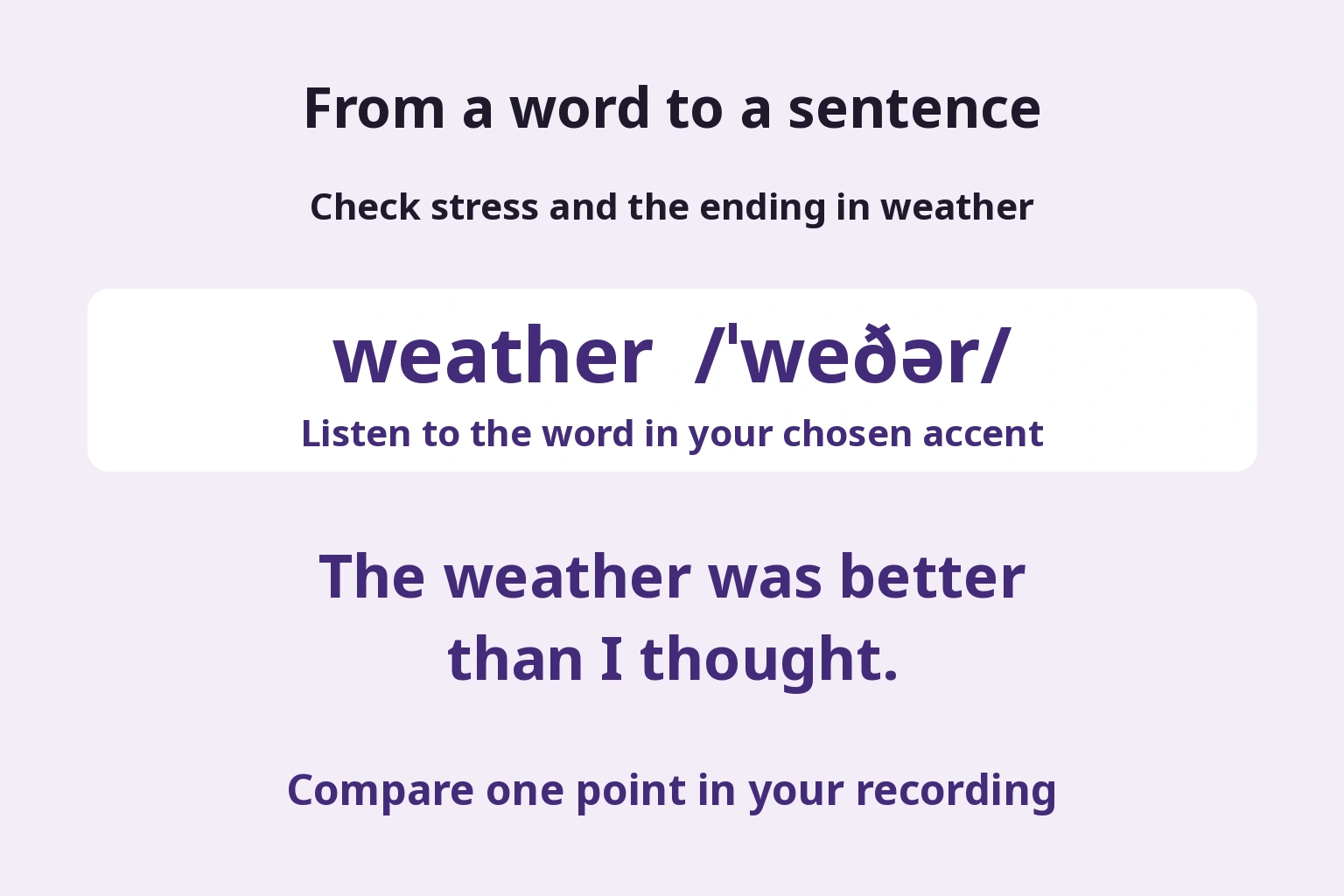
Listen to the dictionary’s word recording, say weather, then weather was, then the full sentence. Record yourself and compare the same point. A different voice pitch is not automatically a pronunciation error. If you cannot hear the difference, return to the word rather than simply increasing speed.
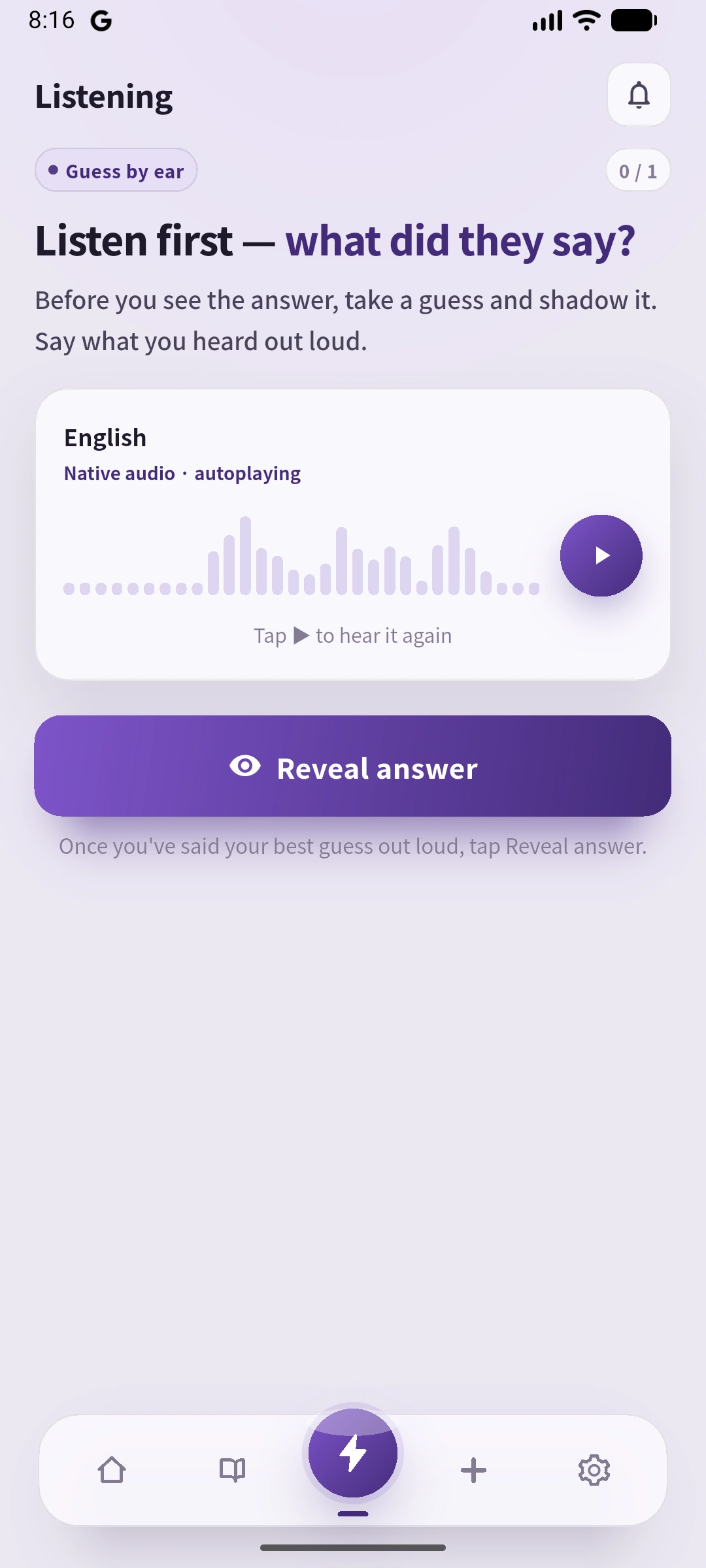
We created one card with this shared sentence through the normal Add screen in SpeakGain. The observed flow was Knowledge → Learn this card → Listening / Guess by ear → Reveal answer → Answer. Listening hid the sentence and played the reference audio. To compare written symbols with the sentence, reveal the answer and return to the saved English text.
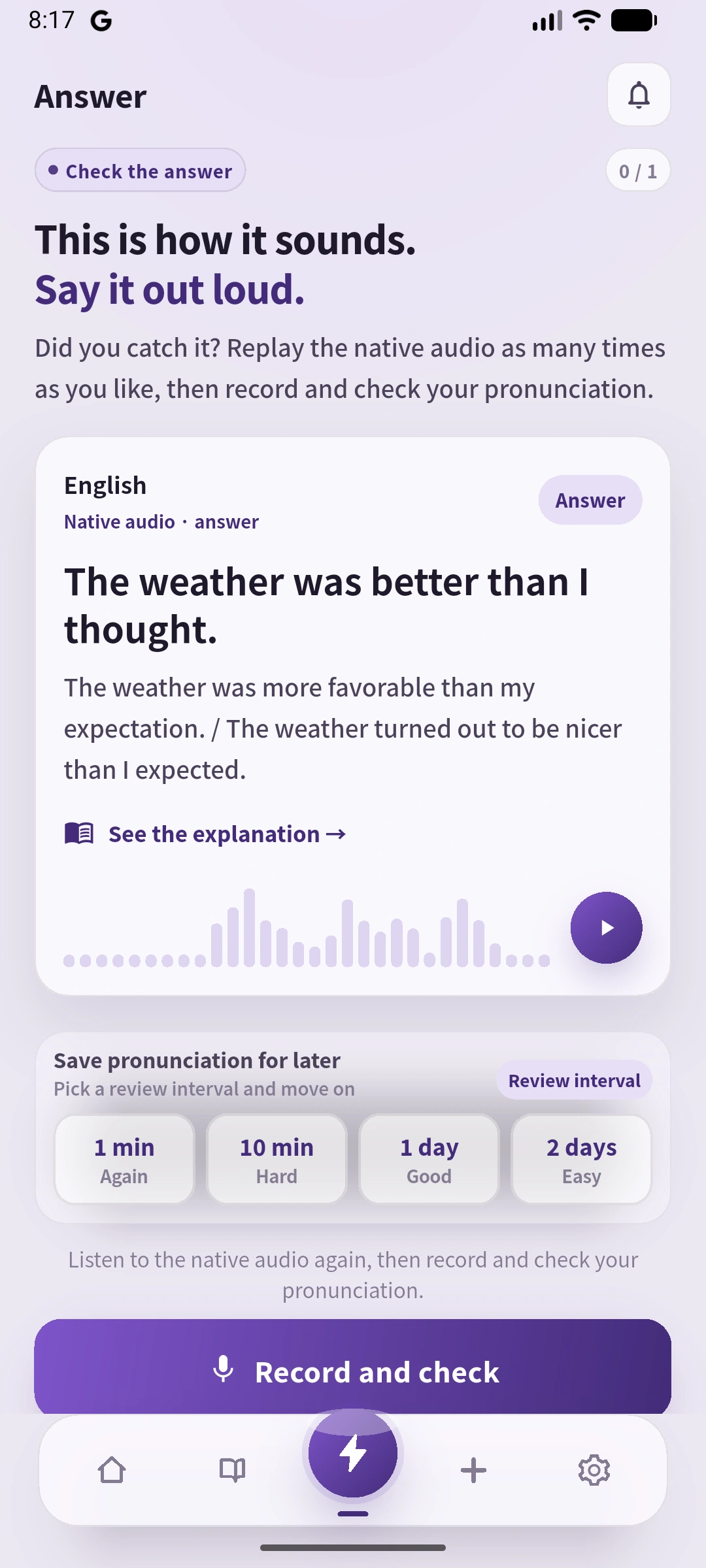
On Answer we verified the saved sentence, an English meaning explanation, model playback, review-interval choices and the Record and check entry. We did not submit a learner recording or test or publish a pronunciation judgement or score. The dictionary remains the place to check transcription; this example does not present SpeakGain as displaying IPA or judging symbol reading.
Frequently asked questions
Must I memorise all the symbols?
No, not before starting. Learn useful contrasts and stress, then add unfamiliar symbols through words and audio.
How many English symbols are there?
It depends on the accent model and classification. English teaching charts are not the entire IPA, and choices about diphthongs, weak vowels and r-colouring change the inventory.
Should I choose British or American English?
Start with the model relevant to your materials or conversations. Check hot, go and final r; neither national label means every speaker sounds identical.
Why do dictionaries disagree?
Accent models and notation conventions both vary. Identify the dictionary series and read its key before deciding the audio is different.
Can I write the pronunciation in my own alphabet?
Use it as a temporary reminder, not the final answer. A familiar spelling can hide distinctions. Keep the original symbols and audio.
Do children need IPA?
Age alone does not justify a full-chart memorisation task. Our recommendation is to start with familiar words and listening, then introduce useful symbols when reading them helps.
Can I pronounce a word from symbols alone?
Pair them with audio while learning. A broad dictionary transcription leaves out phonetic detail; it also cannot check your own production.
Our editorial verdict
Use phonetic symbols as a dictionary-reading tool, not a gate you must pass before speaking. Today, read weather’s stress and ending, listen in one chosen accent, say The weather was better than I thought., and compare one point in your recording. Return to the key for an unfamiliar symbol and to a sentence for a familiar word.