
Should you change your English accent? Intelligibility and what to practise first
Published
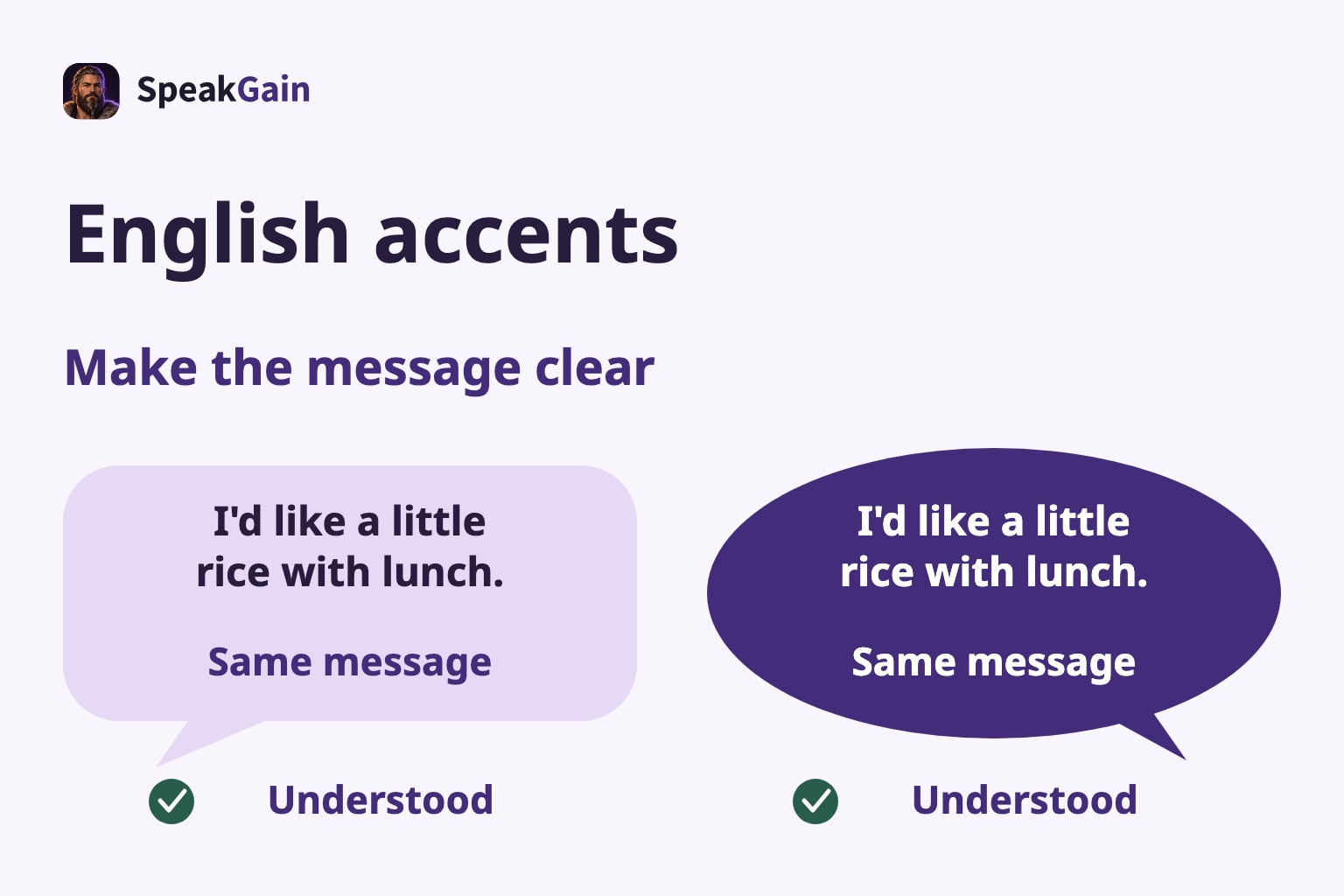
You do not need to erase your English accent as a blanket goal. Understanding depends on useful sound contrasts, missing or added sounds, stress and grouping, and the listener’s familiarity; sounding native-like is a separate target. Start with a word that actually caused a misunderstanding, compare one short recorded sentence, and practise listening to more than one speaker.
Accent, intelligibility, comprehensibility and native-likeness
An audible accent is not itself evidence that a message failed. Munro and Derwing asked 18 native-English listeners to transcribe and rate speech produced mainly by Mandarin speakers. Some strongly accented samples were well understood: the dimensions were related, but not interchangeable. This is not a study of every learner or every conversation. Munro & Derwing, 1995
| Term | Meaning | Research treatment | What it means for you |
|---|---|---|---|
| Accent / accentedness | Pronunciation features, or perceived distance from a comparison variety | Listeners rated accent strength in the study | Being noticed as an L2 speaker is not the same as being misunderstood |
| Intelligibility | Words or content actually understood | Exact word matches in transcription in that study; methods vary | Did the listener hear rice as rice? |
| Comprehensibility | Perceived ease or difficulty of understanding | Listener ratings of ease | A listener can get the words but still work hard |
| Native-likeness | Similarity to a chosen native-speaker model | An instructional goal discussed by Levis, not a fourth separate outcome in the study above | An optional personal target, not the sole condition for communication |
Levis distinguishes native-like pronunciation goals from an intelligibility-based approach and argues for selective teaching based on individual needs. Levis, 2005; Levis, 2018
Our view: ask what was understood before asking where your voice sounds as if it comes from. If a rice order was understood, an unfamiliar vowel colour alone does not make the order a failure. If an important word was mistaken for another, select that word. Ask a teacher, “What did you hear me order?” instead of only “Is my accent bad?” This is an informal check, not a laboratory measurement.
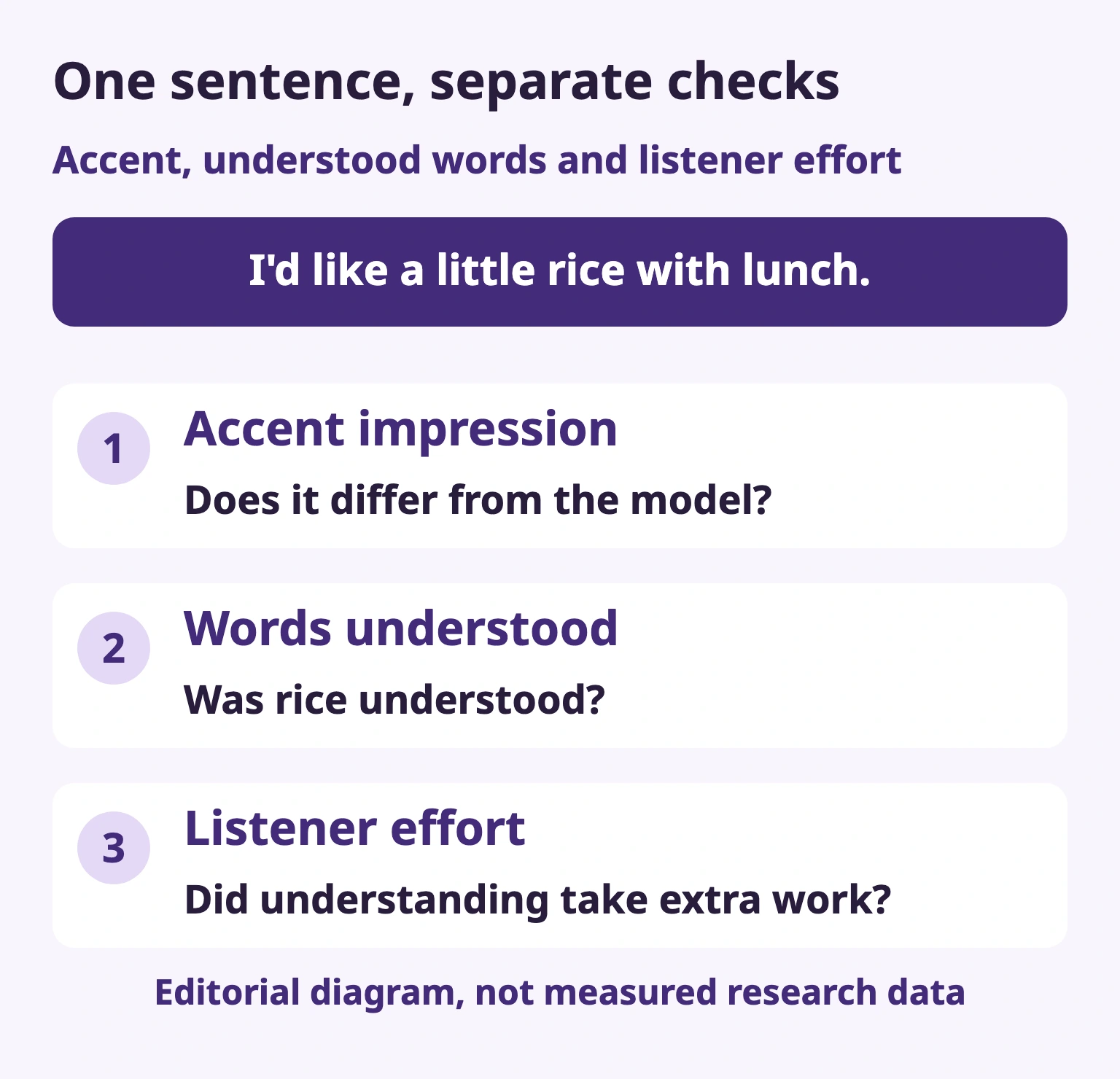
Accent concerns pronunciation here. Vocabulary choices and grammar need different checks. If your written sentence also fails to express your meaning, changing its sounds will not solve that wording problem.
What we would practise first
Jenkins’ Lingua Franca Core proposes pronunciation teaching oriented to understanding between speakers using English as a shared language, with accommodation skills rather than imitation alone. It is not a guarantee that a fixed short list works in every setting. Jenkins, 2000; Jenkins, 2002
The order below is our editorial decision, not an experimentally established ranking or a reproduction of the Core. Change it when your conversations reveal a different need.
| Priority | Possible communication impact | Example | Practice |
|---|---|---|---|
| 1. An actual misunderstanding | An order, name or number changes | rice heard as another word | Check what was heard; repeat the target in its sentence |
| 2. Useful consonant/vowel contrasts | Two relevant words become hard to distinguish | rice/lice; ship/sheep | Listen to dictionary models, then record one word in a sentence |
| 3. Added/missing sounds and clusters | Word shape or ending information changes | An extra vowel after like; missing s in likes | Keep the ending while comparing a word and a short group |
| 4. Word stress and message focus | A word or the important information is harder to find | LITtle; rice when choosing food | Check lexical stress; mark the information your listener needs |
| 5. Pace and grouping | The listener has to reconstruct the message | Rushing an entire order | Preserve words and use meaningful groups |
| 6. Fine details of one model | Optional refinement once the message works | A particular model’s vowel colour | Choose a relevant personal target; recheck understanding |
Our Japanese source considers added vowels and L/R as possible checks. An English-language reader can have any first language: that is not your diagnosis. Write four notes about a recent conversation: setting, intended word, word understood, next feature to compare. If you do not know what was heard, write “unconfirmed”. Choose an actual repeated problem over a list of sounds you already handle.
Keep useful contrasts and the shape of the word
Research has observed vowel insertion in samples of Japanese-accented English, with variation by rate and sound environment. That does not describe every Japanese speaker. Tajima, Erickson & Nagao
We would inspect an added vowel only if it occurs in your recording. Compare like, like with, then I’d like a little rice with lunch. Do not remove the k while trying to remove an extra vowel. A word-final stop need not have a large audible release every time. The goal is to preserve the word, not to explode every consonant.
If your own difficulty is L/R, compare little and rice with dictionary audio, practise their initial sounds and return to a little rice. If it is a vowel contrast, choose a useful pair such as ship/sheep. Use the consonant guide and vowel guide for sound mechanics. We do not prescribe L/R first to someone who already distinguishes it, or claim that th or vowels never matter.
Stress and rhythm give clues to words and meaning
Levis’ word-stress chapter explains how stress and individual sounds help listeners identify words; misplaced stress can interfere with understanding. It does not establish that every stress difference matters equally or that rhythm always outweighs sounds. Levis, 2018
Our choice: check a word’s stress, then choose the message’s focus. little starts with its stressed syllable. If a server asks whether you want rice or bread, rice is a sensible focus in the practice sentence; another context can change that choice.
Say I’d like a little RICE with lunch. The capitals mark our contextual focus, not shouting or automatic analysis of a recording. Listen, mark rice, record naturally, and check whether it stands out while the other words remain. If you lose L/R while following rhythm, return to the word. If concentrating on L/R breaks the sentence into isolated syllables, return to a little rice. Use stress and intonation and connected speech for the next step.
Listen, imitate and compare one sentence
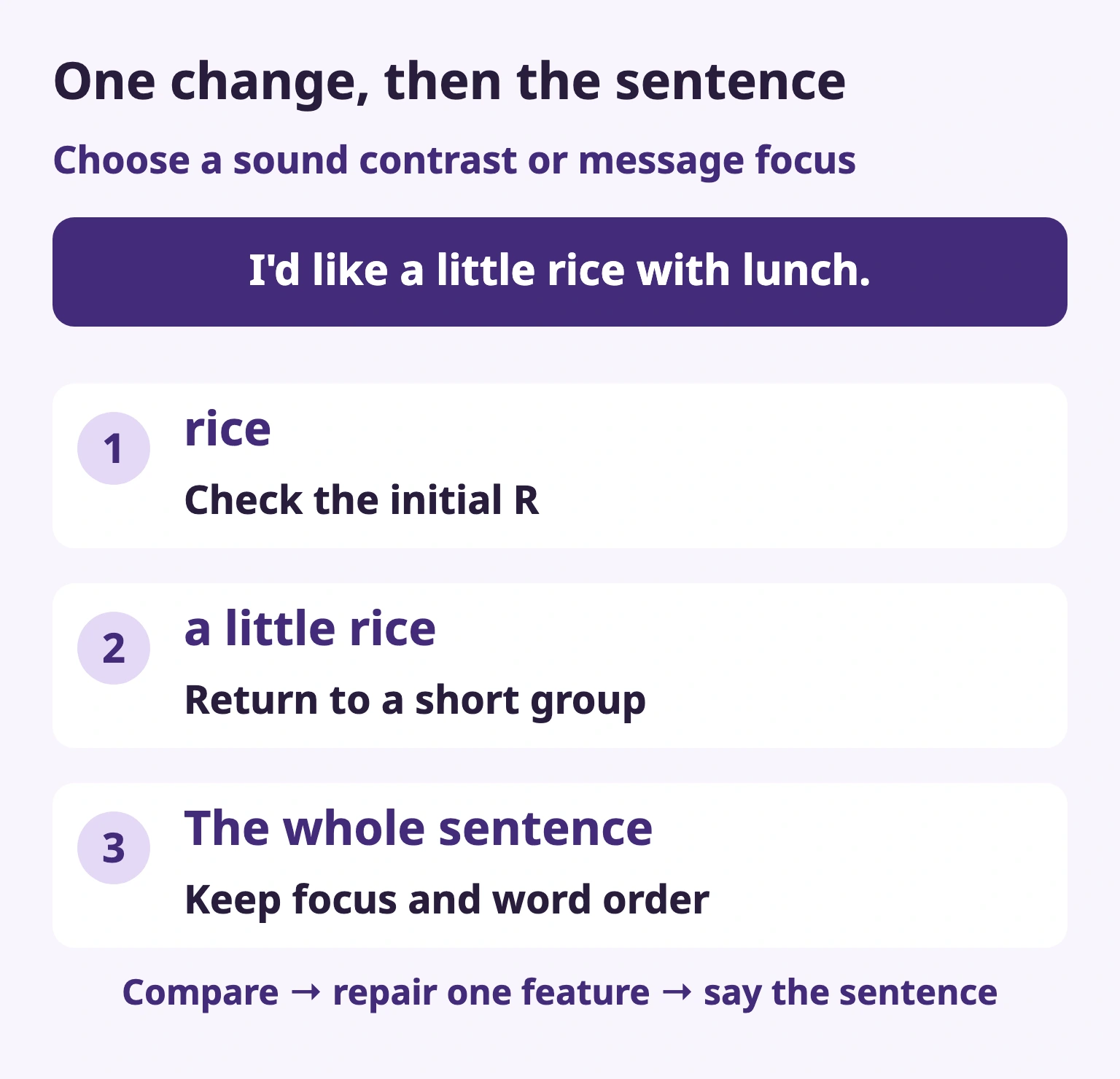
Selective practice follows the needs-based approach above; our five-to-ten-minute starting session is an editorial suggestion, not a validated dose. Use the same sentence in the model and your recording: I’d like a little rice with lunch. Choose the initial R or rice’s prominence for this round.
- Confirm the meaning: a little rice to accompany lunch. Listen without talking over the model.
- Imitate with the text visible. Shorten to rice or a little rice when necessary, then return.
- Record yourself with an ordinary recorder in a quiet place.
- Compare only today’s feature. Note an audible difference or leave it unconfirmed.
- Repair one feature, record the whole sentence again and try it before hearing the model tomorrow.
You need not copy a model’s low voice. Voice quality and word recognition are different questions. If you cannot judge the sound, ask a teacher about that word rather than repeating indefinitely. Your own comparison does not certify that every listener will understand it.
We added one card with this sentence through SpeakGain’s normal Add flow, opened Knowledge from Library and selected Learn this card. Listening hid the sentence and presented reference audio; Reveal answer opened Answer with the same sentence, an English explanation, playback and the Record and check entry.
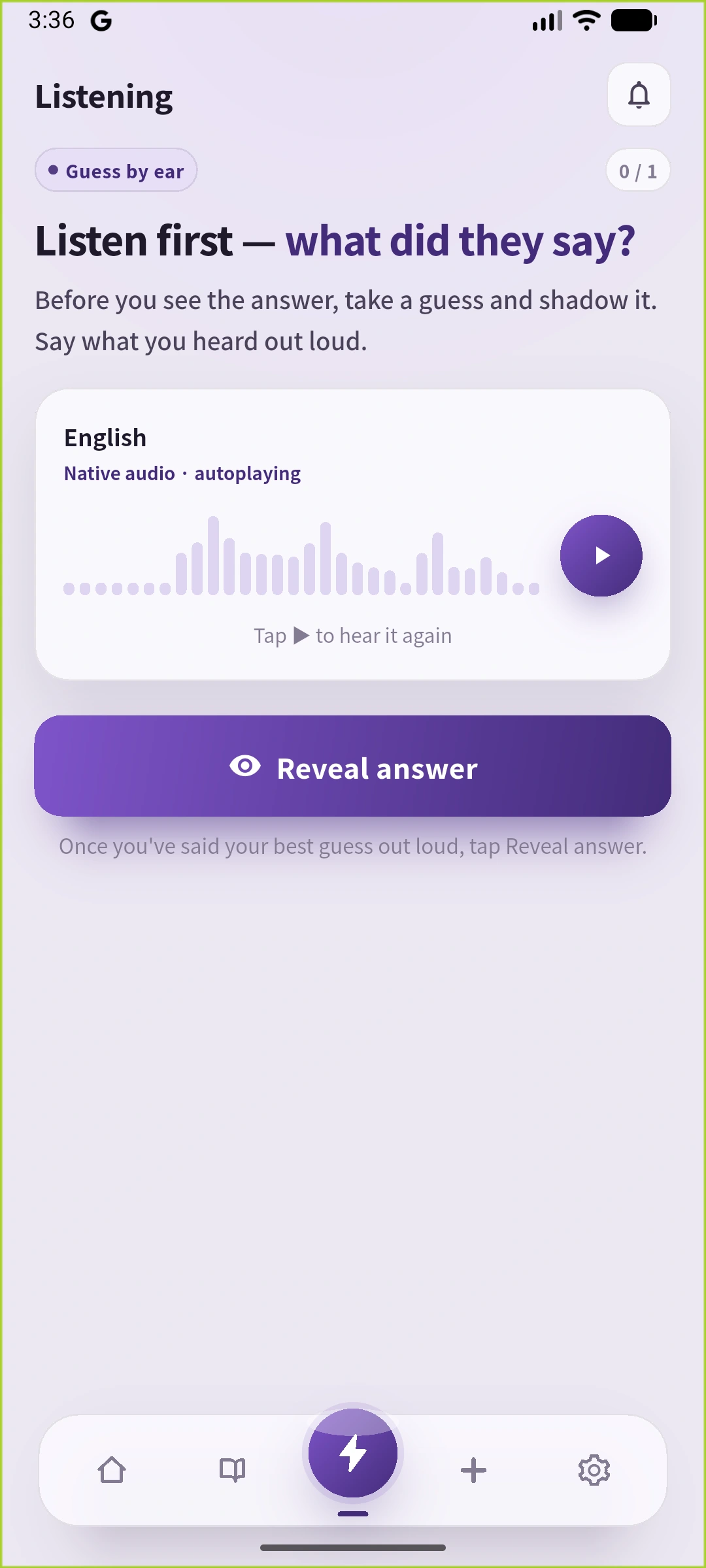
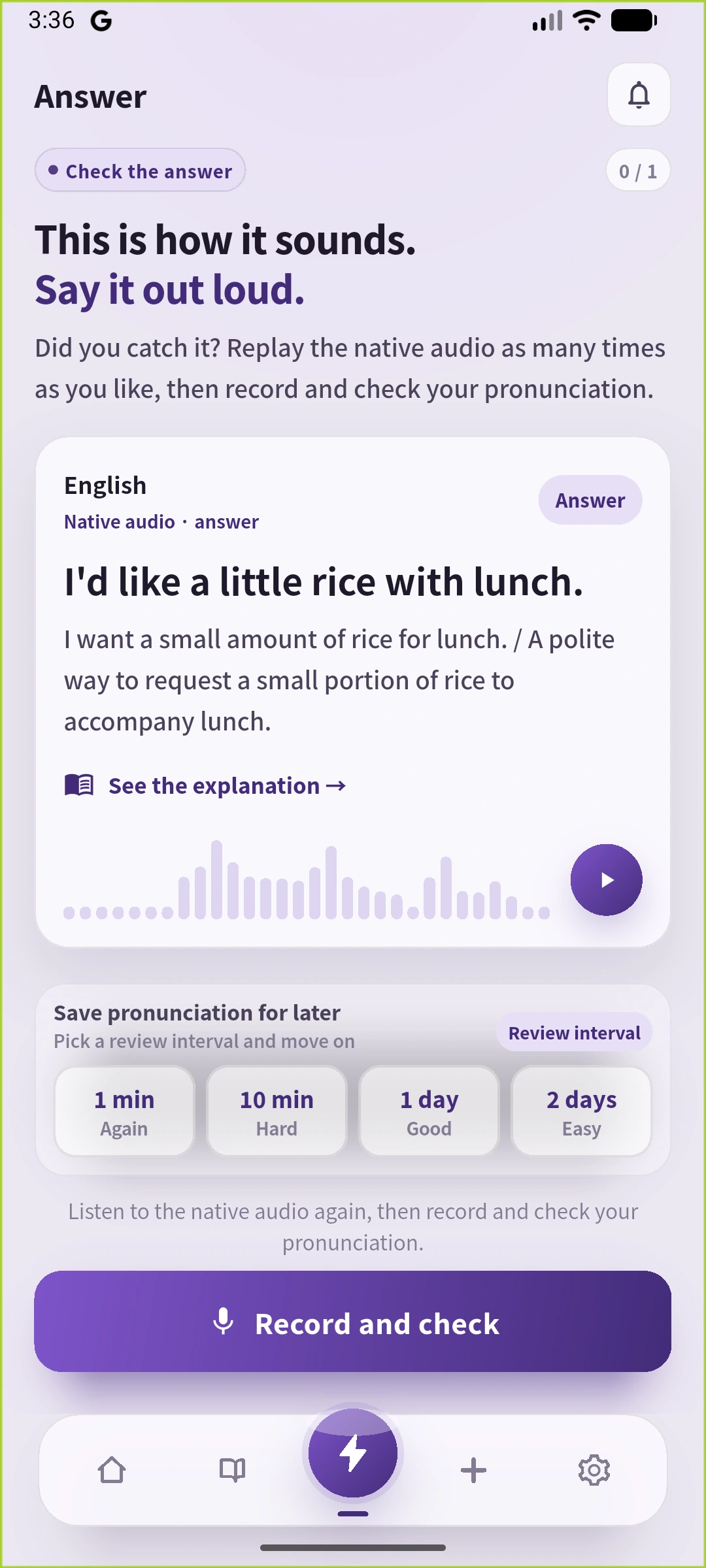
We did not submit a learner recording or verify a judgement result. The independent comparison above can use an ordinary recorder. Bars in the reference-audio panel are not presented as measurements of your stress or accent.
For a fuller word-to-sentence routine, see English pronunciation practice.
Get used to other speakers without ranking accents
Bradlow and Bent found adaptation to Chinese-accented speech among native-English listeners; multiple-talker exposure supported understanding a new talker in that experimental setting. It does not promise rapid access to all accents for every learner. Bradlow & Bent, 2008
We recommend extending beyond one familiar voice. Choose short material with a transcript and a topic relevant to your work or travel. A country label cannot tell you exactly how an individual will speak.
If you miss rice but recognize it in the transcript, listen for how that speaker realizes the vowel. Learn to find the word rather than mentally “correcting” their accent. Start with twenty to forty seconds as our practical suggestion: listen without text and note the request; check the transcript; revisit the missed word; hide the text and check the message again. Then try an unheard clip from the same speaker and a clip from another.
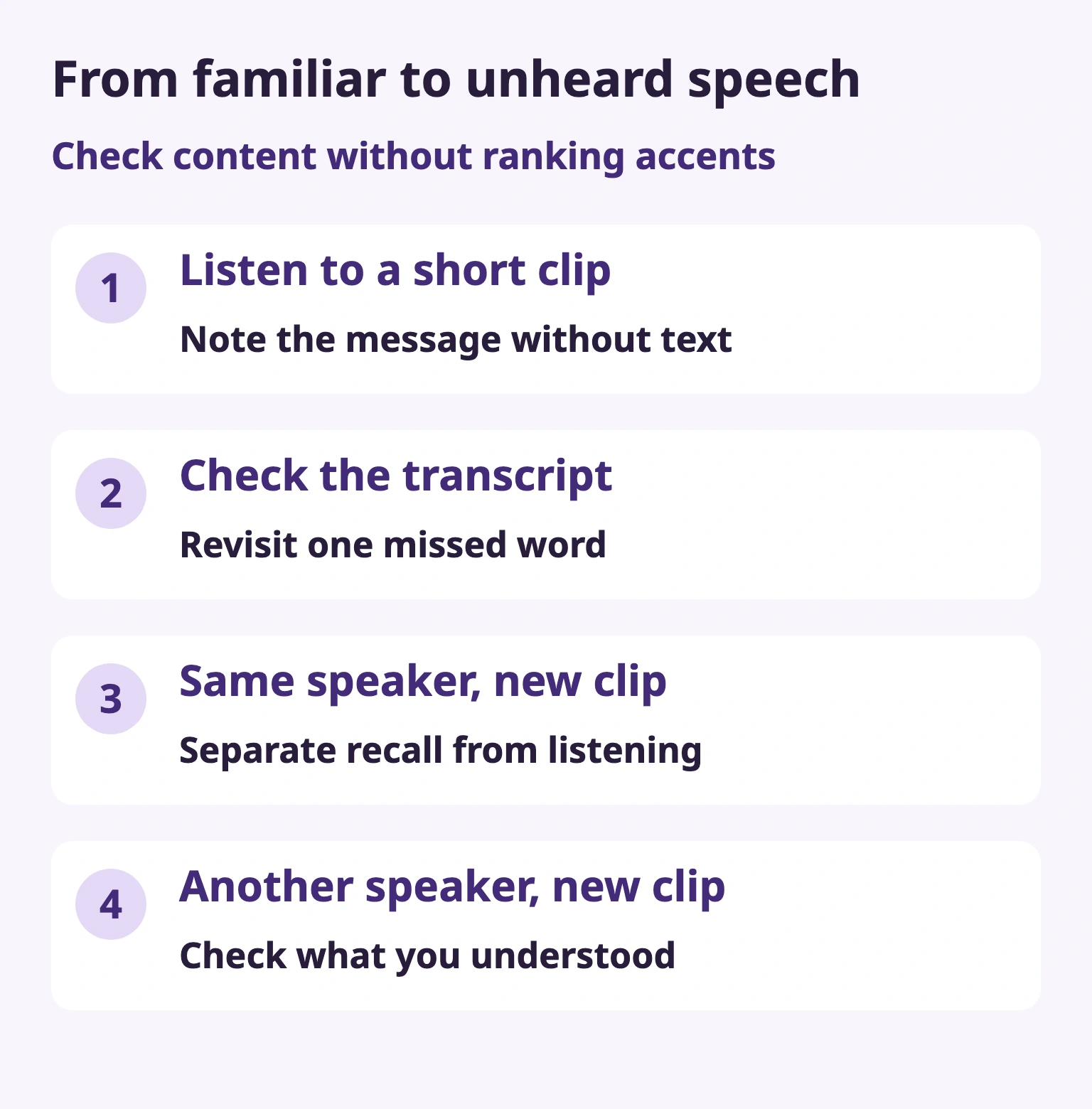
Separate remembering a transcript from understanding new speech. Unknown vocabulary, topic, speed and connection noise can also cause difficulty: use the listening study guide to diagnose the problem.
In conversation, ask Could you say the last word again? or Did you say rice? Identify the uncertain part without judging the speaker. For names, numbers and deadlines, confirm in writing too.
A three-week editorial plan
Research on adaptation and selective teaching informs this plan, but three weeks is not an accent-removal deadline or a guaranteed result. Start with five to ten minutes and adjust the workload. Adaptation; individual needs
| Week | Speaking | Listening | End-of-week check |
|---|---|---|---|
| 1: Choose one sentence | Record the common sentence; choose R or focus | Check one speaker’s short clip against text | Can you name the target and the reason for a missed word? |
| 2: Change one condition | Use rice in another sentence | Same speaker’s new clip, then another speaker | Can you check the target outside memorized material? |
| 3: Your real setting | Use the target in an order or work sentence | An unheard clip before checking text | Separate understood, misunderstood and unconfirmed |
For week two, try I’d like some rice, please. In week three ask what your partner heard in your actual sentence. Keep target, observation, confirmation and next step as notes. Liking your recording more is a valid feeling, but not a listener test. After a missed day, resume one sentence; do not compensate with a long rushed recording.
Methods we do not recommend
Our recommendations keep the goal tied to a communicative task. Pursuing a preferred model for personal reasons is still a choice. Levis
| Method | Why we avoid it | Alternative |
|---|---|---|
| Complete accent erasure as the only goal | A vague standard can count successful messages as failures | Check a concrete order or explanation |
| Imitating an accent as a joke | It caricatures people and avoids understanding their message | Inspect the person’s actual words respectfully |
| Repairing everything at once | You cannot tell what helped | One target, then the full sentence |
| Competing to sound fast and native-like | Missing words can hide behind speed | Preserve words and meaningful grouping |
| Treating one generated voice as the correct accent | One model is not all English | Fix a speaking model; broaden listening |
| Transcription or a score as the only proof | Machine output is not a partner’s understanding | Check the recording and the received message |
Frequently asked questions
Is having an accent embarrassing?
We do not treat it as a defect to be ashamed of. An accent rating alone does not establish a communication failure. Practise a repeatedly misunderstood word without rejecting your language background.
Must I sound native-like?
No universal requirement. Begin with being understood in your setting. Acting or personal preference can justify an additional model-based goal; do not postpone conversation until your accent disappears.
American or British English?
Choose a suitable, repeatable model. Neither is the only correct accent. Keep the model fixed for a comparison round and expand speakers for listening. Viking is one American-English example.
What should I correct first?
A word that actually caused a misunderstanding. Then check its contrast, sounds, stress and grouping. Your interface language is not your first-language diagnosis.
What if another accent is hard to follow?
Ask about the uncertain word; practise short clips with transcripts and then new speakers. Adaptation research supports the possibility of learning, not instant understanding of everyone. Study
Can adults change pronunciation?
Adult learning has been observed. Bradlow and colleagues reported retained perception and word-production gains after intensive Japanese-adult L/R training. This specific laboratory contrast does not validate our short routine or guarantee whole-accent change. Bradlow et al., 1999
What if the words are understood but effort is high?
Check useful sounds, pace and grouping one at a time. Ease and successful recognition are separate questions; processing-time research also distinguishes them. Munro & Derwing, 1995
Does SpeakGain score whether an accent is correct?
We do not present it as an accent or pronunciation judge. Similarity to Viking is not proof of communication success. Use specific comparisons and human clarification when needed.
Our editorial verdict
Repair what obstructs your message before trying to erase your accent. Today, record I’d like a little rice with lunch., choose R or focus, practise a shorter group and return to the full sentence. Check another sentence and a partner’s understanding next. For listening, move from a checked clip to an unheard one. Clearer communication and broader listening are useful goals without an accent hierarchy.
Sources
Primary publisher abstracts and author chapter summaries were inspected; they are not presented as full-method reviews. The practice order, timings and plan are our editorial proposals.