
Everyday English conversation: core phrases and how to practise them
Published
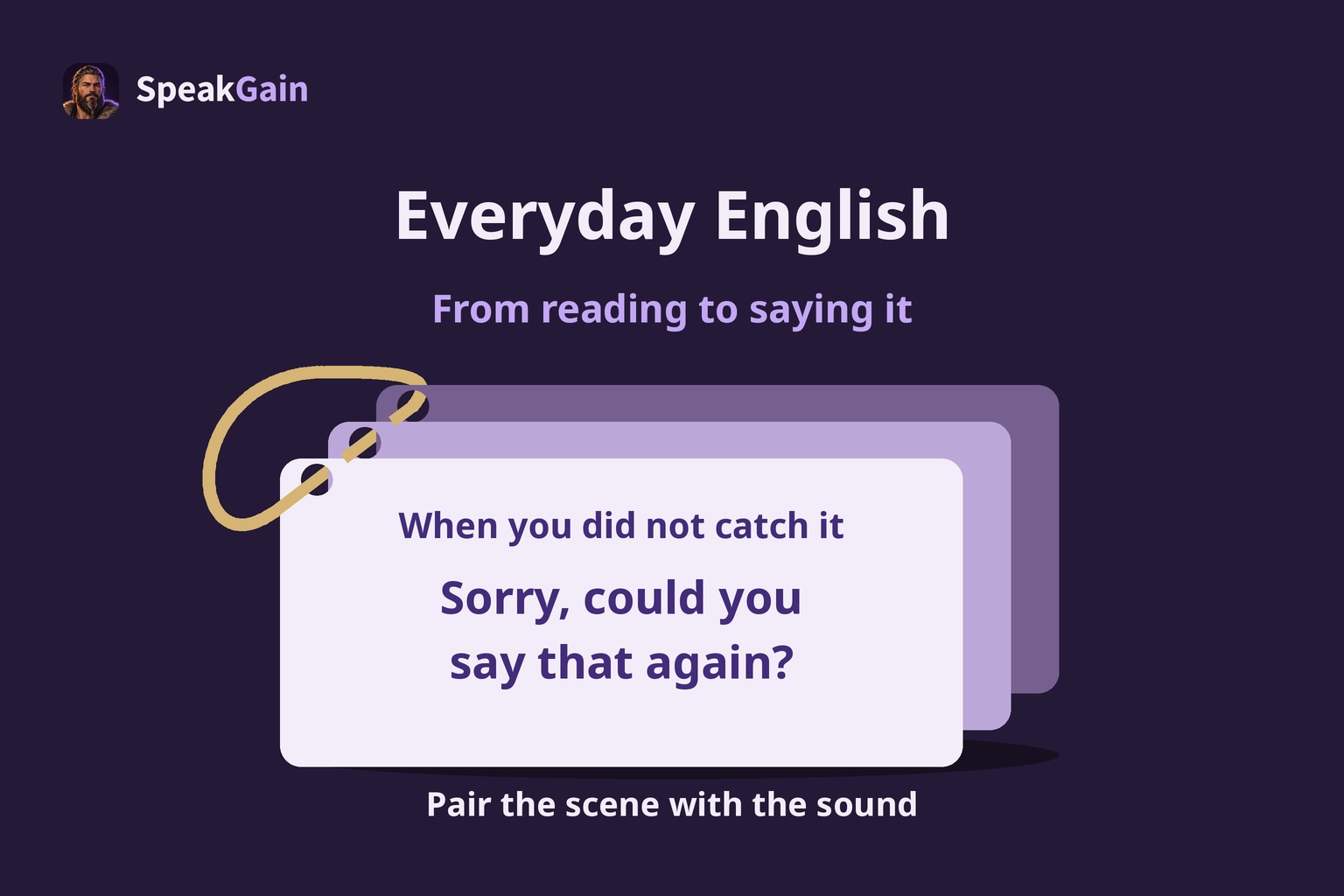
Start everyday English with greetings, reactions and requests for repetition, then add requests, invitations and refusals, feelings, thanks and apologies, and endings. Choose ten sentences you would actually use, such as “Good morning.”, “I see.” and “Sorry, could you say that again?”, and practise them with sound and a specific scene. Our suggested starting routine is ten minutes a day for one or two weeks, including a short exchange with the English hidden.
That is a practice plan, not a promise of fluency. If a phrase looks familiar but disappears when you need it, give it a cue: who are you speaking to, what happened, and what do you want them to understand? This guide picks a small core for adult beginners rather than asking you to memorize a hundred unrelated lines.
Core phrases by everyday situation
“Polite” is a guide, not a fixed score. The request, relationship and tone matter too. Start with the rows you need today.
| Scene | Phrase | Meaning | When to use it | Caution |
|---|---|---|---|---|
| Greeting | Good morning. | A morning greeting | Meeting a colleague in the morning | Use Hello at other times |
| Replying | Good, thanks. And you? | You feel well; ask back | Replying to How are you? | Choose a reply that fits your state |
| Understanding | I see. | You understand | Hearing an explanation | It does not necessarily mean agreement |
| Positive reaction | That sounds great. | A positive response to a plan | Hearing good news or a pleasant plan | Unsuitable for a troubling story |
| Repetition | Sorry, could you say that again? | Ask to hear it again | You missed the words | Do not pretend to understand with Yes |
| Request | Could you help me carry this bag? | Ask for help carrying a bag | You need practical help | Name the action and object |
| Invitation | Would you like to have lunch? | Invite someone to lunch | Suggesting lunch together | Add a day if needed |
| Refusal | Thanks, but I can’t today. | Decline today | You cannot accept an invitation | Offer another day only if you mean it |
| State | I’m a bit tired. | You need some rest | Describing how you feel | Tired and tiring have different roles |
| Thanks | Thanks for your help. | Thank someone for helping | After receiving help | Put the reason after for |
| Apology | Sorry I’m late. | Apologize for arriving late | You missed the expected time | Add the next action when needed |
| Ending | See you tomorrow. | Say goodbye until tomorrow | You will meet tomorrow | Otherwise choose Bye or another ending |
The rows are choices, not a script you must recite in order. A quick greeting may be enough; a misunderstanding may require a repair phrase before anything else.
The first ten we would learn
Our editorial choice covers starting, responding, repairing and ending a conversation. It is not a measured frequency ranking.
- “Good morning.” — An easy scene to find in your day.
- “I see.” — Acknowledge an explanation without inventing an opinion.
- “That sounds great.” — Respond to a positive plan.
- “Sorry, could you say that again?” — Keep a missed message from ending the exchange.
- “Could you help me carry this bag?” — Make a concrete request.
- “Thanks, but I can’t today.” — Decline without leaving your answer unclear.
- “I’m a bit tired.” — Give a truthful short answer about your state.
- “Thanks for your help.” — Tie thanks to what the person did.
- “Sorry I’m late.” — Acknowledge a small everyday mistake.
- “See you tomorrow.” — Close a conversation when tomorrow really fits.
Replace the morning greeting or tomorrow’s goodbye if your day does not include those scenes. The invitation and the longer greeting reply can be your next additions.
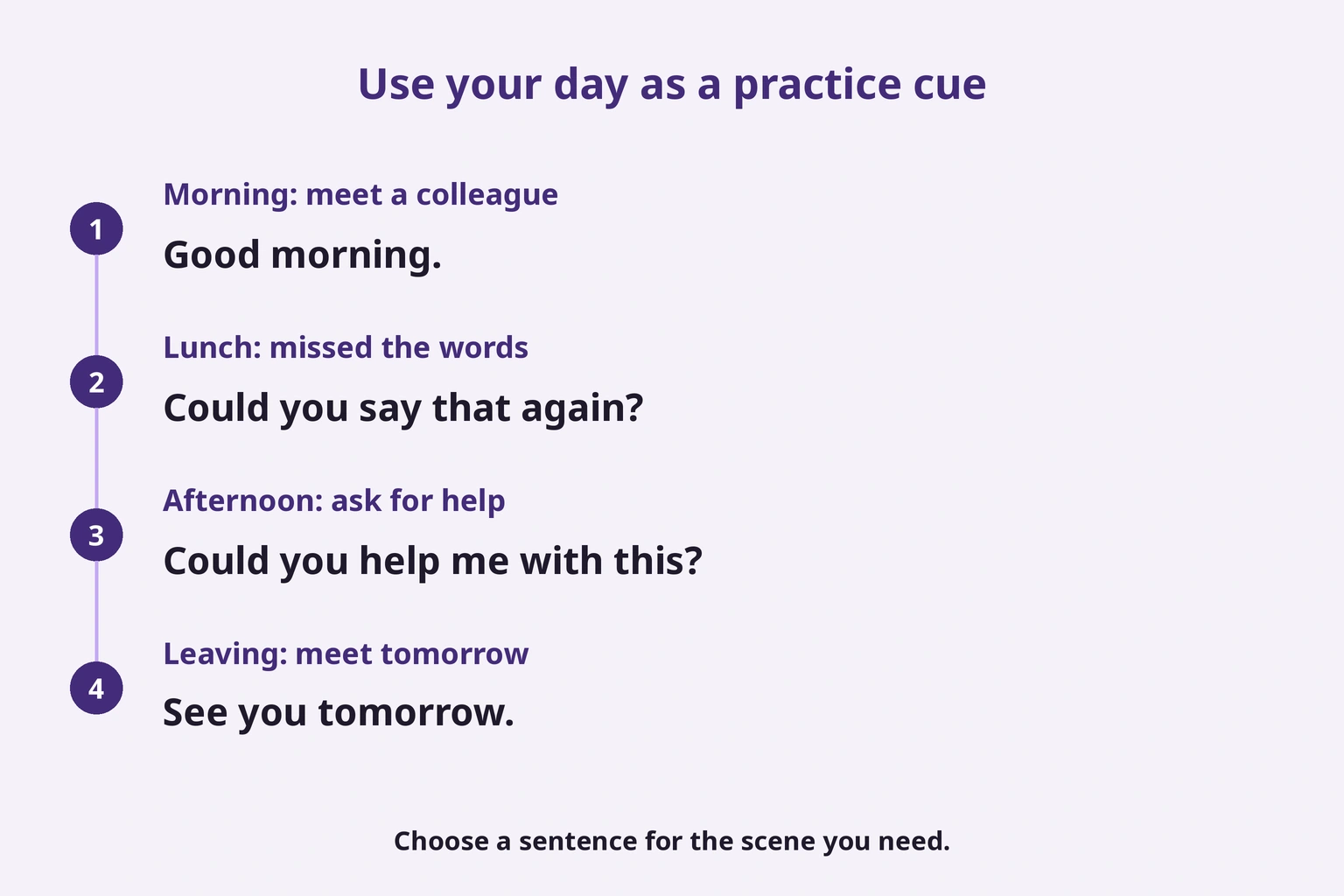
1. Greeting: start and return a short greeting
Core: “Good morning.”; use “Hello.” when time is irrelevant. To “How are you?”, one option is “Good, thanks. And you?”.
Reply: Return the greeting, or answer “I’m okay, thanks.” when that fits. Passing someone in a corridor does not require a long update.
Common trap: “Good night.” is for leaving at the end of the day or going to bed, not arriving in the evening. Cambridge’s greetings guide distinguishes these uses. “How do you do?” is a formal first-meeting greeting, so we do not put it in this everyday starter set.
Make it yours: “Good morning, Alex.” Add the person’s name. For first meetings, reunions and more answers, see English greetings and replies.
2. Reactions: understanding is different from agreement
Core: “I see.” for understanding; “That sounds great.” for a pleasant plan. Cambridge explains short response tokens as ways to show listening and interest.
Reply: To “I’m going to the beach this weekend.”, try “That sounds great.” The speaker might continue with “I’m looking forward to it.” A follow-up question is optional.
Common trap: Do not use “I see.” as automatic agreement. If you explicitly agree, “I agree.” says so. A positive reaction also needs to match the news: it does not fit someone’s difficulty.
Make it yours: “That trip sounds great.” Name the topic while retaining the pattern. Find more response functions in English backchannel responses.
3. Repetition: ask for another attempt
Core: “Sorry, could you say that again?” If speed is the problem, “Could you speak more slowly, please?” is another option. British Council’s checking-understanding lesson practises repetition and slower repetition.
Reply: When someone asks you, say “Sure.” and repeat the relevant part. After understanding, you can say “Thanks. I understand now.” For a time, confirm “At three?” if needed.
Common trap: “One more.” does not identify whether you want another item or another explanation. Saying “Yes.” without understanding can also sound like agreement.
Make it yours: “Sorry, could you say the time again?” Replace the vague object with the information you missed.
4. Requests: identify what help you need
Core: “Could you help me carry this bag?” When the object is already clear, “Could you help me with this?” can work. Cambridge’s requests guide explains indirect requests and the directness of “I want”.
Reply: “Sure. What do you need?” if you can help; “Sorry, I can’t right now.” if you cannot. A request needs room for either answer.
Common trap: Please alone does not identify the action. “This” can also be unclear when the other person cannot see the object. Could in this pattern is a present request, not a question about past ability.
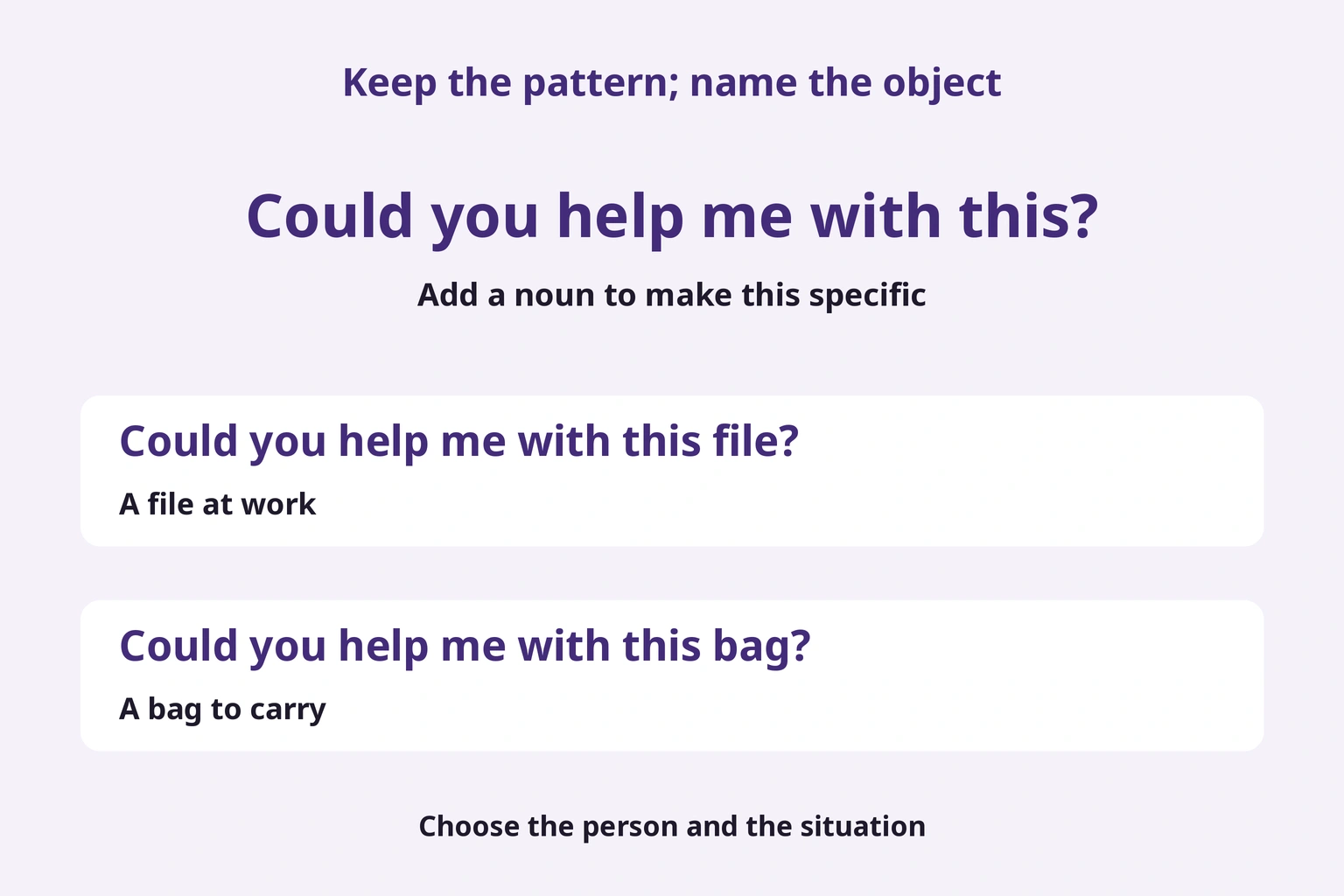
Make it yours: “Could you help me with this file?” or “Could you help me with this bag?”. See making requests in English for permission questions and more demanding requests.
5. Invitations and refusals: leave a real choice
Core: “Would you like to have lunch?”; decline with “Thanks, but I can’t today.” British Council explains would you like (to) as an invitation pattern.
Reply: Accept with “Yes, I’d love to.”; receive a refusal with “No problem.” If you genuinely want another day, suggest “How about Friday?”.
Common trap: “It’s difficult.” can leave the reason or decision unclear. “I can’t today.” identifies the time you cannot join. “Would you like lunch?” may offer food; adding the action and company clarifies your invitation.
Make it yours: “Would you like to have lunch with us tomorrow?” If it is too long, start with the short invitation and then ask “Tomorrow?”.
6. Feelings: say what fits today
Core: “I’m a bit tired.” or, when you feel well, “I’m good, thanks.” You do not have to explain every detail.
Reply: A possible question is “Did you sleep well?”; a short answer is “Not really.” Match how much you say to the conversation.
Common trap: “I’m tiring.” does not describe feeling tired. Tired describes the state; tiring describes something that causes it. The same distinction applies to bored/boring. British Council’s -ed/-ing lesson explains the difference.
Make it yours: “I’m a bit tired today.” or “I’m excited about the trip.” Choose something you actually feel rather than collecting adjectives without scenes.
7. Thanks and apologies: choose your purpose
Core: “Thanks for your help.” for help received; “Sorry I’m late.” for your late arrival.
Reply: “You’re welcome.” to thanks, or “No problem.” to a minor apology if it really is fine. When needed, the person running late adds “I’ll be there in five minutes.”.
Common trap: “Thanks for you.” does not give the reason for thanks. Use a noun or action, as in “Thanks for waiting.”. Do not replace gratitude with an apology every time. Cambridge explains thanks for + noun/-ing and replies.
Make it yours: “Thanks for your advice.”; “Sorry I missed your call.” See saying thank you in English and apologizing in English for the detailed distinctions.
8. Endings: match the next meeting
Core: “See you tomorrow.” when you will actually meet tomorrow; otherwise “Bye.” is available.
Reply: “See you.” to a goodbye; “Thanks. You too.” to “Have a good day.” when the wish applies to the other person as well.
Common trap: You too is not a universal return: if a server wishes you an enjoyable meal while working, Thanks may be enough. Do not promise tomorrow out of habit when there is no such plan.
Make it yours: “See you next week.” for next week’s class; add “It was nice talking to you.” when appropriate. The Cambridge greeting/farewell guide provides further usage context.
Choose ten from your own day and change one part
Decide the scene, choose a short pattern, replace one object or time, and check the whole meaning. “Could you help me with this file?” fits asking a colleague about a file. A cue such as “colleague, file” lets you practise retrieving the line instead of reading it.
Changing any word does not guarantee a natural sentence. Check unfamiliar combinations against dictionary examples; return to the shorter original if unsure. Include a repair and refusal phrase, not just greetings. If ten lines are already familiar, locate the one you cannot say with the English hidden before adding more. how to memorize English sentences explains the sentence-learning process in more detail.
Ten minutes: sound, scene, recording
This allocation is our editorial suggestion. On busy days, practise two or three of the same ten lines.
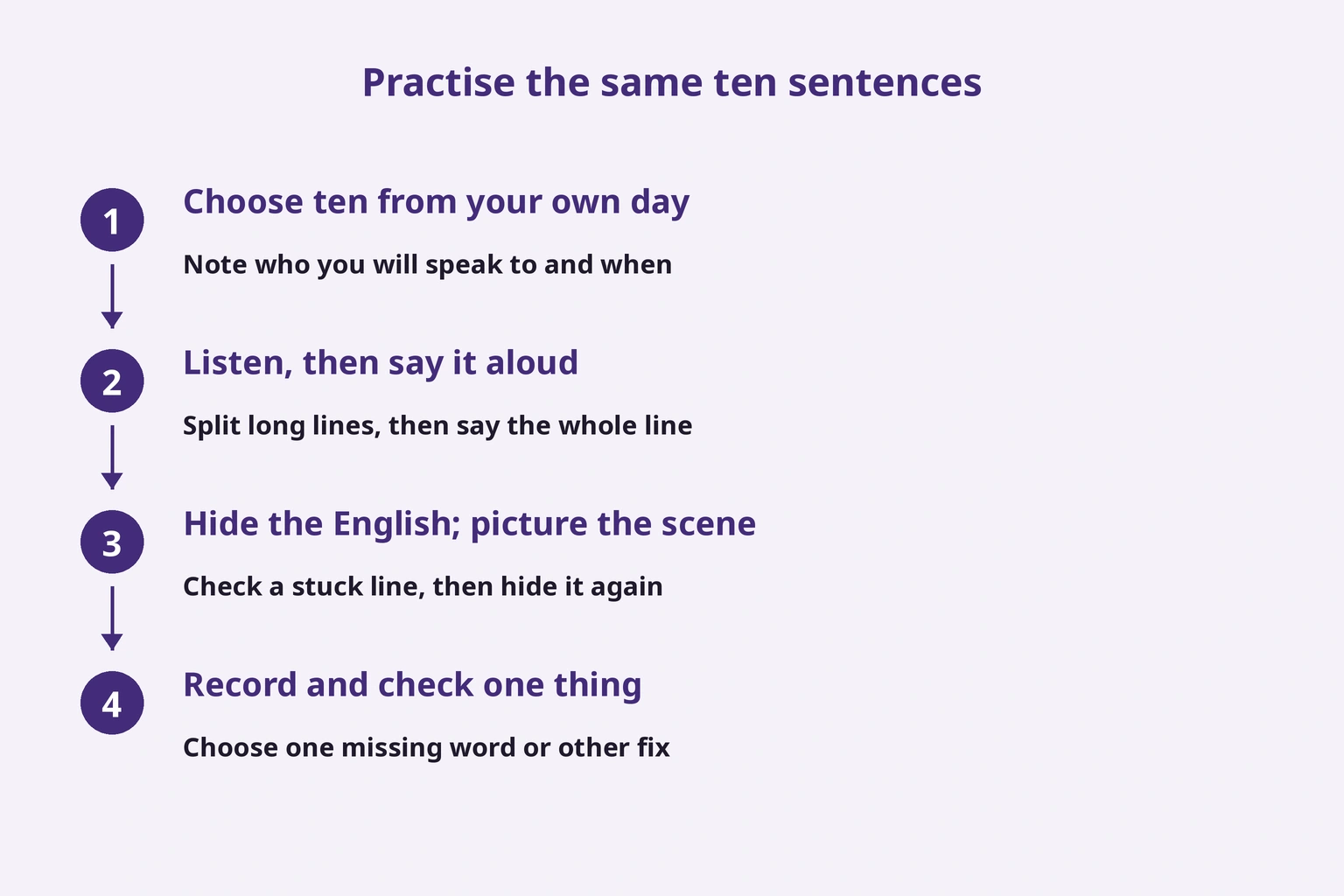
- Two minutes: check meaning and listen. Know who does what; avoid relying only on a spelling-based guess.
- Three minutes: stop the audio and repeat. Break a long line into chunks, then return to the whole sentence.
- Three minutes: hide the English and imagine the scene. If you get stuck, check once, hide it and try again.
- Two minutes: listen to one recording. Check whether you finished and omitted a necessary word. Choose one correction, then say it again.
Recording makes your speech available to review; it is not an automatic pronunciation judgement. Matching the model’s voice quality is not the goal. Ask a teacher or conversation partner about a particular sentence and scene when you need an outside check.
Save your own sentence and listen again in SpeakGain
We created one card for the core phrase “Could you help me carry this bag?” through the normal Add screen in SpeakGain. On the device, Card library → “Knowledge” → “Learn this card” led to “Listening” / “Guess by ear”, where the English was hidden and reference audio played. “Reveal answer” opened “Answer” with the saved sentence, meaning explanation, playback, review-interval choices and the “Record and check” entry.
These are actual English-interface screens. “Native audio” on this card and the player below use AI-generated “Deep-voiced Viking” audio, not a human native-speaker recording. This example demonstrates saving, listening again and revealing the sentence. Recording submission or pronunciation judgements were outside this device check.
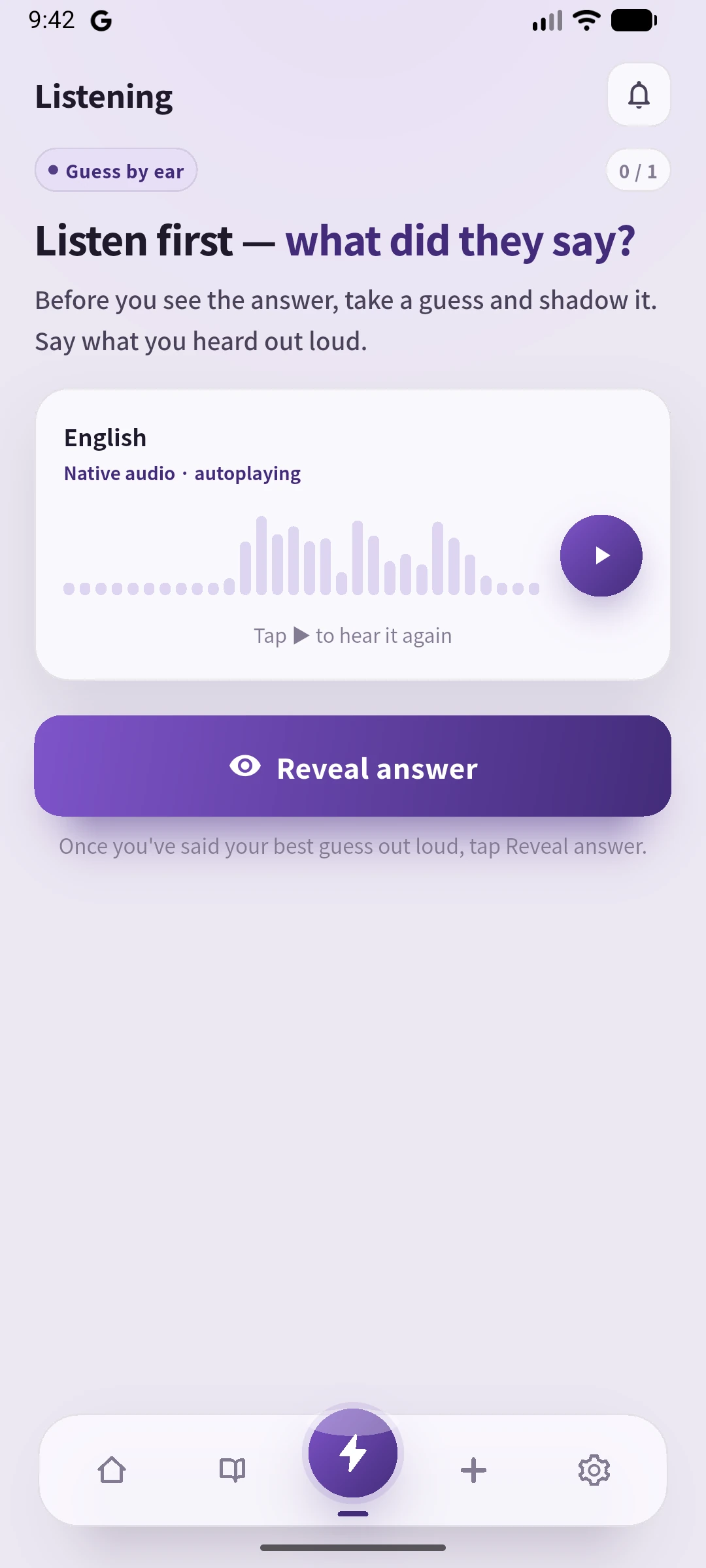
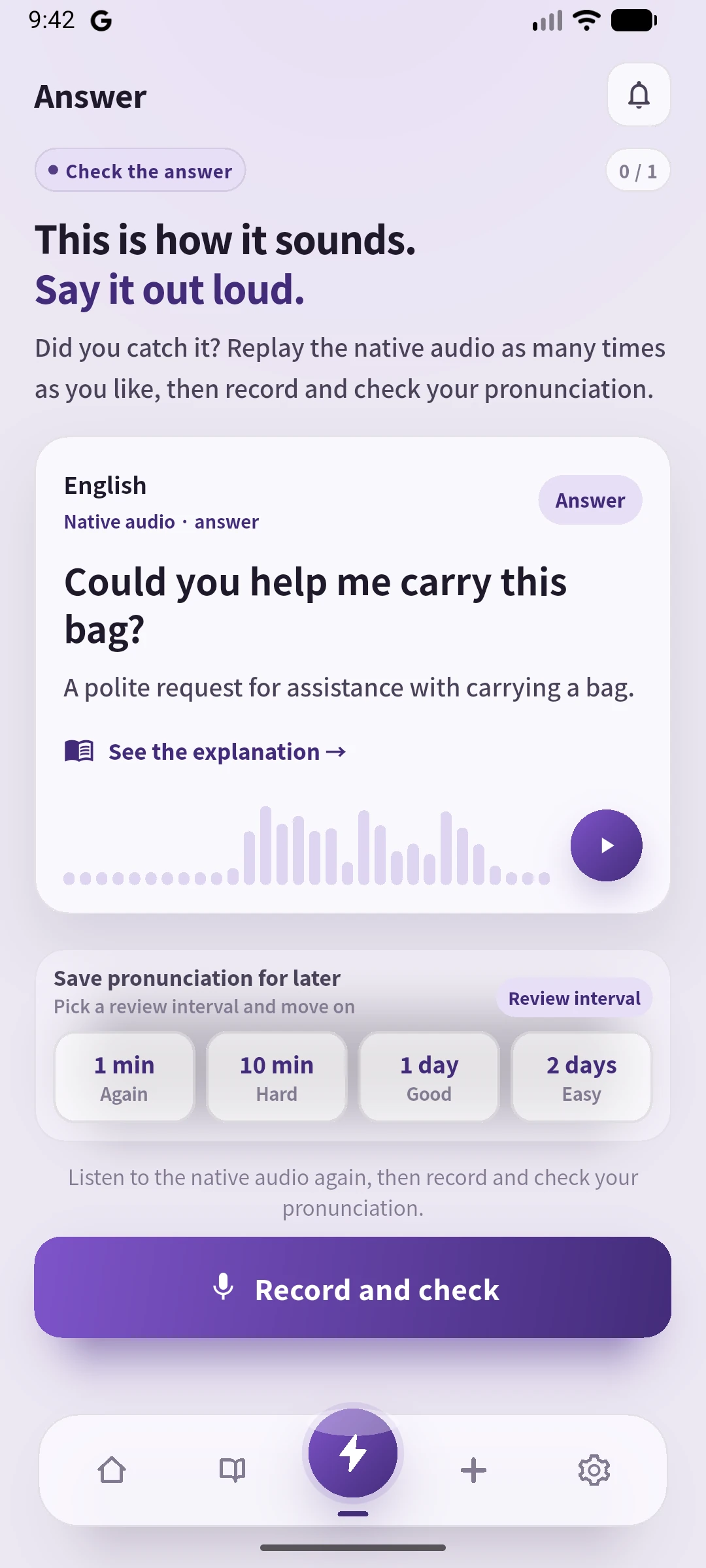
AI-generated reference audio for the shared sentence
Could you help me carry this bag?
A one- to two-week plan
| Days | Task | Check |
|---|---|---|
| 1 | Choose ten useful sentences | Can you name the person and purpose? |
| 2–3 | Listen and say two or three per session | Can you finish the line? |
| 4–5 | Hide the English; use scene cues | Which lines stop you? |
| 6–7 | Add one reply; change the order | Can you start without the first greeting? |
| 8–10 | Change one noun or time; record | Does the new meaning still fit? |
| 11–14 | Try in conversation or role-play | Can you respond to the answer? |
At a week, separate lines you can retrieve from those you still need to check. Retain the difficult ones in week two. Shuffle scene cues so the list order is not your only prompt. An unexpected reply is a reason to use your repair phrase. For topics and your own short answers, see English free-talk topics.
Methods we do not recommend for this goal
Reading long lists without speaking does not test whether you can retrieve a phrase in its scene. Listening while doing something else also does not check whether you can start saying it. Both can be useful inputs, but reserve time to hide the English and speak.
We would not make every line longer and more formal before learning a short usable request. We also avoid assigning one English translation to every function of a word in your first language: a line may express understanding, agreement, thanks or apology. Decide the purpose first. These are editorial priorities, not measured claims that one routine works for everyone.
Frequently asked questions
How many words do I need? No single total settles whether you can manage your topics and your partner’s responses. Learn the words in your ten useful sentences, then add what an actual exchange shows is missing.
Is memorization enough? It is a starting point. You also need to choose a line, understand an answer and change a detail.
Is very polite English wrong? No. Match relationship and situation rather than treating longer wording as always better.
Can I study alone? You can listen, recall and record alone. Real exchanges are needed to check unexpected answers and whether your meaning reaches another person.
When can I start online conversation practice? You need not master everything first. Prepare a greeting, a repetition request and a sentence about yourself, then state the scene you want to practise.
Ten new sentences every day? No. Reuse the same set for one or two weeks, changing one part when useful.
Our editorial verdict
Put a repetition request and a refusal in your first set, alongside greetings. They let you state what you did not understand and what you cannot do. Before increasing the count, practise one useful line with its sound, hide it, add one reply and check one point in a recording. Bring the sentence that failed in conversation back into the next practice session.
Usage sources were checked on 14 October 2026. The first-ten selection, time allocation and schedule are editorial suggestions. Additional dictionary checks: tired, sorry, late, formal how do you do.