
Phonics for adults: spelling-to-sound patterns and how to practise
Published
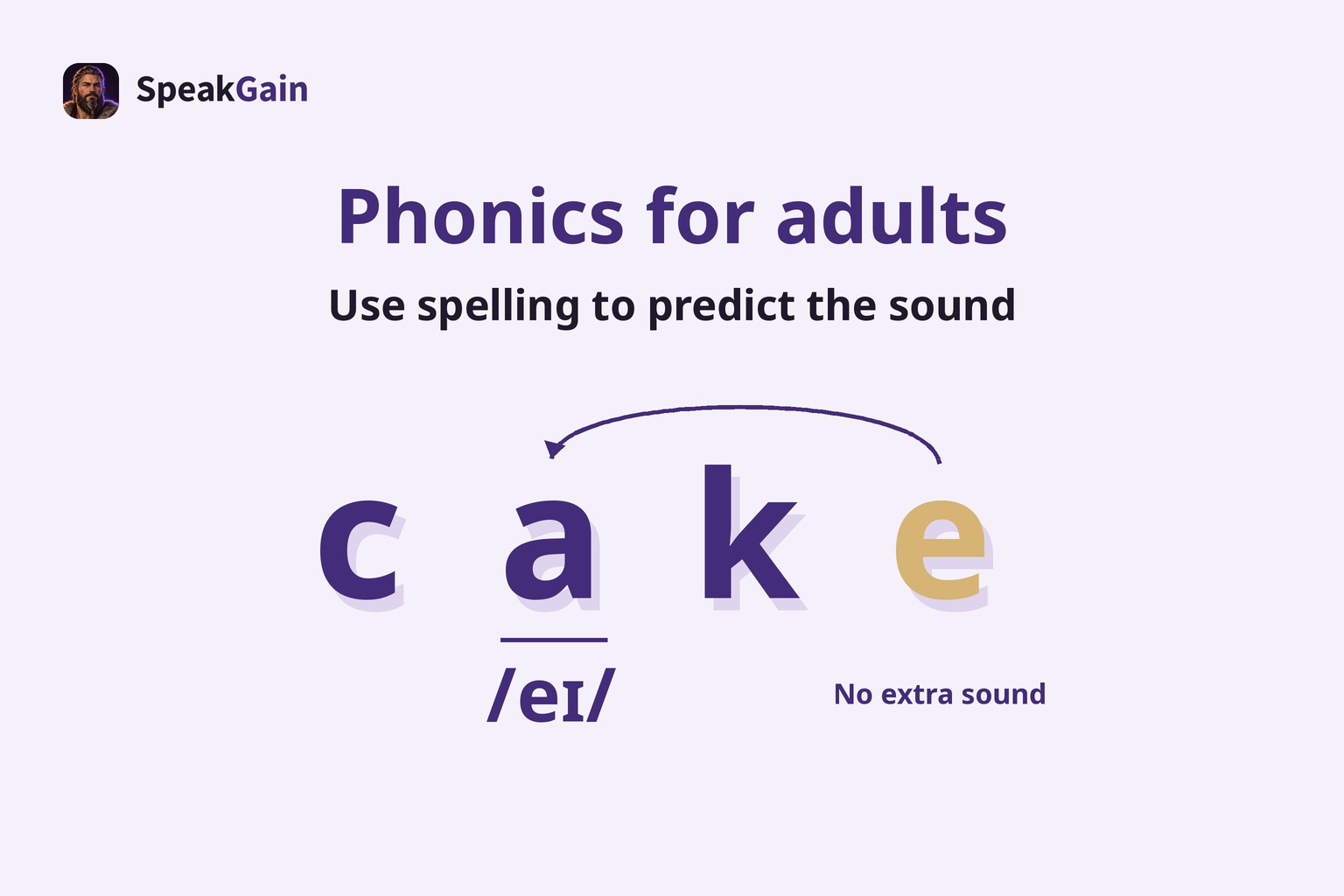
Phonics teaches the relationships between written letters or letter groups and speech sounds, giving you clues to a word’s pronunciation from its spelling. Adults can use it to approach unfamiliar words and revisit familiar ones, but spelling alone cannot settle every exception, accent difference or sentence-level stress pattern. Our editorial starting order is single consonants and short vowels, then consonant digraphs and silent-e patterns; add vowel teams and r-related spellings as your vocabulary requires.
You may know cake by sight yet have no strategy for another word with the same shape. Or you may discover that a familiar spelling does not match the pronunciation you assumed. The useful question is which letters belong together and which part needs checking—not whether you can recite every rule. This is an adult spelling-to-sound guide, not a children’s materials list.
England’s official English curriculum distinguishes letter–sound correspondences, blending sounds into words and common exception words. That children’s literacy curriculum does not establish a fixed timetable for an adult learning English as another language.
Main phonics rules: common patterns, with many exceptions
These are common patterns, with many exceptions—not rules that guarantee a pronunciation. IPA in the sound column refers to the spelling chunk, not always to the whole word. British conventions are the starting point, with useful US alternatives shown. “Exception” means different from the introductory pattern, not completely beyond explanation.
| Pattern | Spelling | Sound (IPA) | Example words | Common exceptions or other readings |
|---|---|---|---|---|
| Single consonants | b, m, t | /b/, /m/, /t/ | bag, map, top | lamb has a silent b; letter names are different |
| c and g | c; g | /k/ or /s/; /ɡ/ or /dʒ/ | cat, city; gap, gem | cello starts /tʃ/; get and give keep /ɡ/ |
| Short vowels | a, e, i, o, u | /æ/, /e/, /ɪ/, UK /ɒ/–US /ɑ/, /ʌ/ | cat, bed, sit, hot, cup | many, pretty, find, most, put have different readings |
| Silent e / CVCe | a_e, i_e | /eɪ/, /aɪ/ | cake, time | have, give do not follow these predictions |
| Silent e / CVCe | o_e, u_e | UK /əʊ/–US /oʊ/; /juː/ or /uː/ | home, cube, rule | love and some have /ʌ/; move has /uː/ |
| Vowel teams | ee, ea | often /iː/ | see, team | bread has /e/; great has /eɪ/ |
| Vowel teams | ai, ay; oa | /eɪ/; UK /əʊ/–US /oʊ/ | rain, day; boat, coat | said has /e/; broad differs from boat |
| Vowel teams | oo | /uː/ or /ʊ/ | food, book | blood has /ʌ/ |
| Consonant digraphs | ch, sh, th | /tʃ/, /ʃ/, /θ/ or /ð/ | chip, ship, thin, this | school has /k/, chef /ʃ/; th has two common sounds |
| Consonant digraphs | ph, ck | /f/, /k/ | phone, back | uphill’s p and h belong to different parts |
| r-related vowels | ar, or | UK /ɑː/, /ɔː/; US /ɑr/, /ɔr/ | car, fork | war and word differ from these predictions |
| r-related vowels | er, ir, ur | stressed UK /ɜː/, US /ɝ/ or /ɜr/ | her, bird, turn | weak final er in teacher: UK /ə/, US /ɚ/ or /ər/ |
The spelling groups and examples draw on DfE’s spelling appendix and the historical Letters and Sounds resource, especially Phases 3 and 5. Dictionary conventions and accent differences are checked against Oxford’s pronunciation guide. The table is our adult-oriented reorganization. For producing the sounds themselves, use English vowels and English consonants; we do not repeat mouth-and-tongue instructions here.
Phonics versus phonetic symbols
Phonics helps you predict a reading from ordinary spelling; IPA helps you check the sound represented in a dictionary. Use both with audio. Neither knowing a rule nor recognizing a symbol guarantees that you can reproduce its sound.
| Question | Phonics | IPA in a dictionary |
|---|---|---|
| Starting point | Ordinary letters and spelling chunks | Symbols representing sounds |
| Main job | Propose a reading for an unfamiliar word | Check that word’s vowels, consonants and stress |
| cake | Recognize a_e and predict /eɪ/ | Check /keɪk/ against audio |
| have | Notice that the same prediction fails | Check the strong form /hæv/ |
| Limit | Spelling can have several readings; stress is not always apparent | Transcription depends on dictionary/accent conventions; connected speech needs listening too |
Cambridge’s pronunciation pages pair transcriptions with UK and US audio. Choose one model for a comparison rather than switching accents midway. IPA /e/ versus /ɛ/, or /ɝ/ versus /ɜr/, can reflect transcription conventions rather than extra sounds to memorize.
For dictionary transcription checks, see how to read English phonetic symbols.
1. Single consonant letters: sounds, not alphabet names
Pattern: begin with b, m and t in bag, map and top. Saying the name of b is not the same as identifying bag’s opening sound. Check c in cat/city and g in gap/gem next.
Exceptions: get and give retain /ɡ/ even before e or i; cello begins /tʃ/, and lamb’s b is silent. The letter after c or g gives a clue, not a universal answer. Letters and Sounds includes alternative readings; Oxford’s cello entry confirms that particular exception.
Self-check: do you substitute your alphabet’s letter names, or add a vowel after a final consonant? Japanese learners can check for an added vowel after map’s p; other learners should observe their own reading rather than assume that exact difficulty applies to everyone.
Original sentence: Put the bag on the mat. Identify bag and mat, confirm their sounds, then listen to the whole sentence. Supporting words such as the need their own confirmation; this is not a claim that one rule decodes the entire sentence.
2. Short vowels: cat is not the letter name of a
Pattern: short CVC words such as cat, bed, sit, hot and cup are useful starting points. C means consonant, V means vowel. Cat’s a is /æ/, not the alphabet name /eɪ/.
Exceptions: put has /ʊ/; find, most, many and pretty also resist the introductory short-vowel prediction. A short written word is not automatically a short-vowel word. Hot’s vowel differs across UK and US models, and some vowel contrasts are regional. DfE’s appendix explicitly notes accent-dependent exceptions.
Self-check: if your first language has a familiar reading for each vowel letter, are you importing that reading into English? Do not treat English vowel pairs merely as the same sound made longer or shorter; the vowel guide handles their actual sound differences.
Original sentence: The cat sat by the red cup. Check a in cat/sat, e in red and u in cup. By is not part of today’s short-vowel target. Confirm it instead of forcing it into the rule.
3. Silent e: compare cap with cape
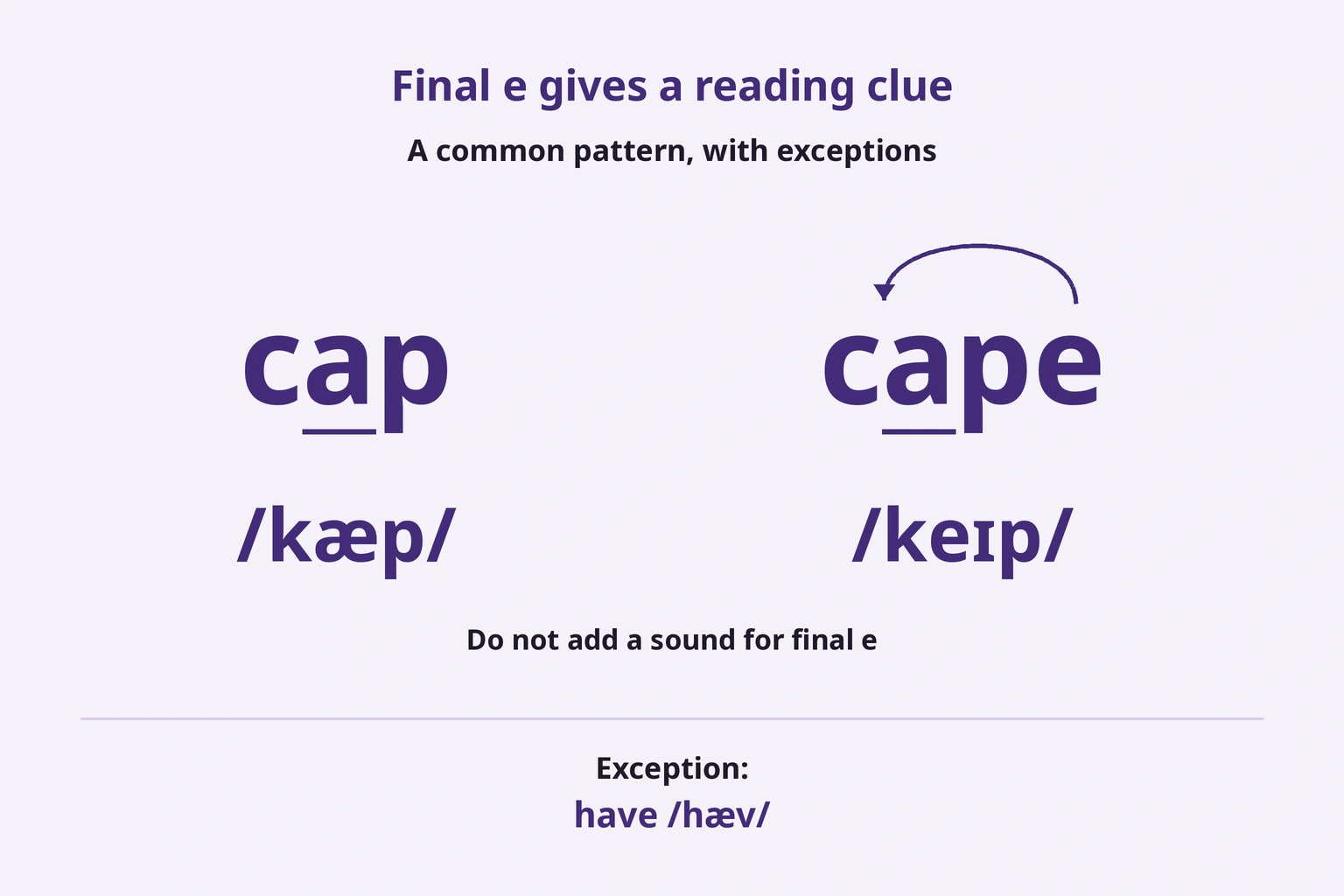
Pattern: in CVCe words, the vowel often has a reading resembling its letter name: cap/cape, kit/kite and hop/hope. The final e usually does not add a separate sound. Start with a_e /eɪ/, i_e /aɪ/ and o_e UK /əʊ/–US /oʊ/. Compare cube /juː/ with rule /uː/ for u_e.
Exceptions: have, give, love and some matter early because they are ordinary useful words. Final e has more than one job: the official spelling appendix discusses have/live/give under spelling a word-final /v/. Live also has different pronunciations depending on meaning. DfE spelling appendix
Self-check: are you saying a final e as an additional vowel, or keeping cake’s a identical to cat’s? Mark a and e as a separated pair before listening to the whole word. Do not pause after each letter in actual speech.
Original sentence: Jane made a cake for the team. Target the three a_e words Jane, made and cake. Team adds an ea example, but you can leave that for the next practice unit.
4. Vowel teams: recognize the group, then check the word
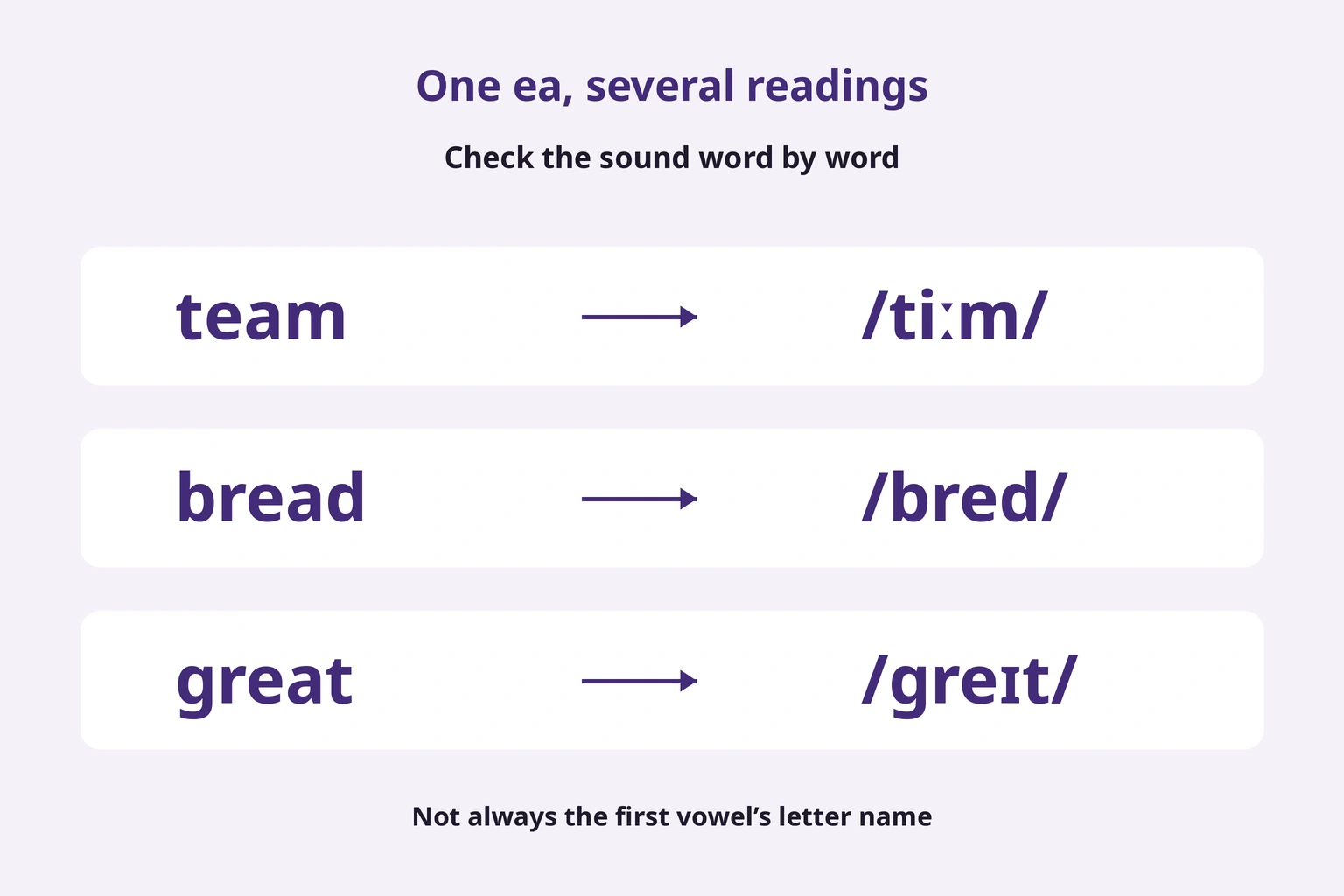
Pattern: recognize ee in see/green, ea in team/sea, ai in rain/wait and oa in boat/coat as spelling groups rather than a sequence of alphabet names.
Exceptions: ea gives /e/ in bread and /eɪ/ in great; ai gives /e/ in said. Oo includes food /uː/, book /ʊ/ and blood /ʌ/. Recognizing two letters together does not determine a single sound. Cambridge bread, Oxford blood
Self-check: are you giving two vowel letters two separate beats, or relying on “the first vowel says its name”? That shortcut does not cover these examples. Read the chunk as a candidate, then confirm it.
Original sentence: The team will wait by the boat. Mark team, wait and boat. For an exception review, add just bread and explain why its ea differs; do not expand into a huge exception list immediately.
5. Consonant digraphs: ch, sh, th, ph and ck
Pattern: two letters can represent one consonant: chip’s ch /tʃ/, ship’s sh /ʃ/, phone’s ph /f/, back’s ck /k/. Th represents /θ/ in thin and /ð/ in this, so learn both examples.
Exceptions: school has ch /k/, chef has ch /ʃ/. Adjacent letters need not form one digraph: uphill separates up and hill. Letters and Sounds, Oxford uphill
Self-check: do you read ph as an independent p followed by h, or pronounce ck twice? If thin/this are hard to reproduce, identify the correct IPA first and use the consonant guide for the sound practice.
Original sentence: Check the photo on this sheet. Mark ch/ck in check, ph in photo, th in this and sh in sheet. Focus on sh alone first if observing all five is too much.
6. r-related vowels: keep the accent consistent
Pattern: check ar, or, er, ir and ur as groups in car, fork, her, bird and turn. American teaching often calls these r-controlled vowels. The r-related sound is not simply a familiar vowel followed by your native spelling of “r.”
Exceptions: war and word differ from the introductory car/fork patterns. Weak final er in teacher is not the same context as stressed her. Stress and accent remain part of the lookup. Cambridge war, Oxford word
Self-check: are you comparing UK car /kɑː/ with a US model /kɑr/ as though one must be wrong? Keep one accent model. The exact American transcription may be /ɝ/ or a vowel-plus-r sequence depending on the dictionary. Oxford pronunciation guide
Original sentence: Turn the car toward the park. Start with ar in car and park, confirm toward separately, and include turn’s ur when ready.
Which rules first, and how much is enough?
Our first milestone is recognizing a useful spelling chunk, proposing a reading and correcting the part that differs in the dictionary—not reciting all the rules. Start with consonants/short vowels, move to digraphs/silent e, then add vowel teams and r spellings. This gives you small units to use in existing vocabulary instead of postponing all English until a children’s course is complete.
For one session, choose one pattern, two or three examples, one different reading and one short sentence. For a_e, compare cake/made with have, then return to Jane made a cake for the team. This is our practice recommendation, not a validated minimum dose or a promise about days to mastery.
The US education department’s adult reading review discusses adult basic literacy and letter–sound analysis but notes limited second-language research. Adults who already read some English are not identical to beginning adult literacy learners. If decoding itself is difficult, systematic instruction may be appropriate; our small-dose approach is not a reason to withhold it.
Next session, predict before playing the audio. If you miss the spelling group, revisit it. If the group is clear but producing its sound is difficult, use vowel/consonant practice. If a known word changes during a sentence, practise that sentence rather than memorizing more spelling labels.
A practical prediction-and-check routine
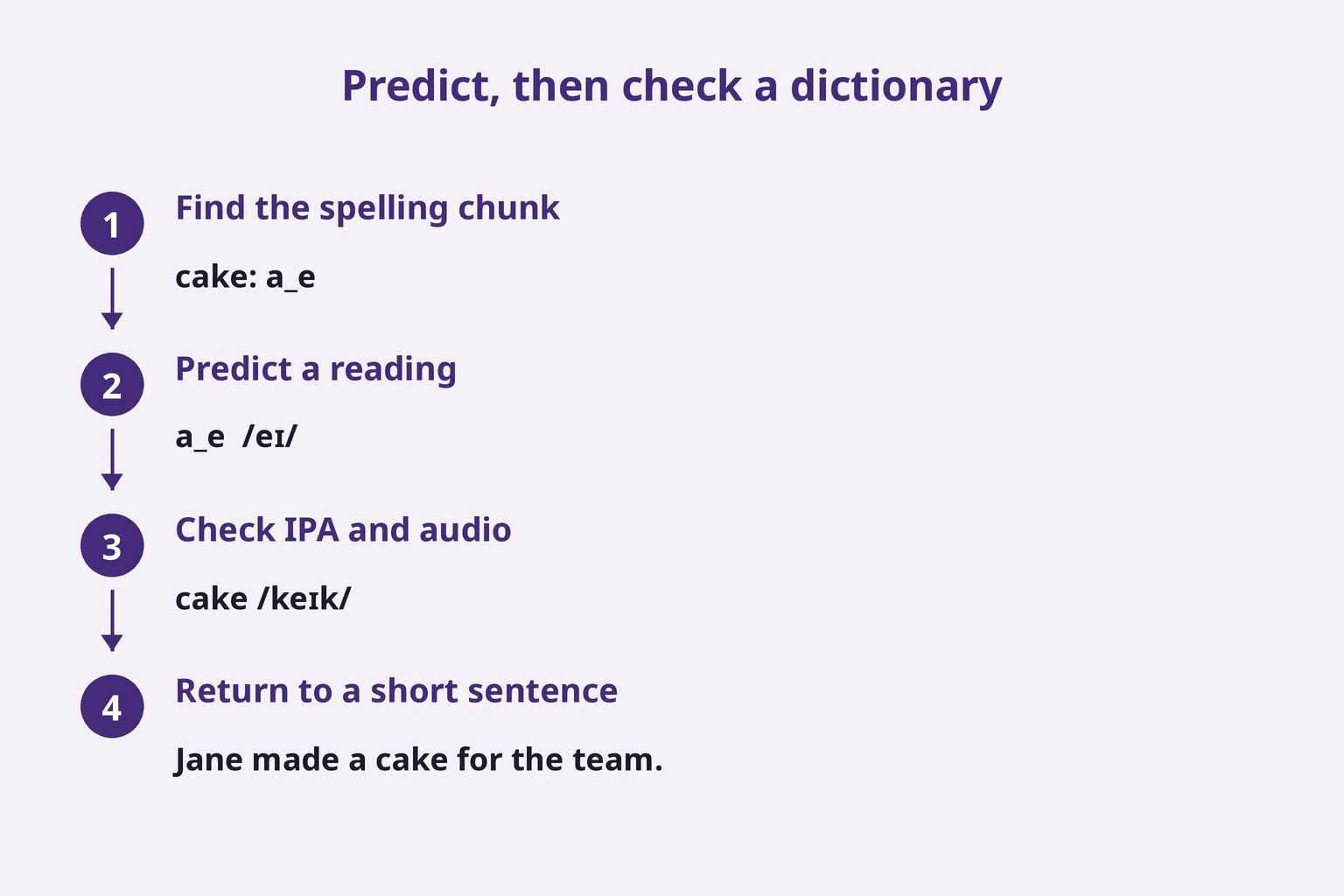
- Choose Jane made a cake for the team. Understand its meaning first.
- Mark Jane, made and cake if a_e is today’s target.
- Predict /eɪ/ before opening the dictionary.
- Check IPA, audio, meaning and stress. Record one part where a prediction failed rather than abandoning the whole pattern.
- Listen to the sentence, imitate it, record yourself and listen back to one target word. This is observation, not pronunciation scoring.
If cake becomes cat-like only in the sentence, return to the same phrase. If have repeatedly attracts the cake prediction, review have separately. These are different problems. For a broader routine use pronunciation practice; for remembering the word use vocabulary review.
Listen again to a saved sentence in SpeakGain
We added Jane made a cake for the team. as one card through the normal Add screen. On the device we followed Knowledge → Learn this card → Listening / Guess by ear → Reveal answer → Answer. Listening hid the sentence and played its reference audio; Reveal answer displayed the saved English. Answer showed the sentence, meaning explanation, playback, review-interval choices and the Record and check entry. We did not submit a recording or verify pronunciation judgements or scores.
These are actual English-interface screens. Native audio on this card and the player below refer to AI-generated Deep-voiced Viking audio from SpeakGain, not a human native-speaker recording or official dictionary audio. We use SpeakGain here to save and revisit one sentence; this example does not present it as a phonics course or a spelling-reading assessment.
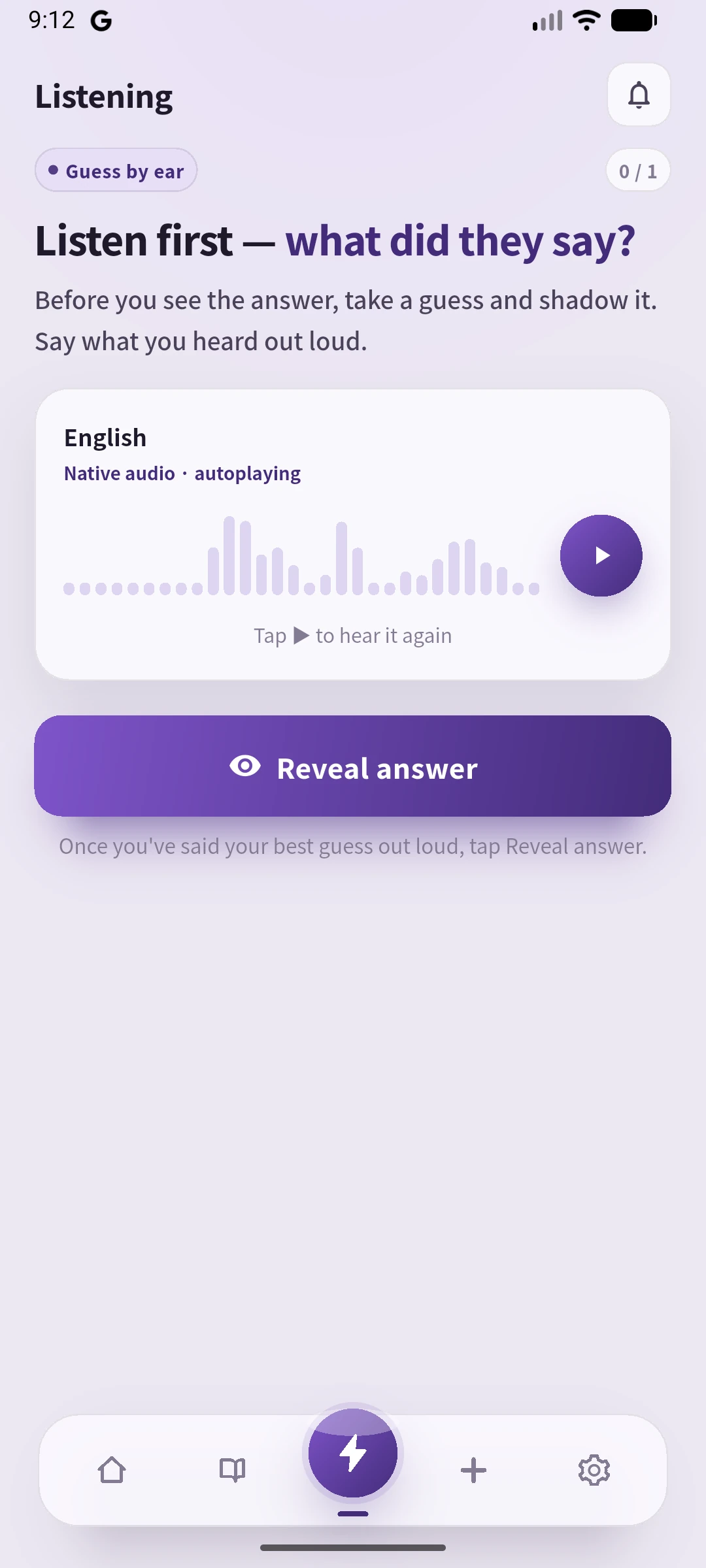
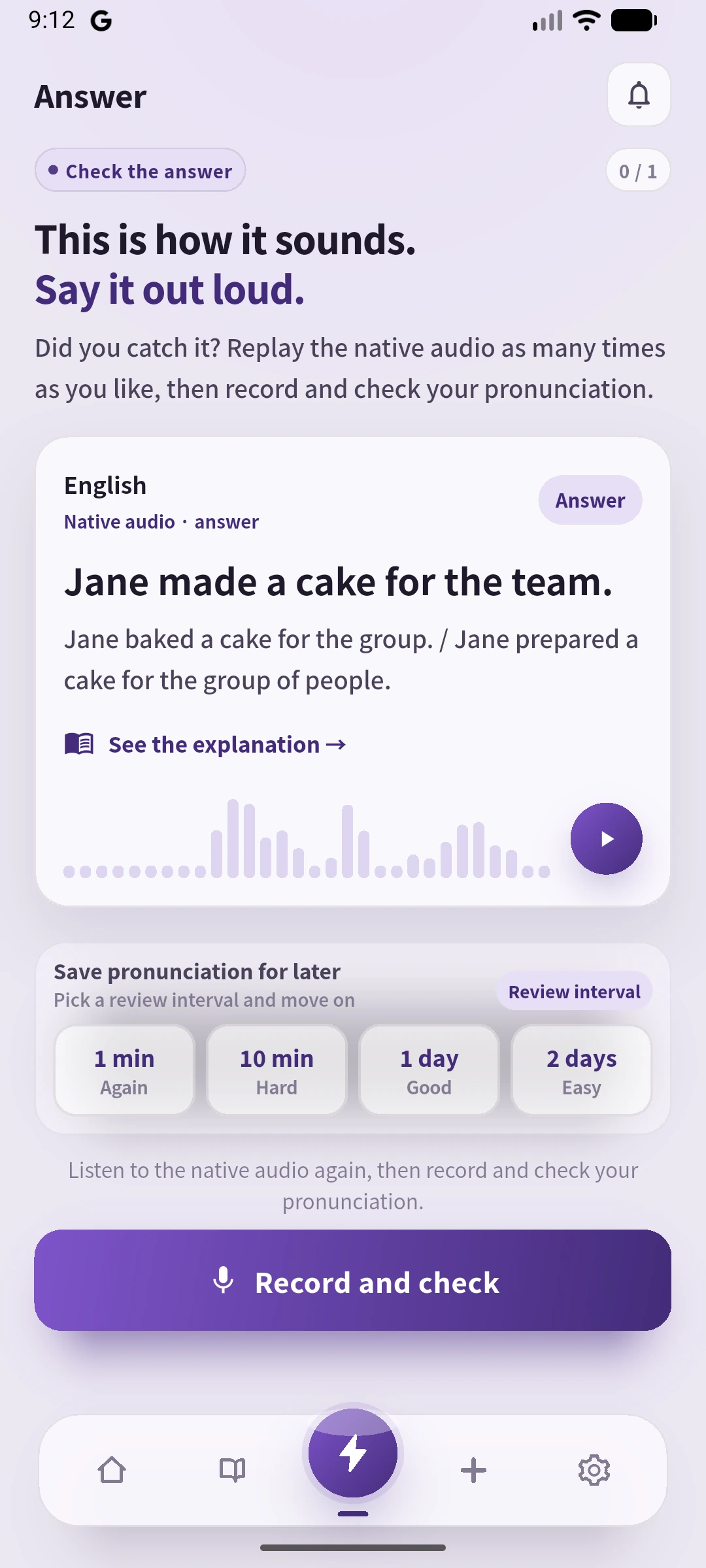
AI reference audio for the shared sentence
Jane made a cake for the team.
Methods we do not recommend
Completing an entire children’s programme first is not an automatic prerequisite for adults who already read English. Revisit the gaps that affect your vocabulary; seek systematic support if basic reading remains difficult.
Do not memorize exception-heavy slogans as universal rules. “Final e always changes the vowel to its name” fails for have; “two vowels always mean the first letter name” fails for bread. Pair a common pattern with one useful different reading.
Do not replace audio with respelling in your first language. It can merge different English sounds or add sounds absent from the word. Nor does spelling knowledge alone finish pronunciation, vocabulary, stress or connected-speech learning.
A short note on teaching children
Show letter sounds as well as names, blend sounds in words with taught correspondences, and check meaning in short texts. Coordinate with the child’s teacher rather than turning our adult priorities into an age-based curriculum. DfE curriculum
The 2007 Letters and Sounds resource is historical evidence here, not a recommendation of a currently validated complete school programme. DfE’s programme-validation explanation
FAQ
Is phonics useful for adults?
Yes, as a way to organize spelling–sound clues and propose readings. It does not guarantee pronunciation improvement or replace listening and sound practice.
Can I start at any age?
Our recommendation is to start with a word you need rather than wait because of your age. We do not promise the same progress rate for everyone.
Should I learn IPA first?
Use both on a chosen word: predict with phonics, check with IPA and audio. You need not memorize every symbol before reading anything.
Why learn patterns if there are exceptions?
They reduce repeated guessing and help locate what to confirm. Check a different reading word by word instead of pretending exceptions disappear.
Does silent e always work?
No. Cake/time fit the introductory prediction; have/give do not. Final e has other spelling functions.
How many rules are enough?
There is no fixed pass count. Begin with a useful small set you can identify and confirm in a short sentence, then add what new words require.
Will phonics alone give me native-like pronunciation?
No. Knowing the likely reading differs from reproducing sounds and speaking a sentence with its stress and connections.
Should children follow this adult order?
Not automatically. Coordinate sounds, reading and meaning with their existing instruction.
Editorial verdict
Learn adult phonics as a prediction-and-confirmation tool, not a system that always produces the right answer. Start small, include exceptions early and return to a sentence before expanding the list. Today, identify a_e in Jane made a cake for the team., confirm the words and imitate the whole phrase. The goal is a usable reading of English you need, not a completed chart.
Sources
DfE English curriculum, spelling appendix, historical Letters and Sounds, programme validation, LINCS adult-reading research review, Cambridge pronunciation, Oxford pronunciation guide. Checked 14 October 2026. Priorities, self-checks, practice dose and English sentences are editorial contributions; institutional sources are not endorsements of this article’s adult routine.