
Hobbies in English: ask, answer and build a four-sentence reply
Published
Use hobby for an activity you enjoy outside work. You can also answer with I like …, I’m into … or In my free time, I …; ask What do you do in your free time? to invite a reply.
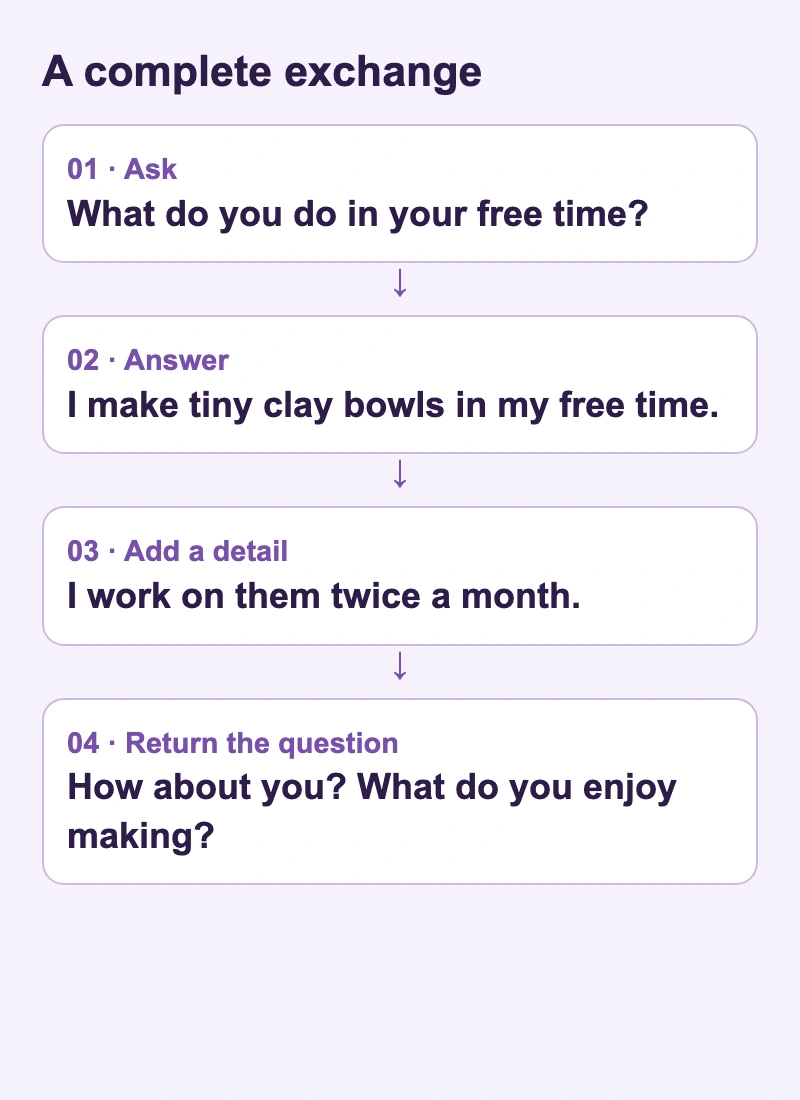
A complete exchange
| Ask | English |
|---|---|
| Ask | What do you do in your free time? |
| Answer | I make tiny clay bowls in my free time. |
| Add a detail | I work on them twice a month. |
| Return the question | How about you? What do you enjoy making? |
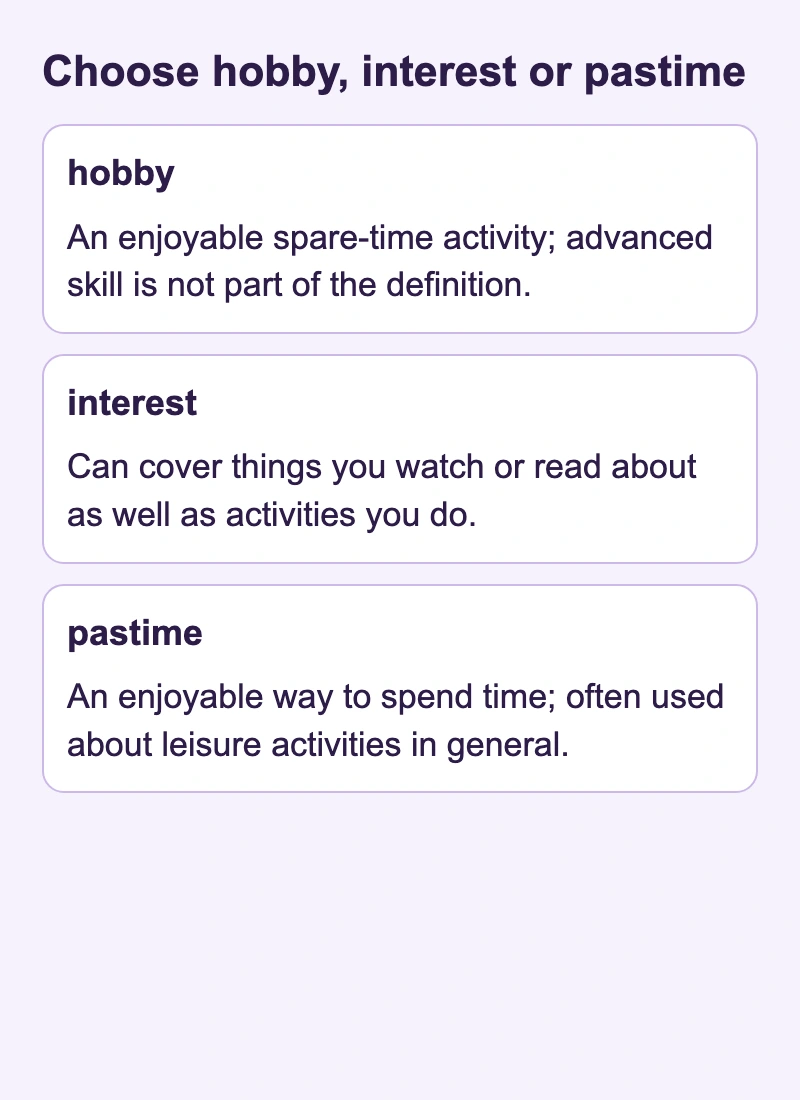
Choose hobby, interest or pastime
If you are learning English, you do not need a special hobby title before you can answer. Separate an activity you actually do from a subject you enjoy learning about.
| English | Meaning |
|---|---|
| hobby | An enjoyable spare-time activity; advanced skill is not part of the definition. |
| interest | Can cover things you watch or read about as well as activities you do. |
| pastime | An enjoyable way to spend time; often used about leisure activities in general. |
| be into | An informal way to express enthusiasm; follow it with a noun or an -ing form. |
| passion | A strong liking or enthusiasm, stronger than a casual like. |
Oxford includes swimming and cooking under hobby, and gives a My favourite hobby is … example. That does not support banning hobby for ordinary activities or treating My hobby is … as a grammar error. The pronunciations are /ˈhɒbi/ (UK) and /ˈhɑːbi/ (US); the plural is hobbies.
Oxford: hobby / interest / pastime
I'm interested in pottery, but I haven't tried it yet.
I'm into making clay bowls.
I have a passion for making clay bowls.
Cambridge: talking about interests · Oxford: passion
Ask for the situation
With someone you have just met, start with a question that leaves room for an ordinary free-time activity.
| Situation | English | Meaning |
|---|---|---|
| New acquaintance or colleague | What do you do in your free time? | An open question about free time. |
| Language exchange or lesson | What are your hobbies? | A direct question about hobbies. |
| After someone mentions pottery | How did you get into pottery? | A follow-up about the activity they named. |
At work, leave space for a short answer. When your partner names an activity, ask about that activity rather than reading out a list of unrelated questions.
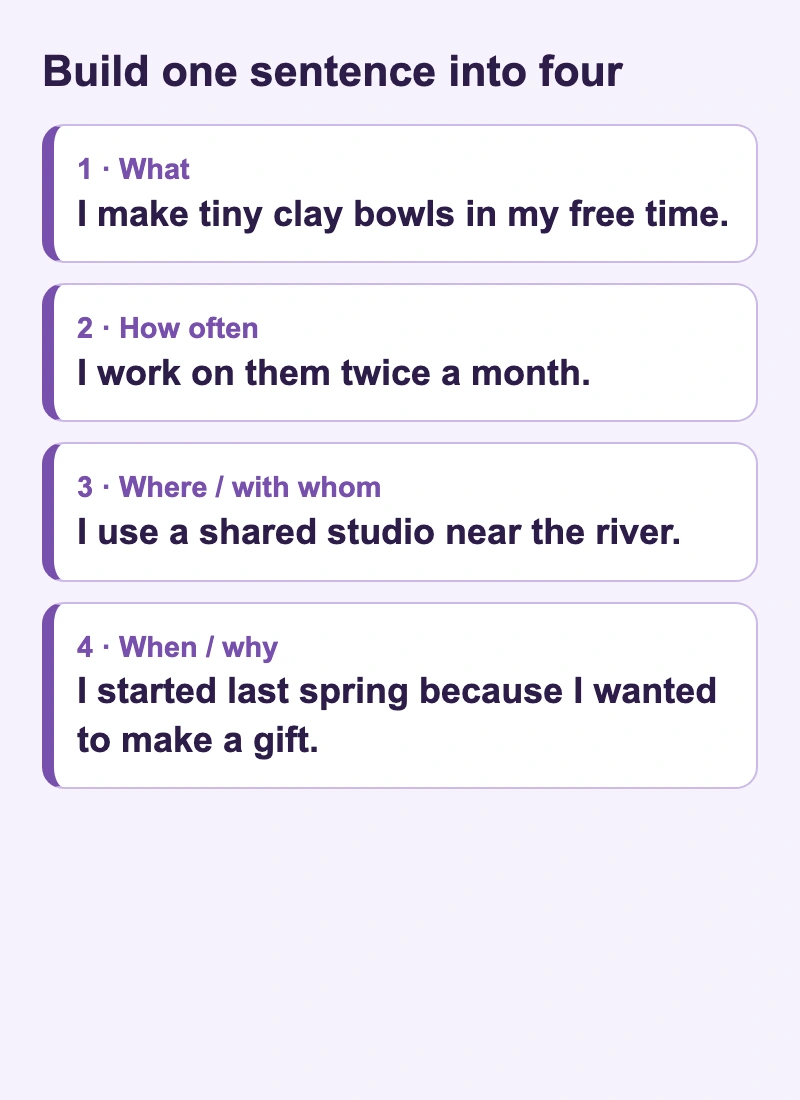
Build one sentence into four
A colleague asks about your time outside work during a break. The first sentence answers the question. Add the next sentence when the listener stays interested; each adds a different detail, so you can pause after any of them.
What
I make tiny clay bowls in my free time.
The activity: making small bowls from clay.
How often
I work on them twice a month.
Frequency: two sessions each month.
Where / with whom
I use a shared studio near the river.
Place: a studio shared with other makers.
When / why
I started last spring because I wanted to make a gift.
Starting point and reason: a gift last spring.
How about you? What do you enjoy making?
Give your partner the next turn.
No hobby, a new hobby or a former hobby
| Situation | Reply |
|---|---|
| No particular hobby | I don't have a regular hobby, but I like watching short documentaries. |
| A recent start | I've just started making clay bowls. |
| A former activity | I used to make clay bowls, but I haven't used the studio this year. |
Offer something you currently enjoy, even without calling it a hobby.
Use started + -ing for the beginning; add last month to locate it in time.
Use used to + base verb for a past habit that is no longer current.
Pair activities with verbs
| Activity | Verb phrase |
|---|---|
| a ball game | play table tennis |
| a musical instrument | play the cello |
| a craft | do pottery |
| an outing to swim | go swimming |
| an outing to watch birds | go birdwatching |
| a viewing activity | watch short documentaries |
Learn the verb with the activity. Play fits games and instruments, but it is not a general replacement for every free-time verb.
Oxford: play · Oxford: go · Pearson: do pottery
Say the reply and return the question
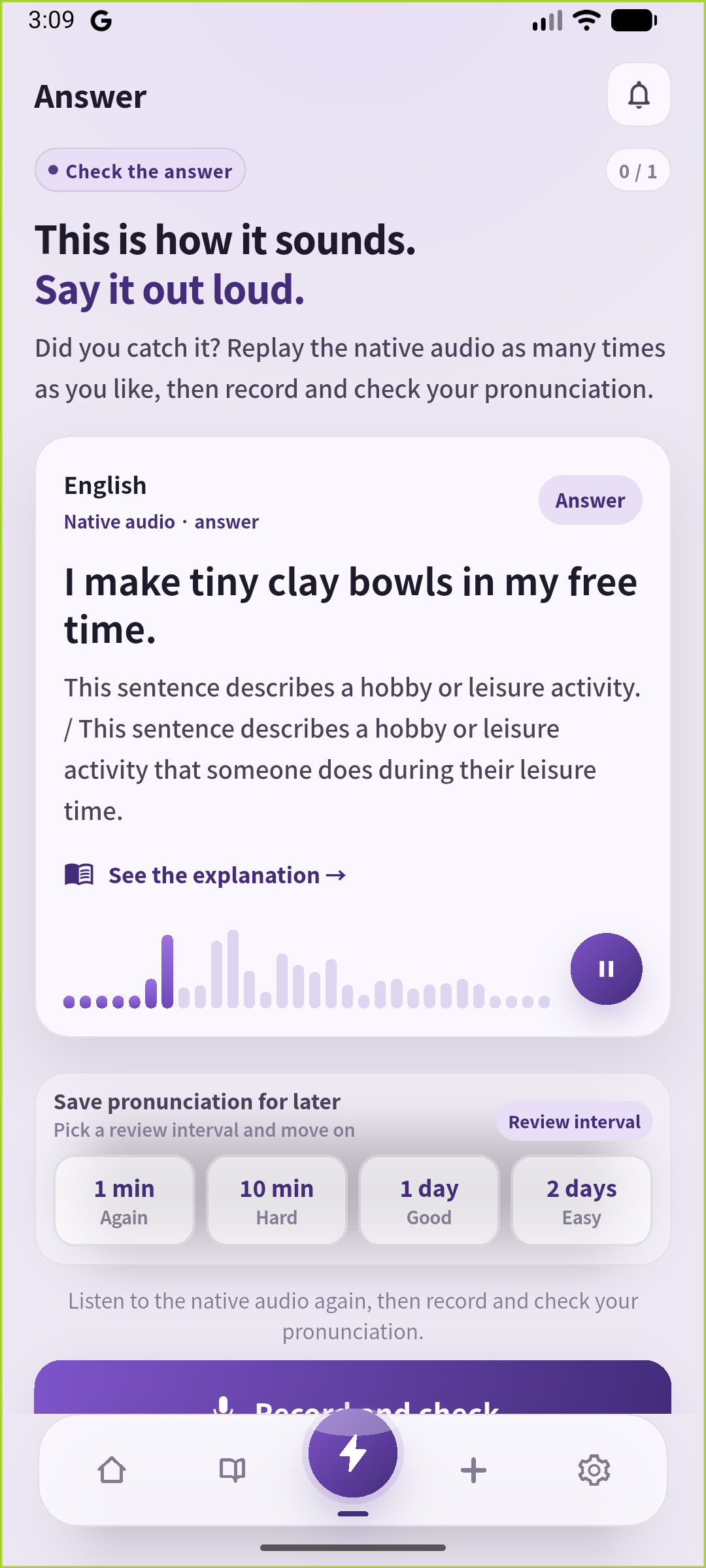
Listen to each line below, then substitute details from your own activity. Put the text away and record the four lines plus the return question. Listen for the frequency and place: could a listener pick out both?
In our app SpeakGain, keep your bowl-making reply and return question together so you can listen, say them again and check your recording before meeting your partner. FSRS provides review timing for the saved cards.
Questions learners ask
Can I say My hobby is …?
Yes. My hobby is making clay bowls. describes an activity. There is no need to ban hobby; you can also reply with I make … when that matches the question.
What can I put in a social profile?
A short field can use noun phrases: Pottery · Birdwatching · Table tennis. Save the longer explanation for a conversation.
What about interviews or speaking tests?
In an interview, give a real example and connect it to work only when relevant. In a test, answer the question before adding detail.
Job interview practice · IELTS speaking practice
Take it into conversation
Prepare the activity, frequency, place and starting story, then choose how much to say in the actual exchange. Finish by inviting your partner to speak.