
Glad vs happy: explain what made you happy, with eight spoken examples
Published
I’m happy describes pleasure broadly; I’m glad often responds to something welcome or expresses gratitude. Add to + verb, that + clause or about + noun to explain the reason. For a result you approve of, pleased can fit; delighted expresses strong pleasure, while thrilled adds excitement.
Start with the reason and the listener
Picture daylight still coming through the window after work, or a family recipe you thought was lost turning up in a drawer. These are different reasons to feel happy. A colleague checking a floor plan needs a more specific response than a friend hearing about your afternoon.
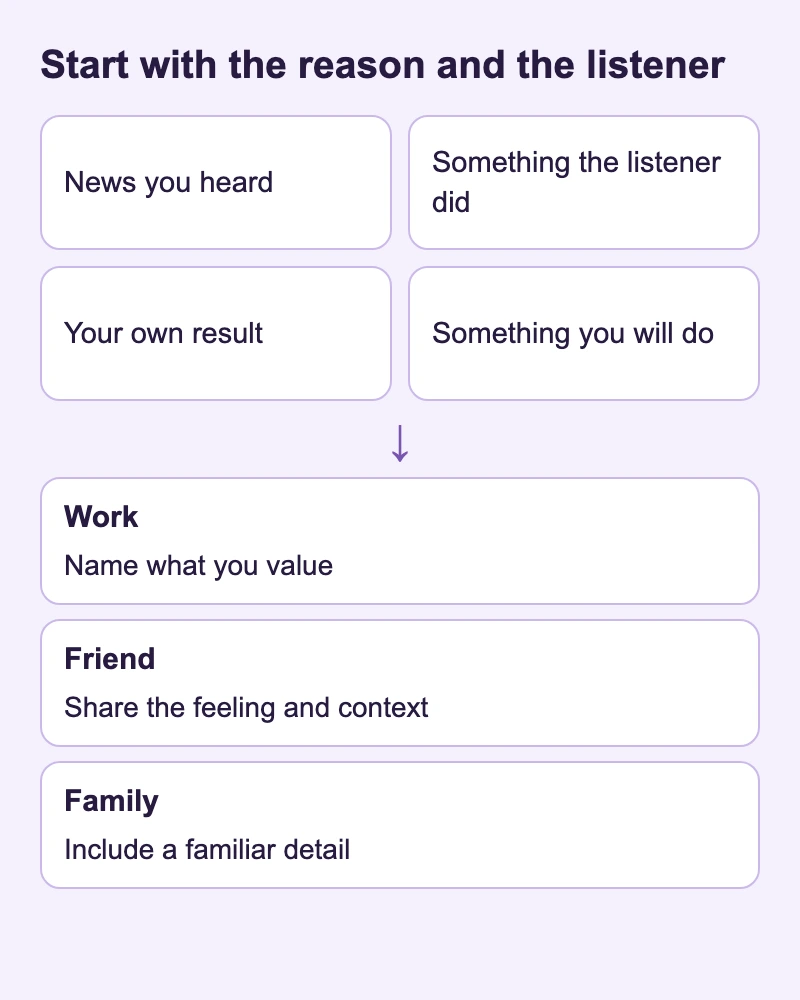
| Reason / listener | Pattern | Message |
|---|---|---|
| News you heard / Friend | glad to hear + Clause | Hearing that the riverside path is open again. |
| Something the listener did / Family | glad (that) you + verb | Appreciating the listener’s advance labelling of storage jars. |
| Your own result / Work | pleased with + noun | The revised floor plan |
| Something you will do / Friend | glad to lend | Willingly offering to lend a spare easel. |
Happy and glad are not a stopwatch
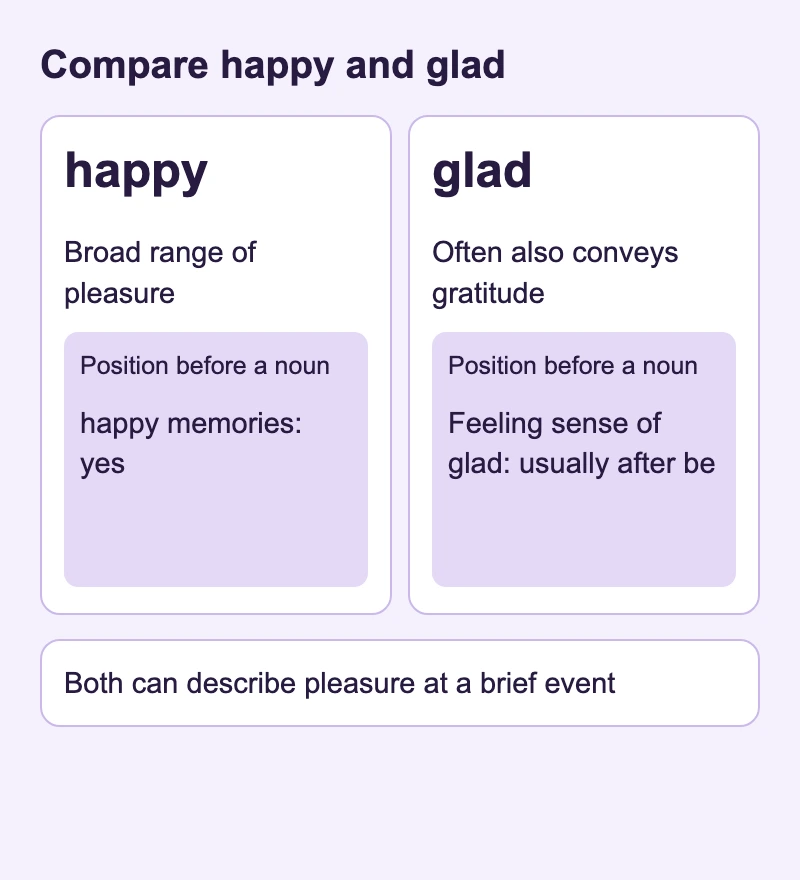
Oxford’s comparison gives happy the broadest meaning and notes that glad often conveys gratitude. Happy can describe a brief event as well as a wider state, so “happy lasts a long time; glad lasts a moment” is an unreliable rule.
They also differ in position: happy can come before a noun, as in happy memories. In its usual feeling sense, glad follows a linking verb rather than modifying a noun directly. Both can introduce your reaction to welcome news.
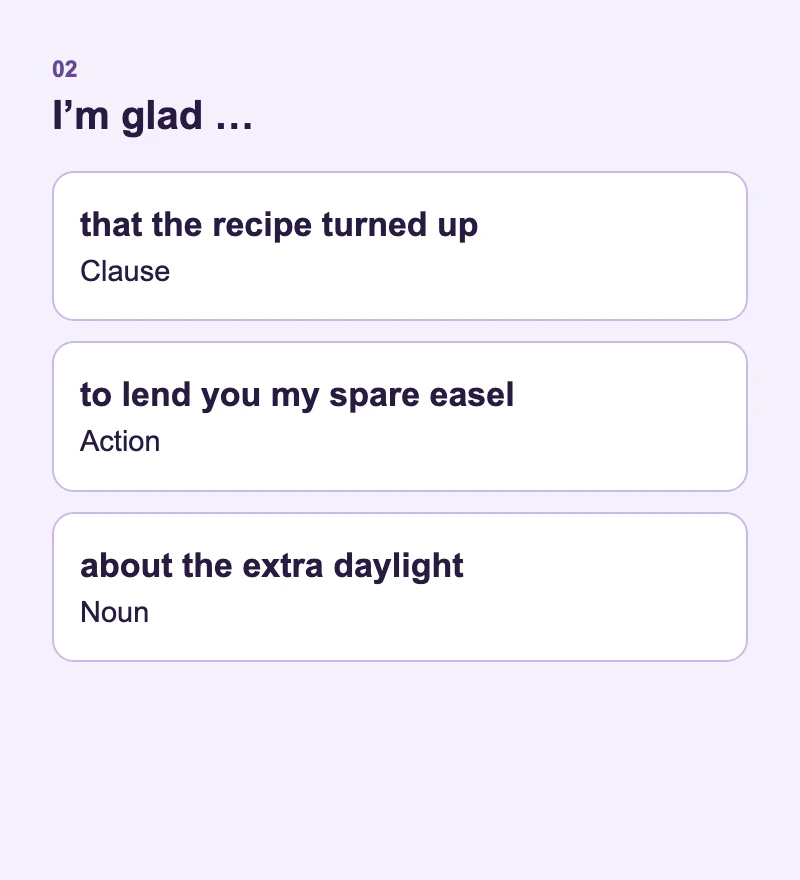
Build the part after the adjective
Use that + subject + verb for a fact: the recipe is the subject and turned up is the verb. You may omit that. Use about + noun phrase to name the topic, such as the extra hour of daylight. Use to + base verb to connect an action, such as see in the mural sentence. Glad also takes to, that and about.
I’m glad to lend you my spare easel. can be a willing offer to lend an easel, rather than a report of an earlier feeling. Happy to has a willing sense too. An action after to does not automatically mean you are eagerly waiting for a future event.
I'm glad to hear the riverside path has reopened.
Use glad to hear for welcome information: a friend tells you the riverside path is open again.
I'm glad you labelled the jars before I arrived.
Use glad (that) you + verb to appreciate what the listener did: a family member labelled the storage jars before your arrival. That is omitted here.
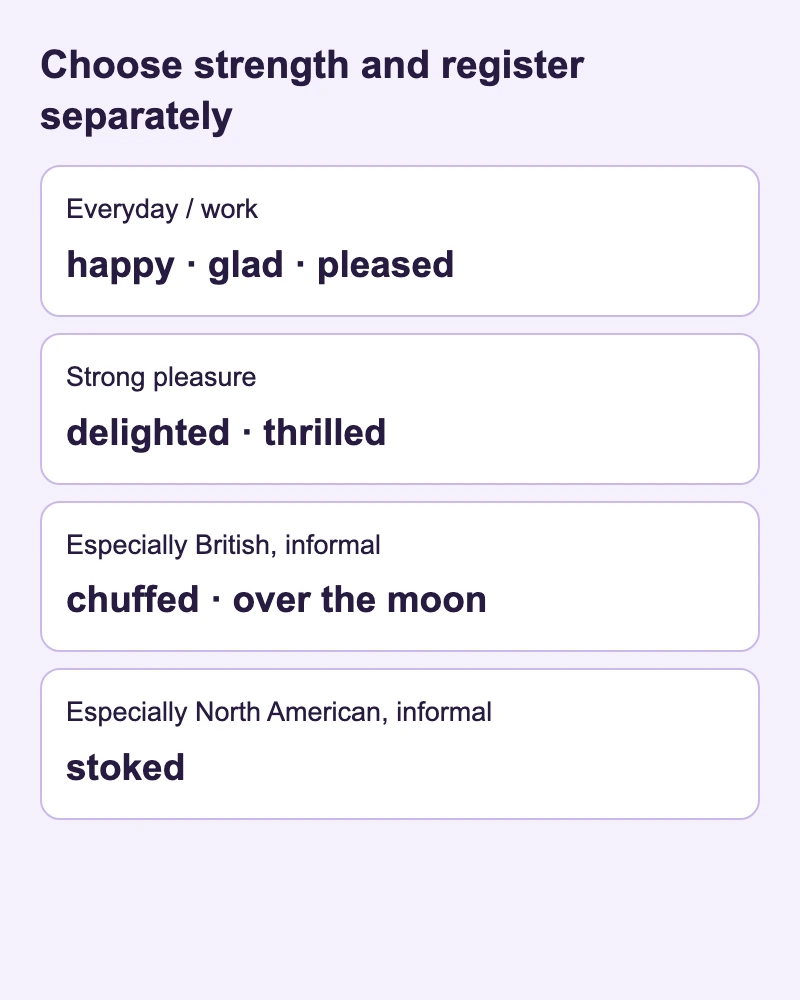
Choose strength and register separately
The work column below is a practical choice based on dictionary meanings and examples. It is not a ranking of emotions. Pleased is useful in a considered response about a result, but is not restricted to business.
| Word | Meaning / register | At work |
|---|---|---|
| happy / glad | Pleasure; a welcome outcome Everyday and work contexts | Routine messages |
| pleased | Pleasure or satisfaction A measured response to a result | Measured result updates |
| delighted | Very pleased Warm or formal expressions of pleasure | Warm formal responses |
| thrilled | Very pleased and excited Rather informal enthusiasm | Enthusiasm with familiar colleagues |
| chuffed | Very pleased British, informal; familiar listeners | Talk with close colleagues |
| stoked | Excited and pleased Especially North American, informal | Casual team chat |
| over the moon | Extremely happy and excited Especially British, informal idiom | Sharing joy with close colleagues |
pleased / delighted / thrilled / chuffed
Oxford: stoked / over the moon
When thanks or praise does the job
If the main purpose is to acknowledge kindness, start with Thank you and name what the person did. If you want to praise an action, identify what worked. A literal statement of your happiness may leave that purpose unclear. For receiving praise, use the compliment replies guide; for another person’s success, see congratulations.
Give the feeling a voice
Check the dictionary forms: happy /ˈhæpi/, glad /ɡlæd/, pleased /pliːzd/, delighted /dɪˈlaɪtɪd/ and thrilled /θrɪld/. Stress the first syllable of happy and the middle syllable of delighted. Keep the final consonants in pleased and thrilled together without adding a vowel.
The synthetic sentence recordings below let you hear the feeling with its reason. Try giving GLAD more prominence, then shift attention to RECIPE. Those choices highlight different parts of your message; they are rehearsal options, not a single required melody.
Oxford: happy / delighted / pleased / thrilled
I'm happy about the extra hour of daylight.
Enjoying a small change in the day.
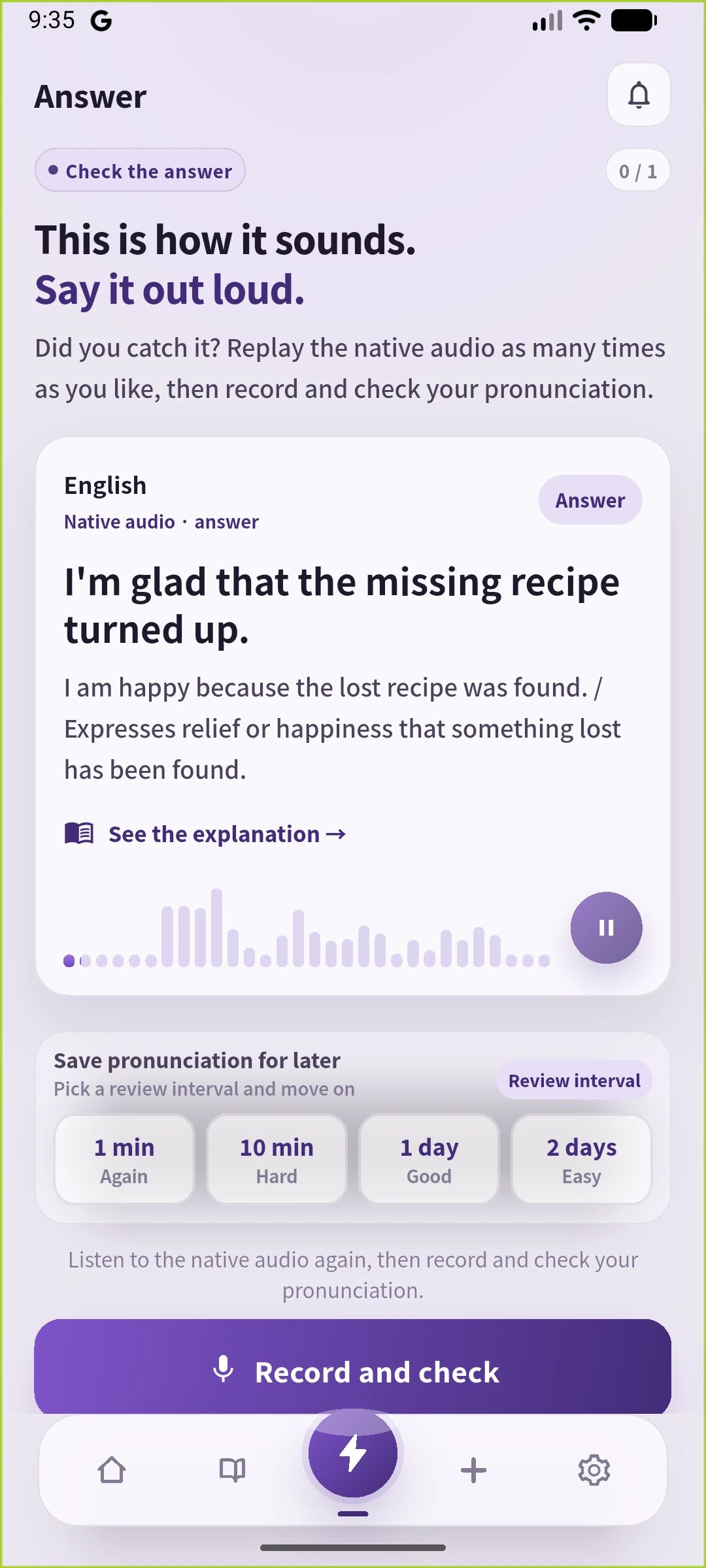
I'm glad that the missing recipe turned up.
A lost family recipe has been found.
I'm glad to lend you my spare easel.
Willingly offering to lend a spare easel.
I'm pleased with the revised floor plan.
Approving a revised design.
I'm delighted that our pear tree has fruit.
Celebrating the first fruit on a pear tree.
I'm thrilled to see my mural on the library wall.
Excited to see your own work in a public space.
I'm glad to hear the riverside path has reopened.
Hearing that the riverside path is open again.
I'm glad you labelled the jars before I arrived.
Appreciating the listener’s advance labelling of storage jars.
Tell three small stories from this week
- Recall one welcome change, one recovered object and one result you liked this week.
- Choose a listener for each. Decide whether your reason is best expressed as a noun, a clause or an action.
- Say each sentence aloud, then repeat it with the feeling or the reason more prominent.
For the recovered-recipe story, save the line in our app SpeakGain and try telling it to your family without reading. Replay the part you stumbled over, then carry the sentence through turned up in one attempt.
Questions learners ask
Does I’m happy sound childish?
No. Happy is a general adjective. A concrete reason often adds more useful detail than a rarer synonym.
Can I switch glad and happy everywhere?
No. They overlap after be, but their noun positions and other meanings differ. Check the whole pattern rather than changing one word.
How do I talk about yesterday?
Use I was happy or I was glad. For example: I was glad that the missing recipe turned up.
Which one fits a work email?
Pleased with works for satisfaction with a result. Delighted can convey strong pleasure in a formal response; choose wording that matches what actually happened.
Can I use slang at work?
Stoked, chuffed and over the moon are informal. They may suit familiar colleagues; pleased or delighted is an easier choice for keeping a first client email formal.
Take one good thing from today and give it a reason, a listener and a voice. You do not need an extraordinary event to say something precise.