
How to pronounce the: choose by sound, then say it in a sentence
Published
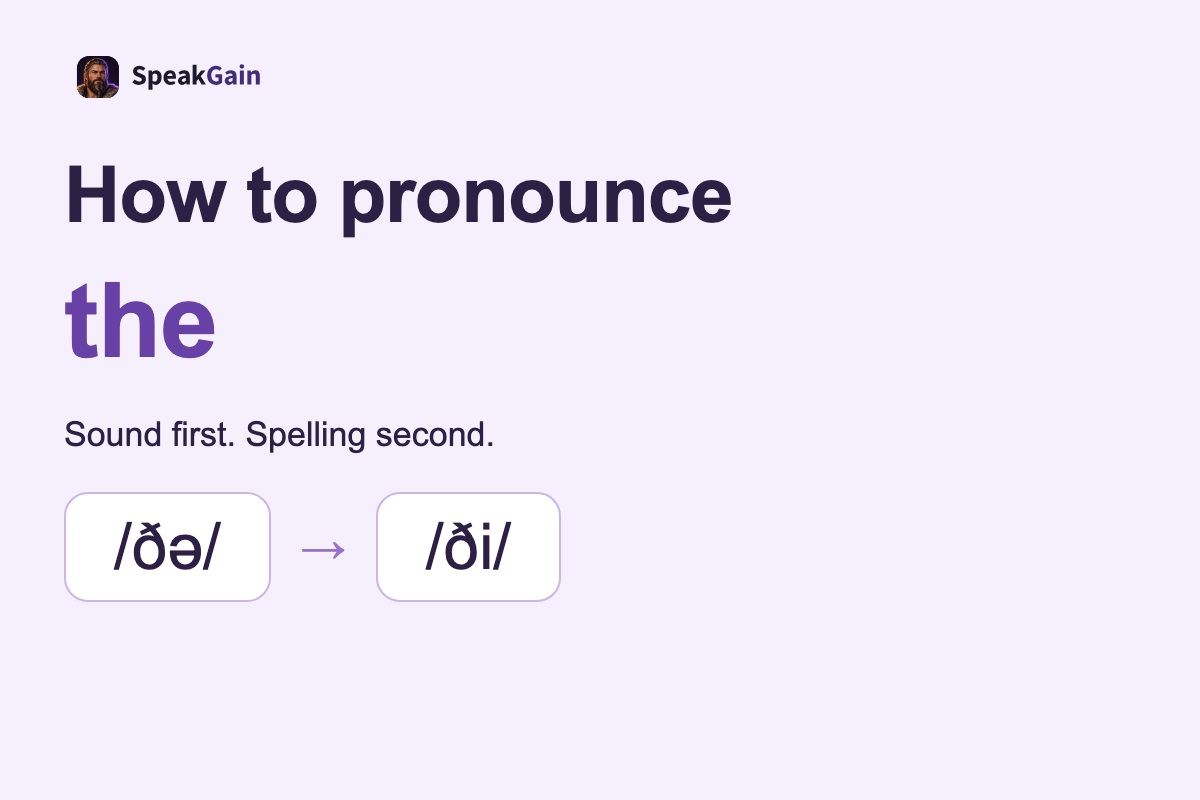
The usual starting point is /ðə/ before a consonant sound and /ði/ before a vowel sound: the next sound decides, so hour takes /ði/ but university takes /ðə/. For emphasis, the strong form /ðiː/ can appear even before a consonant.
A quick choice before you speak
Oxford lists /ðə/, prevocalic /ði/ and strong /ðiː/ for both British and American English. The unstressed /i/ before a vowel does not mean you must stress or stretch the word. Merriam-Webster also notes that /ðə/ sometimes occurs before a vowel.
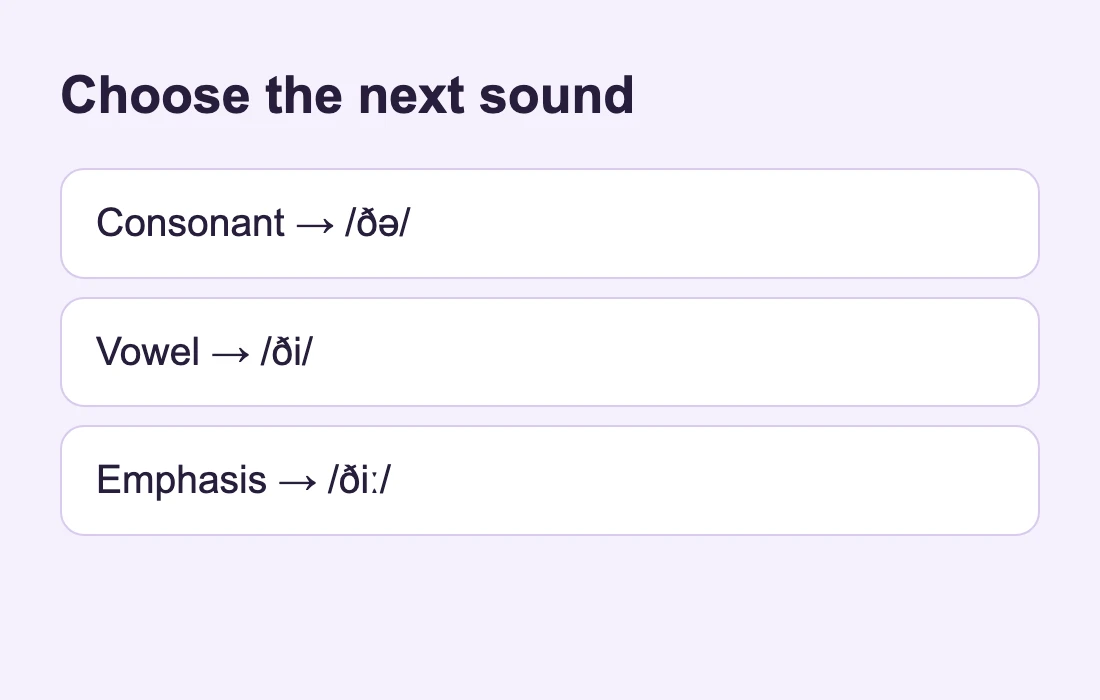
| Next sound | Usual the | Example |
|---|---|---|
| Consonant sound | /ðə/ | the lamp |
| Vowel sound | /ði/ | the entrance |
| Emphasis | /ðiː/ | THE curator |
When the letters send you the wrong way
Read the first spoken sound, not the first printed letter. In the table, /j/ is the consonant at the start of yes; /w/ is the consonant at the start of we. Silent h in hour and honest leaves a vowel at the beginning. The linked Oxford entries let you check the words instead of memorising a list of spelling exceptions.
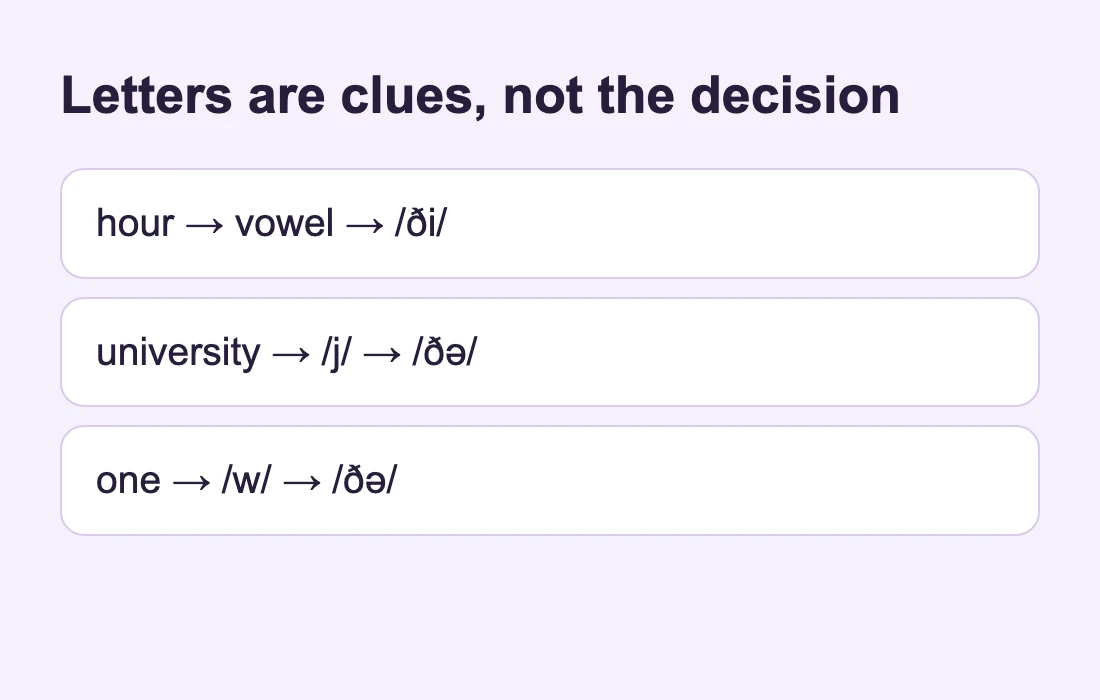
| Word to check | First sound | Choice |
|---|---|---|
| hour | /aʊ/ | /ði/ |
| house | /h/ | /ðə/ |
| university | /j/ | /ðə/ |
| umbrella | /ʌ/ | /ði/ |
| one | /w/ | /ðə/ |
| only | /əʊ/ (UK) | /ði/ |
| European | /j/ | /ðə/ |
| honest | /ɒ/ (UK), /ɑː/ (US) | /ði/ |
| FBI | /e/ | /ði/ |
| NASA | /n/ | /ðə/ |
FBI begins with the letter name F /ef/, so the FBI takes /ði/. NASA is pronounced as a word beginning /n/: the NASA archive takes /ðə/. This is a sound choice when the is already needed; it does not tell you whether an organisation’s name needs an article.
- Open the following word in a learner’s dictionary and choose the UK or US recording you want to follow.
- Find the first sound in the transcription; skip the stress marks /ˈ/ and /ˌ/. A silent printed letter contributes no sound.
- Play the word, then join the + word. Recheck the sound if you change accent or the way an abbreviation is read.
Give the strong form a reason
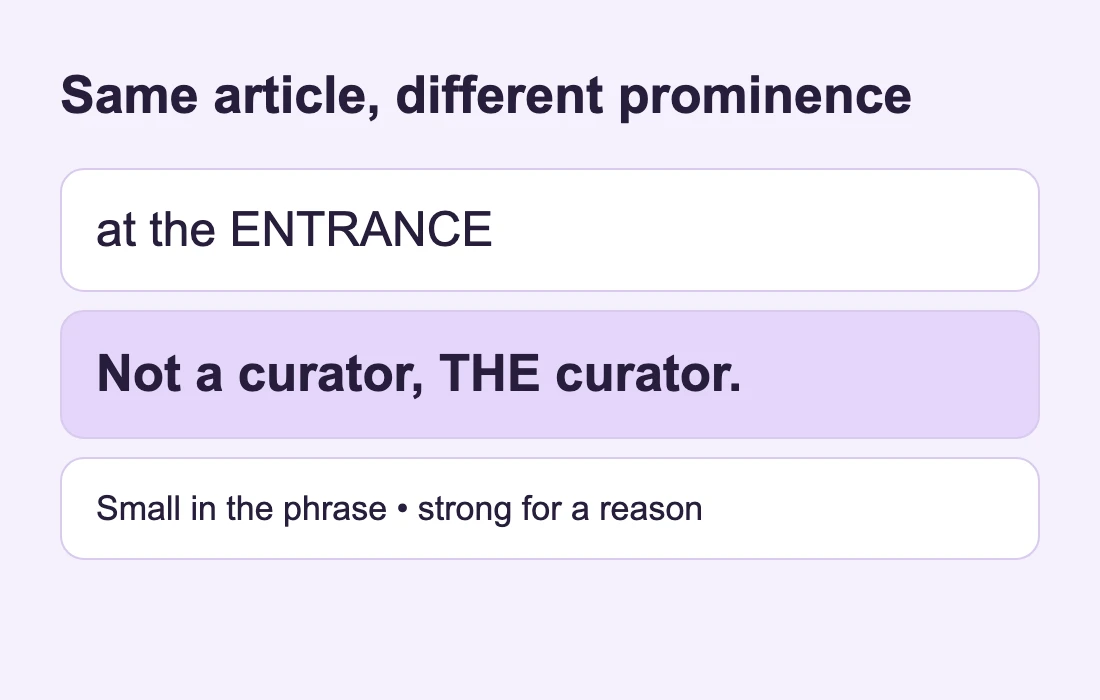
Imagine a visitor recognising the curator behind a famous exhibition: Not a curator, THE curator. Give the second the /ðiː/ to signal that this is the particular, important person. Oxford explicitly records this emphatic use; it is not restricted to poetry or old-fashioned speech. Merriam-Webster also describes a stressed form before a long pause. If you hesitate while searching for a noun, you may hear that long form, but a pause is not a command to lengthen every the.
Keep a weak the inside the phrase
Try at the entrance as one group, then beside the lamp. Let the article fit between the more informative words, rather than inserting a pause on each side. Iowa State’s connected-speech chapter describes assimilation affecting /ð/ in in the and on the; that can make the consonant less distinct. It does not mean that /ð/ must disappear whenever the follows n.
For the wider set of linking and sound changes, see our connected-speech guide.
For /ð/, let voiced air pass at a light tongue–teeth contact instead of making a firm /d/ stop. The consonant guide covers tongue position and th practice in detail.
Six lines to hear and try
Each clip below is synthetic speech generated once in SpeakGain with the Deep-voiced Viking character, shared across all language editions. Use it for sentence practice; compare the isolated forms with the dictionary recordings above. In the final line, try your own emphatic second the rather than treating the synthesiser’s stress as a pronunciation verdict.
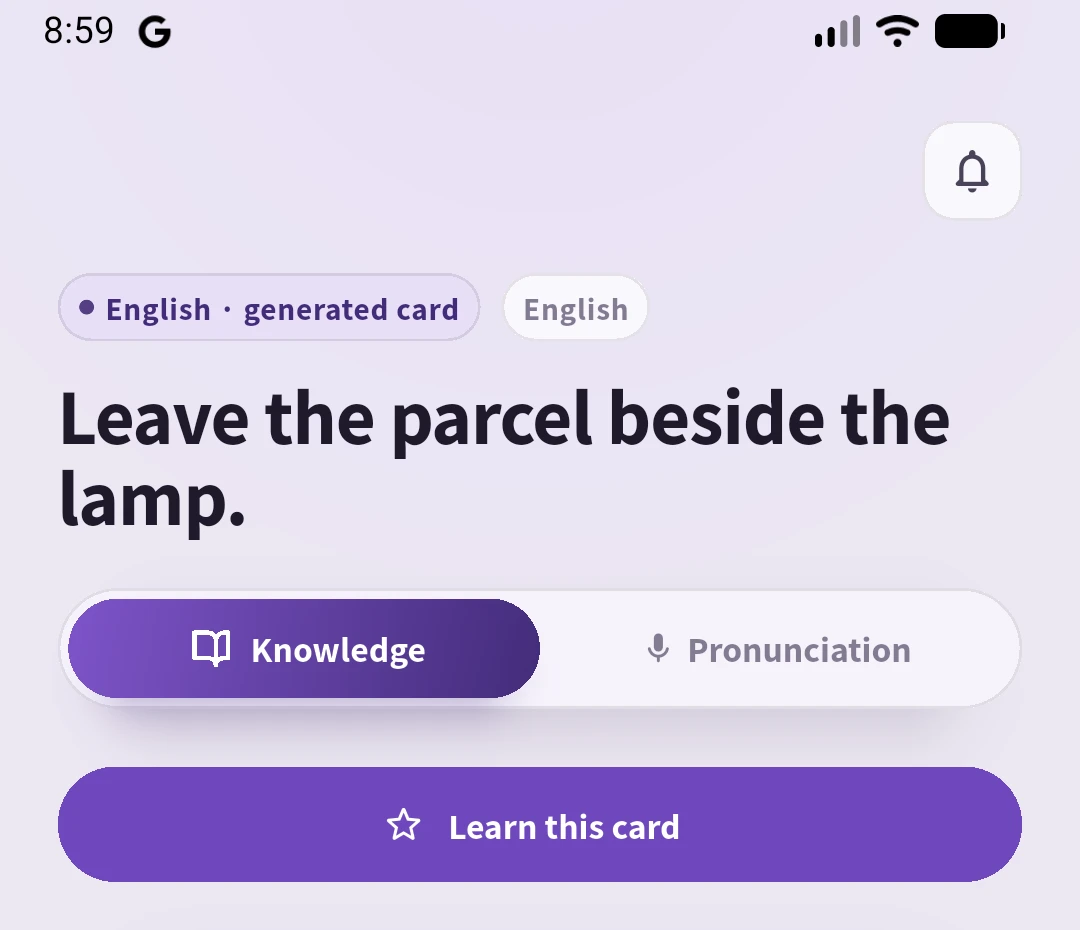
Leave the parcel beside the lamp.
parcel /p/, lamp /l/: two short /ðə/ choices.
Listen to sentence 1
Meet me at the entrance after lunch.
entrance starts with a vowel: practise at the‿entrance without a gap.
Listen to sentence 2
The hour on the ticket is wrong.
hour starts with a vowel; ticket /t/ starts with a consonant.
Listen to sentence 3
The university opens its archive on Friday.
university starts /j/; archive starts with a vowel.
Listen to sentence 4
Choose the one with the orange lid.
one starts /w/; orange starts with a vowel.
Listen to sentence 5
Not a curator, the curator.
Try the first noun as a correction, then stress the second the /ðiː/.
Listen to sentence 6
Build a comparison from your own sentence
Pick a message you actually need to say: a delivery instruction, a meeting point, or a line from a programme or game. Underline each the and mark the next word’s first sound. Listen to a model, speak the entire line, and record one take on your phone. Replay only the transition where you stalled; decide whether to change the vowel, the emphasis or the gap, then make one new take.
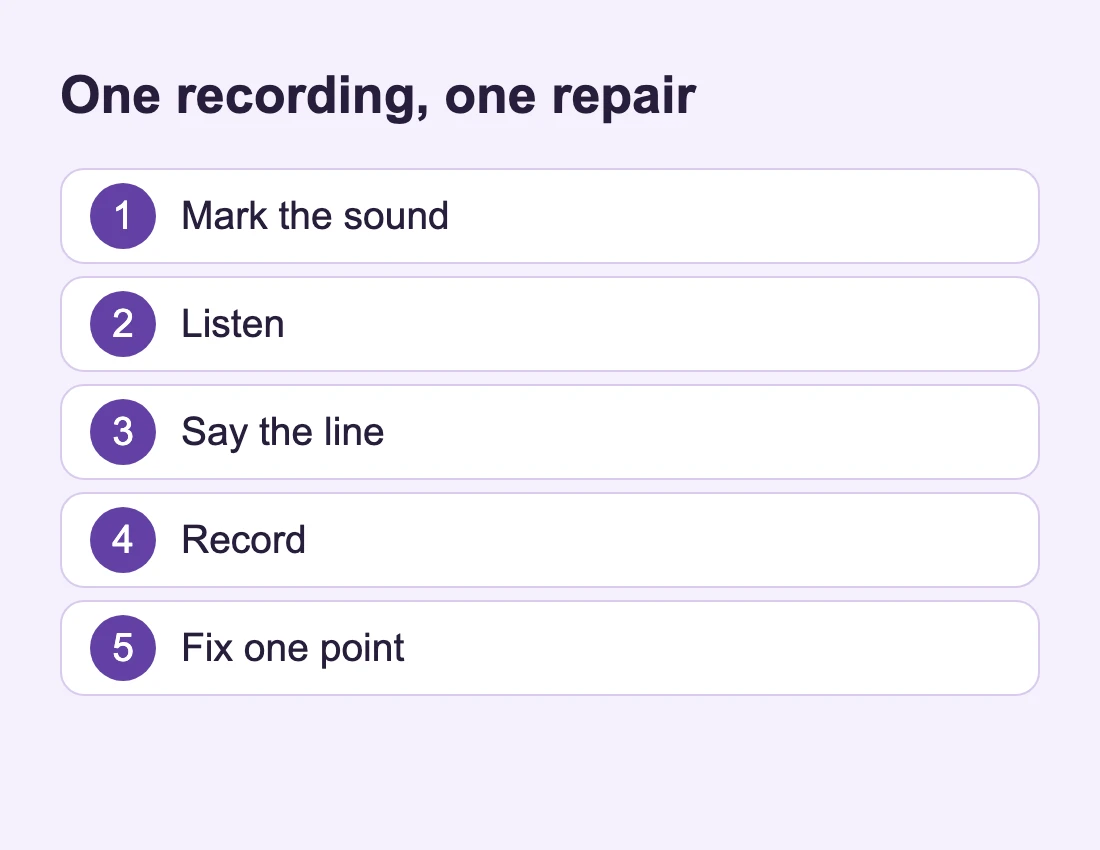
A two-week example: on days 1–4, work on one consonant/vowel contrast; on days 5–7, put it into one useful sentence. In week two, revisit the recording on three separate days and add a new sentence only when you can explain your choice.
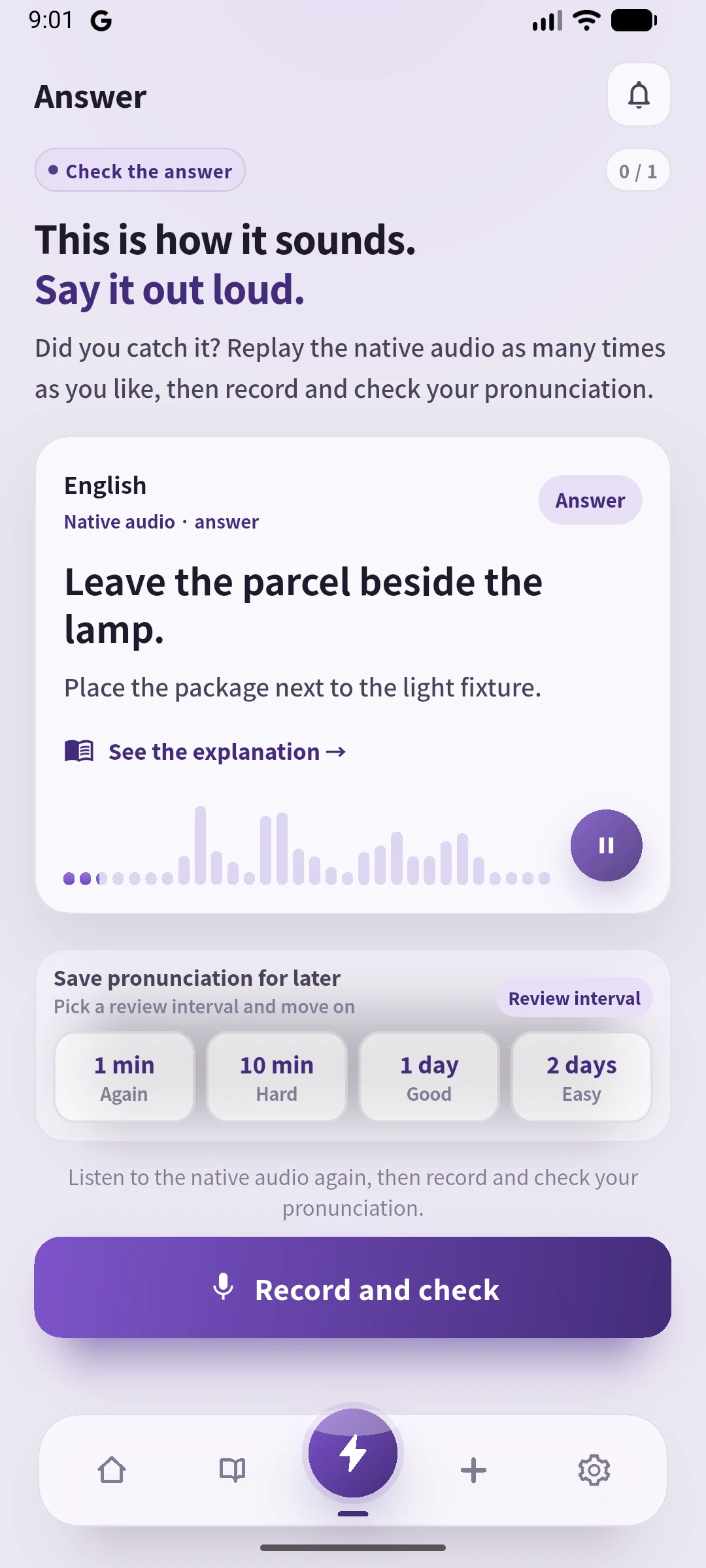
In our app SpeakGain, you can save the chosen English line as a card and play its character audio. The real screens below show the saved phrase and its listening practice; the interface is English. You can also record and inspect word-level feedback, then return when FSRS schedules a review. Word scores do not identify whether your weak or emphatic the was appropriate; use the context and your recording for that judgment.
Questions that come up when reading aloud
Is this the same idea as a/an?
Both choices depend on the next sound, but a/an changes the written article. The keeps its spelling and changes pronunciation; the articles also have different grammatical jobs.
Does /ðiː/ sound old-fashioned?
No. The emphatic use is listed in current dictionaries. Use it when emphasis helps the meaning, rather than on every noun.
Do British and American speakers use different rules?
Oxford lists the same three forms for both. The next word may differ by accent, so check the accent you are using instead of applying a spelling rule.
Does a capital The in a title force /ðiː/?
Capitalisation alone does not mark spoken emphasis. Start with the next sound and listen to the title’s official spoken introduction if it has a conventional reading.
Should I use the strong form whenever I read slowly?
Keep strong /ðiː/ for intended emphasis or a deliberate isolated form. Slowing a sentence down does not require giving every article the same prominence.
Keep the decision small
Before the next sentence, ask two things: what sound comes next, and am I deliberately emphasising the article? Then practise the whole phrase, so a correct choice does not become an extra pause.