
Telling time in English: two ways to say it, five phrases to practise
Published
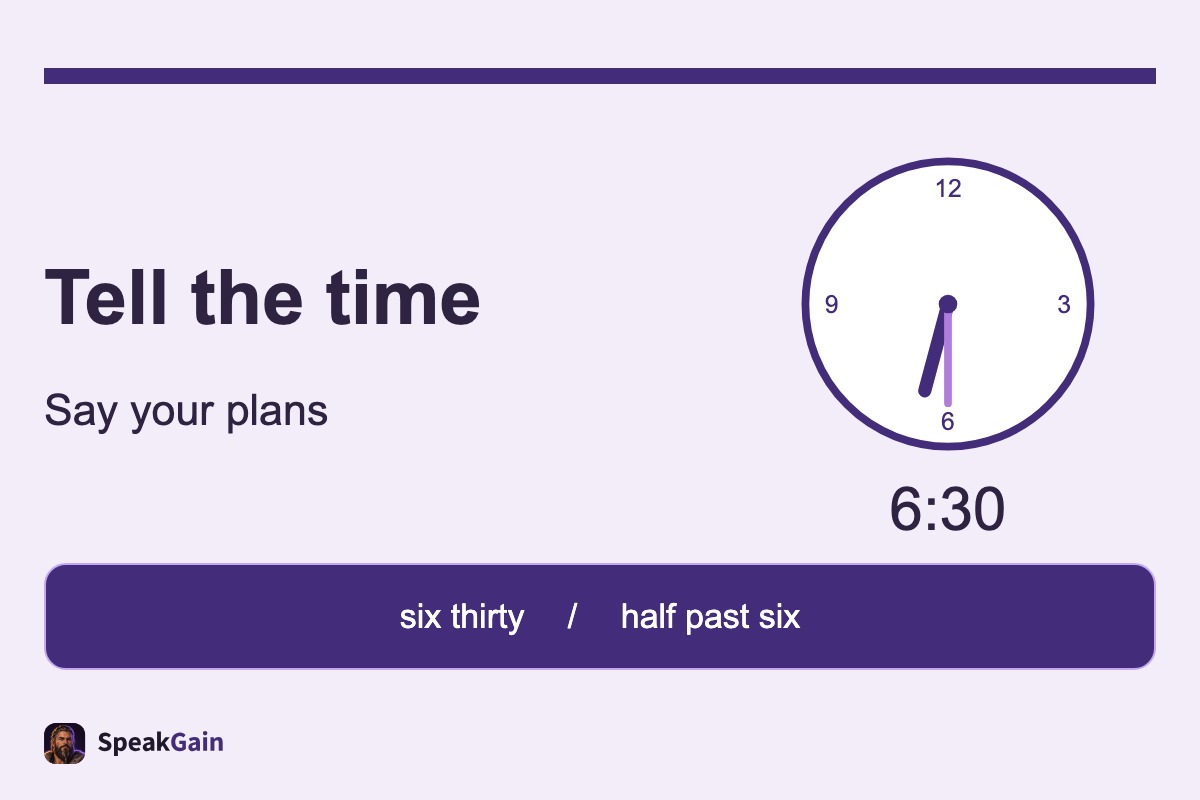
Say 6:30 as six thirty or half past six. Start with hour + minutes so you can answer quickly, then learn to recognise past/to when listening. Add a.m./p.m. if the part of the day is unclear; use o’clock only for whole hours.
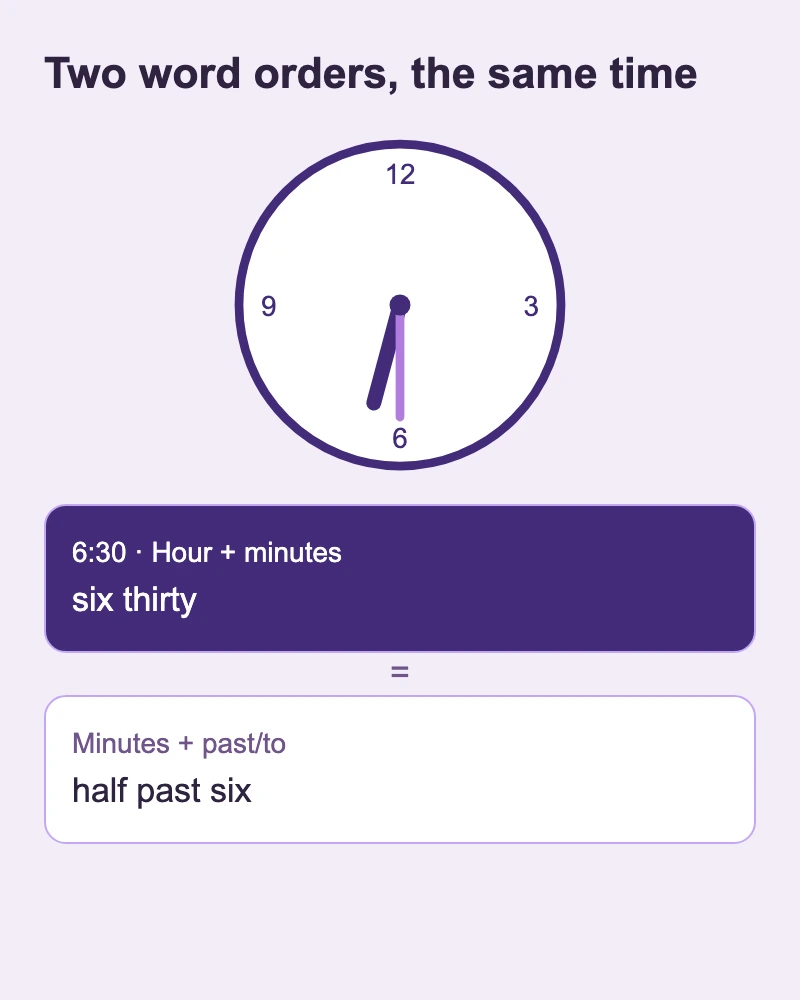
Two word orders, the same time
With hour + minutes, 6:05 is six oh five: the zero is spoken as oh. With past, give the minutes elapsed and the current hour: ten past six. With to, subtract the minutes from 60 and name the next hour: 6:40 = twenty to seven.
a quarter means 15 minutes; half means 30. For 6:30, the hour after past is six. You do not have to calculate both versions every time you speak. Use the number form for a quick answer, and practise the other form until you can recognise the same time.
Common times you can use today
| Time | Hour + minutes | With past/to |
|---|---|---|
| 6:00 | six o’clock | six o’clock |
| 6:05 | six oh five | five past six |
| 6:10 | six ten | ten past six |
| 6:15 | six fifteen | a quarter past six |
| 6:20 | six twenty | twenty past six |
| 6:30 | six thirty | half past six |
| 6:40 | six forty | twenty to seven |
| 6:45 | six forty-five | a quarter to seven |
| 6:50 | six fifty | ten to seven |
| 6:55 | six fifty-five | five to seven |
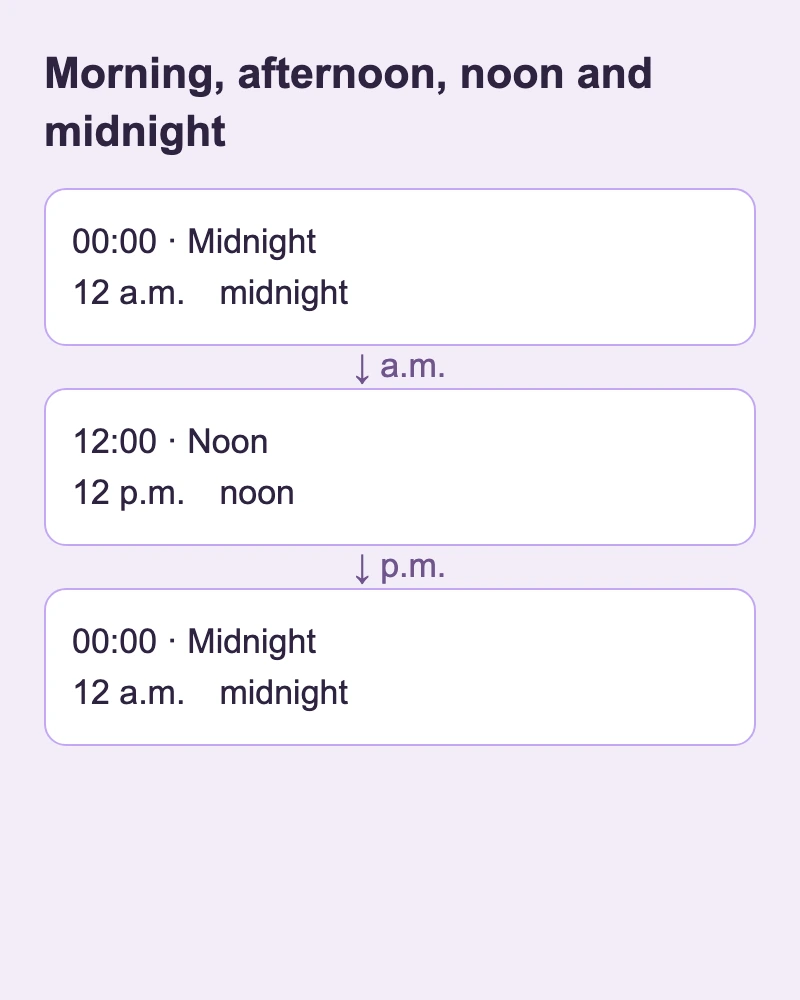
Morning, afternoon, noon and midnight
a.m. covers midnight to before noon; p.m. covers noon to before midnight. In the usual convention, 12 a.m. means midnight and 12 p.m. means noon. For arrangements, noon and midnight are clearer. Give the date as well if a midnight booking could fall on either of two days.
In conversation you can add in the morning, in the afternoon, in the evening or at night. Choose six p.m. or six o’clock in the evening rather than combining o’clock with a.m./p.m..
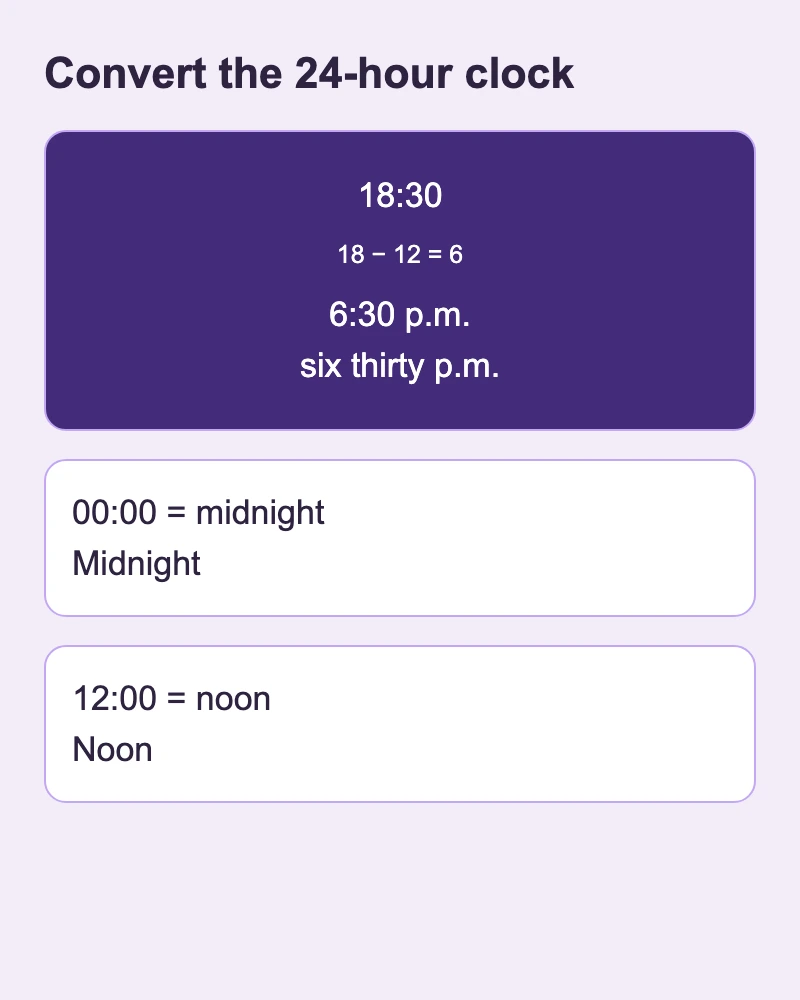
Turn a 24-hour display into a spoken time
For displays from 13:00 to 23:59, subtract 12 from the hour to speak in the 12-hour system: 18:30 = six thirty p.m.. 18:00 becomes six p.m., not eighteen o’clock. For 11:01, say eleven oh one, not eleven eleven.
In a timetable context, 18:30 can also be read as eighteen thirty. How often you hear this depends on the setting. For an ordinary appointment, a 12-hour time with the part of the day is a practical choice. Do not add p.m. to 18:30.
In American English you may hear a quarter after six instead of a quarter past six, and sometimes a quarter of seven for a quarter to seven. These are alternatives, not rules every American follows. six fifteen and six forty-five give you straightforward options without choosing a regional form.
Ask, confirm and give a time
What time is it? asks for the current time. So does Do you have the time?; without the, Do you have time? asks whether someone is available. For an event, name it: What time does the repair cafe open? — At six thirty.
at six thirty gives a time; around six thirty makes it approximate; by six fifteen gives a deadline; until six forty-five says how long something continues; from six thirty to seven fifty gives the start and end; six thirty sharp stresses the exact time. Bringing an item by a time is different from helping until that time.
When confirming a volunteer shift with someone elsewhere, make the place explicit: Is that six thirty p.m. Hanoi time? Do not infer the time zone from a bare number in an invitation.
When your first language points to a different hour
Do not carry over your language’s hour reference automatically. English half past six is 6:30, because six is the hour already reached; a quarter to seven is 6:45, because seven is still ahead. If your language counts a half hour towards the next hour, picture the digital time before choosing the English number. Also keep the current-time answer singular: It’s six thirty, regardless of how your language agrees with hour numbers.
Say five times from your own week
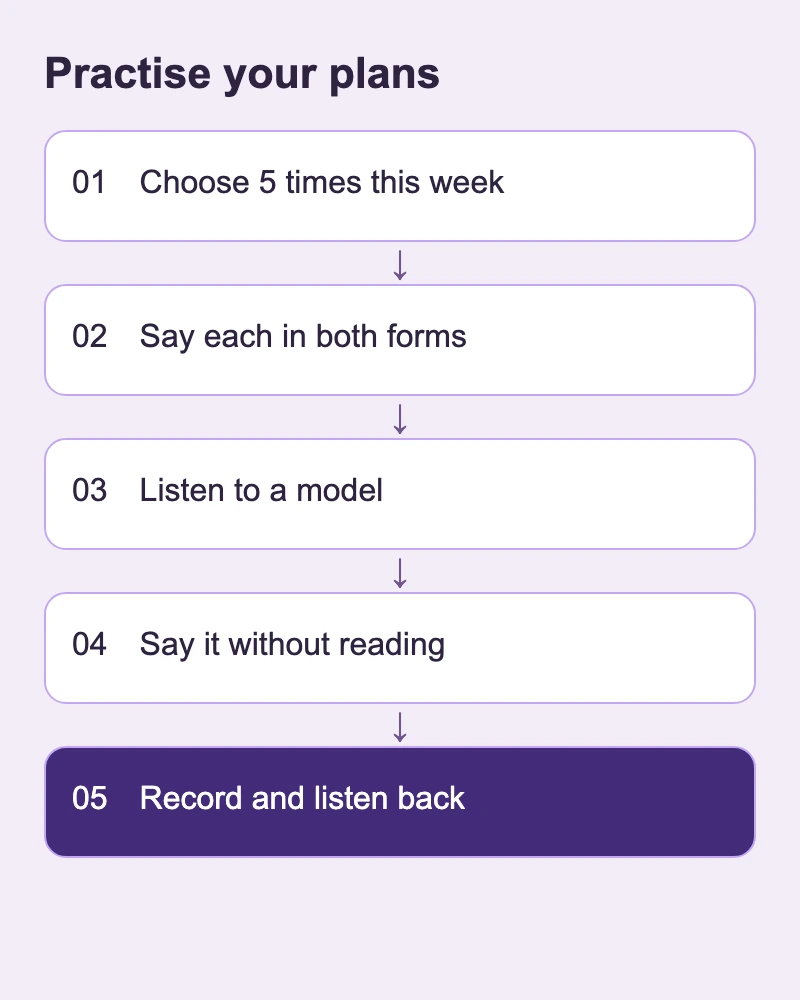
Pick five real times from your week: arrival, a deadline, a start, when you must leave and a final slot. Write each in both table patterns, then put it in a sentence. These five clips model one evening at a community repair cafe; the examples use Viking synthetic speech.
1
The volunteer check-in is at six oh five.
Volunteer arrival: 6:05.
2
Please bring the lamp by six fifteen.
Lamp delivery deadline: 6:15.
3
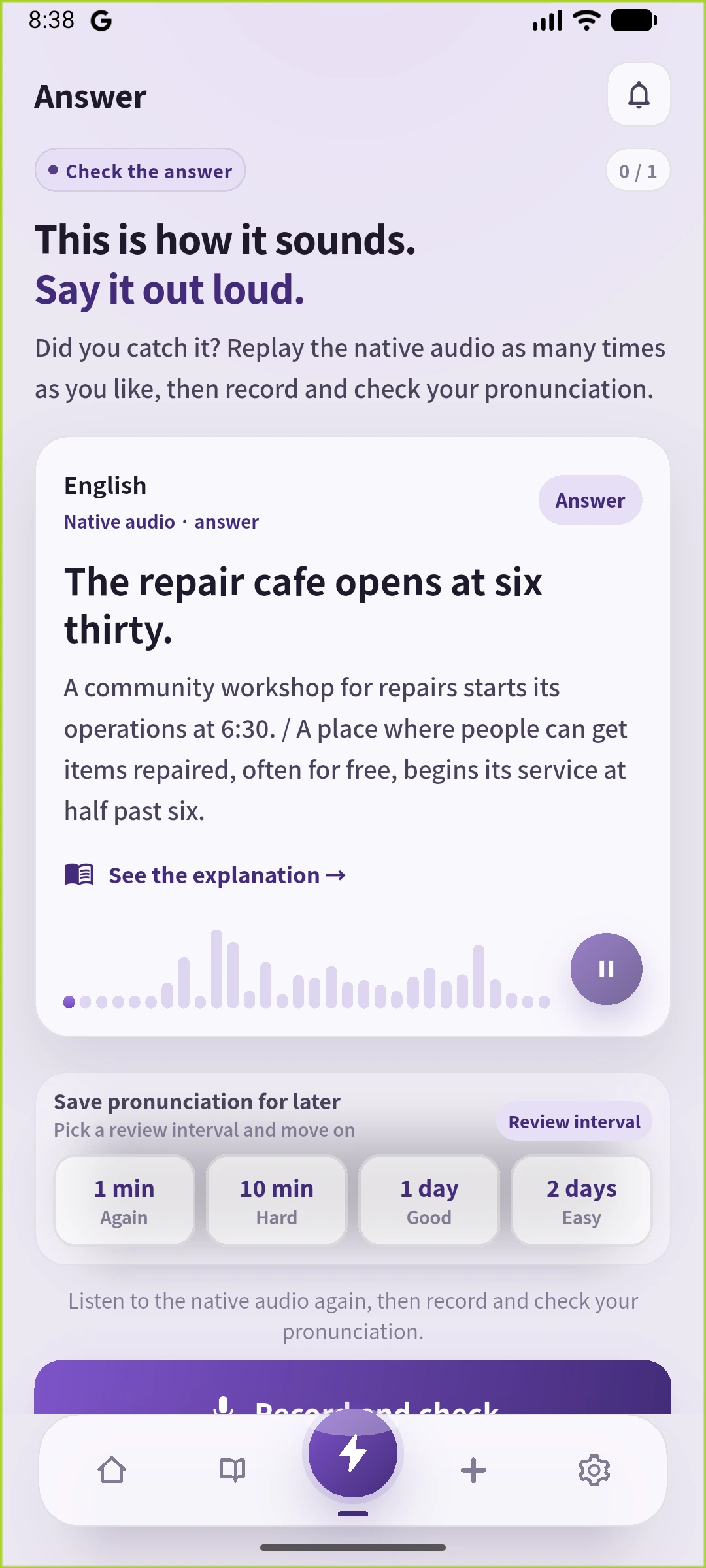
The repair cafe opens at six thirty.
Doors open: 6:30.
4
I can help until a quarter to seven.
Help continues until 6:45.
5
The last repair slot is at ten to eight.
Final repair appointment: 7:50.
Listen once, look away and say the sentence. Then replace only the time expression with its partner: six thirty becomes half past six, with the rest of the message unchanged. Record yourself on your phone. On playback, check the zero, the past/to link and whether you named the correct hour.
Did clip 4 leave you writing 7:15? Before another attempt, mark 6:45 on a clock and work out how many minutes remain until seven. For a separate speaking check, use the opening-time card in our app SpeakGain: pause the audio, cover the sentence and announce the opening with half past instead of the displayed number form. Both announcements must bring the visitors to the cafe at 6:30.
Listen and write the numbers
Hide the transcripts and play clips 4 → 1 → 5. Write only the clock times before opening the answer. Then say those numbers using hour + minutes: this checks that you understood the time rather than copied a sequence of sounds.
Show the answers
Answers: 6:45, 6:05, 7:50. The first is not 7:15: to seven counts towards seven.
Frequently asked questions
Must I use quarter instead of fifteen?
No. six fifteen and a quarter past six both mean 6:15. Use the form you can say reliably first.
Can o’clock follow minutes?
No. six o’clock means 6:00. Use six thirty or half past six for 6:30.
Is 12 a.m. lunchtime?
In the usual convention it is midnight. Say noon for midday; use midnight and the date when arranging something at night.
What to take into your next appointment
Take one reliable pattern into your next appointment: hour + minutes. Add the part of the day, check whether a time is a deadline or an end point, and confirm the time zone when needed. Build listening recognition of past/to alongside that speaking habit.
For dates, years and number sequences, see saying numbers in English.