
How to say numbers in English: years, decimals, prices and large numbers
Published
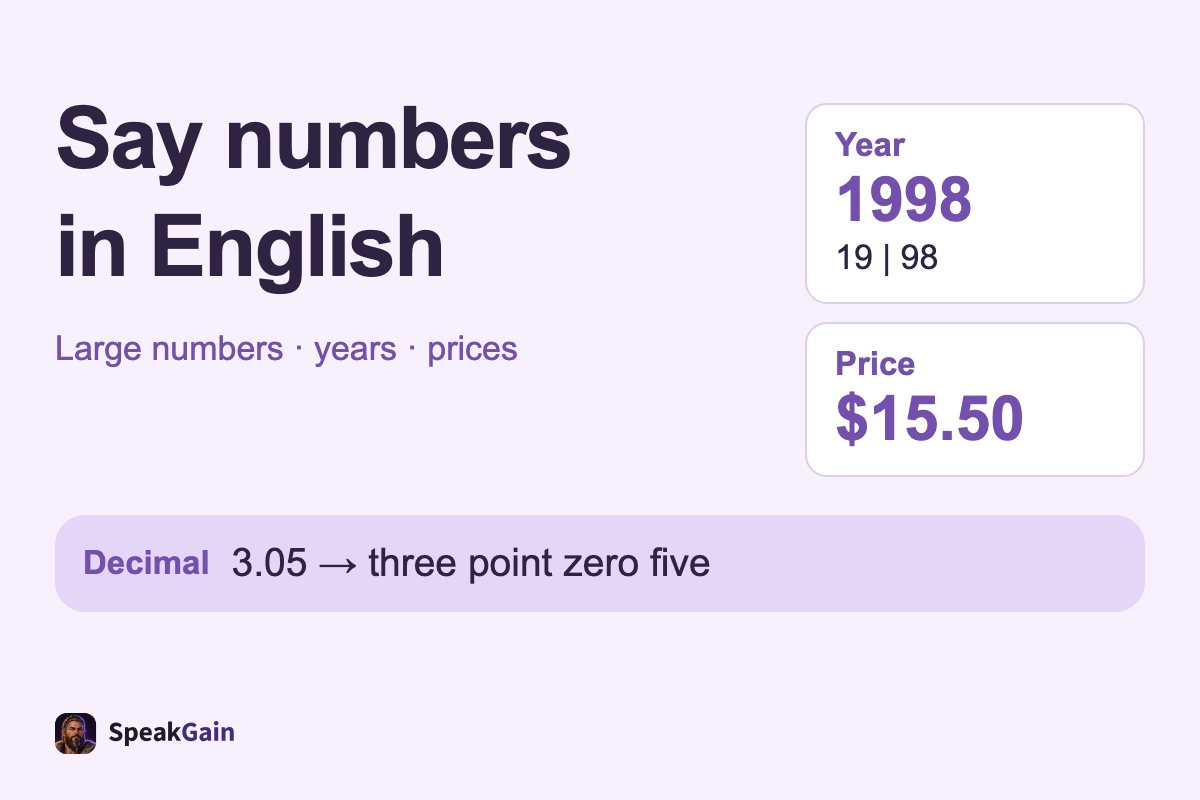
Say large numbers in groups of three with thousand, million and billion; years often use two pairs, while decimals use point followed by individual digits. Money, dates and codes each need their own pattern, and thirteen versus thirty depends on stress as well as the ending. Pick one number you actually need to say today before working through the examples.
Large numbers: find the groups before you speak
In 2,400,000, the left group counts millions, the middle group counts thousands and the last group is zero. You can say two million four hundred thousand or two point four million. The commas help you find the groups; you do not say “comma”. Cambridge’s Number guide explains grouping and number-word forms.
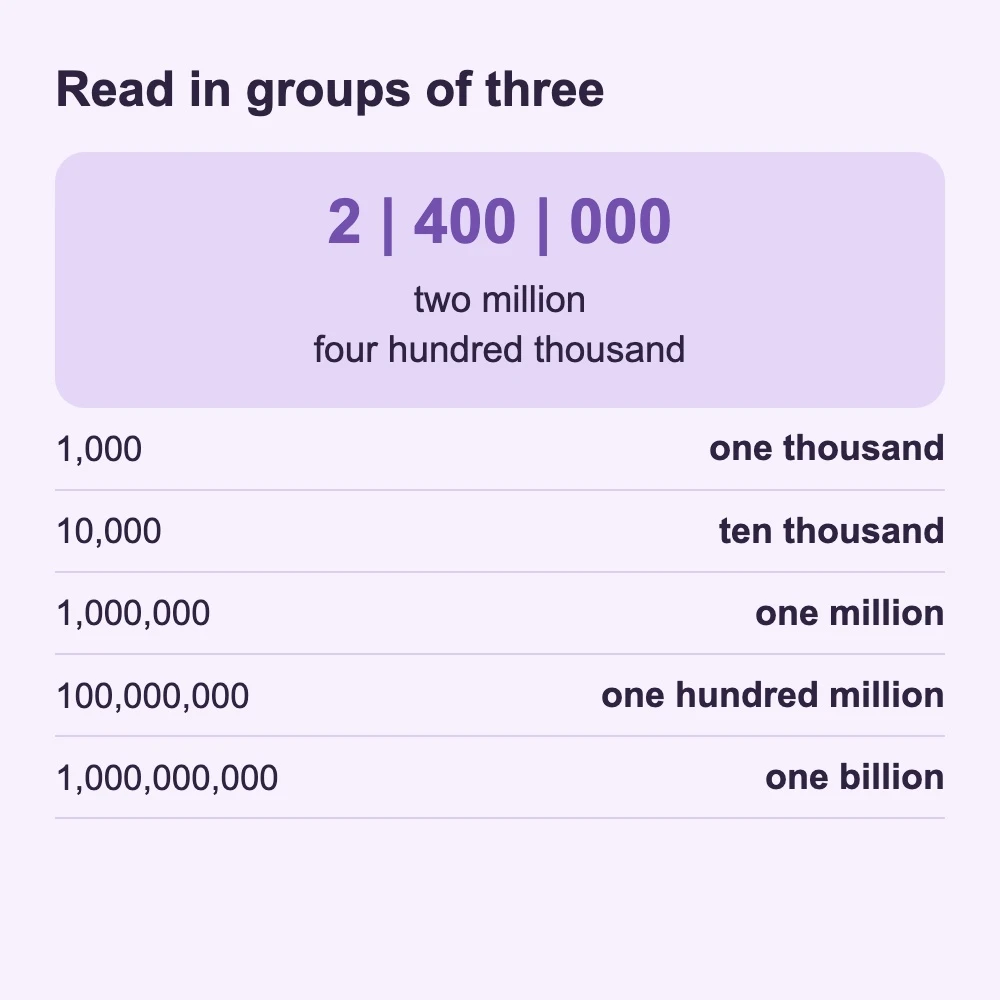
| Number | Say it |
|---|---|
| 1,000 | one thousand |
| 10,000 | ten thousand |
| 1,000,000 | one million |
| 100,000,000 | one hundred million |
| 1,000,000,000 | one billion |
Try 145,208: one hundred and forty-five thousand, two hundred and eight. Read 145, add thousand, then read 208. Skip an all-zero group. After a specific quantity use two million dollars; use millions of dollars for an unspecified large amount.
British usage includes one hundred and eight. You will also hear one hundred eight in American English. Compare Cambridge’s and with Mango’s number-building guide: omission of and is an accepted variant, not a missing digit.
The budget is 2.4 million dollars.
A budget of $2,400,000.
The budget is two point four million dollars.
Years: two pairs, with several alternatives around 2000
For 1998, say nineteen ninety-eight. This is a year label, so it does not need the long counting form. The examples below follow Cambridge’s Dates and EF’s year guide.
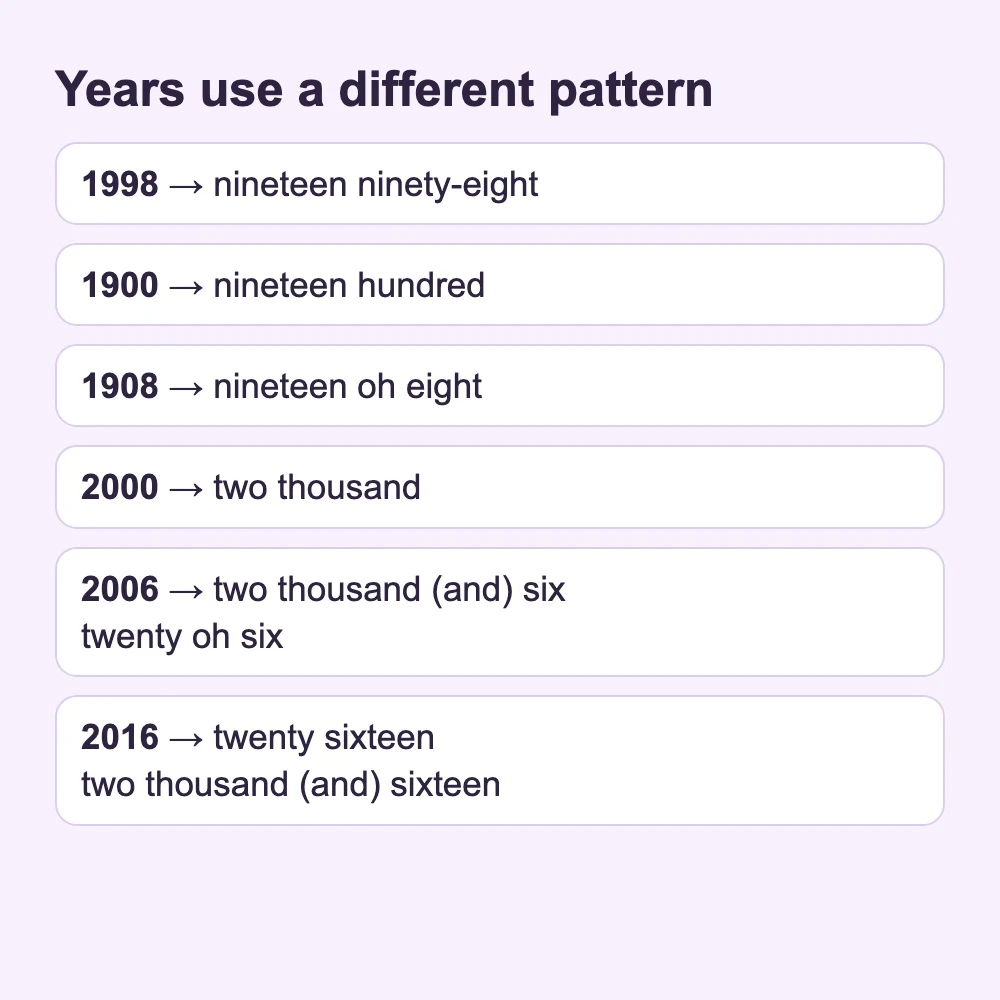
| Number | Say it |
|---|---|
| 1900 | nineteen hundred |
| 1908 | nineteen oh eight |
| 1998 | nineteen ninety-eight |
| 2000 | two thousand |
| 2006 | two thousand (and) six / twenty oh six |
| 2016 | twenty sixteen / two thousand (and) sixteen |
| 2026 | twenty twenty-six / two thousand (and) twenty-six |
Do not turn “two pairs” into a rule with no exceptions. 2006 can be two thousand six, two thousand and six or twenty oh six. For 2016, both twenty sixteen and two thousand (and) sixteen work. Parentheses in the table mean that the form occurs with or without and.
I was born in 1998.
A birth year: 1998.
I was born in nineteen ninety-eight.
We opened in 2006.
An opening year: 2006.
We opened in two thousand and six.
Decimals, fractions and percentages: keep each decimal digit
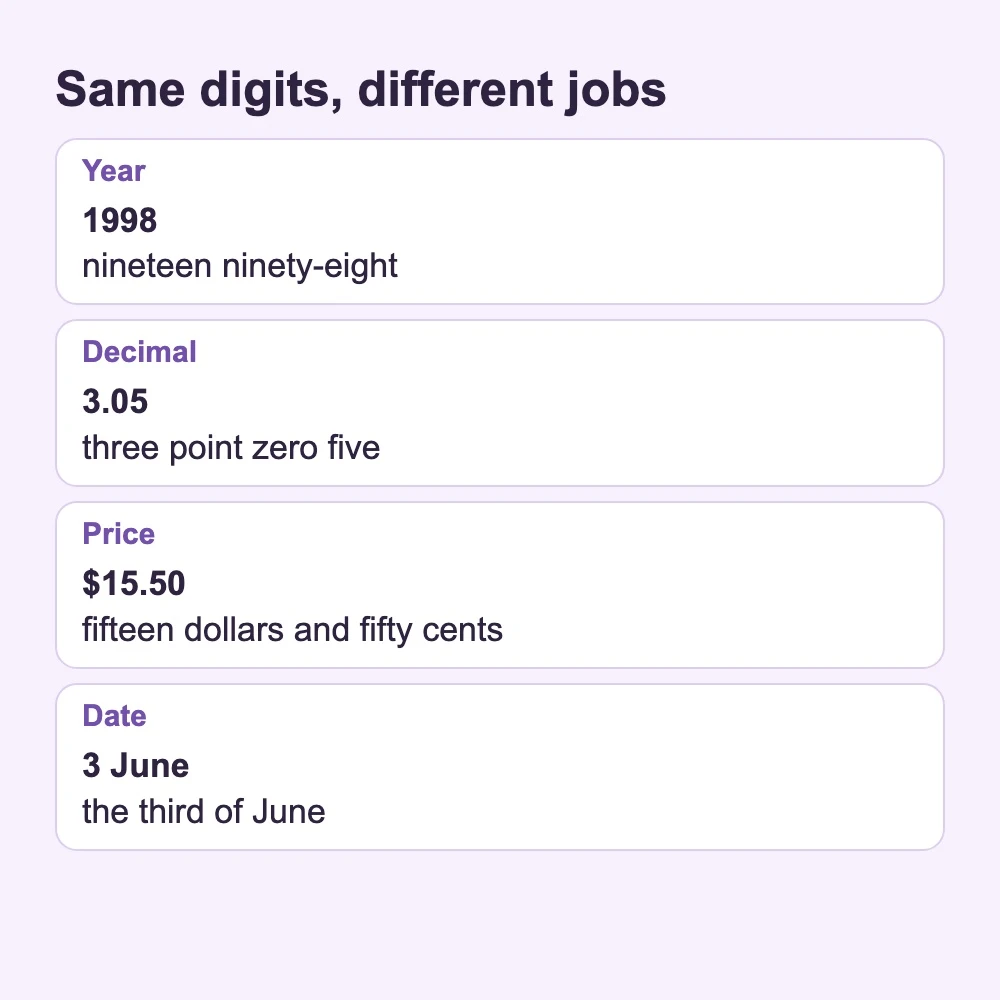
3.05 is three point zero five. Keep the zero after point: three point five would be a different value. English notation uses a decimal point; if your language uses a decimal comma, change how you read the notation too.
| Number | Say it |
|---|---|
| 3.05 | three point zero five |
| 1/2 | one half |
| 3/4 | three quarters / three fourths |
| 12.5% | twelve point five percent |
For fractions, say a cardinal numerator and an ordinal denominator, making the denominator plural for numerators above one. 1/2 is one half; 3/4 can be three quarters or three fourths. See EF’s fraction guide and Oxford’s quarter entry.
Zero works in decimals and codes. British English also uses nought, as in nought point four (Cambridge). You will hear oh in years, times and phone numbers; it is not a replacement for zero in every context.
The rate is 3.05 percent.
A percentage: 3.05%.
The rate is three point zero five percent.
We need 3/4 of a litre.
A quantity: ¾ litre.
We need three quarters of a litre.
Prices: $15.50 has a money pattern
The explicit form is fifteen dollars and fifty cents. When the currency and price context are already clear, fifteen fifty is also used. Contrast this with a decimal read digit by digit. If you are giving someone a price for the first time, including the currency helps them check it. Mango’s money guide shows both full and shortened forms.
It costs $15.50.
A price: $15.50.
It costs fifteen dollars and fifty cents.
Dates and times: name the month to remove ambiguity
3 June can be the third of June; with the month first, you can say June third. British written dates usually put the day first, while US dates put the month first. A date such as 03/06 is therefore ambiguous across conventions. Name the month when checking it (Cambridge’s Dates, Mango’s date examples).
The day uses an ordinal: 1st first, 2nd second, 3rd third, 12th twelfth, 21st twenty-first. For the time 4:05, say four oh five.
The meeting is on the 3rd of June.
A meeting date: 3 June.
The meeting is on the third of June.
We start at 4:05.
A start time: 4:05.
We start at four oh five.
Phone numbers and codes: individual digits
Phone numbers are read digit by digit, with zero or oh for 0 (Mango’s phone-number section). For the code 7049, the example uses seven zero four nine. Practise checking back what you heard in English phone calls.
The code is 7049.
An access code: 7049.
The code is seven zero four nine.
Thirteen or thirty? Listen through to the ending
The dictionary forms are thirTEEN and THIRty. UK IPA: thirteen /θɜːˈtiːn/, thirty /ˈθɜː.ti/; US IPA: /θɝːˈtiːn/ and /ˈθɝː.t̬i/. The mark ˈ comes before the main stressed syllable. Compare the final /n/ of thirteen with the /i/ ending of thirty too (thirteen, thirty, IPA key).
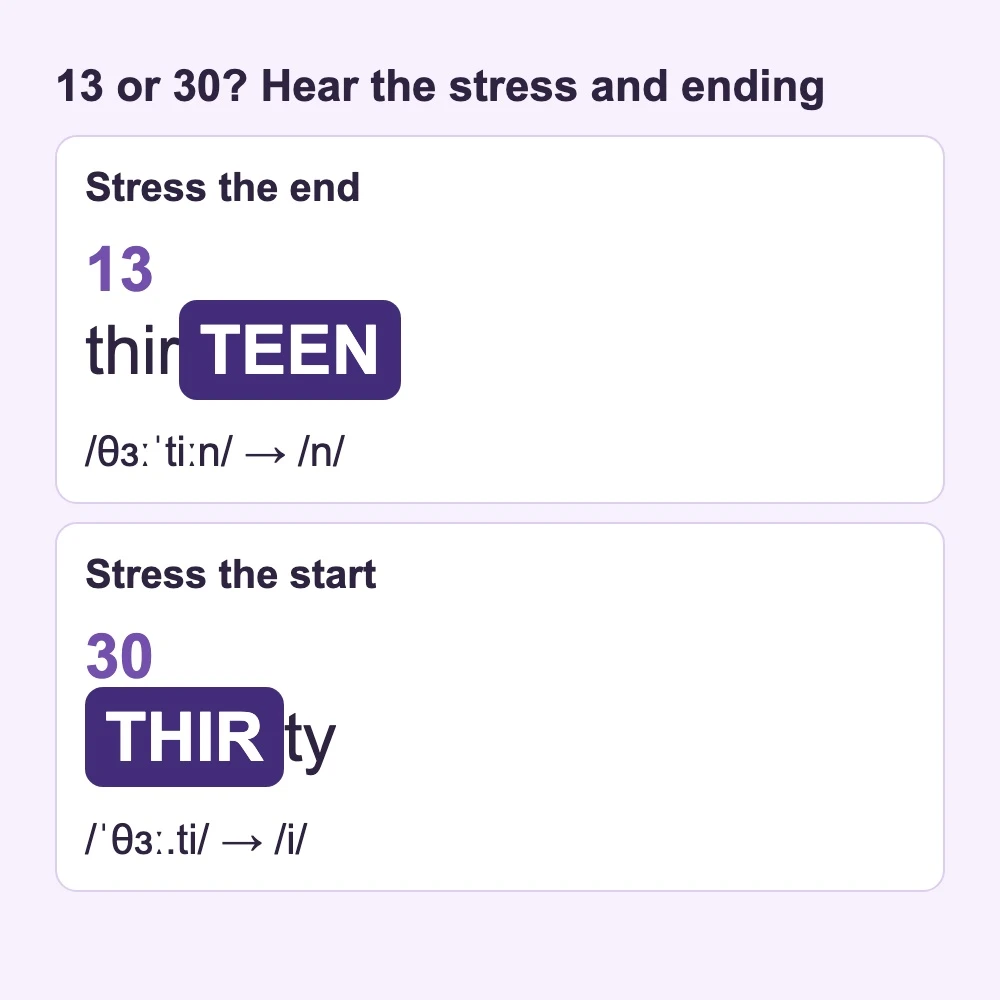
Sentence rhythm can change how prominent a syllable sounds. After practising the pair alone, listen to it in a sentence. Do not choose a number from its first sound: wait for the ending. (Cambridge, Ship or Sheep?, p. 10)
Thirteen, not thirty.
Correcting 30 to 13.
Thirteen, not thirty.
Make five of your own numbers into sentences
- Choose five numbers from your work or life: a budget, birth year, percentage, price and appointment date.
- Replace the numbers in the examples and say the whole sentence. Include the currency, percent or month name as needed.
- Record it, then check the number of digits, the units and the ending of thirteen/thirty. Hide the written number and say it again.
The reference clips here are AI synthetic speech generated in SpeakGain, the app we develop for practising your own sentences. To keep a sentence for practice, add it through SpeakGain’s normal Add screen, open it in the Library and start learning. Reveal the answer to see the saved sentence and replay its audio.
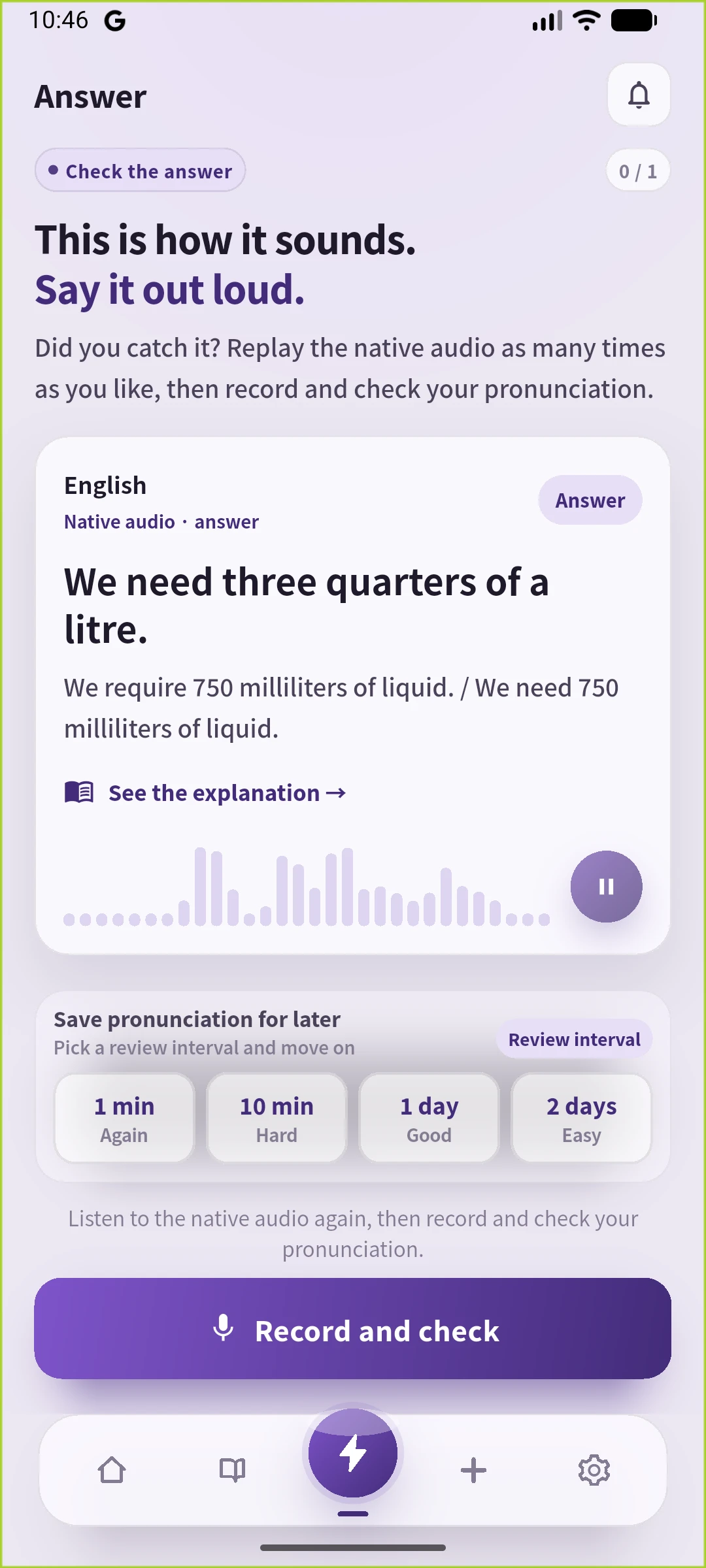
When comparing your recording, check the amount as well as the sound: did you say 240,000 instead of 2,400,000, or leave out dollars? An app score does not guarantee that the number itself is correct.
Questions that come up while checking
Must I use and? British usage includes it before the tens or units following a hundred. American usage also allows omission. Neither pattern should be treated as the only possible answer.
Does billion mean a million million? In current English usage here it means 1,000,000,000, a thousand million (House of Commons Library). Check this carefully if your language uses a similar-looking word for another value.
Can 2006 be twenty oh six? Yes; two thousand (and) six is also used. Years have alternatives.
Group large quantities in threes, choose the year pattern for years, and read decimal digits individually. Start with one number from your next conversation and say its unit too.