
Ways to say no in English: 15 refusals with audio and practice
Published
To say no politely in English, acknowledge the invitation or offer, state your decision clearly, and add a short true reason or one alternative only if useful. Choose the strength for the person and the thing you are declining; if you have decided against it, Maybe leaves the decision unclear.
Build a refusal in three parts
A friend invites you to a rooftop screening, but you have an early shift the next morning. This sentence acknowledges the invitation, says you cannot attend and explains the scheduling problem. The three parts are a useful frame, not three compulsory sentences: keep the decision and shorten the rest when appropriate.
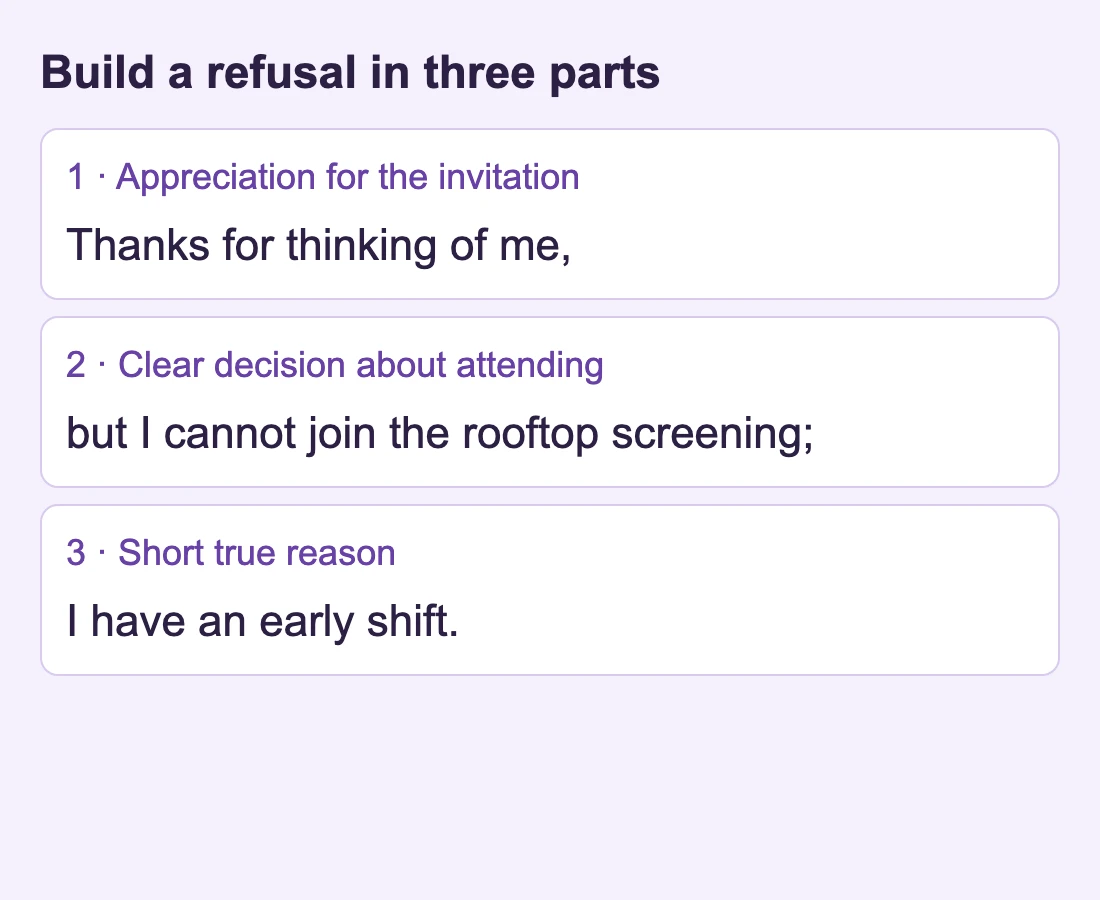
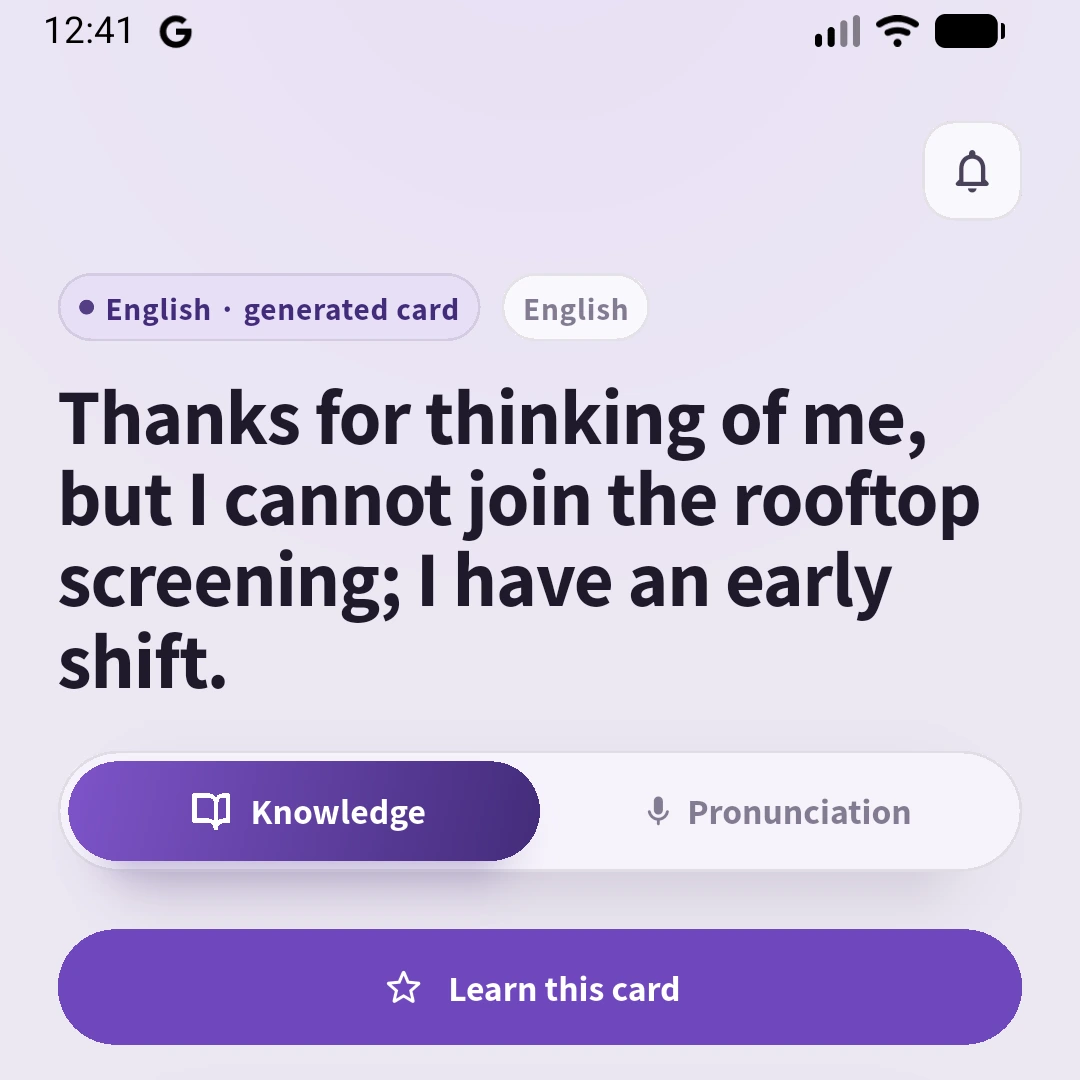
Thanks for thinking of me, but I cannot join the rooftop screening; I have an early shift.
Choose by situation and strength
Read across from acknowledging the other person, to a short answer, to an explicit decision. The final column can be too firm for a first reply to a friend; it helps when you need to remove doubt. A sales caller and a close friend do not need identical wording.
Invitation: rooftop screening
| Wording | Invitation: rooftop screening |
|---|---|
| Warm opening | 01 Thanks for thinking of me, but I cannot join the rooftop screening; I have an early shift. Appreciation + refusal + scheduling reason. |
| Short answer | 02 I will skip the rooftop screening tonight. A short decision about tonight. |
| Clear decision | 03 I have decided not to go to the screening. Please count me out. A settled decision; do not include you in the numbers. |
Favour: rabbit care
| Wording | Favour: rabbit care |
|---|---|
| Warm opening | 04 I wish I could help, but I cannot look after your rabbit this weekend. Acknowledge the request without agreeing to care for the rabbit. |
| Short answer | 05 I cannot care for the rabbit overnight, but I can bring hay on Friday. Refuse overnight care; offer a specific smaller task. |
| Clear decision | 06 I will not be able to take responsibility for the rabbit. Make clear that you cannot accept responsibility. |
Offer: borrowing a cargo bike
| Wording | Offer: borrowing a cargo bike |
|---|---|
| Warm opening | 07 That is kind of you, but I would rather not borrow your cargo bike. Acknowledge generosity while declining the loan. |
| Short answer | 08 I will pass on the cargo bike; I have booked a delivery. Decline because delivery is already arranged. |
| Clear decision | 09 I have already arranged transport, so I will not borrow the bike. Close the question of borrowing the bike. |
Sales: gym membership
| Wording | Sales: gym membership |
|---|---|
| Warm opening | 10 I appreciate the information, but I will pass on the gym membership. Acknowledge the information while declining membership. |
| Short answer | 11 I do not want to sign up for a gym membership. State that you do not want to enrol. |
| Clear decision | 12 My answer is still no. Please do not call me about this membership again. Repeat the refusal and ask for no further calls about it. |
Extra work: exhibit translations
| Wording | Extra work: exhibit translations |
|---|---|
| Warm opening | 13 Thank you for asking, but I cannot translate the exhibit labels this week. Decline this week’s translation work. |
| Short answer | 14 I cannot translate all twelve labels, but I can translate two by Thursday. Limit the quantity and give a real deadline. |
| Clear decision | 15 We have decided not to proceed with the exhibit translation proposal. Decline the proposal itself, not just its timing. |
Decide whether to add a reason or alternative
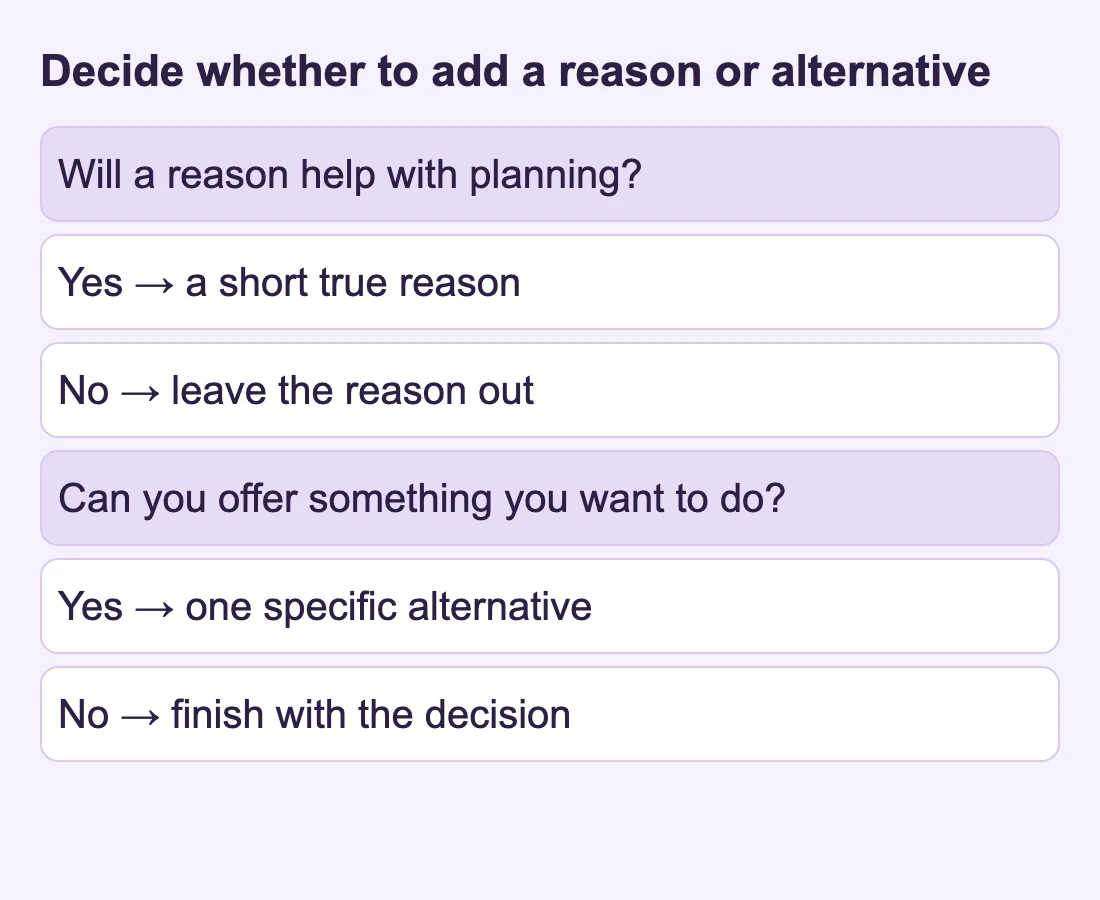
Before mentioning your early shift or private circumstances, ask whether that detail helps the other person plan. Our editors favour giving a useful true reason or leaving it out. An early shift explains why you cannot stay for a screening. If you prefer to keep personal circumstances private, the second screening example gives a decision without a reason. You do not need to invent another appointment to make a refusal sound acceptable.
Offer one alternative only when you can and want to do it. Bringing hay on Friday is a different commitment from caring for a rabbit overnight. State that limit so your helpful suggestion does not become agreement to the whole request. If there is no workable alternative, finish after the refusal.
Say no a second time
If someone asks again after you have decided, repeat the decision rather than collecting new excuses. The comparison below concerns repeated calls about a gym membership. The firm answer names the unwanted action without insulting the caller.
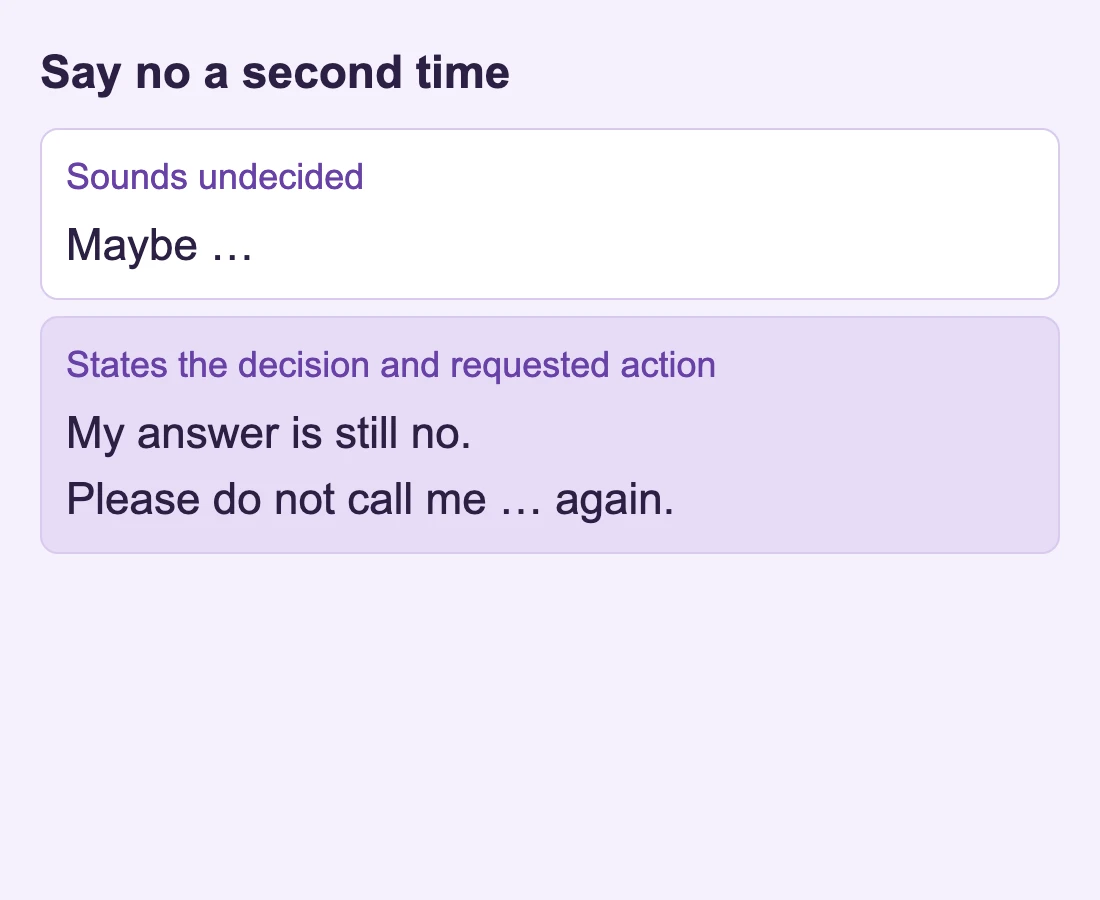
My answer is still no. Please do not call me about this membership again.
Decline extra work or a proposal
For an exhibit translation proposal, decide what you are refusing first. Use example 15 when the proposal will not go ahead, 13 when this week is impossible, and 14 when you can accept a smaller amount. Saying you cannot do twelve labels and can do two is a limit, not acceptance of all twelve.
For an added meeting, specify the unavailable time; for work outside your role, specify the responsibility you cannot accept. Keep the decision near the beginning of an email, too. For making the request, see making requests in English; for discussing prices or conditions, see English for negotiation.
Listen, speak and check your own refusal
Pick three situations you might face next week: a rooftop screening, rabbit care and exhibit translations, for example. Write down the person, the request and what you can actually offer. Adapt the sentences to those facts. All fifteen audio examples below use the same English across language editions.
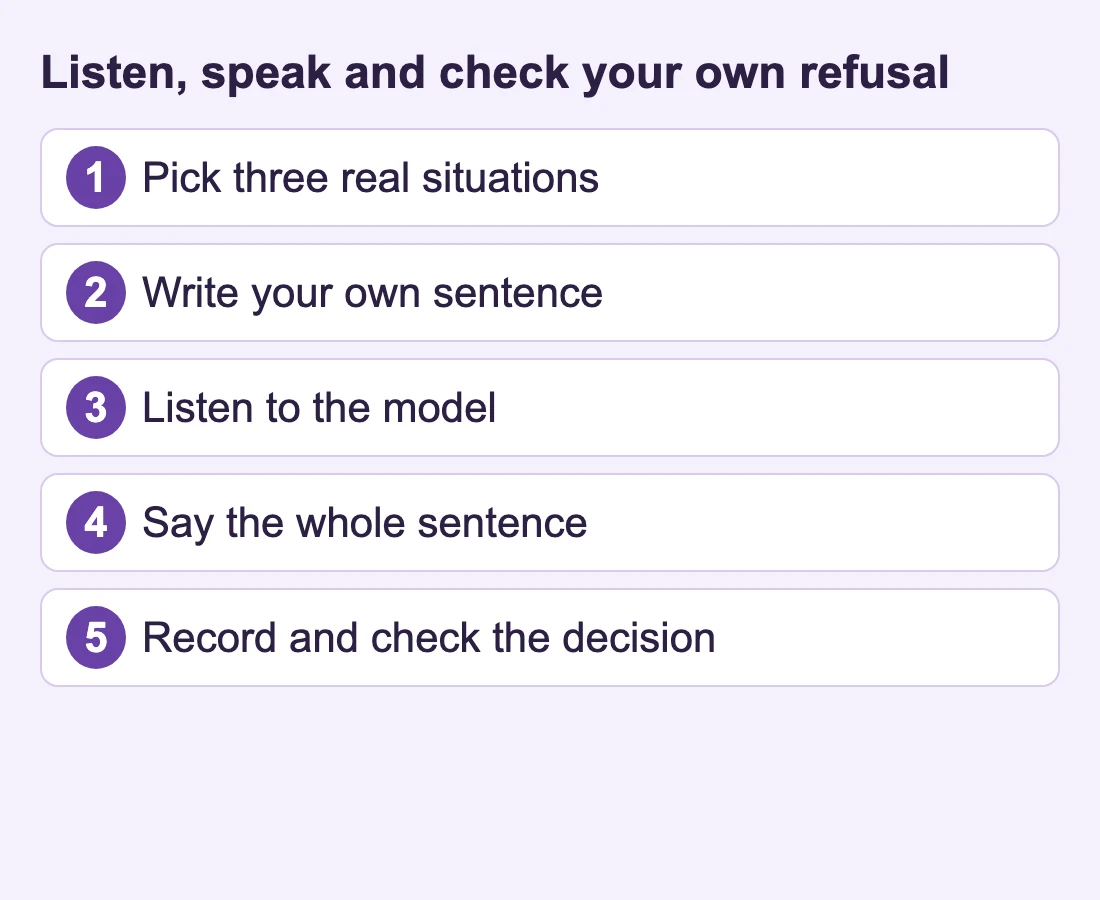
Listen back without reading. Can you identify cannot, will not or pass, and hear what is being declined? Do not judge every refusal by whether a final t is audible. Check the negative meaning, object and time limit together. If the decision is unclear, practise that part alone, then return to the complete sentence.
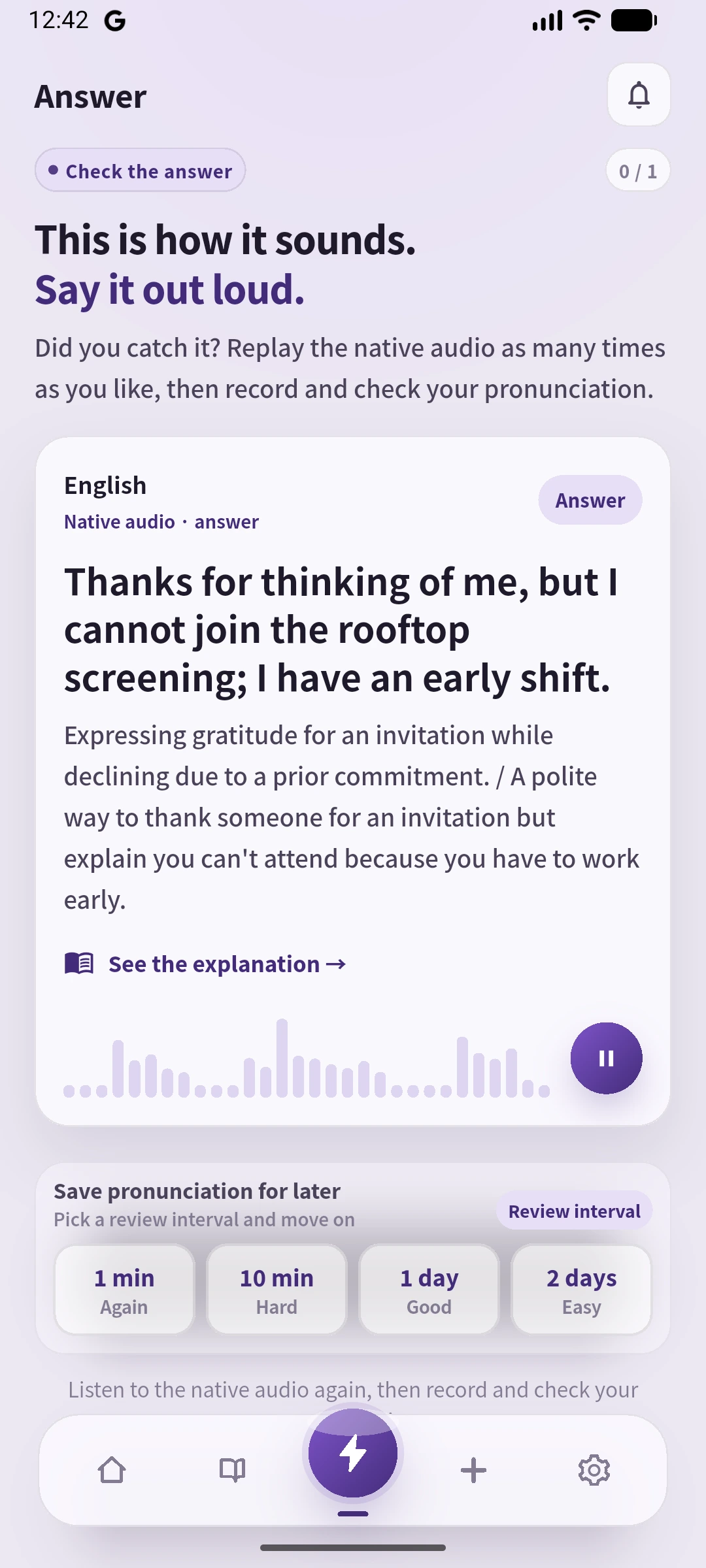
In SpeakGain, our own app, you can save the English sentence you want to use as a card and play its generated audio. The real screens below show a sentence from this article added through the normal Create flow. The app also offers recording with word-level pronunciation feedback and FSRS review prompts. Choose suitable wording yourself: pronunciation feedback does not evaluate politeness.
Audio for all 15 examples, in table order
01 Thanks for thinking of me, but I cannot join the rooftop screening; I have an early shift.
02 I will skip the rooftop screening tonight.
03 I have decided not to go to the screening. Please count me out.
04 I wish I could help, but I cannot look after your rabbit this weekend.
05 I cannot care for the rabbit overnight, but I can bring hay on Friday.
06 I will not be able to take responsibility for the rabbit.
07 That is kind of you, but I would rather not borrow your cargo bike.
08 I will pass on the cargo bike; I have booked a delivery.
09 I have already arranged transport, so I will not borrow the bike.
10 I appreciate the information, but I will pass on the gym membership.
11 I do not want to sign up for a gym membership.
12 My answer is still no. Please do not call me about this membership again.
13 Thank you for asking, but I cannot translate the exhibit labels this week.
14 I cannot translate all twelve labels, but I can translate two by Thursday.
15 We have decided not to proceed with the exhibit translation proposal.
Word choices and common questions
Oxford labels decline formal in its sense of politely refusing an offer or action. Refuse can mean saying you will not do what someone asks, or will not accept an offer. Reject includes refusing to accept or consider an idea or plan. Turn down is a phrasal verb for declining an offer or proposal. A verb alone does not determine how your whole reply sounds.
Must I start with Sorry?
Use it when you want to express regret. As a practical wording choice, you can also begin with appreciation, as several table examples do. There is no need to insert an apology into every practice sentence.
Is No by itself rude?
A factual yes/no question and an invitation are different contexts. With an invitation, acknowledging the person gives you a way to soften the reply while keeping the decision clear. Avoid Maybe when you have already decided against attending.
Does I’m afraid mean I am frightened?
Oxford’s afraid entry also describes a polite way to introduce disappointing information. That use does not require a literal fear interpretation.
Prepare one refusal you can use
Choose one refusal you expect to need. Before adding more polite words, check that a listener can tell what you will not do. Keep the reason true and the alternative realistic. Then rehearse a second reply so a repeated invitation does not catch you without words.
References
Meaning and usage checked on 24 October 2026.