
English collocations: 42 useful combinations to check and say
Published
English collocations are words that regularly go together, such as make a decision and heavy rain. Start with something you want to say, check its partner words in a dictionary, then put the combination into your own sentence and say it aloud. A usable sentence is a better starting task than memorising a whole list.
Oxford defines collocation through words occurring together unusually often. Knowing two separate meanings does not tell you which combination speakers usually choose. An idiom has a meaning different from its individual words; many collocations remain quite transparent. “Chunk” is a broader teaching term for language handled as a unit, rather than a single grammatical category.
Spot the pattern around a central word
These five patterns are a way to look at combinations, not an exhaustive taxonomy. The labels follow the dictionary parts of speech. Articles can sit inside a combination, and verbs still change tense in a sentence.
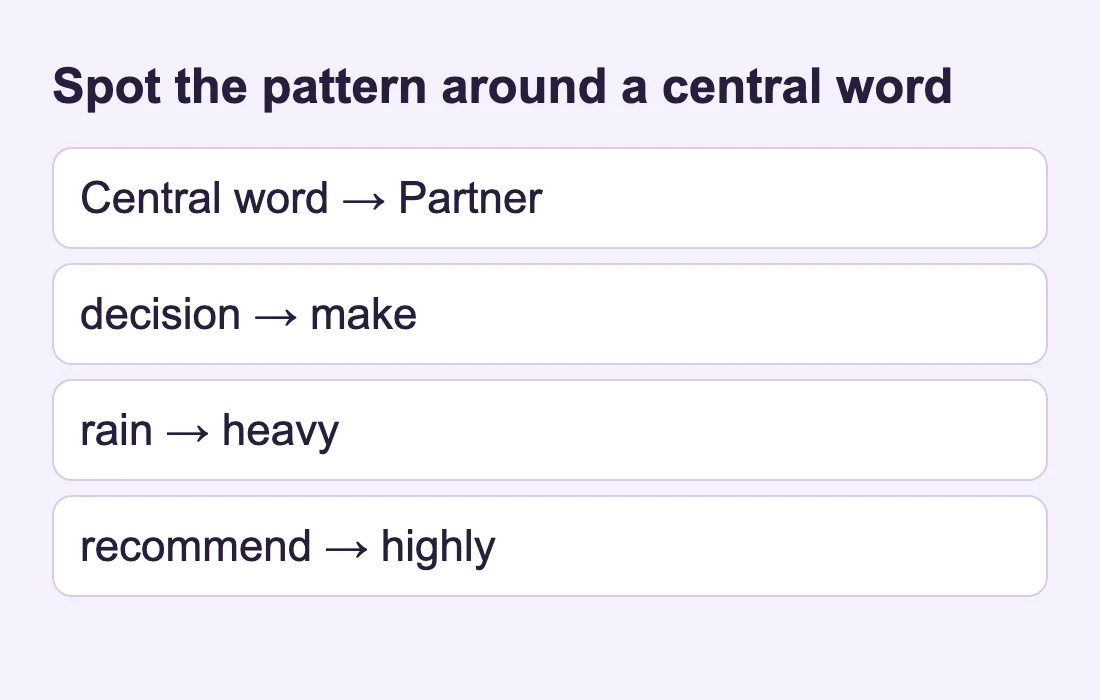
| Pattern | Examples |
|---|---|
| Verb + noun | make a decision take notes |
| Adjective + noun | heavy rain strong wind |
| Adverb + adjective | fully aware bitterly disappointed |
| Verb + adverb | breathe deeply think deeply |
| Noun + noun | office equipment weather forecast |
42 combinations grouped by situation
The sentences follow a group preparing a community stargazing evening. Borrow a combination for your own situation rather than memorising the astronomy story. Each combination links to the Oxford entry used to check it.
Work and organising
Raise a question brings an issue up for consideration; ask a question can simply request an answer.
| Combination and meaning | Sentence example |
|---|---|
| make a decision decide |
We must make a decision about the rooftop venue. |
| reach an agreement come to an arrangement |
The club and the school reached an agreement on access. |
| raise a question bring up an issue |
Mina raised a question about wheelchair access. |
| meet a deadline finish by the due time |
We met the deadline for the park permit. |
| give a presentation present to an audience |
Jon will give a presentation about Saturn. |
Study and discovery
Research, knowledge and progress are uncountable in these uses: do not add a.
| Combination and meaning | Sentence example |
|---|---|
| take notes write down information |
I took notes during the telescope demonstration. |
| do research investigate a subject |
We did research on safe viewing sites. |
| conduct an experiment carry out a test |
The children conducted an experiment with coloured filters. |
| gain knowledge learn more |
You can gain knowledge of the night sky at the club. |
| make progress move forward |
Our volunteers are making progress with the star map. |
Money and time
Raise money means collect funds here. Spare the time means manage to make time available.
| Combination and meaning | Sentence example |
|---|---|
| save money keep spending lower |
Borrowing folding chairs will save money. |
| spend money use money |
We spent money on red torches. |
| raise money collect funds |
We need to raise money for a telescope. |
| cut costs reduce expenses |
Sharing a van helped us cut costs. |
| waste time use time poorly |
We wasted time looking for the missing lens cap. |
| save time use less time |
Labelling the cables will save time after sunset. |
| spare the time make time available |
Can you spare the time for a short safety briefing? |
| run out of time have no time left |
We ran out of time before testing the last telescope. |
Rest and reactions
Catch a cold concerns becoming ill. Highly recommend expresses a strong recommendation.
| Combination and meaning | Sentence example |
|---|---|
| take a break pause an activity |
Let’s take a break before carrying the telescope upstairs. |
| have a rest rest for a while |
Have a rest while I set up the tripod. |
| get some sleep sleep for a while |
Get some sleep before the overnight observation. |
| catch a cold become ill with a cold |
I caught a cold after the rehearsal. |
| feel tired experience tiredness |
I felt tired after packing the astronomy equipment. |
| breathe deeply take deep breaths |
Breathe deeply before explaining the star map. |
| highly recommend strongly suggest choosing |
I highly recommend this pocket star atlas. |
| fully aware know or understand completely |
We are fully aware of the rooftop safety rules. |
| bitterly disappointed very unhappy at an outcome |
The children were bitterly disappointed when clouds hid Saturn. |
| pleasantly surprised unexpectedly pleased |
Our guide was pleasantly surprised by the clear view. |
Weather and travel
In these senses, heavy describes rain and traffic. This does not give a rule for every noun describing intensity.
| Combination and meaning | Sentence example |
|---|---|
| heavy rain intense rainfall |
Heavy rain forced us to move the telescopes indoors. |
| strong wind powerful wind |
A strong wind shook the poster stand. |
| thick fog dense fog |
Thick fog covered the hill beside the observatory. |
| clear sky a sky without clouds |
A clear sky gave us a good view of Jupiter. |
| catch a bus get on a bus in time |
We can catch a bus to the observatory at six. |
| miss a bus arrive too late for a bus |
I missed the last bus after the meteor shower. |
| book a ticket reserve admission or travel |
Book a ticket for the planetarium before Friday. |
| heavy traffic many vehicles on the road |
Heavy traffic delayed the delivery of the display boards. |
Cooperation and preparation
Keep and break a promise concern fulfilling or failing a commitment. Equipment is uncountable.
| Combination and meaning | Sentence example |
|---|---|
| pay attention listen or look carefully |
Pay attention to the red lights near the stairs. |
| take responsibility accept a duty |
Lena took responsibility for locking the roof door. |
| keep a promise fulfil a commitment |
We kept our promise to invite the local scout group. |
| break a promise fail a commitment |
Cancelling without calling would break our promise. |
| office equipment items used in an office |
We borrowed office equipment to print the sky charts. |
| weather forecast prediction of weather |
The weather forecast says the clouds will clear by nine. |
How to check a combination yourself
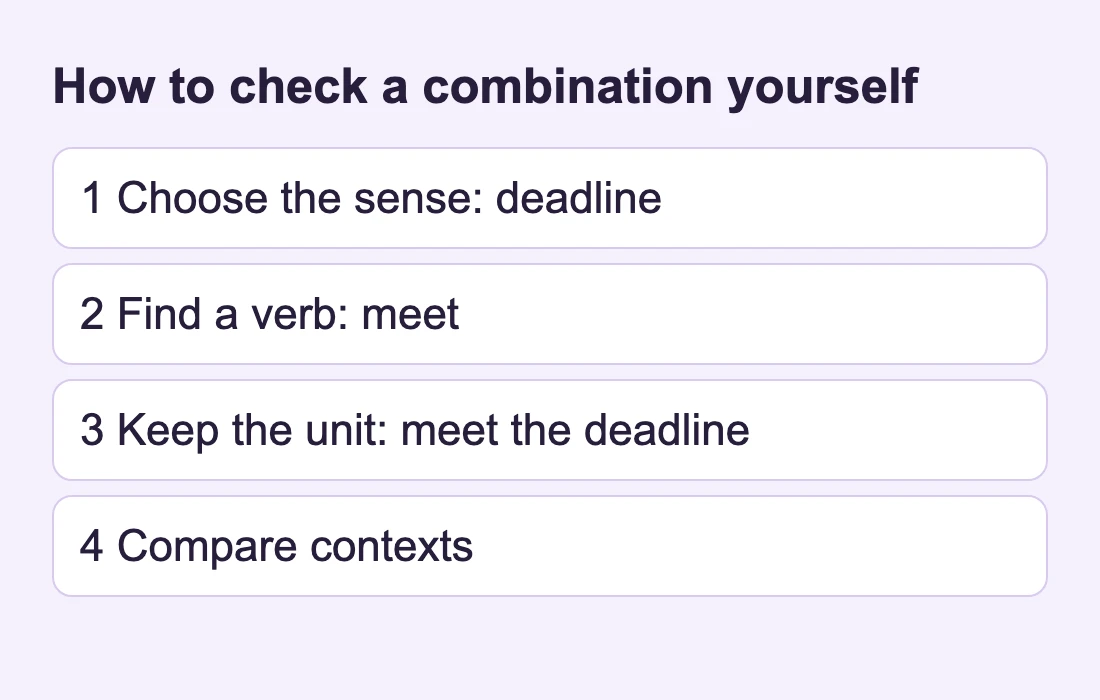
- Choose the central word: for a finishing date, look up deadline rather than guessing a general verb meaning “achieve”.
- Find the right sense in a learner’s dictionary. The deadline entry offers examples and an Oxford Collocations Dictionary box. Check the verb partners; a dedicated collocations dictionary can provide more if the preview is insufficient.
- Keep the construction: meet the deadline, rather than just meet. Add the task and date that matter to you.
- For more context, try SKELL: enter the base word, choose Word Sketch, then click a combination for example sentences. Its official guide says no registration or payment is required. Results are automatic: compare several examples with the intended sense instead of treating one hit as a verdict.
When a translation chooses the wrong partner
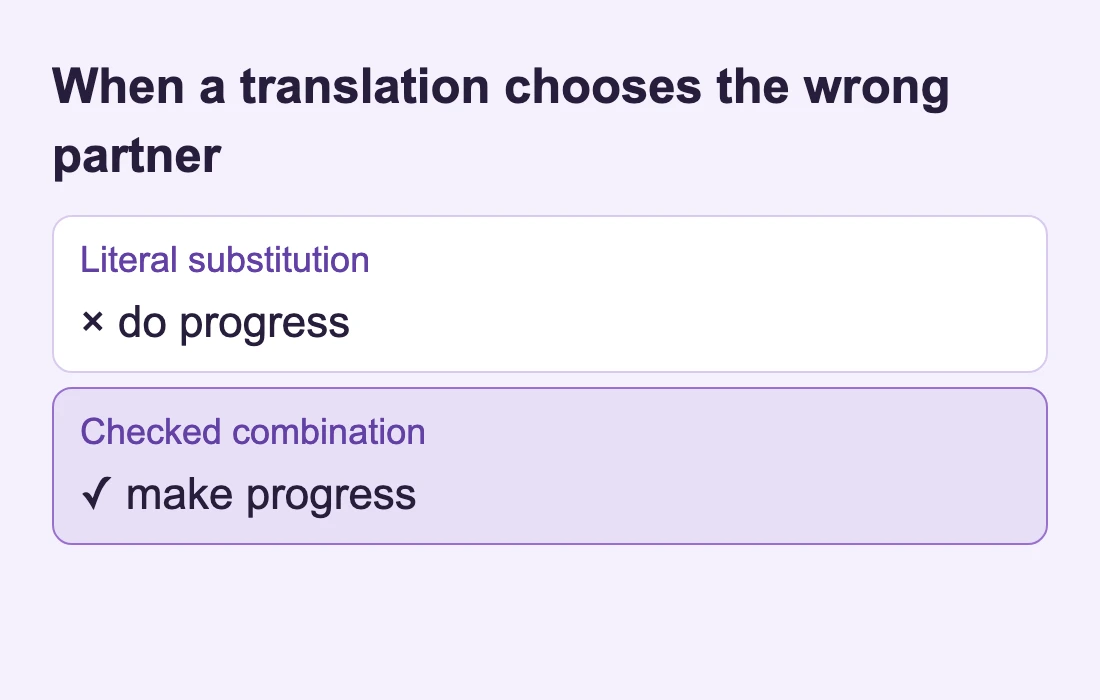
Your first language may use one general verb where English divides the job between several partners. Test that possibility with do research and make progress; do not extend one partner to every noun. Another useful check is heavy rain rather than strong rain for ordinary rainfall.
Practise five combinations in your own voice
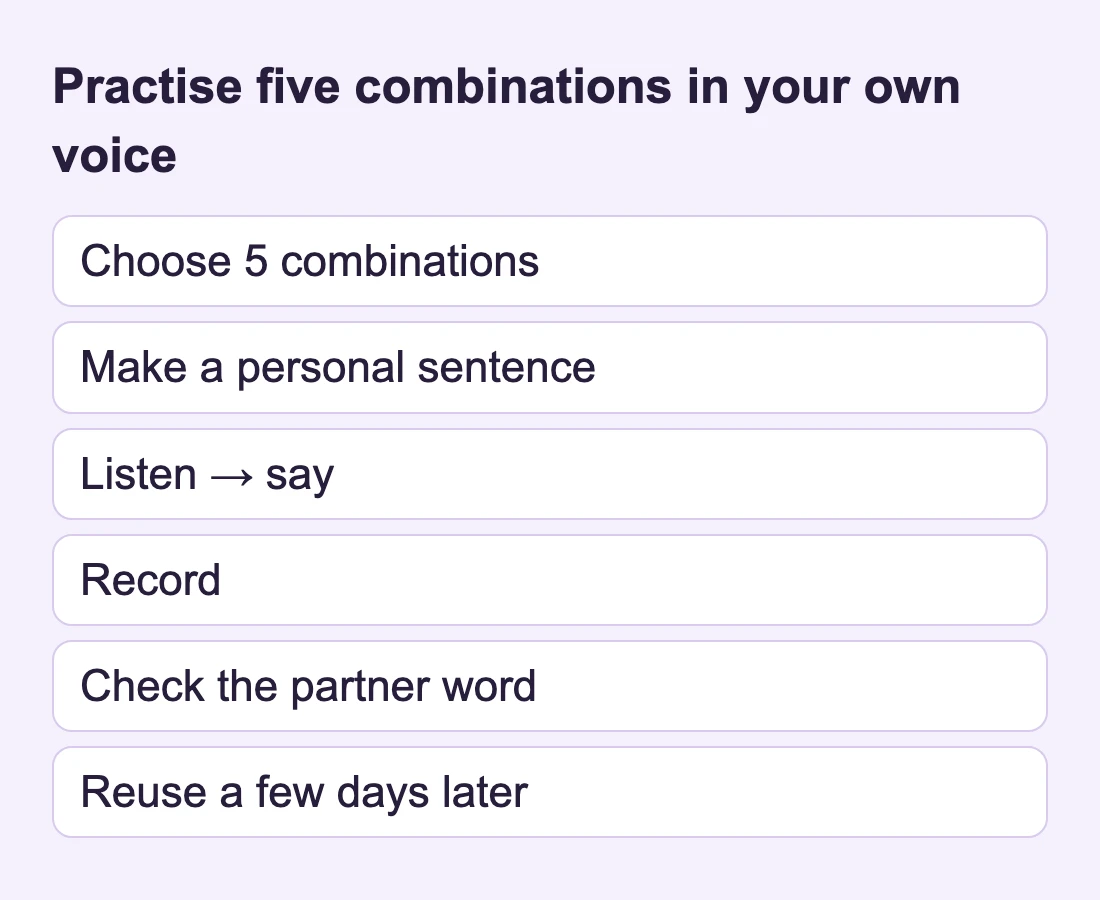
- Pick five combinations connected to something you expect to talk about this week.
- Write one or two personal sentences, preserving the checked meaning and construction.
- Listen to one sample below and attend to the whole combination.
- Hide the sample and say your own sentence without reading the list.
- Record it. On replay, ask one question: did I actually say the partner word I intended? Repair that one choice and try again.
- A few days later, use the same combination in a different sentence.
These five model sentences share one audio set across every language edition. For IELTS Speaking practice, use a suitable sentence to tell a real story about organising an event; there is no need to squeeze every combination into one answer.
1. We must make a decision about the rooftop venue.
2. We need to raise money for a telescope.
3. I highly recommend this pocket star atlas.
4. Heavy rain forced us to move the telescopes indoors.
5. Pay attention to the red lights near the stairs.
Listen to a sentence you have saved
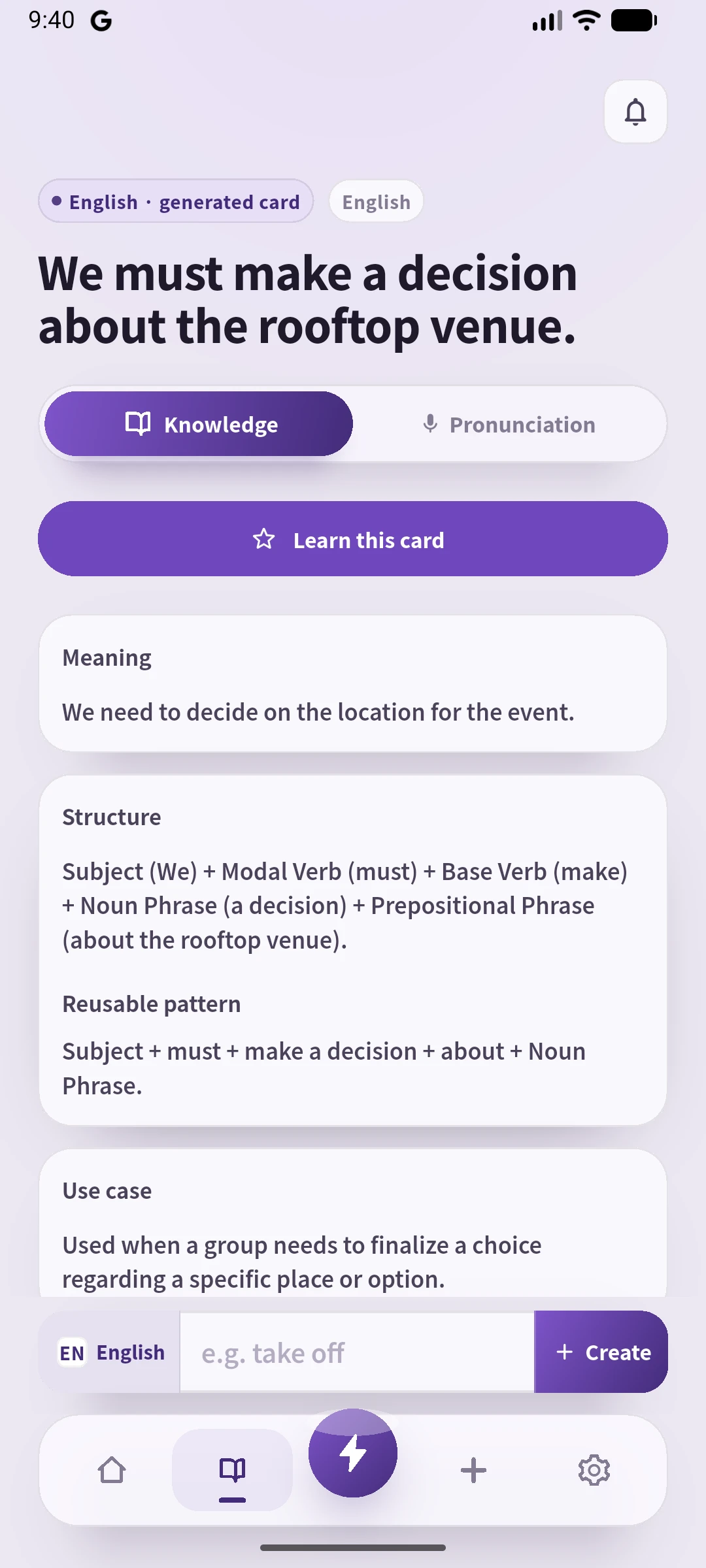
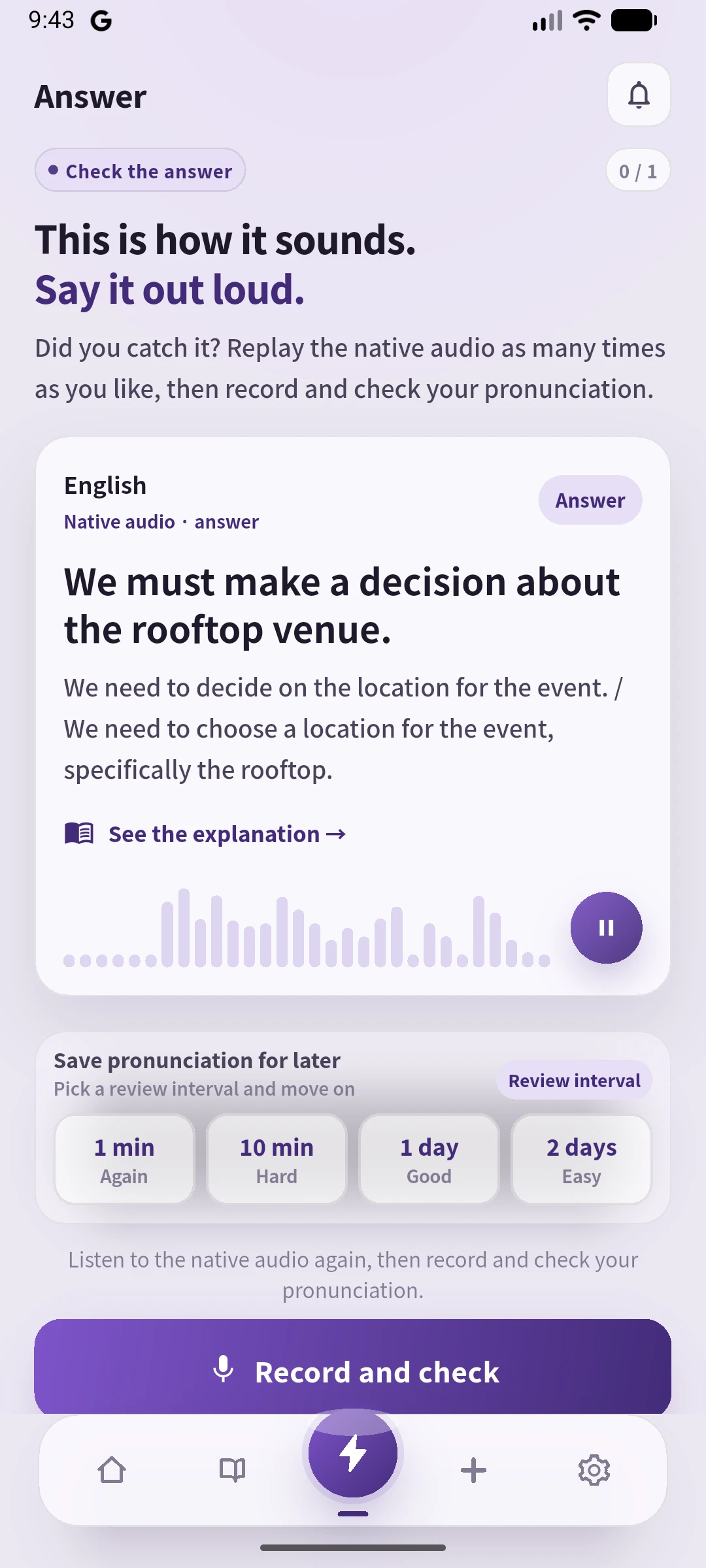
SpeakGain is our app. After checking a combination in a dictionary, you can save the complete sentence as a card and play its model in listening practice, as shown here. Listen and say your sentence; with a microphone, you can then record for pronunciation feedback. That feedback does not decide whether a collocation is correct. Both screenshots show the English interface and the first model sentence.
Questions learners ask
How many should I learn?
Choose five that you have a reason to use. Add more after you can say your own sentences without the list.
Are collocations phrasal verbs?
A phrasal verb combines a verb with an adverb or preposition to give a new meaning. Collocation describes which words tend to occur together. These perspectives can overlap; they are not mutually exclusive boxes.
Is an unlisted combination wrong?
Not necessarily. Dictionaries select what they include. Check sense and context in another source; if still unsure, choose an attested combination for your intended meaning.
Choose a sentence for your next conversation
Before your next conversation, pick one combination, revisit its dictionary entry and describe a real plan with it. Replay your recording for one concrete check: whether the expected partner word made it into the sentence.