
How to Annotate an English Book Without Losing the Story
Published

When reading a book in English, underline a sentence you want to use, put a question mark beside a break in the story, and star a scene you want to revisit. Keep moving until your planned stopping point. Then move one to three sentences into a note, say them aloud, and check the note the next day. The marks tell you where to return; they are not an instruction to copy the whole page.
Give each mark one job
Try no more than five marked places in a 15-minute session. This is a working limit to keep your pencil from taking over the reading. If you reach five, finish the section without adding more and choose the useful places afterward.
| Mark | Meaning | Use it when | At the end |
|---|---|---|---|
| Underline | I could say this myself | A short phrase fits a conversation or journal entry | Consider it for your note |
| ? | I lost the thread | You cannot tell who did what or why the next event happened | Read a few more lines; clear it if the story resolves it |
| ★ | Return to this scene | An image, decision, or change in a character stands out | Try to recall the scene in one line |
Use the same meanings whether you write in pencil or use tabs. If you prefer two highlighter colors, give one to “I want to use this” and one to “I need to check this”; keep the star as a pencil or tab mark. Do not color a whole paragraph when one sentence is enough to find your way back.
Mark an original six-line page
Read this original mini-scene straight through first. It was written for this article, so it is not a quotation from a published book.
The last bus had already left the square.
Mira folded the map and looked down the empty street.
A light was still on in the little bookshop.
“I thought it was closed,” she said.
She tried the handle, but the door would not open.
A handwritten note said, “Back in five minutes.”
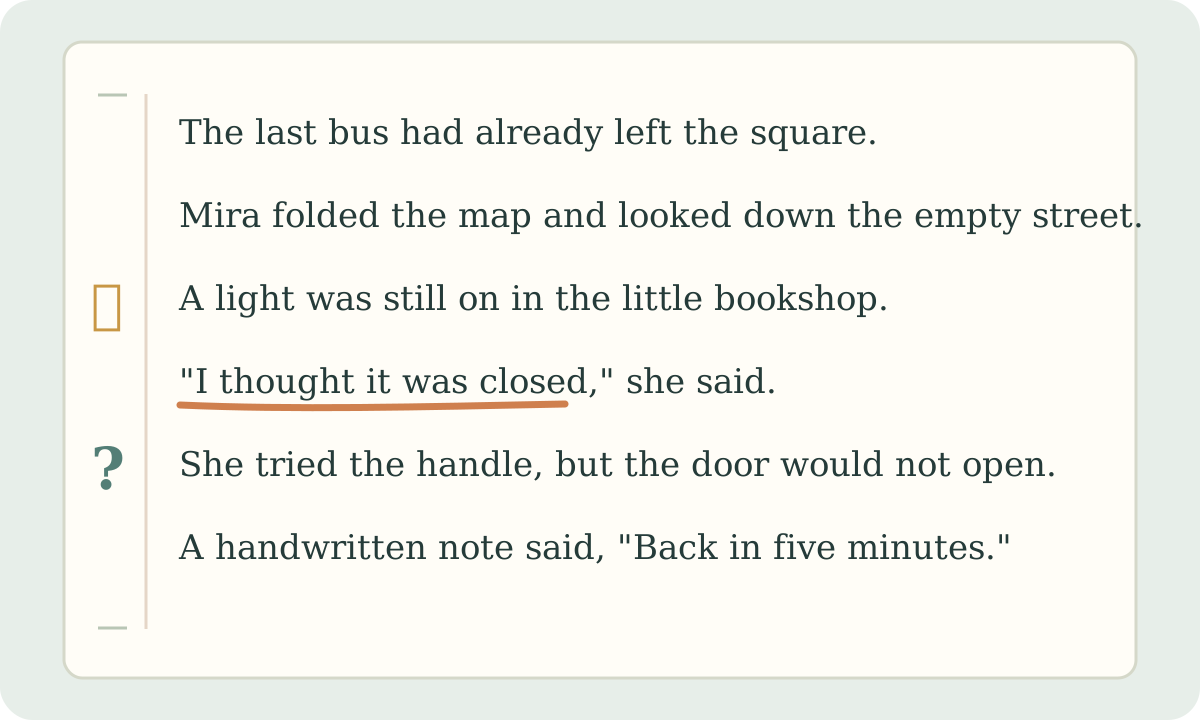
The star beside line three preserves the image of the one lit shop on an empty street. The underline in line four picks out I thought it was closed, a short phrase you could use yourself. The question mark beside line five records a moment of confusion: why is a lit shop locked? Line six offers an answer, so you can leave that question in the book instead of copying it into your notebook. A mark does not automatically become a study item.
Run one session in order
Here is one 15-minute session to try. Adjust the number of pages to the book, but decide where to stop before opening a dictionary. The Extensive Reading Foundation’s guide stresses books that readers can understand and enjoy, with enough continuity to keep reading.
| Time | Action | On the sample page |
|---|---|---|
| 1 minute | Choose a stopping point: five pages or the end of a scene | Decide to finish all six lines |
| 10 minutes | Read for the gist; make only the three kinds of marks | Mark lines three, four, and five, then read line six |
| 3 minutes | Review the marks and select one to three sentences | Keep lines four and three; the question on line five is resolved |
| 1 minute | Say the chosen sentences aloud | Say I thought it was closed once |
The next day, open the note before starting a new section. Hide the English for a moment and recall the scene and meaning. If you cannot, return to the source page and read the line before and after the sentence. Putting the note where your next reading session begins makes it easier to actually reopen it.
Turn the marks into a small note
One to three sentences is a practical guideline for keeping the note short. You can keep one, two, or none on a day when nothing is useful. In this example the question mark is resolved, so only the underlined phrase and starred scene remain.
Record four things together: English sentence / meaning in this scene / source and page or location / why you kept it. p.1 below is a practice page number for this original mini-scene.
Example note 1
- English sentence:
"I thought it was closed," she said. - Meaning in the scene: Mira expected the shop to be closed
- Source: Original mini-scene “Mira’s Bookshop,” p.1, line 4
- Why I kept it: I can reuse
I thought ...
Example note 2
- English sentence:
A light was still on in the little bookshop. - Meaning in the scene: The shop was lit on the empty street
- Source: Original mini-scene “Mira’s Bookshop,” p.1, line 3
- Why I kept it: It brings back the setting
For a real book, use the title and its printed page number or the location shown by your e-book app. Write a reason such as “I might say this” or “the character changed her mind” in one line. If your real question is whether to look up an unfamiliar word, use our unknown words guide; this note is for what you decide to keep after reading.
Copy this template for the next session:
Note template
- English sentence:
- Meaning in the scene:
- Source (title + page/location):
- Why I kept it (one line):
Choose marks for the book you have
| Medium | While reading | How to return | Useful choice |
|---|---|---|---|
| Your paper copy | Start with pencil: underline, ?, and ★. Pen is permanent; reserve a highlighter for a single sentence you have chosen | Use a tab at the page edge to find the pencil marks | Best when you want to revise your mark system |
| Library or borrowed copy | Write the mark on a removable tab. If tabs are unsuitable, put the page number and first few words on a slip of paper | Open the page from the slip and locate the line | Keeps the borrowed page clear |
| Kindle | Highlight a short sentence; add a brief note for a question | Open the book’s notes or annotations list and jump back | Makes highlights available together |
| Other e-book apps | Use a highlight or note if that app offers one; otherwise record chapter and location separately | Use its annotation list or your location note | Avoid assuming every app has the same controls |
If you use two colors on paper, try orange for a phrase to say and blue for a question to check. Keep the star in pencil. Highlighting a whole paragraph makes you reread it just to choose a sentence later. Start with a short underline.
Amazon’s Kindle overview describes highlights, notes, and finding annotations again. The labels vary by device. Open the notes or annotations view once and check that you can get from a highlight back to its place in your current book. For another e-book app, inspect its own controls; if you cannot find a notes list, record the chapter and location in your separate note.
Fix the four ways notes stall a book
| What happens | Change for the next session |
|---|---|
| Almost every line is marked | Return to a five-mark limit. If you cannot follow any page, test an easier book with the first book guide |
| Copying stops the story | Put only a mark and page number in the book; reserve the three minutes after reading for transfer. Keep just one sentence if the note runs long |
| You never reopen the notebook | Say the previous sentence before opening the next chapter. Keep only notes whose source page you can find |
| You cannot explain an old mark | Keep underline, ?, and ★ consistent; add a one-line reason in the note and page number on any tab |
If translation is needed to follow the scene, use our bilingual books guide for that separate reading method. Here, adjust only what you mark while reading and what you save after it.
Say the sentence, then revisit it
Look at the first note and say I thought it was closed. Try changing the place: I thought the café was closed. The next day, imagine when you would say “I thought it was closed,” then check the original sentence and scene.
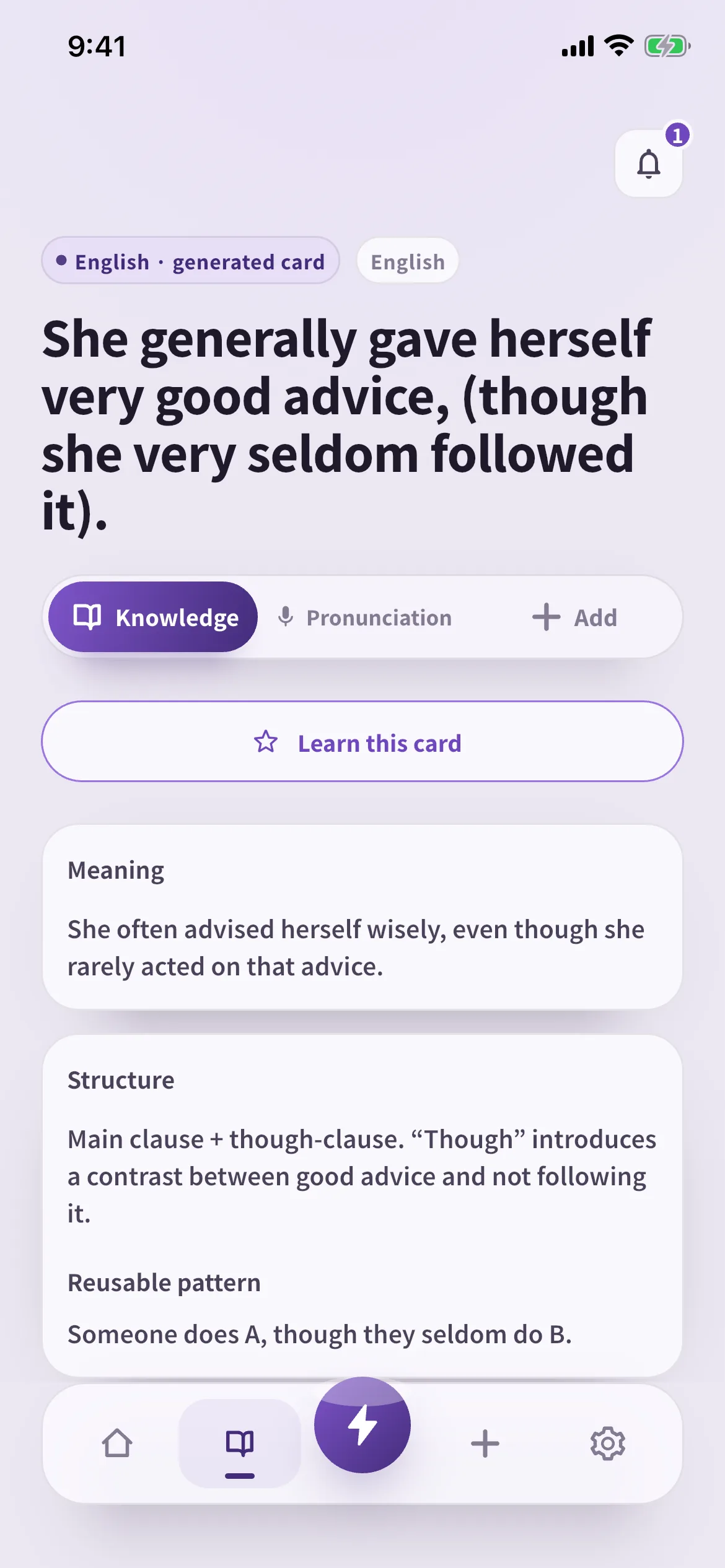
In SpeakGain, which we develop, you can type a short sentence yourself, listen to generated English audio, say it aloud, and revisit its card later. Recording for an online pronunciation assessment is optional. SpeakGain does not automatically import or scan book text; use it after you choose the sentence, not while you are trying to read the page.
Frequently asked questions
Can I write directly in a book?
Try pencil in your own copy first. If you want clean pages, write the same underline, ?, or ★ on a removable tab beside the line. For a borrowed copy, record page number and opening words on a slip of paper instead.
Should I copy every English sentence?
Not when your goal is to keep a story moving. Finish the section, then copy only one to three sentences from your underline or star, along with context and source. A close-reading assignment is a different task and may need its own detailed notes.
Is paper or an app better for notes?
Choose the one you will open before the next session. Paper sits beside the book; a searchable app can help you retrieve a phrase or title later. In either case, keep the same four fields, and type only a sentence you want to speak into SpeakGain.
In short
For your next session, choose 15 minutes and no more than five marks. Use underline, ?, and ★ consistently; select one to three sentences after reading, say them aloud, and open the note before tomorrow’s reading.
For specific titles, compare our six beginner English books and editorial verdicts.
Sources
- Extensive Reading Foundation, Guide to Extensive Reading.
- Amazon, Kindle for Web.