
S and es pronunciation: hear /s/, /z/ and /ɪz/ in real sentences
Published
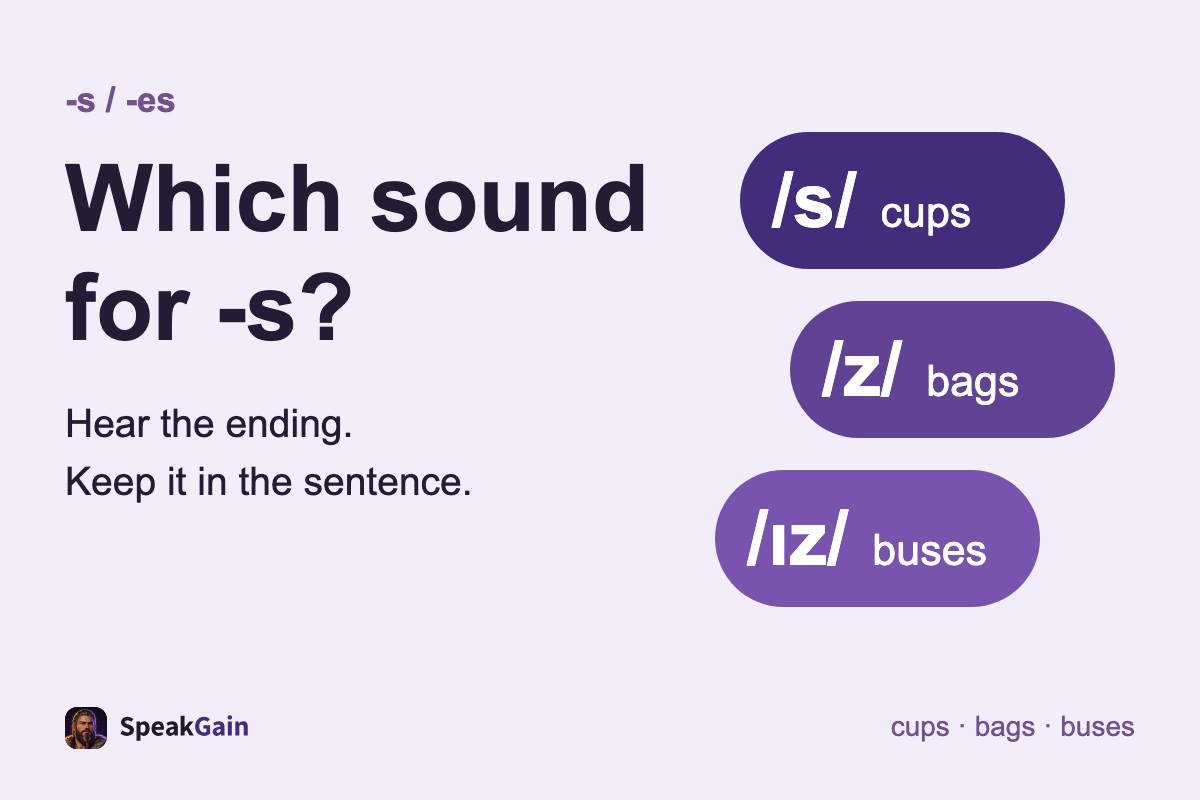
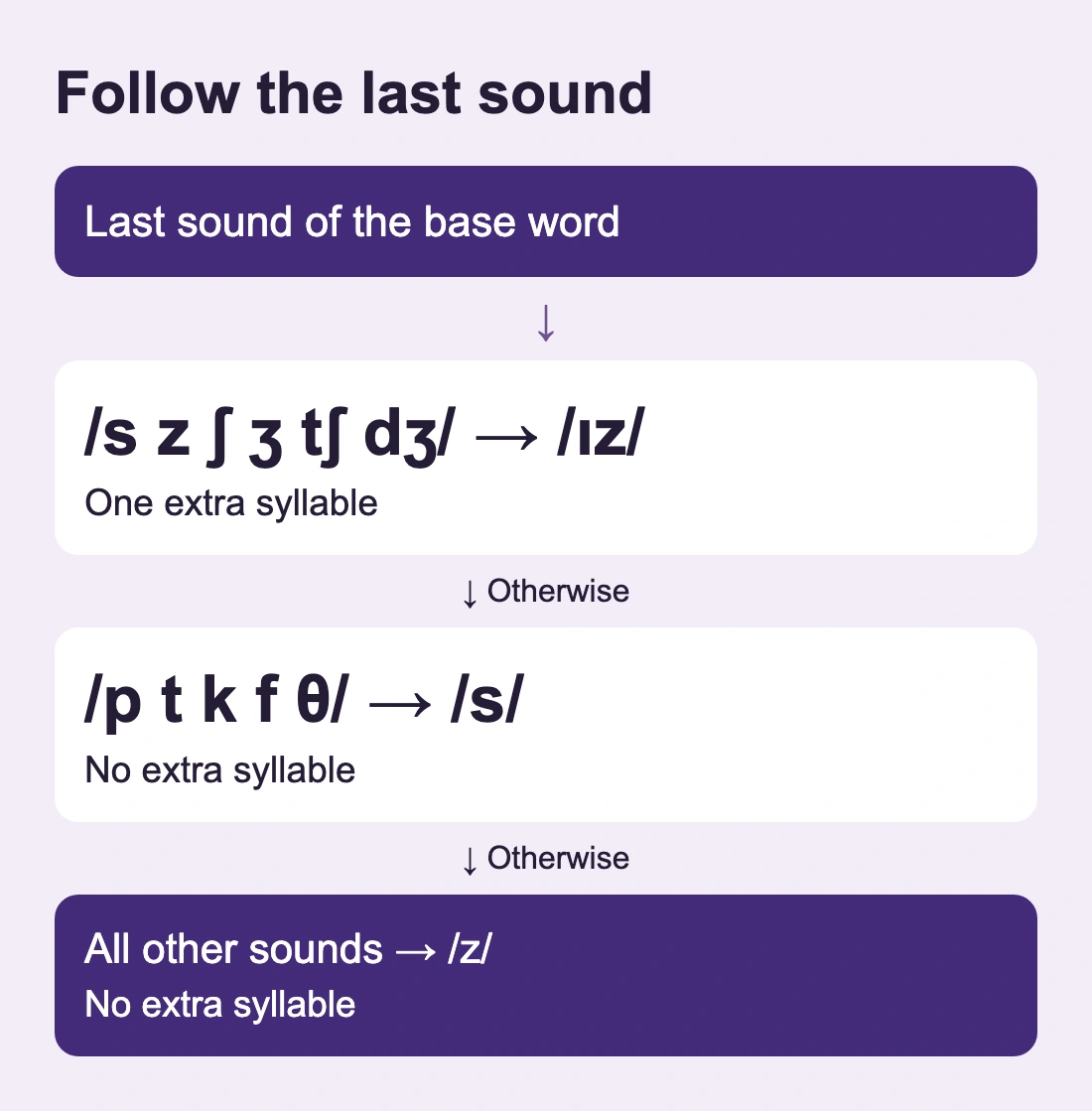
Plural and third-person -s/-es has three pronunciations, chosen by the base word’s last sound, not its last letter. Use /ɪz/ and add a syllable after /s, z, ʃ, ʒ, tʃ, dʒ/; use /s/ after other voiceless consonants and /z/ after other voiced sounds and vowels. If the spelling is misleading, check the dictionary before putting the word into a short sentence.
Start with a listening prediction
Read the twelve words aloud and label their endings /s/, /z/ or /ɪz/. Leave a question mark beside any guess: the three sound workshops below explain what to listen for. Open the answers when you are ready; the recording follows the printed word order.
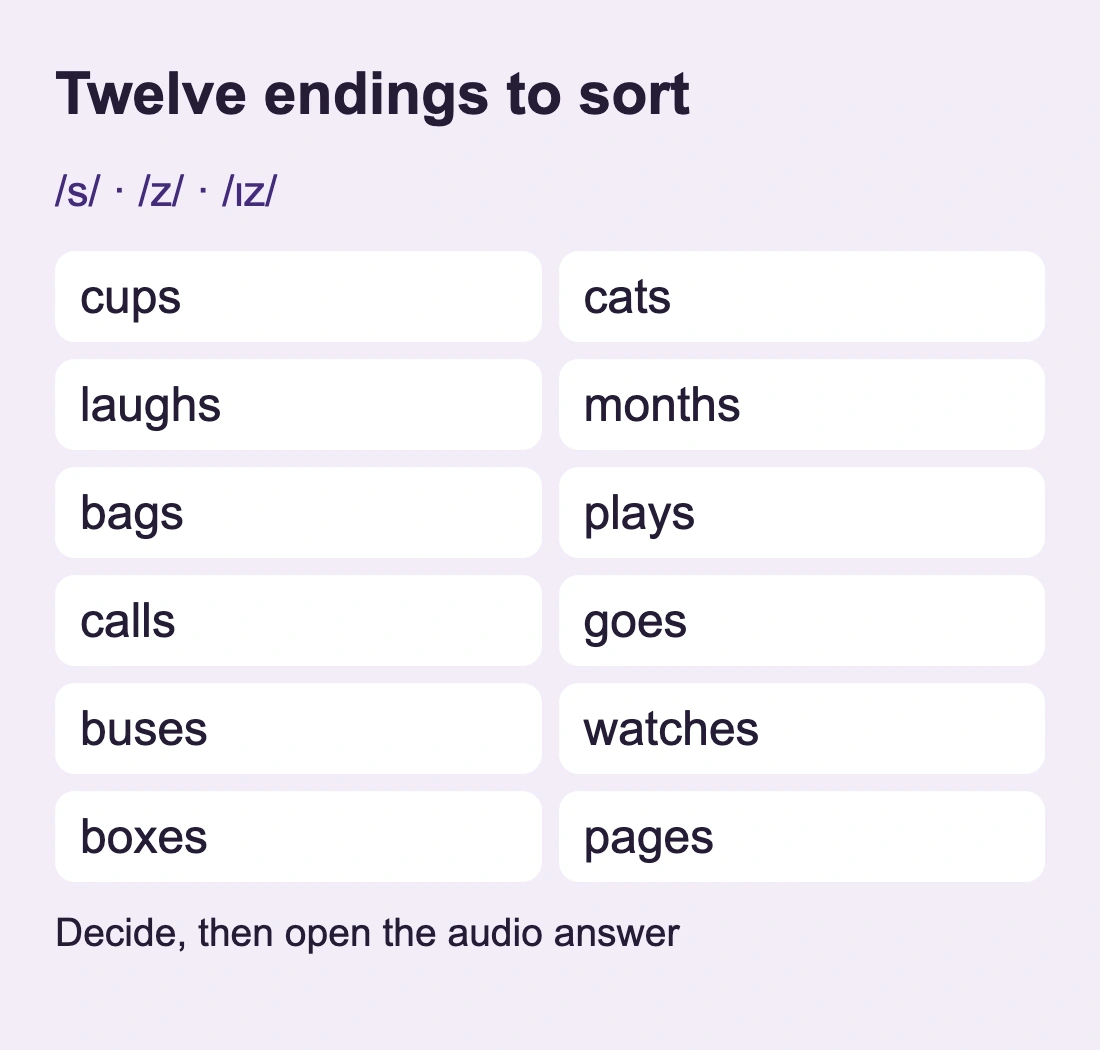
cups · cats · laughs · months · bags · plays · calls · goes · buses · watches · boxes · pages
Show answers and audio
/s/: cups, cats, laughs, months.
/z/: bags, plays, calls, goes.
/ɪz/: buses, watches, boxes, pages.
Show answers and audio
Your route through the three sounds
Use this map to investigate your question marks. Oxford’s suffix entry puts the six sibilants in their own group, so bus does not belong with the other voiceless endings. Work through /ɪz/ first, then compare the two short endings.
/ɪz/: make room for the extra syllable
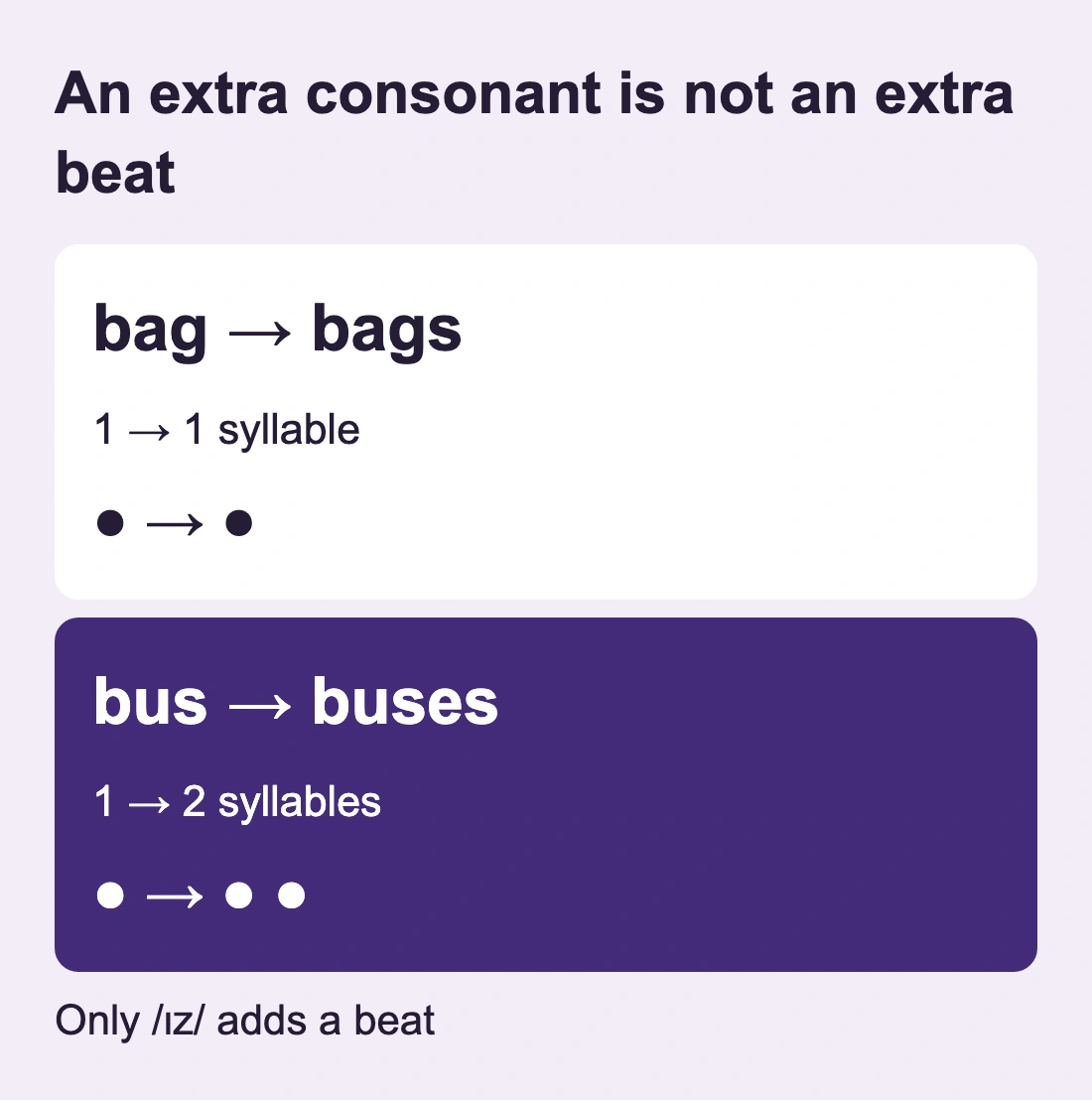
boxes, places and pages arrive here by different spellings: x ends in /s/, ce represents /s/, and ge represents /dʒ/. Each needs /ɪz/. Say bus → buses, then bag → bags: only the first pair grows by a syllable. In Iowa State §5.3, look for [əz] when comparing this long ending with Oxford’s /ɪz/. Both sources distinguish it from a consonant added without a new syllable.
In the first clip, listen for Liz’s and boxes around the short ending in cups. In the second, watches and laughs put the long and short endings in the same sentence. The sentence and answer clips are synthetic speech from SpeakGain’s Deep-voiced Viking character. They are AI audio, not recordings of a person; the linked dictionaries supply word-level pronunciation models.
Liz’s cups are next to the boxes.
Two long endings with a short plural between them.
Liz’s, boxes /ɪz/; cups /s/; link cups‿are.
Listen to sentence
She watches the news and laughs.
A third-person verb with a long ending and one with a short ending.
watches /ɪz/; news has lexical /z/, not a plural suffix; laughs /s/.
Listen to sentence
/s/: finish the consonant cluster
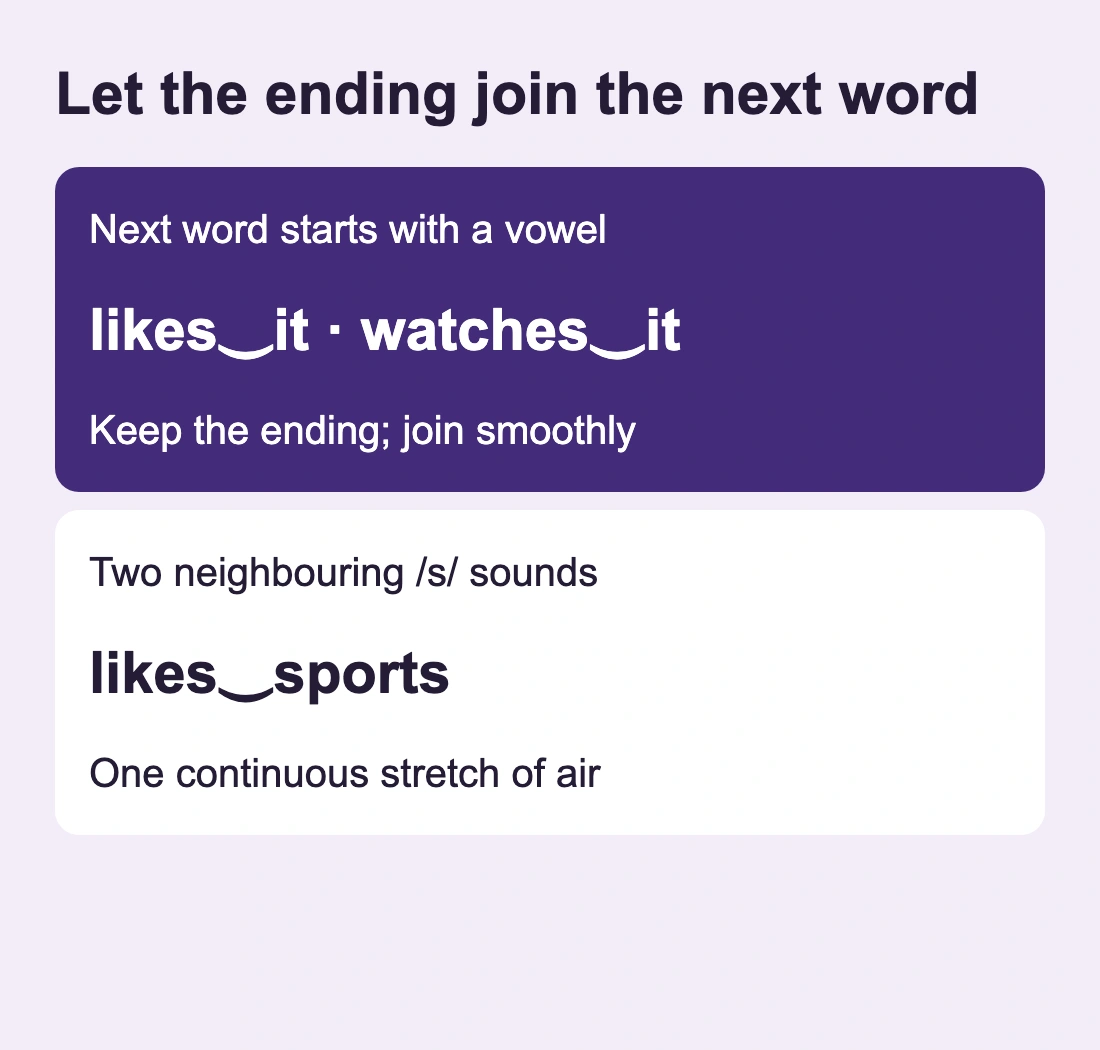
For laughs, the useful clue is the /f/ represented by gh. For months, it is /θ/. Both take /s/, just like cups and cats. Say cup → cups without giving the ending a separate beat, then try likes inside the next sentence.
Rest a finger lightly on your throat and sustain /s/, then /z/: /z/ has vibration. The short ending after /p, t, k, f, θ/ is /s/; after voiced sounds outside the extra-syllable group it is /z/. For a fuller demonstration, see the voicing check in our -ed guide.
He likes it a lot.
A short ending linking to a vowel.
likes /s/; link likes‿it.
Listen to sentence
Keep likes‿it together as you say the whole line. Compare watches‿it: the link uses the final /z/, after the extra syllable already in watches. When practising likes sports, let one continuous /s/ connect the words. These are applications of Iowa State’s C–V and identical-consonant linking. A word boundary need not interrupt the ending that signals number or person.
/z/: goes is short, and says changes its vowel
Does written es always add /ɪz/? goes answers that question: go ends in a vowel, so /ɡəʊz/ remains one syllable. bags, plays and calls also take /z/. With says /sez/ and does /dʌz/, the ending is straightforward but the base vowel changes. Hear them together, then contrast goes with the two-syllable houses in the next clip.
She says he does it well.
Two changed vowels with short /z/ endings.
says, does /z/; link does‿it.
Listen to sentence
The bus goes past two houses.
A written es that stays short, beside a plural that adds a syllable.
bus is the base word; goes /z/; houses /ɪz/.
Listen to sentence
What about Mike’s, Liz’s, it’s and he’s?
Possessive Mike’s takes /s/, Liz’s takes /ɪz/, and my sister’s takes /z/. The preceding sound still decides. Iowa State covers plurals, possessives and third-person verbs together. For contractions of is/has, compare Oxford’s it’s /ɪts/ with the strong form of he’s /hiːz/. Those examples fit the same sound pattern; context, rather than the /s/–/z/ distinction, tells you whether ’s means is or has.
My sister’s bags are in the car.
A possessive ending and a plural ending, both /z/.
sister’s /z/; bags /z/; link bags‿are.
Listen to sentence
A dictionary desk for nine troublesome forms
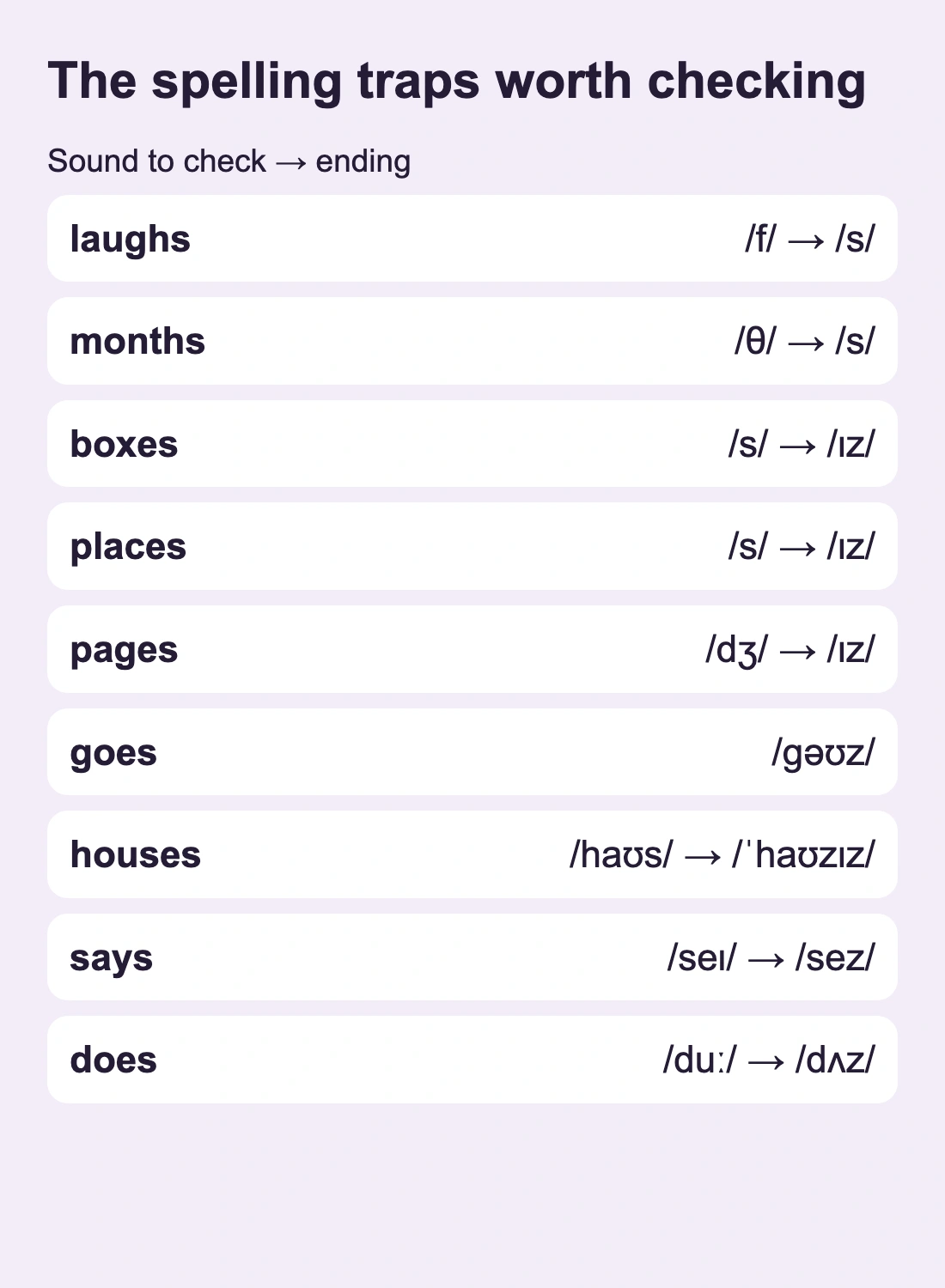
The links below let you check the base and, where supplied, the changed form side by side. houses /ˈhaʊzɪz/ needs particular attention because the stem’s /s/ becomes /z/. A mnemonic for final letters cannot explain that change or the vowels in says and does. The vowel symbols here follow Oxford’s British entries. Its American recordings may sound different in words such as laugh and box while keeping the ending groups shown here.
| Base → ending form | Sound to check → ending |
|---|---|
| laugh → laughs |
/lɑːf/ → /s/ gh represents /f/, so add /s/. |
| month → months |
/mʌnθ/ → /s/ th here represents /θ/, so add /s/. |
| box → boxes |
/bɒks/ → /ɪz/ x represents /ks/: final /s/ takes /ɪz/. |
| place → places |
/pleɪs/ → /ɪz/ ce represents /s/, so add /ɪz/. |
| page → pages |
/peɪdʒ/ → /ɪz/ ge represents /dʒ/, so add /ɪz/. |
| go → goes |
/ɡəʊ/ → /z/ Written es, but /ɡəʊz/ is one syllable. |
| house → houses |
/haʊs/ → /ɪz/ /haʊs/ → /ˈhaʊzɪz/: the stem changes too. |
| say → says |
/seɪ/ → /z/ /seɪ/ → /sez/: the vowel changes; the ending is /z/. |
| do → does |
/duː/ → /z/ /duː/ → /dʌz/: the vowel changes; the ending is /z/. |
Turn one workshop into a recorded comparison
Choose the clip in which your ending disappears or gains an unwanted syllable. Record two takes on your phone: the base–ending pair alone, then its sentence. Replay the part where the word meets its neighbour; decide whether the problem is the chosen ending, its syllable count or the transition. That gives the next attempt a specific target.
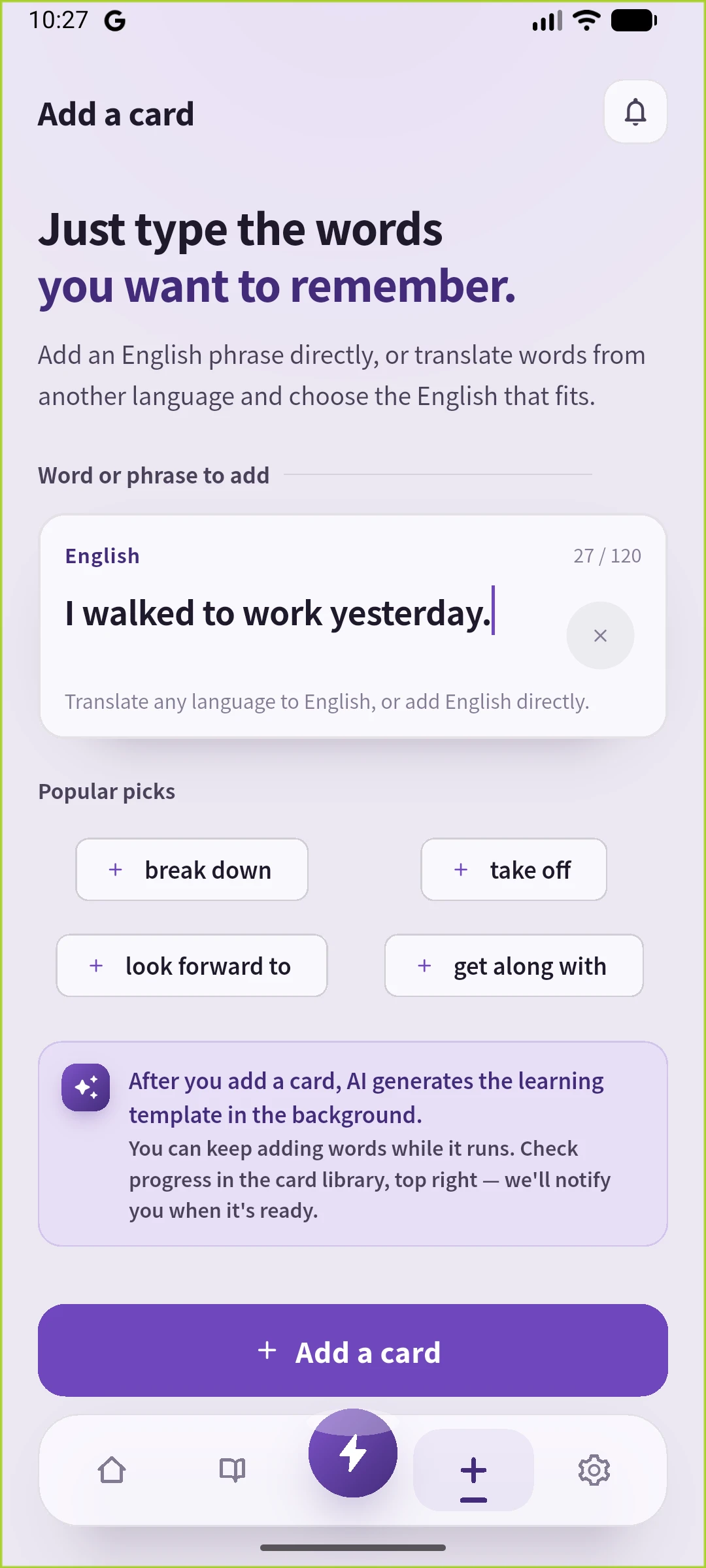
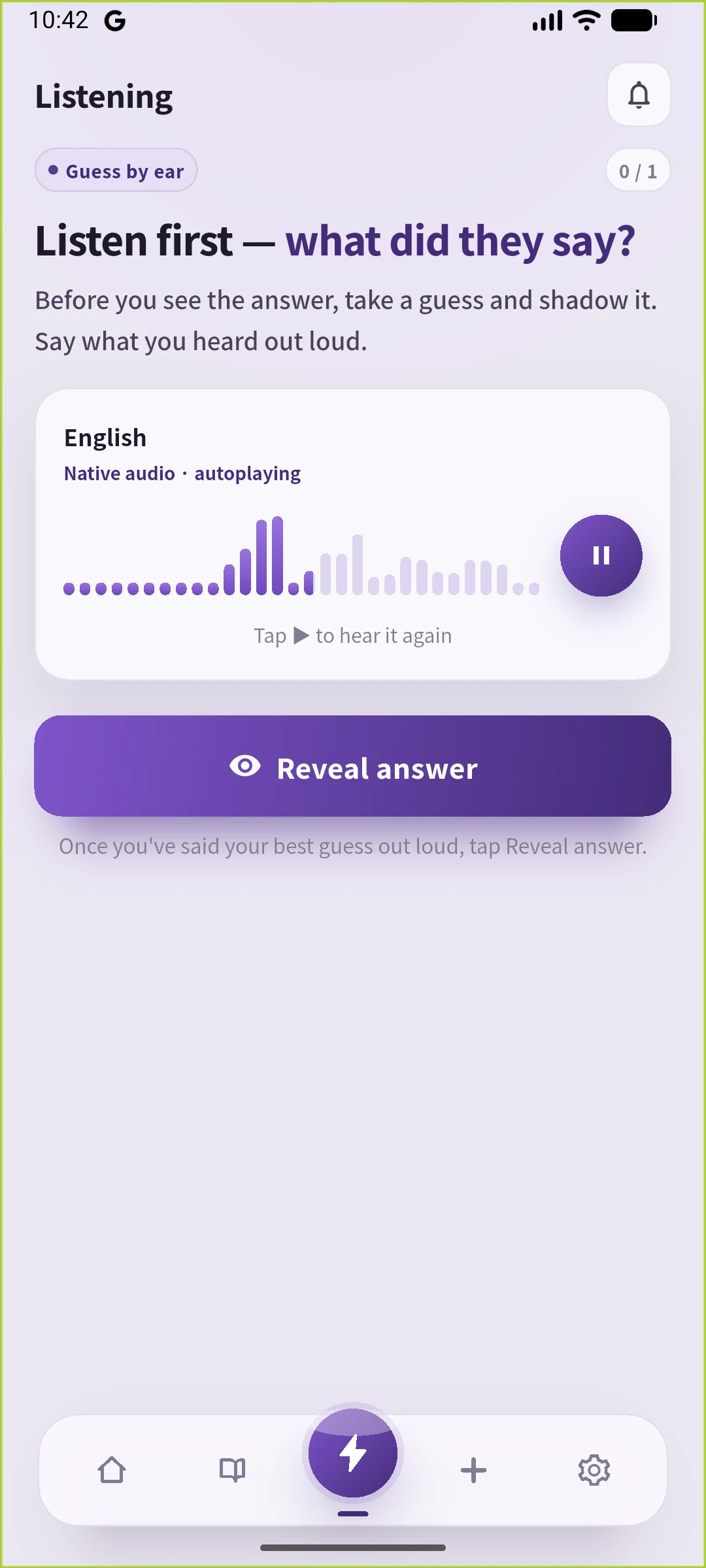
For a sentence you want to revisit, our app SpeakGain provides a place to keep it. Add the English line as a card, then open its listening practice to hear a character voice before speaking. The two screens below show those operations. Record and check can supply feedback on individual words; a score does not certify correct pronunciation. Later reviews appear on an FSRS schedule, so the saved line can return for another attempt.
The three checks work together: choose the sound, keep the right number of syllables, and carry the ending through the sentence. Return to the opening predictions and say the uncertain words once more.