
-ed pronunciation: /t/, /d/ or /ɪd/? Decide by sound, then say a sentence
Published
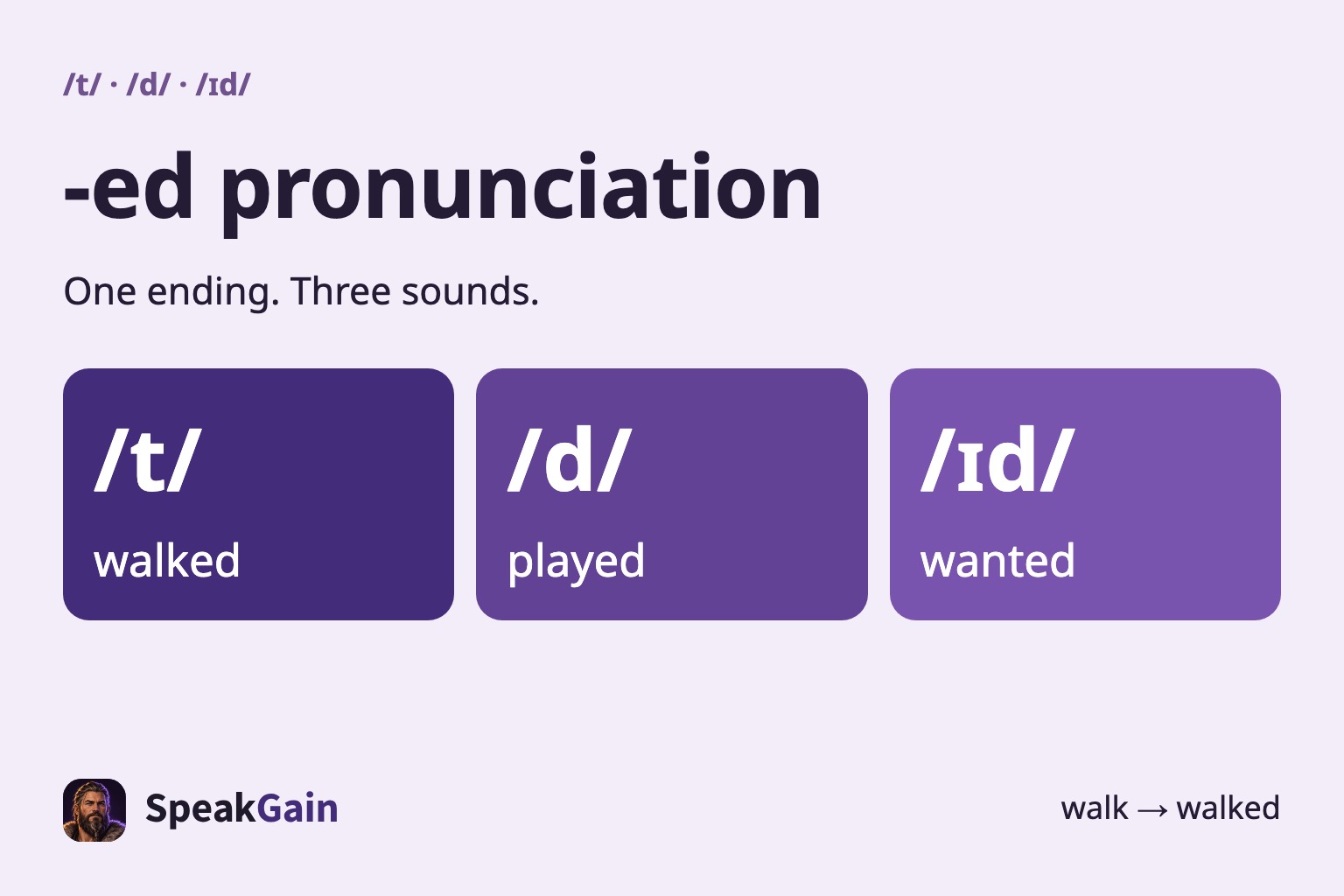
Regular verb -ed pronunciation depends on the last sound of the base verb, not its last letter: after /t/ or /d/, use /ɪd/ and add a syllable; after other voiceless sounds, use /t/; after other voiced sounds and vowels, use /d/. Compare wanted and needed with helped, watched and laughed, then played, called and lived. Say the base verb first, check its final sound, and practise the whole past-tense sentence.
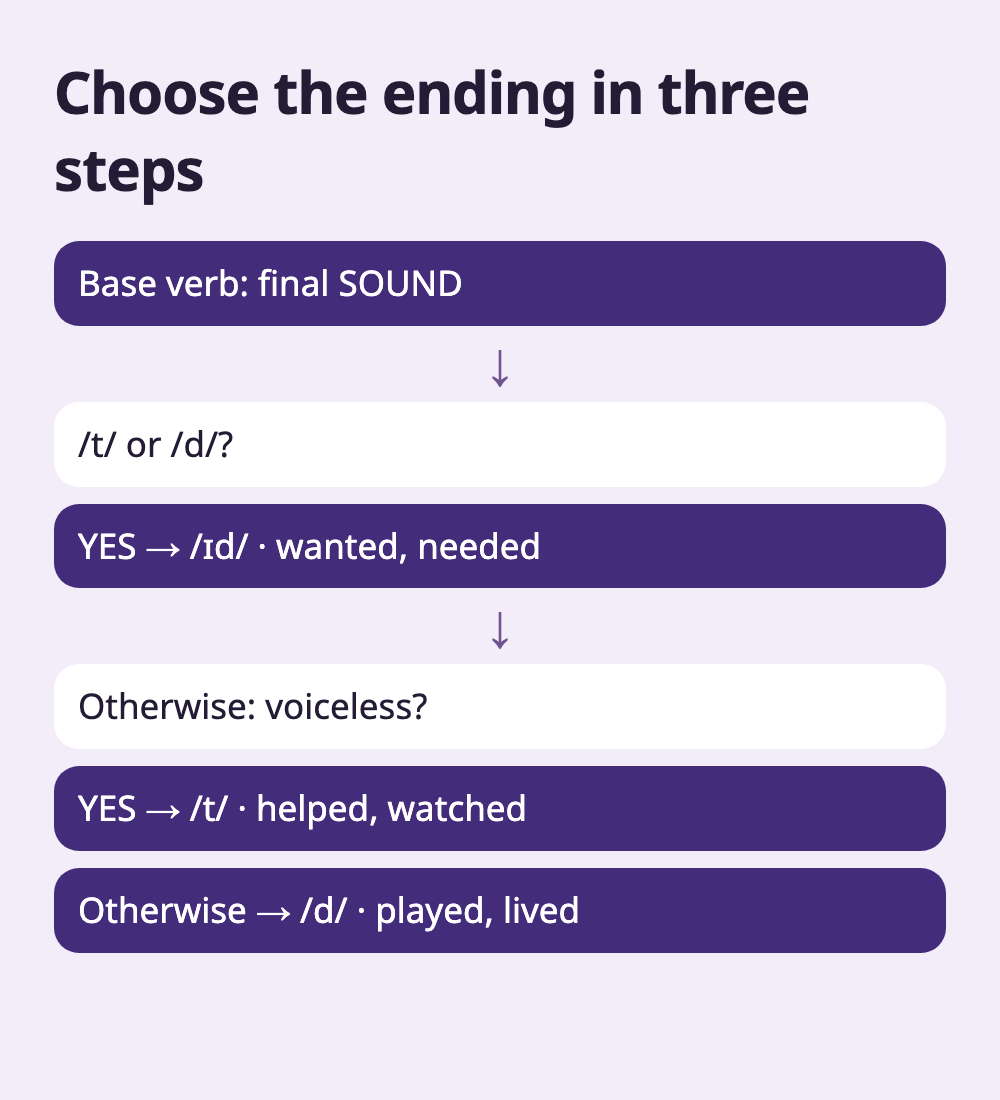
Choose the ending in three steps
Start with the base verb. Ask whether its final sound is /t/ or /d/ before asking about voicing. The three rows below describe regular past forms and regular past participles. Iowa State’s endings chapter gives this sound-based distinction; it transcribes the extra vowel as [ə], while this guide uses the familiar learner notation /ɪd/. The important first check is whether a syllable is added.
Feel voicing without adding a vowel
Rest two fingers lightly on your throat and alternate a long /s/ and /z/. For /z/, feel vibration; /s/ is airflow without that voicing. Keep the vowel out of the test: saying a letter name would test its vowel as well. For a short stop, vibration can be harder to feel, so check the dictionary audio instead of forcing a result. Iowa State’s consonant chapter explains voicing. This throat check is a practical cue, not a pronunciation score.
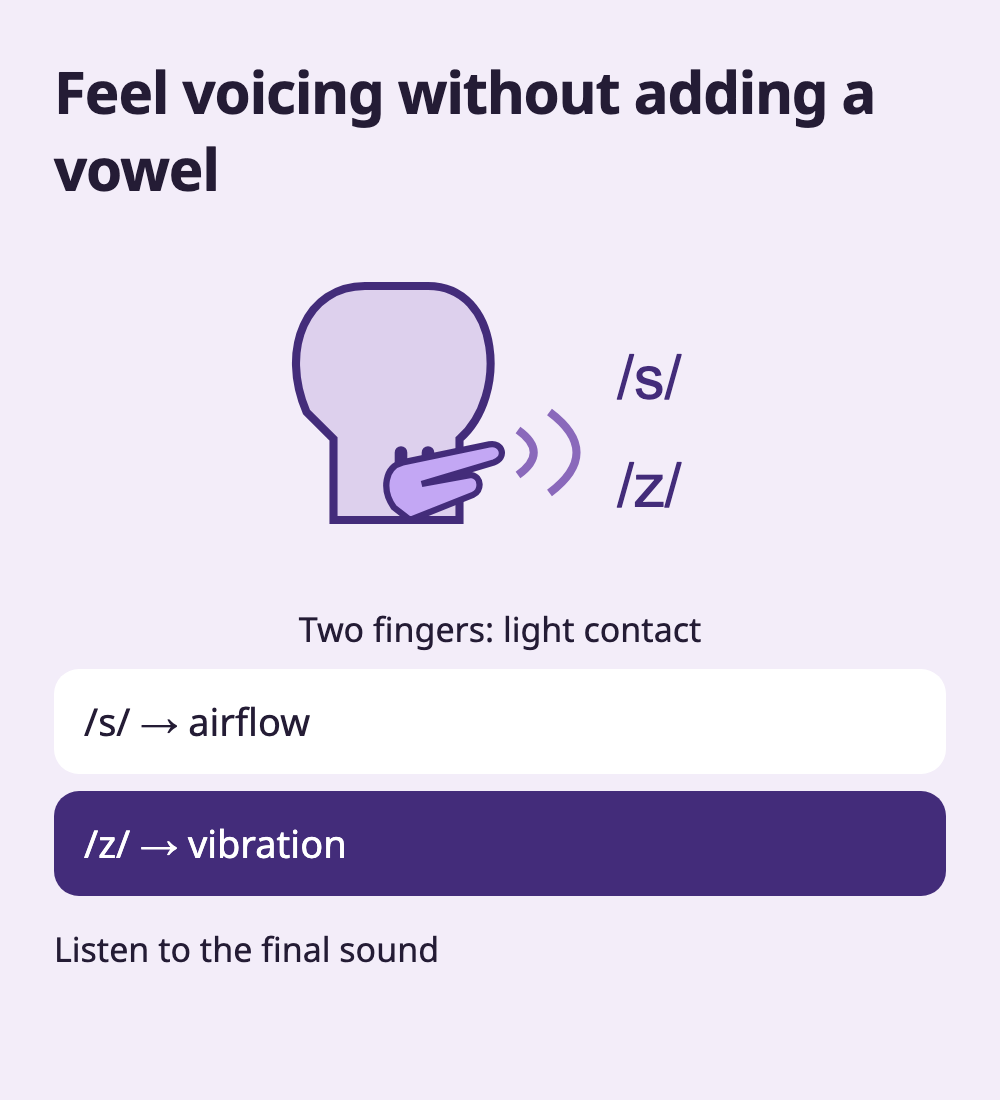
Notice the last sound in help /help/, watch /wɒtʃ/ and laugh /lɑːf/: /p/, /tʃ/ and /f/ are voiceless. Play /pleɪ/ ends in a vowel; call /kɔːl/ and live /lɪv/ end in voiced consonants. Do not whisper the whole word to decide: whispering removes the contrast you are checking.
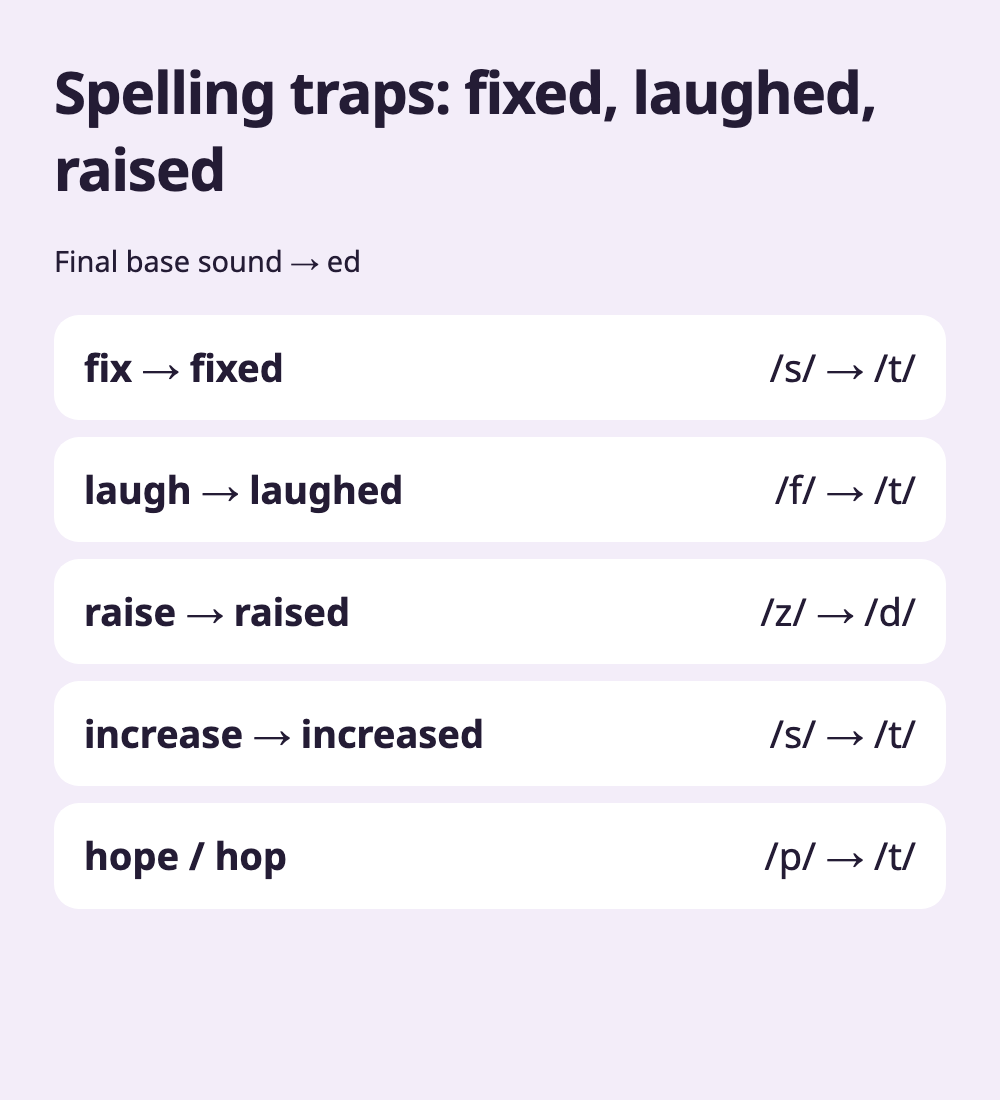
Spelling traps: fixed, laughed, raised
Read the base-form IPA before choosing the ending. These are regular verbs, including the words whose spelling looks misleading. Word forms and IPA were checked in the Oxford learner’s dictionary. The table uses British vowel notation; the ending choices are the same for these US forms.
| Base → past | Final base sound → ed / IPA |
|---|---|
| fix → fixed |
/s/ → /t/ /fɪkst/ |
| laugh → laughed |
/f/ → /t/ /lɑːft/ |
| raise → raised |
/z/ → /d/ /reɪzd/ |
| increase → increased |
/s/ → /t/ /ɪnˈkriːst/ |
| hope → hoped |
/p/ → /t/ /həʊpt/ |
| hop → hopped |
/p/ → /t/ /hɒpt/ |
The x in fix represents /ks/, so its last sound is /s/. The gh in laugh represents /f/. Raise ends in /z/ but the verb increase ends in /s/: the similar written se does not give the same ending. Hoped and hopped both take /t/ after /p/; doubling p changes the spelling pattern, not this ending rule.
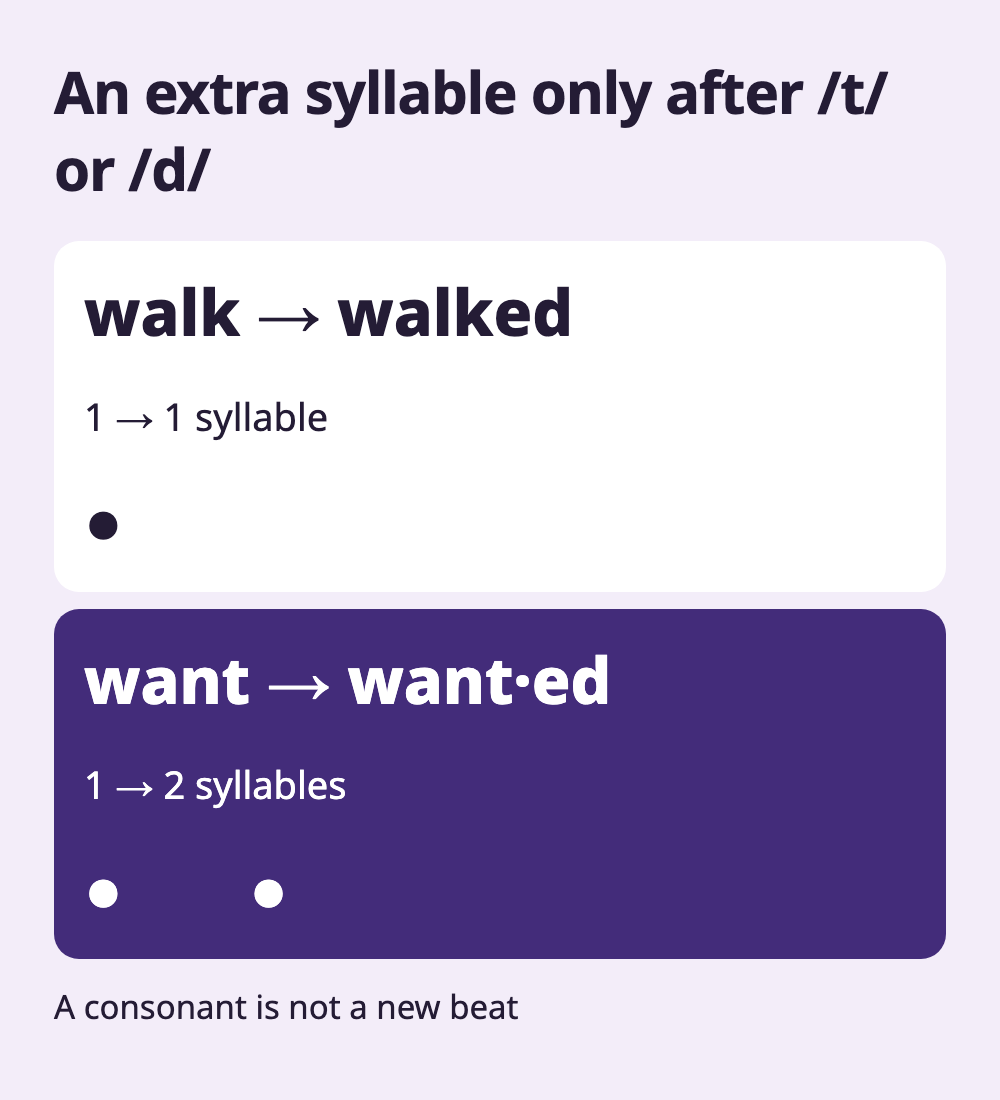
An extra syllable only after /t/ or /d/
Tap once for walk /wɔːk/ and once for walked /wɔːkt/. Then tap once for want /wɒnt/ but twice for wanted /ˈwɒntɪd/. An ending sound can be present without becoming a separate beat. Do not add a vowel between /k/ and /t/ in walked just to make the ending easier.
Adjectives need a meaning check
Do not apply the regular-verb shortcut to every word written with ed. Check the meaning and part of speech in the dictionary. The following are adjective readings; they do not all behave alike.
| Word / meaning | Pronunciation |
|---|---|
| naked · without clothes | /ˈneɪkɪd/ |
| wicked · evil | /ˈwɪkɪd/ |
| crooked · not straight | /ˈkrʊkɪd/ |
| ragged · torn or uneven | /ˈræɡɪd/ |
| beloved · dearly loved | /bɪˈlʌvɪd/ /bɪˈlʌvd/ |
| learned · scholarly | /ˈlɜːnɪd/ |
| learned · acquired / verb past | /lɜːnd/ |
| aged · old | /ˈeɪdʒɪd/ |
| aged · of a stated age | /eɪdʒd/ |
Beloved allows both readings as an adjective. Learned meaning scholarly has two syllables, but learned behaviour has /d/, just like the past verb learned. Aged meaning old has two syllables; the age-label use has /eɪdʒd/. Meaning matters even when the word class stays the same.
Keep the ending when words join
In played‿it, continue from the final /d/ into the next vowel without an unnecessary pause. Try walked‿out in the same way. Before another consonant, as in walked to work, the ending may be much less distinct; casual speech can even delete /t/ or /d/ in a cluster. This is a listening observation, not an instruction to erase every ending. Iowa State stresses keeping the grammatical information; its connected-speech chapter explains linking.
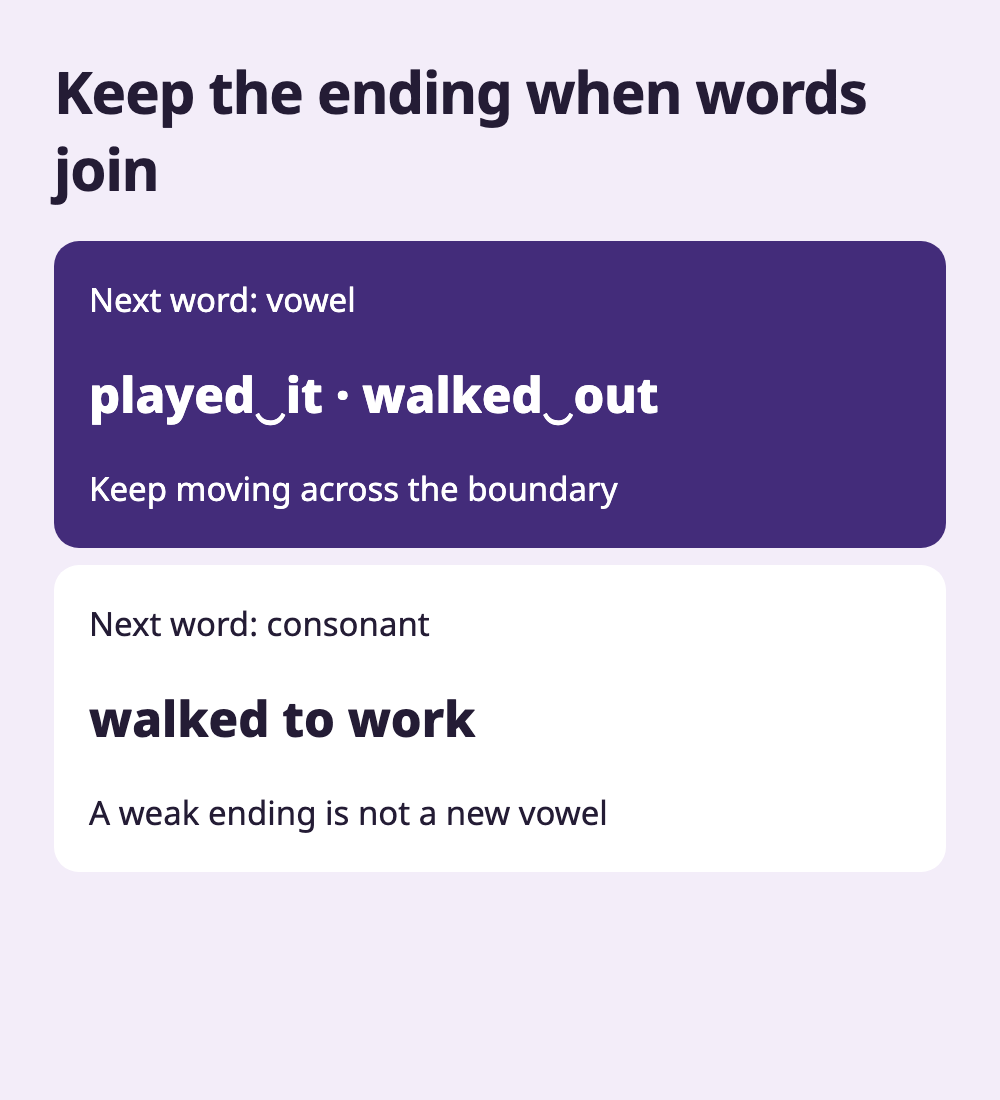
Practise slowly with the ending present, then connect the words at a comfortable pace. A very loud release after every /t/ is unnecessary. For the wider topic, see our connected-speech guide.
Six original sentences to hear and say
First say play → played, walk → walked and want → wanted; then say the complete lines with their time expressions. The recordings are AI-generated SpeakGain Deep-voiced Viking audio, shared across all language editions, not human native-speaker recordings. Use dictionary audio for an isolated word and these clips for the sentence transition.
1. I walked to work yesterday.
walked: /t/; keep the ending before to.
Listen to sentence 1
2. We played it again last night.
played: /d/; connect played‿it.
Listen to sentence 2
3. She wanted a quiet table yesterday.
wanted: /ɪd/; two syllables.
Listen to sentence 3
4. I fixed it and laughed at the result.
fixed, laughed: /t/; connect fixed‿it and laughed‿at.
Listen to sentence 4
5. They called and raised the price last week.
called, raised: /d/; connect called‿and.
Listen to sentence 5
6. We needed help and waited outside yesterday.
needed, waited: /ɪd/; connect waited‿outside.
Listen to sentence 6
Test yourself: sort twelve endings
Before opening the answer, place each word in /t/, /d/ or /ɪd/. Say its base verb and explain your choice. The image and text list show the same twelve words; the answer audio reads them in that order.
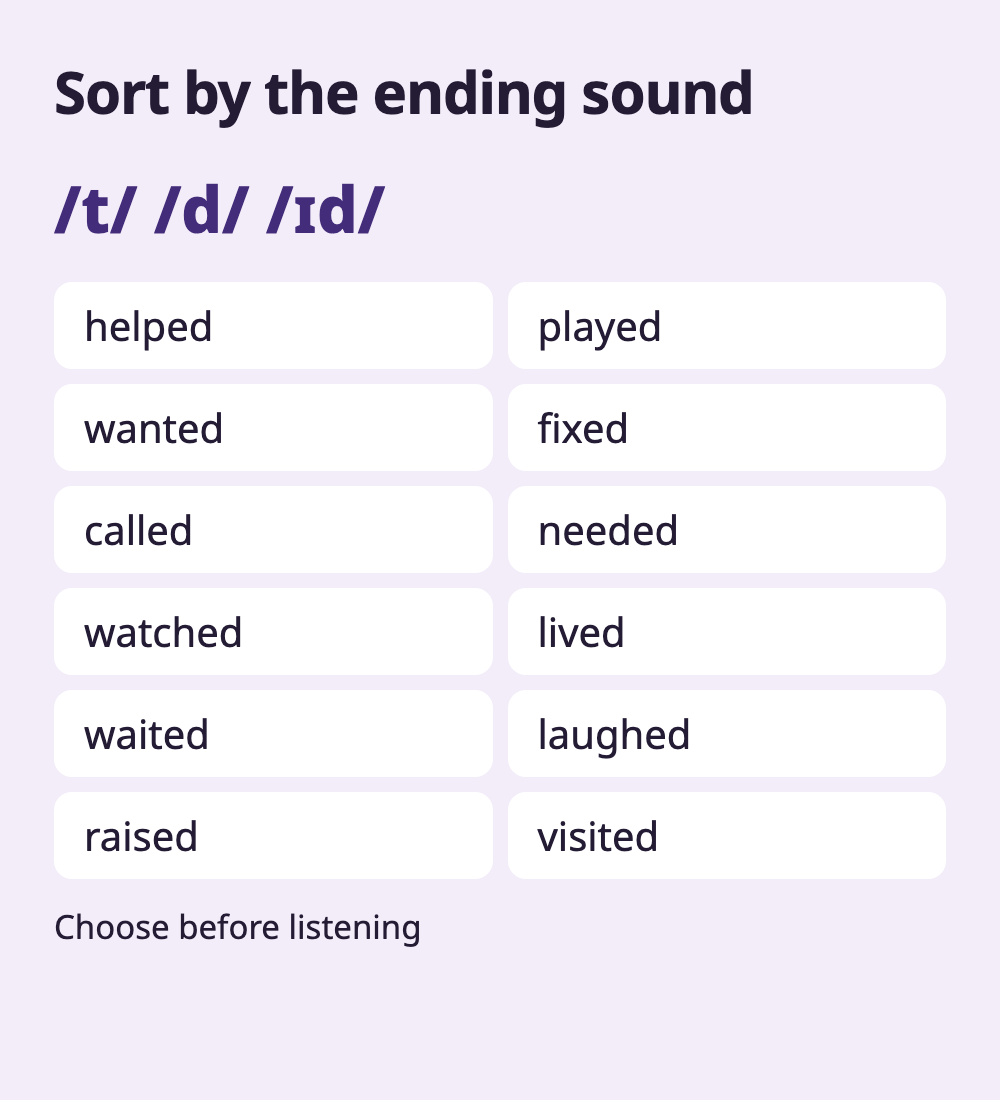
helped · played · wanted · fixed · called · needed · watched · lived · waited · laughed · raised · visited
Show the answer and listen
/t/: helped, fixed, watched, laughed.
/d/: played, called, lived, raised.
/ɪd/: wanted, needed, waited, visited.
Show the answer and listen
If a choice was wrong, write the base verb’s last sound beside it. If the category was right but you added an extra syllable, practise the word inside its sentence. Keep only the missed words for the next round.
Save only what still needs practice
Try this sequence: listen → say → record → compare → choose one repair. Compare the number of syllables and the transition into the next word, not just how strongly the last consonant pops. An ordinary phone recorder works. Save a second take only after choosing a specific change, such as keeping walked to one syllable.
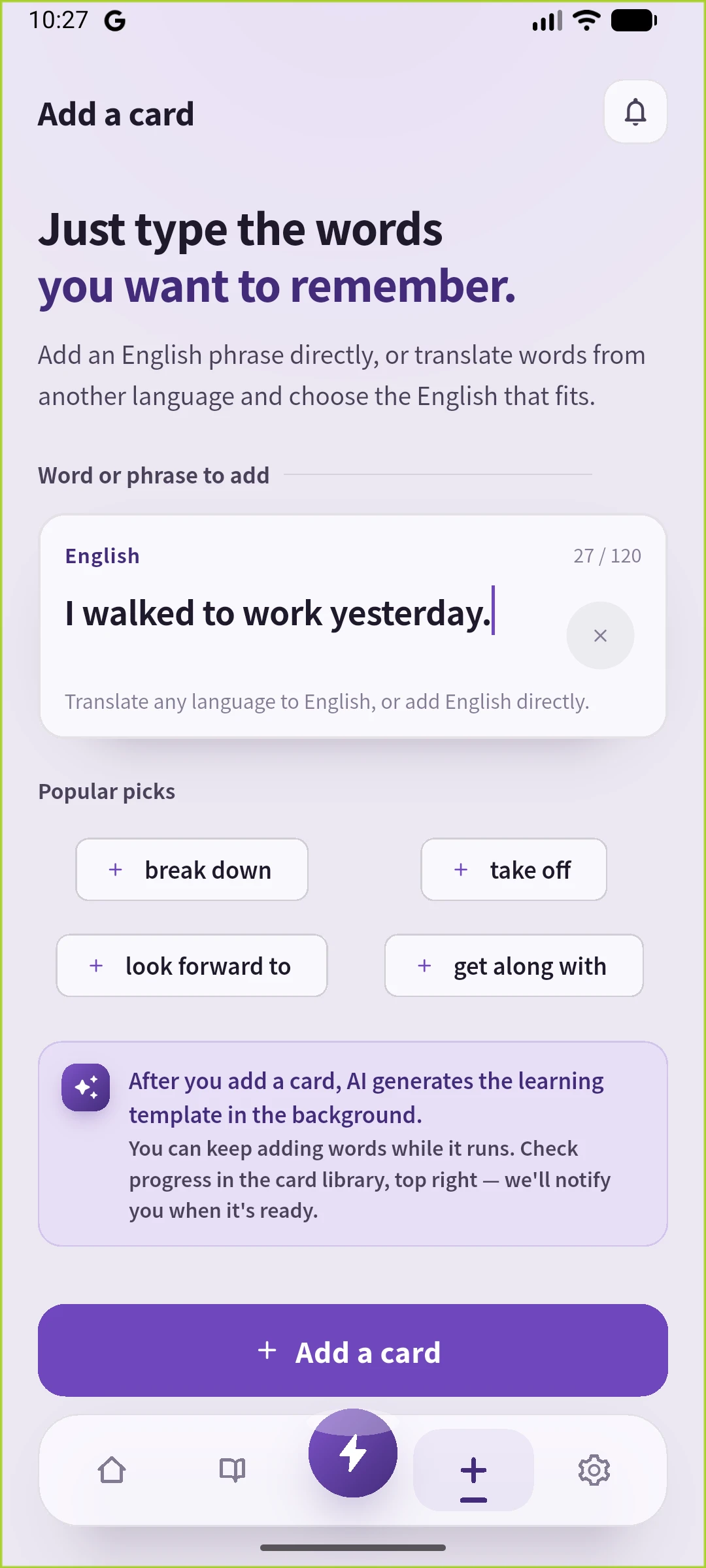
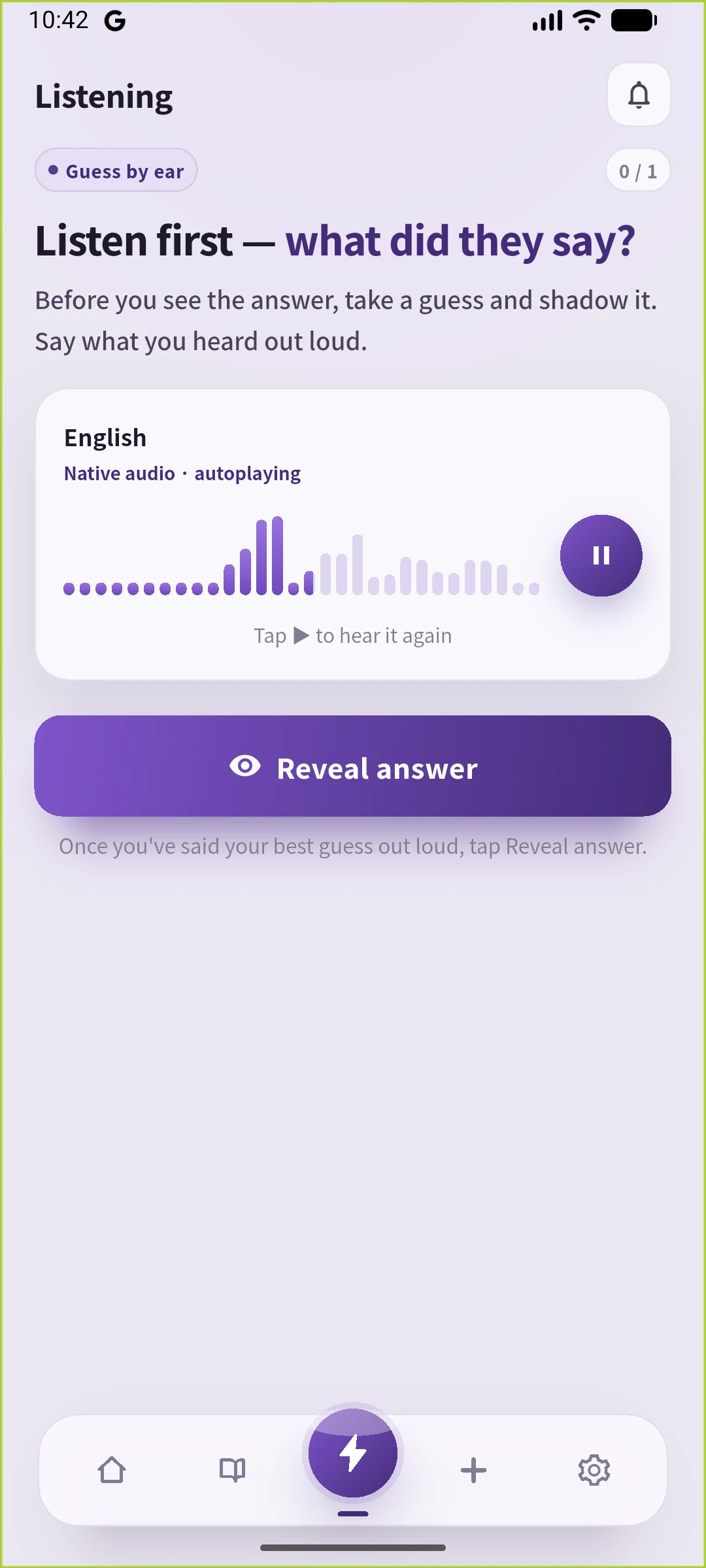
SpeakGain is our own app. You can save one troublesome sentence, listen to its character voice and say it aloud. The English-interface captures below show the normal Add flow and the same saved sentence’s listening screen. Reveal the answer after saying what you heard. Record and check offers word-level pronunciation feedback, and FSRS schedules later reviews; use the feedback as a practice clue, not a guarantee that a sound is correct.
Questions about -ed
Do irregular verbs follow these rules?
Only regular ed forms follow this ending rule. Look up an irregular past form as a whole word.
Does American English use a different rule?
For the examples here, the three categories stay the same. Vowels and the realization of /t/ can differ. Choose one model initially, without treating its accent as the only correct one.
What about past participles and adjectives?
Regular past participles use the same ending choices. Many participial adjectives do too, but the dictionary-checked adjective section shows why you must check meaning rather than assuming all ed spellings follow the verb rule.
Why does the ending disappear in fast speech?
Neighbouring consonants can make it less audible or lead to deletion in casual speech. Replay a short phrase and check the context. When practising, preserve the tense signal instead of deliberately dropping every ending.
Take one ending into your next sentence
Choose one word from your mistakes, identify its final base sound, and put the past form in a sentence about yesterday. Keep the extra beat for /ɪd/ and let the other endings stay short. A clear sentence is the goal; a memorized list of letters is only a starting aid.