
VSTEP Speaking: build answers for Parts 1–3, with audio
Published
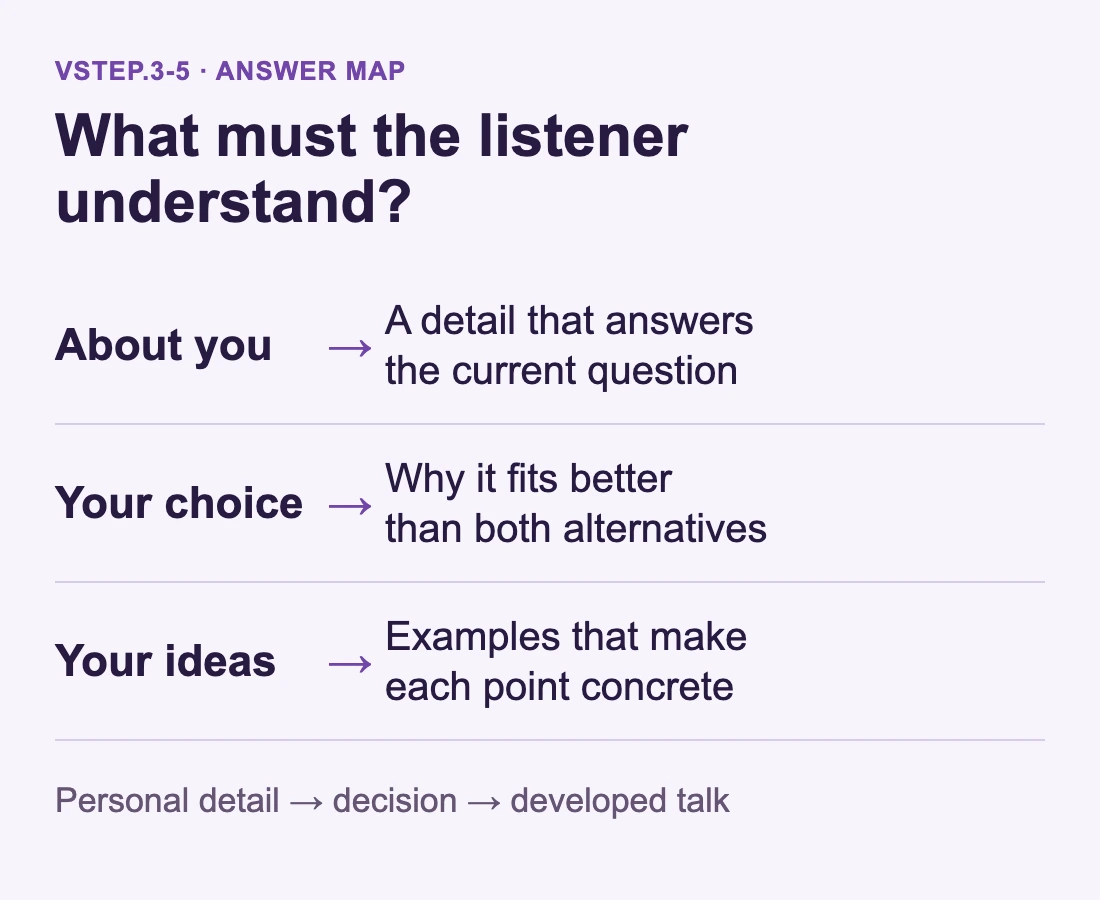
VSTEP is Vietnam’s standardized English proficiency test; its VSTEP.3-5 Speaking section lasts 12 minutes and has three parts: social interaction, solution discussion and topic development. Prepare by giving a direct personal answer in Part 1, choosing and comparing solutions in Part 2, and developing a connected talk in Part 3. Practise from brief notes, record your answer and check whether each reason actually addresses the task.
Recognize the task before planning
The Ministry of Education and Training’s format and ULIS–VNU’s test guide describe these tasks:
| Part | What you receive | What your answer needs to do |
|---|---|---|
| 1: Social interaction | 3–6 questions on 2 topics | Answer the current question with a relevant reason or detail |
| 2: Solution discussion | A situation and 3 proposed solutions | Choose the best solution and argue against the remaining options |
| 3: Topic development | A topic with suggested ideas, followed by discussion questions | Develop the suggestions or your own ideas, then respond to follow-up questions |
The official total is 12 minutes. These two sources do not specify a separate preparation and speaking allowance for each part. Follow the instructions and timer in your organizer’s sample materials. For the exercises below, try 1 minute of notes followed by 2 minutes speaking for Part 2, and 1 minute of notes followed by 3 minutes speaking for Part 3. Those are practice settings, not additional rules inferred from the table.
Part 2: test every option against the same need
Imagine choosing transport for an early flight. Calling a taxi “convenient” says little until you explain whose journey it serves.
Your parents need to reach the airport by 5:30 a.m. with heavy suitcases. A taxi can collect them at home. The first airport bus leaves at 6 a.m. The train runs earlier, but its station is a twenty-minute walk away. Choose a taxi, the bus or the train, and explain why the other two options are less suitable.
Circle get parents and luggage to the airport by 5:30. That is the need all three options must meet. The bus fails on departure time; the train creates a difficult walk; the taxi solves the whole journey at a higher price.
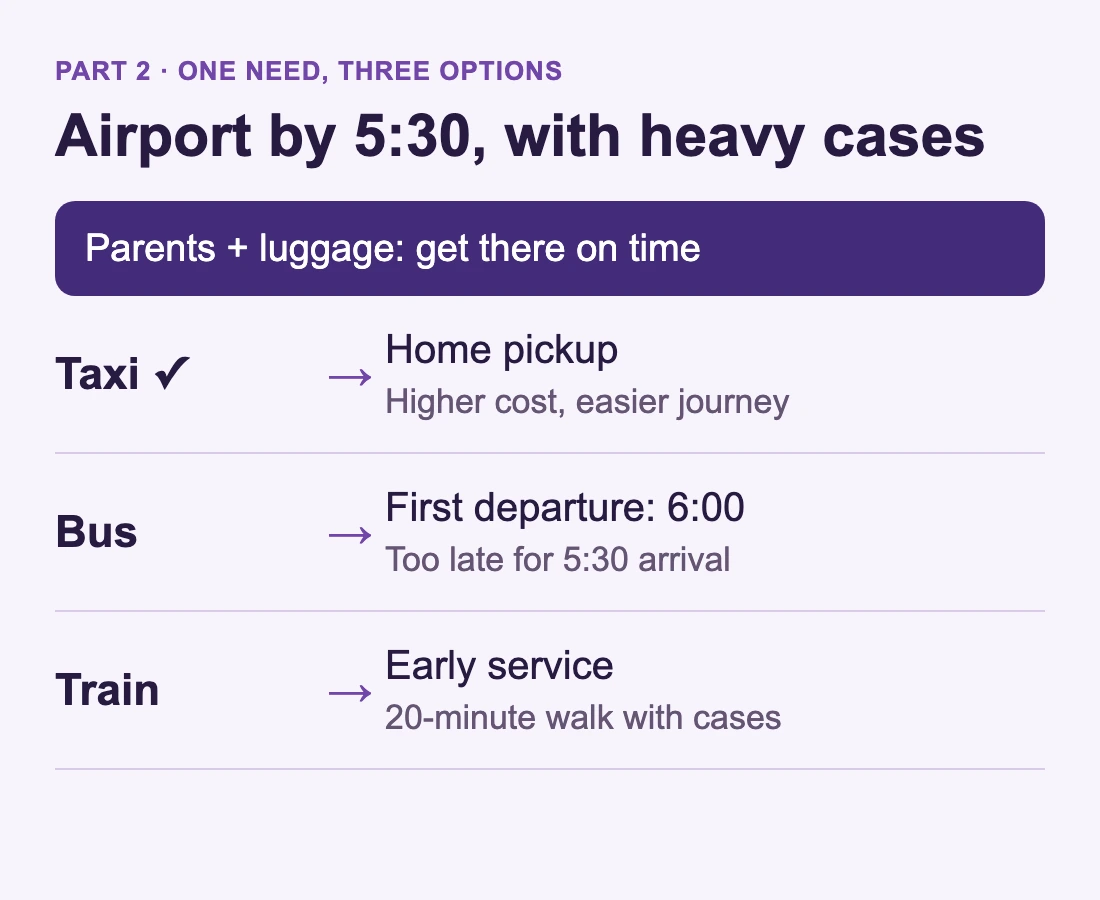
During the one-minute preparation exercise, write a decision at the top of the page and put the two rejected choices underneath it:
need: parents + cases → airport 5:30taxi: home pickup / higher costbus: first departure 6 → too latetrain: early service / 20-min walk
Once every option has a reason beside it, rehearse the first sentence aloud. Spend the remaining preparation time checking that the notes explain the actual journey. Full sentences on paper make it harder to look up and speak.
Hear how the decision holds together
I would book a taxi to get my parents to the airport by five thirty.
It can collect them and their heavy suitcases directly from home.
The first airport bus leaves at six, which is too late for them.
The train runs earlier, but reaching the station means a twenty minute walk with luggage.
For this early journey, the taxi is worth the extra cost.
Listen to the Part 2 example
The final sentence weighs cost against the early journey. For a two-minute practice turn, add how you would arrange collection, why the walk matters to your parents, and when the cheaper train would become attractive. Keep linking those details to the travel need.
Check your recording with three marks on paper: taxi / bus / train. Beside each, write the reason you actually heard. If the train has no reason, add the walking comparison and rerecord that answer. If all three are covered but you finish late, remove a repeated explanation of the taxi.
Then move the required airport arrival to noon and reduce the luggage to one small bag each. Decide again. The bus now deserves a fresh comparison; reciting the earlier rejection would contradict the new situation. This is where memorizing the whole sample stops helping.
When a good comparison gets stuck on a phrase
Try saying the train sentence without looking at it. If reaching the station or with luggage interrupts you, isolate that phrase before returning to the comparison.
We make SpeakGain. A saved sentence becomes a card you can reopen for a short practice session, like this one from the airport answer:
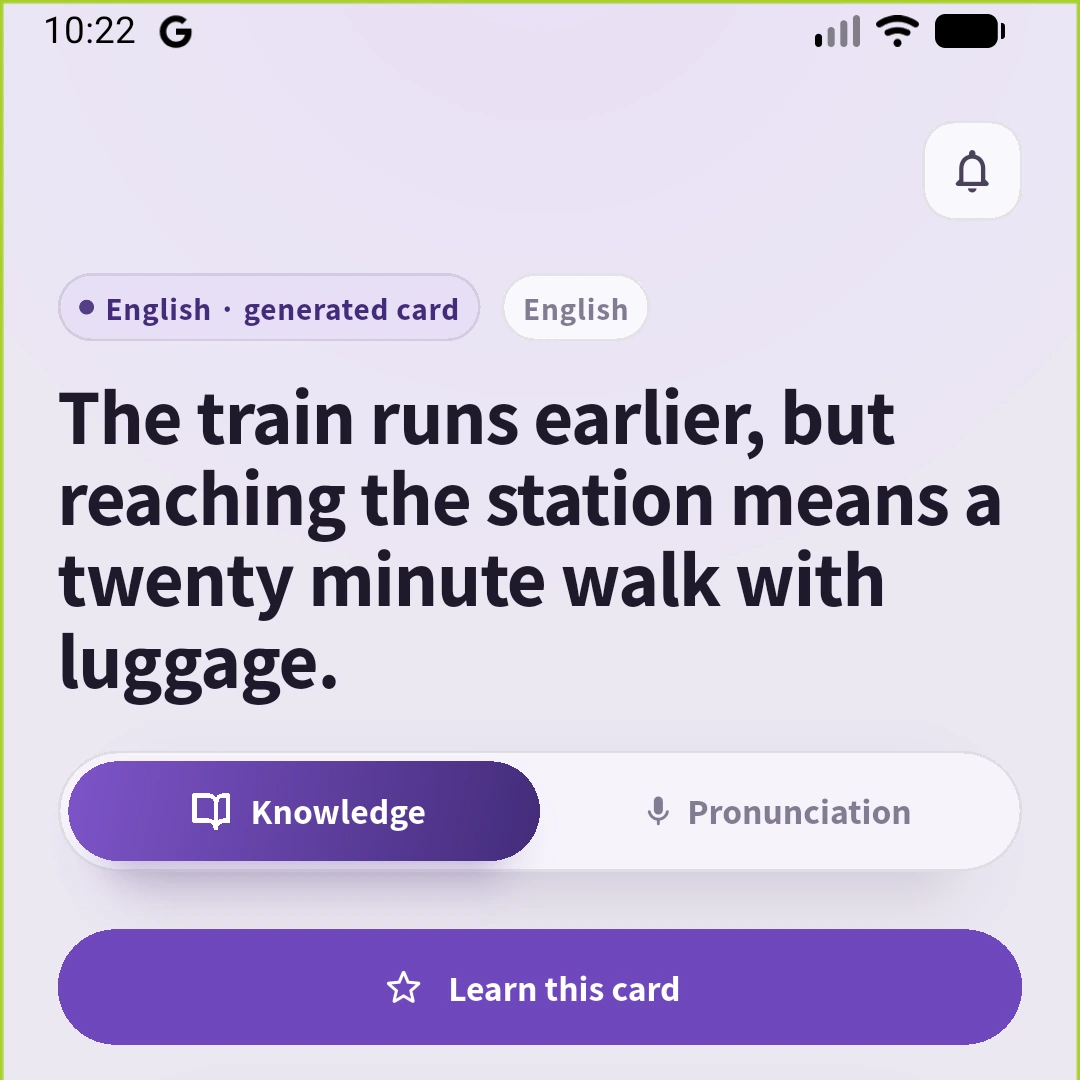
Open its listening exercise to hear the audio and say the sentence aloud. After recording, word-level pronunciation feedback helps you inspect particular words; FSRS schedules later reviews. SpeakGain does not mark VSTEP, predict a level or provide a mock exam.
Part 3: turn a benefit into an example, then handle a new question
The official format allows suggested ideas or your own ideas and ends with discussion questions. Build a talk that leaves you ready to discuss the topic from another angle.
Spending part of a lunch break outdoors can improve the working day.
Suggested ideas: fresh air; a break from screens; energy for the afternoon. You could also discuss how a change of setting helps with a difficult task.
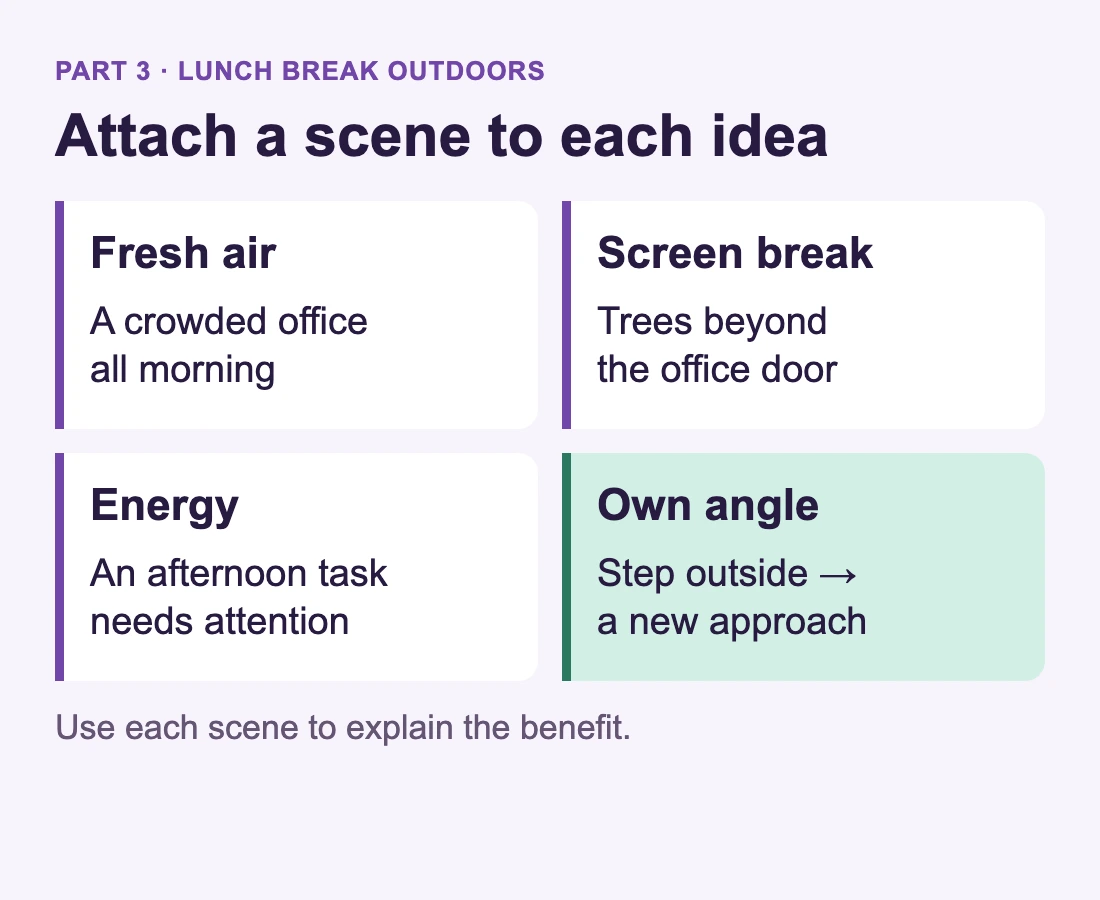
For each idea, prepare something the listener can picture. Under fresh air, note an office that feels crowded after a long morning. Under screen break, picture a tree beyond the office entrance. Under energy, use an afternoon task that needs attention. A personal example about returning to a difficult task gives you an additional angle.
A short talk about lunch breaks
Spending part of a lunch break outdoors can improve the working day.
Fresh air offers a welcome change after a morning in a crowded office.
Looking at trees instead of a screen gives our eyes a different focus.
A short walk can also help us feel more awake for afternoon tasks.
I often return with a new idea after stepping away from a difficult task.
Listen to the Part 3 example
Develop the screen point by describing what you usually look at during the morning, then what changes outdoors. Give the other points the same treatment. During a three-minute practice recording, leave room for a closing thought about how you would use a short lunch break.
Listen back with your notes turned over. Write down the examples you can remember hearing. If you only remember the words fresh air / screens / energy, choose the least developed point and record it with a specific scene. Keep that first talk to compare with your next complete attempt.
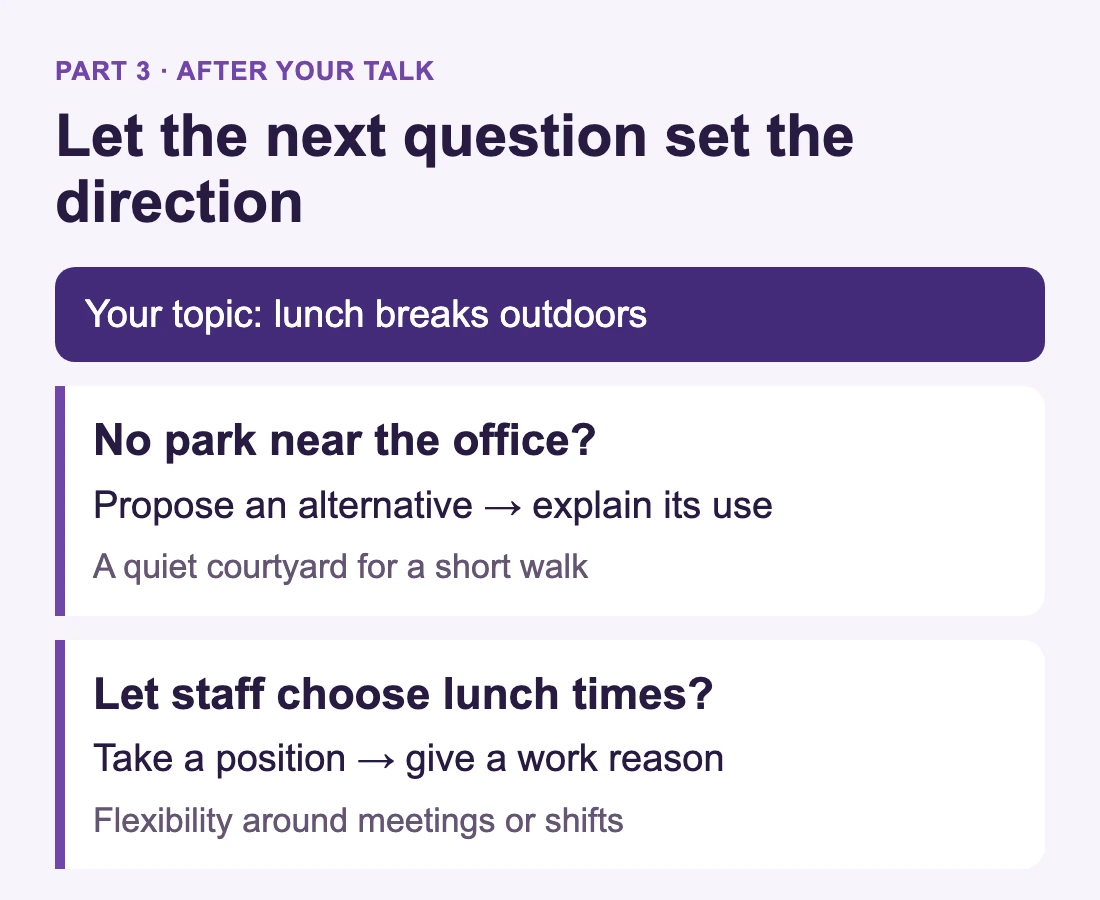
Now ask: What could someone do if there is no park near the office? and Should employers let staff choose when to take lunch? The first asks for an alternative; the second asks for a policy judgment. A new question calls for a new opening sentence.
Part 1: use everyday details that survive a changed question
For cooking, try these three questions in order:
What do you usually cook on a weekday?Why does that meal suit your routine?Have your cooking habits changed recently?
I usually cook rice and vegetables after work.
The meal is quick to prepare, so I can eat before my evening class.
Recently I have started making enough for two evenings.
Listen to the Part 1 example
The answers identify a meal, explain an evening constraint and describe a recent change. At home, prepare the cues meal / evening class / two portions, then put them aside. Make each answer your own by adding a detail such as an ingredient or the day you prepare extra food.
Switch to weather for the second topic: Which kind of weather do you enjoy?, How does rain affect your daily plans?, and Has the weather changed what you do this week? Record your answers in one sitting. Replay each question before its answer: if you described your favourite season when asked about this week, replace that answer with one recent event. This keeps personal material responsive to the question.
What the assessment criteria help you notice
VNU’s published account of research into the VSTEP.3-5 rating scale identifies grammar, vocabulary, pronunciation, fluency and discourse management. Turn those into listening questions: are the tenses appropriate, do words express the intended meaning, are important words clear, do pauses interrupt the message, and do reasons connect to your decision?
Decision 729/QĐ-BGDĐT gives each skill a 0–10 score, rounded to the nearest 0.5; the average of all four skills, rounded to 0.5, determines the level. The ranges are 4.0–5.5 for level 3, 6.0–8.0 for level 4, and 8.5–10 for level 5; below 4.0 no level is assigned under this format. Levels 3–5 correspond to B1–C1, as explained by UEH’s language institute. Check the receiving institution’s certificate requirements.
Build a two-week practice file, with two optional weeks
Give each practice session a date and keep one thing you can check later. In a 15–20-minute session, spend the first few minutes planning, make a recording, and use the rest to address the missing comparison or example you heard.
- Week 1 — choices and personal details. Alternate the cooking/weather questions with the airport decision. Keep one Part 2 recording that covers all three options and a second version with the noon-arrival condition.
- Week 2 — examples and follow-ups. Work through the lunch-break branches. Keep a talk where every main point has an example, plus answers to both follow-up questions. Include brief Part 1 practice at the start of sessions.
- Week 3, if available — unfamiliar constraints. Have a partner change the transport passengers, arrival time or luggage, and invent a new follow-up to the lunch topic. Keep the question alongside the answer so you can check relevance.
- Week 4, if available — complete runs. Work through your organizer’s sample materials with their instructions and timer. Note which part still loses a reason, example or clear ending, and use the next session for that task.
Questions about choices and follow-ups
What if all three Part 2 options seem reasonable? Name the condition that decides between them. For the early-airport problem, carrying suitcases from home matters more than the lowest fare. Acknowledge the cheaper option, then explain why that advantage has less weight here.
How do I start a Part 3 follow-up? Answer its question in your first sentence. For the no-park question, you might suggest a quiet courtyard and explain how someone could use it. For the employer question, state your view about flexible lunch times, then give a workplace reason.
Can I develop an idea of my own in Part 3? Yes: the format permits your own ideas. Keep the connection to the topic explicit. The sample’s final point connects stepping outside with a fresh approach to a task; describe a particular occasion to develop that point.
Choose the airport case when you need practice comparing alternatives, and the lunch-break topic when your points need examples. Before the next complete recording, write the missing reason or example in the margin of your notes. That gives the next attempt a clear job.