
OPIc test preparation: turn your own stories into spoken answers
Published
The OPIc test is a computer-delivered speaking assessment: you answer spoken prompts, and your speech is rated against a proficiency framework such as ACTFL’s. Your Background Survey and Self Assessment help determine the topics and test form. To prepare for the English OPIc, build small pieces of your own stories—description, routine and an event—then answer different questions aloud and listen to your recordings. ACTFL OPIc overview
Before the first answer: two choices that shape the test
The Background Survey asks about work, home, activities and interests; these answers shape the topic pool. Self Assessment asks you to choose the description closest to your current speaking ability and determines the test form. Instructions, a sample prompt and a self-introduction warm-up follow. ACTFL format
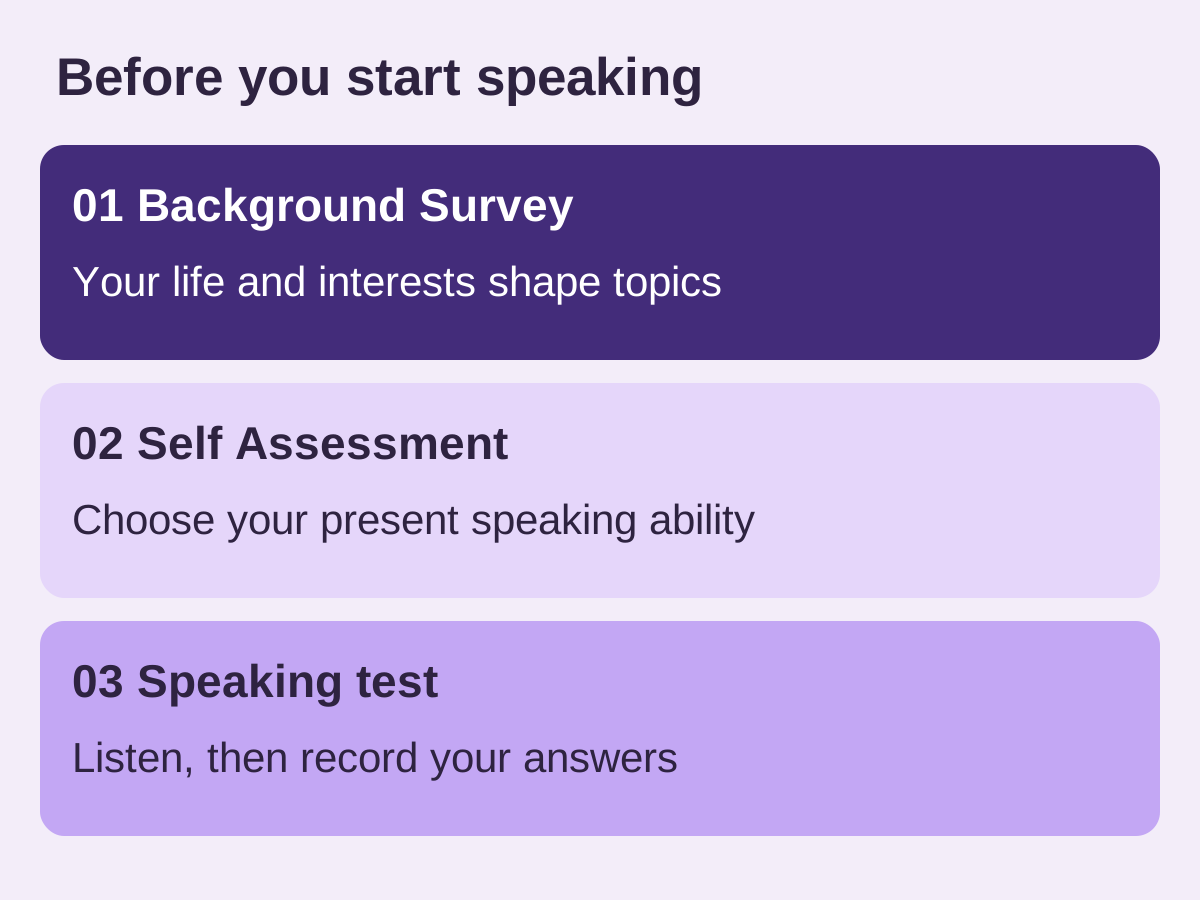
For preparation, write a topic you genuinely know and check whether you can recall a place, a regular activity and a particular incident connected with it. Pick survey answers that reflect your life. For Self Assessment, use what you can actually say today, rather than the level you hope to receive. Official preparation sequence in Japan
Check which administration you are taking. ACTFL describes an average test length of 20–40 minutes. Korea’s official site specifies 12–15 questions and a 40-minute test, about 60 minutes including orientation. Its two sessions include an intermediate difficulty adjustment. Those Korean arrangements are not a universal question count or timetable. ACTFL, OPIc Korea
For an individual certification, LTI’s OPIc page links to its certification options; employer or university candidates should follow their organization’s test instructions. Confirm that English is the language being assessed and which certificate your organization accepts before booking.
A walk becomes three different answers
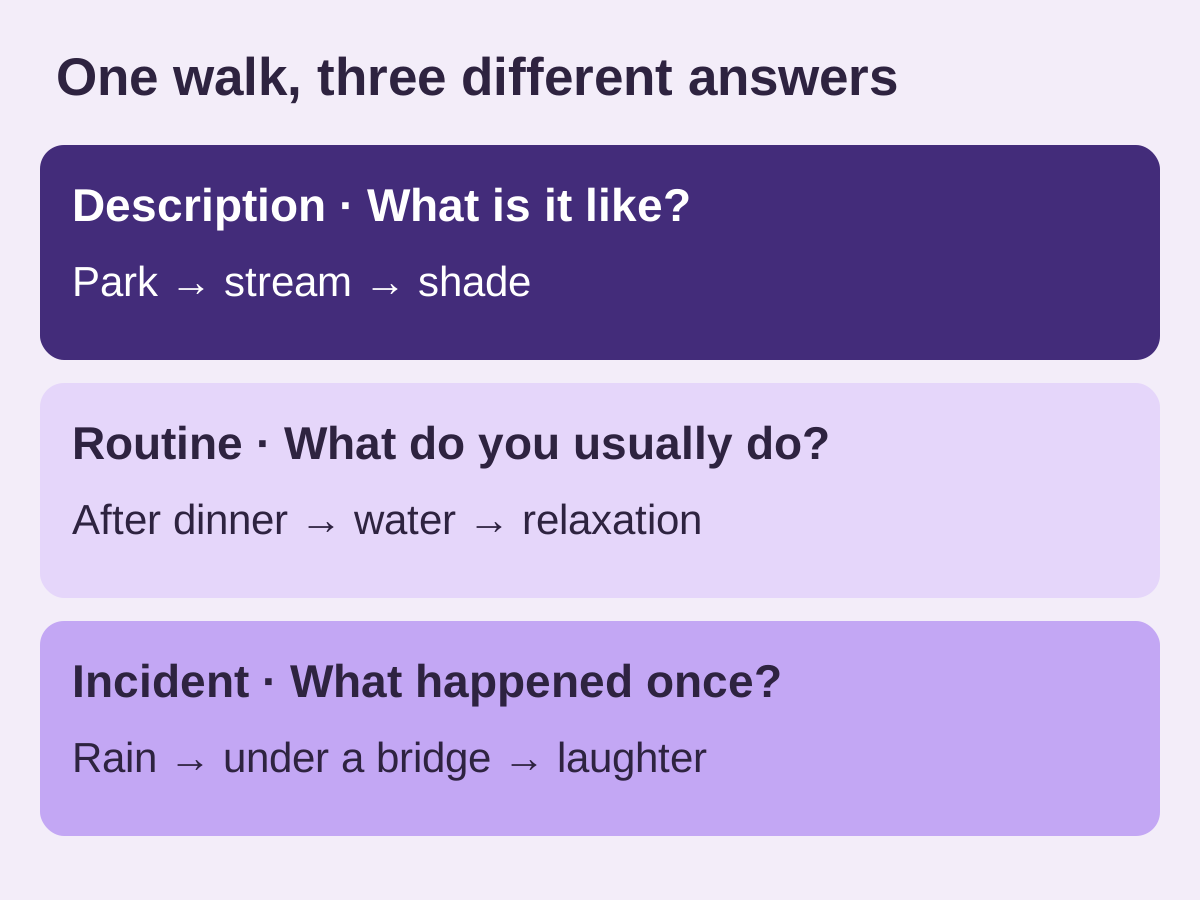
Suppose walking is one of your topics. Start with three spaces on paper: what the place is like, what you normally do, what happened once. The following park story gives you language to replace with your own details. The audio is a synthetic Viking voice; the same English clips appear in every language edition.
Describe the place
Practice prompt: What is the park near your home like? Locate the park first, then add things a listener could picture.
There is a small park near my apartment. It has a walking path beside a stream. The trees keep the path cool in summer.
A location, a visible feature and a seasonal detail.
Replace near my apartment with near my office if that is true for you. If there is no stream, change the landscape rather than memorizing an unfamiliar setting. Speak the revised sentences together.
Explain a routine
Practice prompt: What do you usually do when you go for a walk? Start with the regular action, then add a detail and its purpose.
I walk there after dinner. I put my phone away and listen to the water. A short walk helps me relax after work.
When you go, what you do, and why it matters to you.
If the question asks how often, include a frequency such as three evenings a week. A polished description of trees will not answer that part.
Tell what happened once
Practice prompt: Tell me about a walk that did not go as planned. Move from the interruption to your action and the outcome.
Last Saturday, rain interrupted my walk. I waited under a bridge. Another walker and I laughed about our wet clothes.
An interruption, your response, and a small human detail to close the event.
The verbs interrupted, waited and laughed keep this event in the past. Keep a detail you remember from that occasion; avoid drifting back into a general description of how beautiful the park is.
Keep the facts; change which ones you use
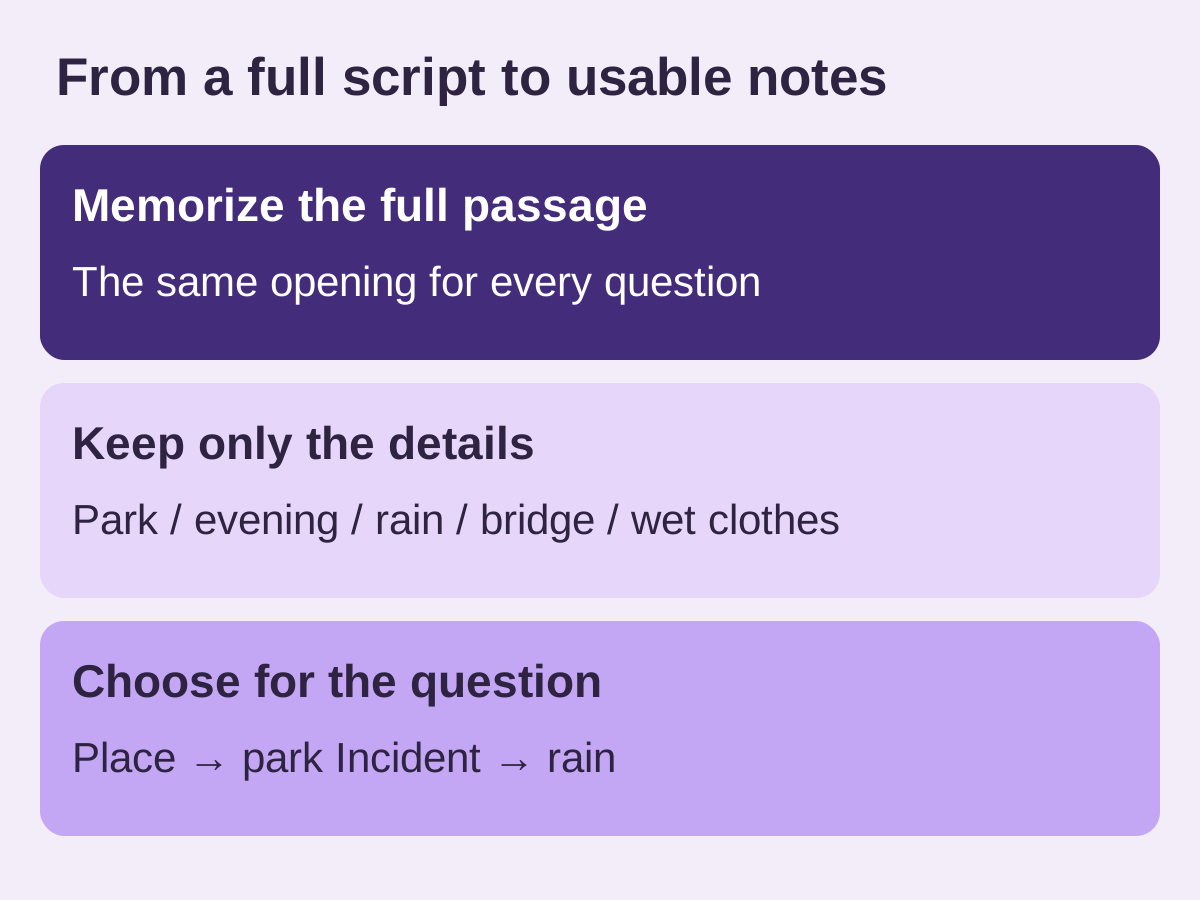
Reduce your notes to park / evening / stream / rain / bridge / wet clothes. Hide the full sentences. For a description, choose park and stream. For an unexpected incident, choose rain, bridge and wet clothes. Do not join all three passages in the same order every time.
For a comparison prompt—How have your walks changed since you started working?—you could begin I used to walk in the morning, but now I go after dinner, then explain the reason. For a self-introduction, begin with your work or daily life and develop what is relevant to the prompt. These are ways to practice different speaking functions, rather than a predicted sequence of test questions.
ACTFL’s test-taker advice says the assessment targets spontaneous language use and cautions against memorized performance. Learn useful expressions, then practice deciding what to say with them. ACTFL test-taker advice
An unfamiliar question still needs a direct answer
If asked what you do when an outdoor activity goes wrong, the rain incident is relevant. Answer the question first, then use the incident to explain. If you lack the exact experience, acknowledge that briefly and introduce a related one:
I have not experienced that myself, but I remember a similar problem during a walk.
A brief bridge from an unfamiliar experience to a relevant one.
Continue with the rain and bridge only if they help answer the question. If the prompt asks for an opinion about transport policy, begin with an opinion, for example I think safer crossings would help people walk more, and use a walking experience as support. Redirecting every topic to the same favorite story loses the question.
A role-play may require you to ask for information. Imagine calling a park office about an evening walk: What time does the walk start? Where should I meet the group? Do I need to book a place? For a cancelled booking, try requesting an alternative: Could I join another group tomorrow? Follow the actual prompt’s requirements. The official OPIc demo lets you become familiar with the interface; Japan’s test description explains the role-play task.
Try three prompts without reading your notes
Shuffle the description, routine and incident questions. Record each answer with a phone recorder, aiming for roughly 60–90 seconds as a practice exercise. This is a training choice, not an official per-question limit. Korea’s official instructions state that there is no individual answer-time limit within the overall test time. Korean test process
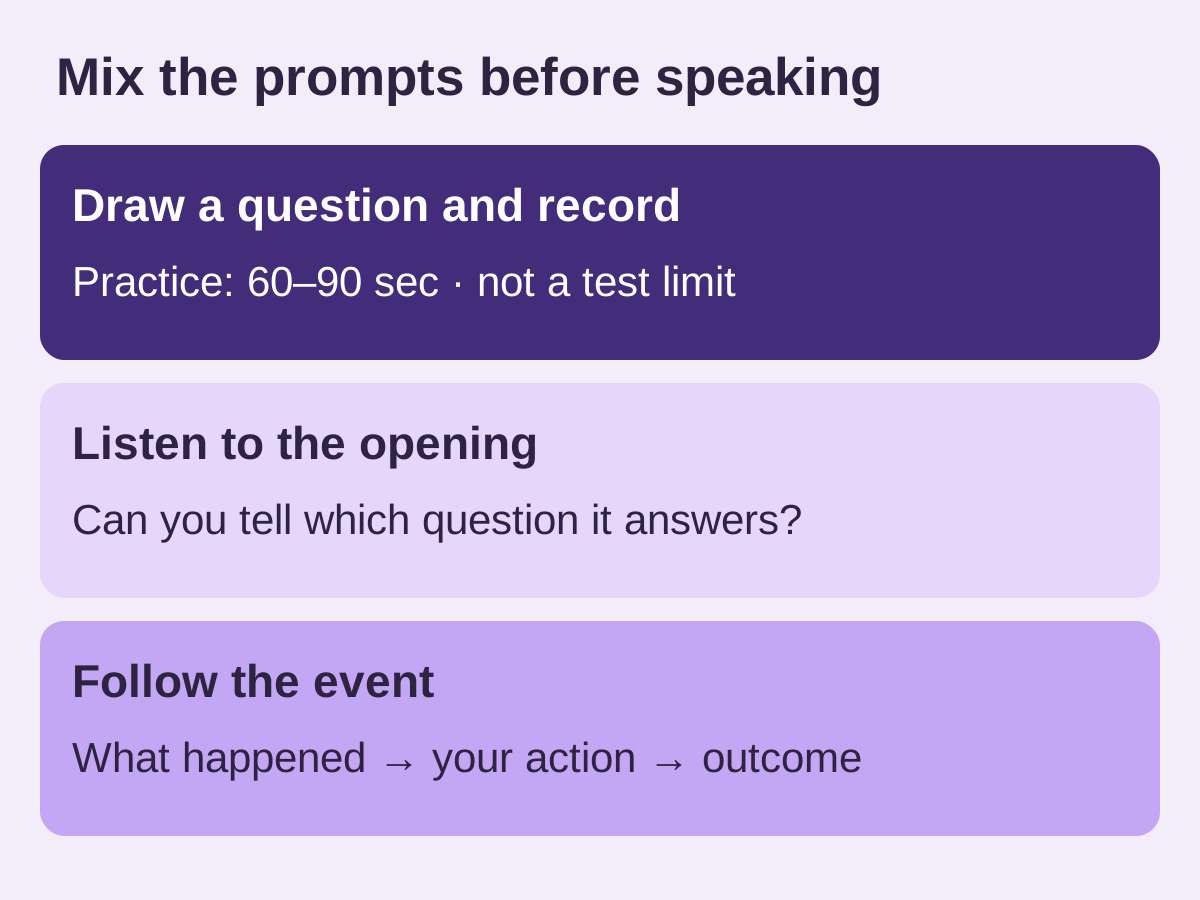
Listen to the opening sentence: could someone identify the question from it? Then check whether the event has a clear sequence and mark where you ran out of things to say. If you lacked words for the setting, work on description. If the timeline became unclear, work on the event. On the next attempt, draw a different question first so that you have to choose your details again.
Replaying a short piece of your story
SpeakGain is our app. You can save your own short material and use its audio for speaking practice. The real English-interface screen below shows a saved card revealed during study, with reference-audio playback available.
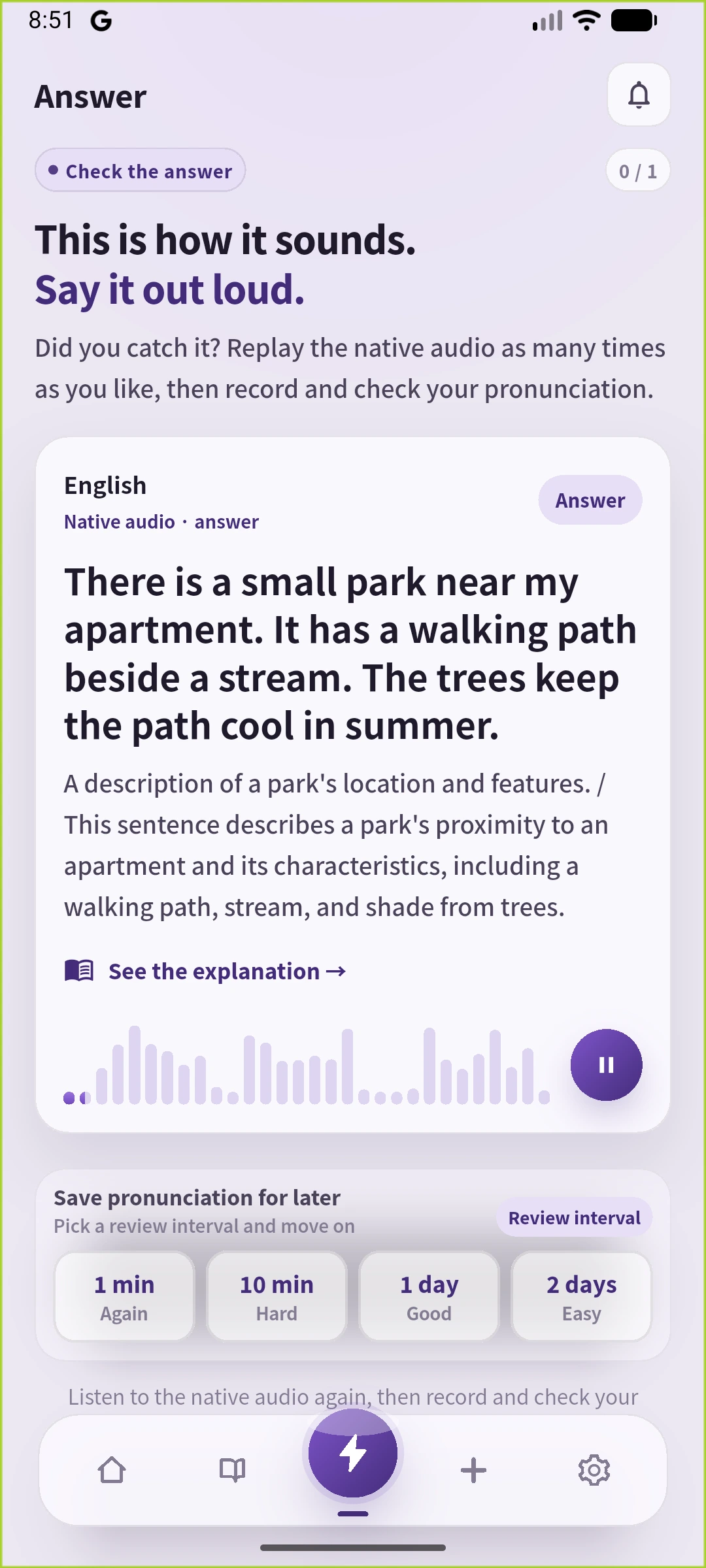
After listening and speaking, Record and check offers pronunciation feedback, and FSRS schedules later reviews. Use word-level feedback to work on sounds, and a separate recording to assess how your full answer addresses the question. SpeakGain does not score OPIc answers, predict a proficiency rating or provide an OPIc mock test. See the app
What does the rating ask you to demonstrate?
OPIc ratings describe sustained speaking ability, rather than a count of impressive expressions. LTI explains that a certified rater evaluates the sample against the selected framework; an Official/Certified OPIc is independently rated by at least two raters. LTI rating process
For readers taking OPIc in Korea, its published descriptions progress from NL through AL, with IM1, IM2 and IM3 inside Intermediate Mid. The IH description includes explaining events and handling unfamiliar complications; AL emphasizes managing time frames and connected narration. Korean rating descriptions When reviewing your own recording, ask whether you explained an event to its conclusion and connected a problem to a response. Those questions help choose practice; they do not calculate your rating.
Give your topics two to four weeks of varied use
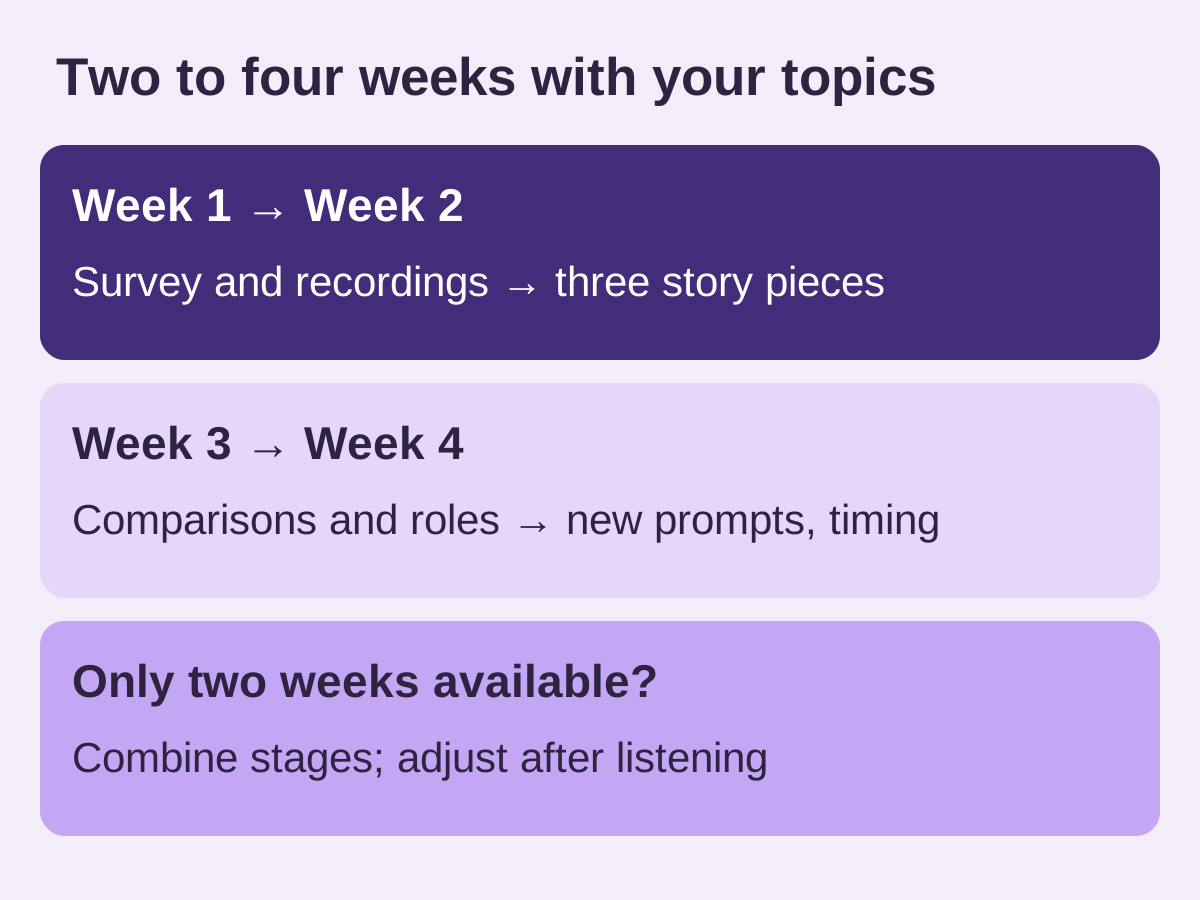
With four weeks available, use week one to explore the official demo and record three topics. In week two, give each topic a place, routine and incident. In week three, mix comparison, role-play and unfamiliar questions. In the final week, practice the overall timing and equipment with questions you have not already rehearsed. For two weeks, combine the first two stages in week one and mixed speaking with timing in week two. Adjust the schedule to your first recordings; it is not a promise of a particular rating.
Questions that come up during preparation
Can I write a script first?
Yes, writing can help you find a clear sentence. Next, reduce it to keywords and answer a different question. Recalling a whole passage and selecting relevant details are separate tasks.
Should I select the highest Self Assessment?
Choose the description that fits your present ability. It determines the test form; selecting a high option is not evidence of a high rating. ACTFL
Is a longer answer always better?
Complete the task with relevant detail. Do not fill a practice timer with unrelated information. Ask yourself whether a listener can follow the description, event or request from beginning to end.
Start with one topic today: say what it is like, what you do, and what happened once. Then change the question order and record again. If you still need to choose a test for your purpose, see our English test comparison.
References
Checked October 23, 2026 (JST). OPIc and ACTFL are trademarks of their respective owners.