
Aptis Speaking test: what to say in each part, with examples and audio
Published
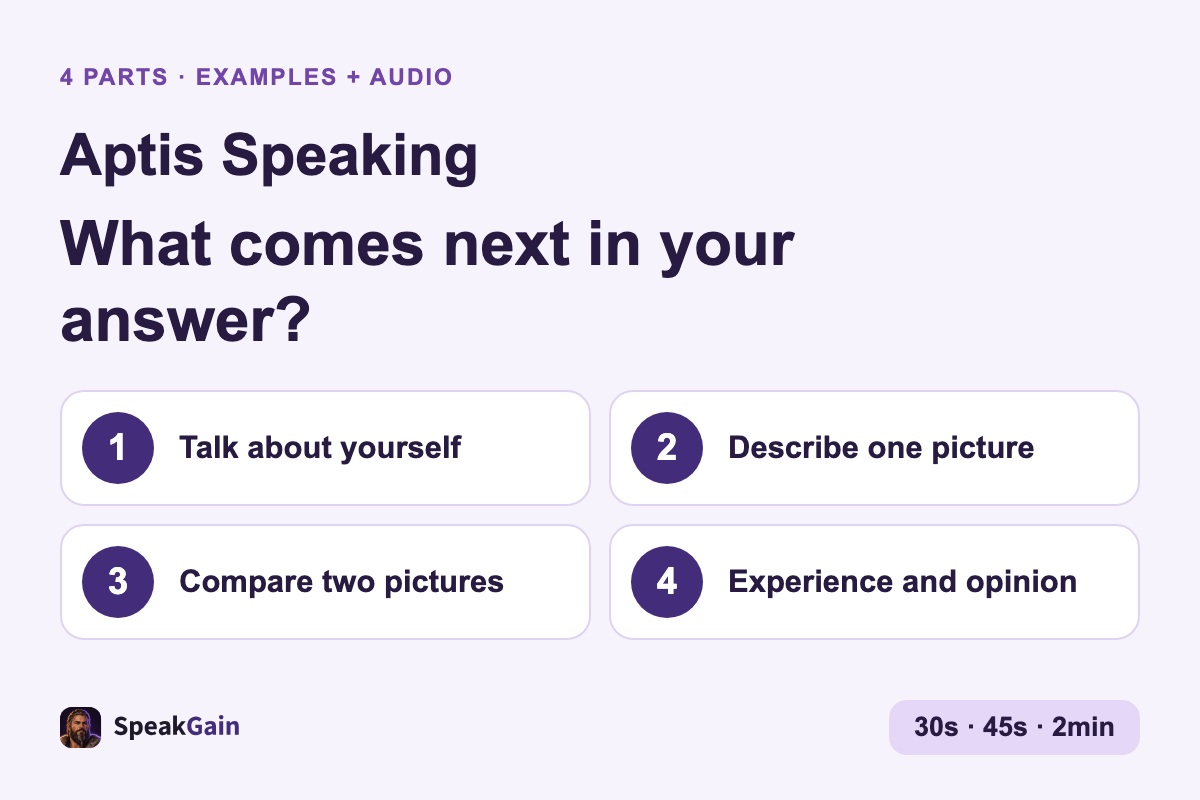
The Aptis General Speaking test has four recorded parts on a computer: personal questions, describing a picture, comparing two pictures, and a longer response on one topic after preparation time. Prepare by choosing an order for your ideas in each part, adding your own experience, and recording answers against the timer.
Set the right timer before choosing your words
General Speaking takes about 12 minutes, and examiners mark your recorded responses. The table follows the British Council format guidance.
| Part and task | Preparation and speaking |
|---|---|
| 1 — 3 questions about you and your interests | Respond when prompted; 30 seconds per question |
| 2 — Describe 1 picture, then 2 related questions | Respond when prompted; 45 seconds per question, 3 responses |
| 3 — Describe/compare 2 pictures, then 2 related questions | Respond when prompted; 45 seconds per question, 3 responses |
| 4 — 3 questions on one topic, answered together | 1 minute; brief notes allowed; 2 minutes for all 3 questions |
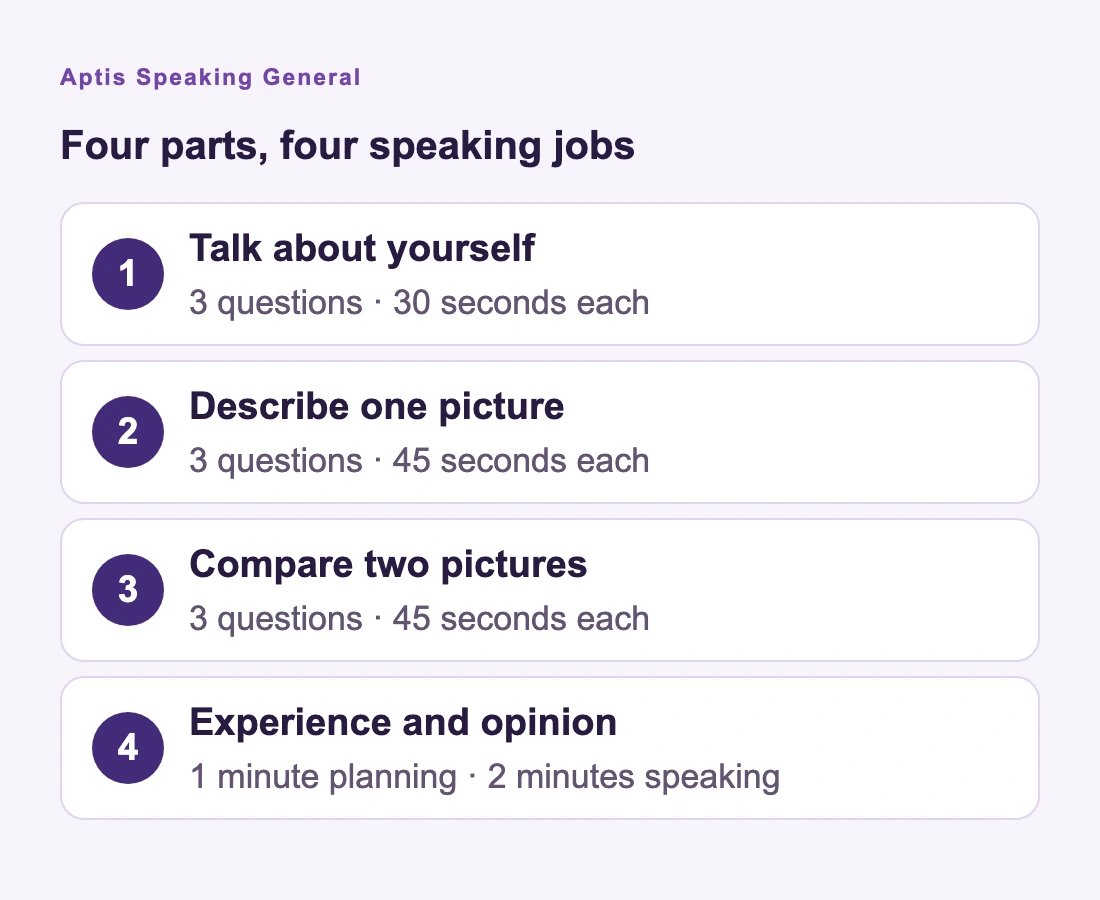
Do not build a minute of planning into Parts 1–3: follow the test prompts. The guidance covers Aptis and Aptis ESOL. Advanced has three sections, so check your booking before using this four-part plan.
What do the score and CEFR level tell you?
You receive a 0–50 score for each skill and a CEFR level. At a boundary between levels, Grammar and Vocabulary can help determine the skill level. Numerical scores are calibrated differently across skills; do not treat a total-score conversion chart as a universal CEFR rule (scoring explanation). For General, British Council Vietnam explains that the reported C corresponds to C1 and does not distinguish C1 from C2 (General results). Confirm the receiving institution’s actual requirement.
For practice, listen for relevant answers, suitable vocabulary and grammar, clear pronunciation, hesitation and connected ideas. British Council recommends these listening checks; they are not a way to calculate your own exam score.
Part 1: give Saturday a place, an event and a reason
Try What do you usually do on Saturday mornings? Name the activity, add a particular occasion, then explain why you like it. A long general introduction uses time that could hold a useful detail.
Short example
I usually spend Saturday mornings at a community workshop. Last weekend, I helped a neighbour repair a bicycle. I enjoy working with other people because we can share practical skills.
Listen to the short answer:
This is a starting point, not a script guaranteed to fill 30 seconds. Time yourself. If you have time left, add who you go with or what you learned; if you run over, keep the direct answer and the most useful detail. Then try Who do you enjoy spending time with? and What skill would you like to learn?
Part 2: scene, action, possible reason
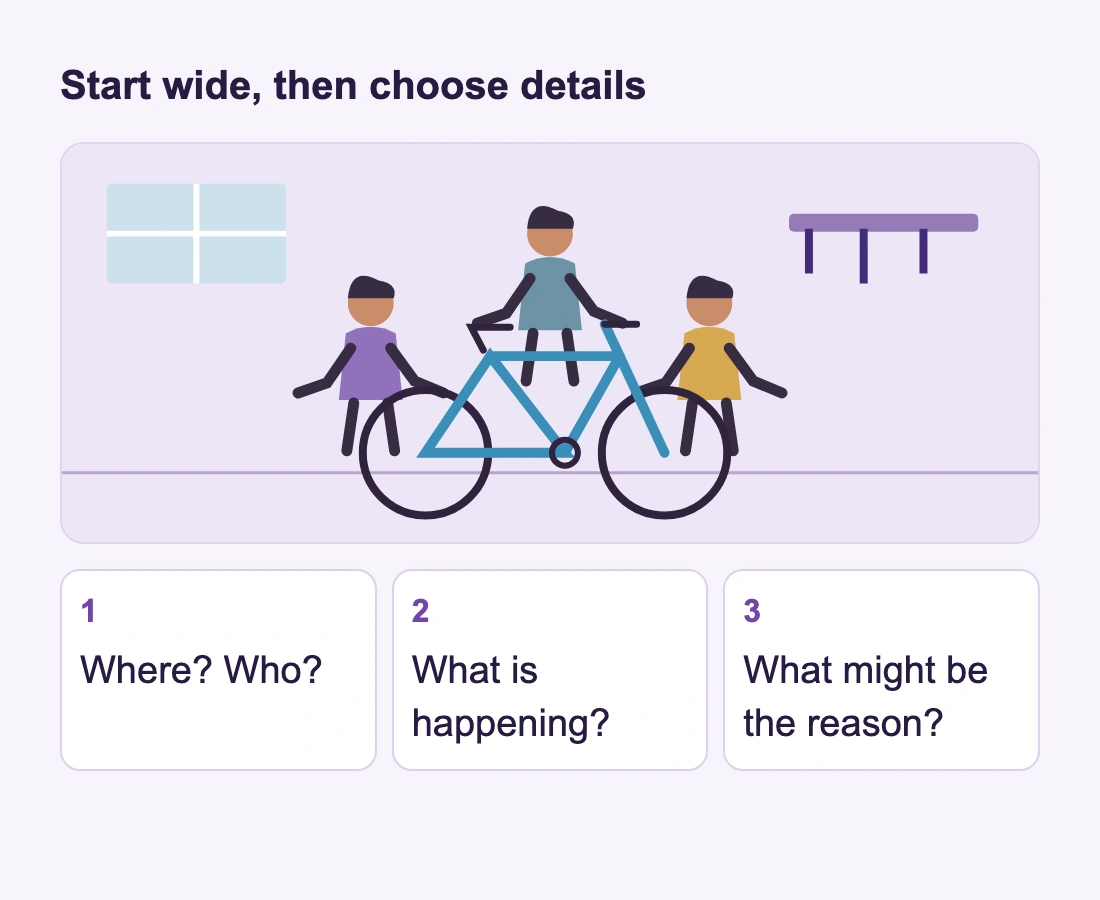
Answer Describe what is happening in this picture. Start with the place and people, choose two visible actions, then offer a cautious interpretation. The word might separates a possible explanation from something you can actually see.
Short example
Three people are working on a blue bicycle in a workshop. One person is holding the handlebars while another checks the front wheel. They might be preparing it for someone who needs transport.
Listen to the short answer:
The next two turns need their own answers: When have you repaired something yourself? and Why do people share practical skills? Give a specific occasion for the first and explain a benefit for the second. Once the question changes, stop listing objects in the picture.
Part 3: compare on the same point
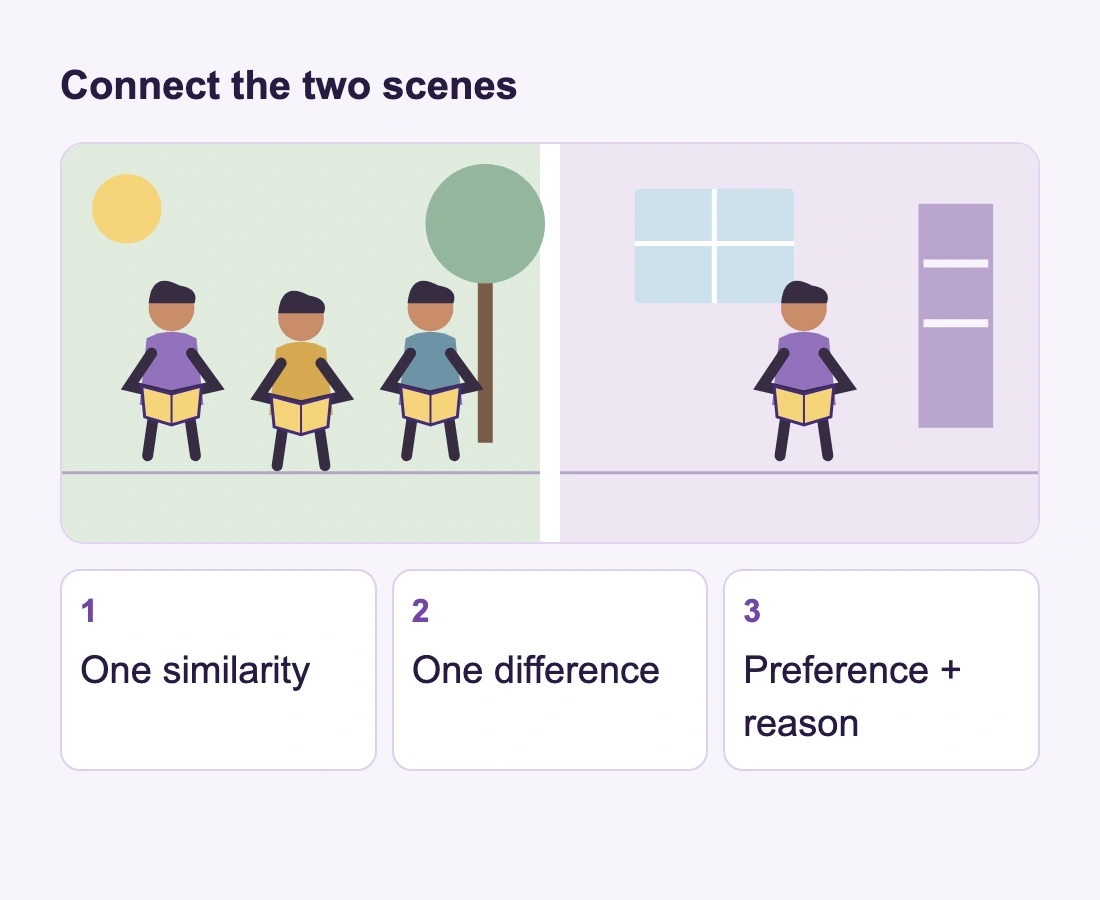
Start with Compare these two ways of reading. Both scenes involve reading; the location and interaction differ. Linking the scenes on one point gives your answer a thread, instead of two disconnected inventories.
Short example
Both scenes show people reading, but one group is outdoors and the other person is alone at home. The people outside can discuss the book, while the person at home has fewer distractions. I would choose the group because hearing different opinions helps me notice new ideas.
Listen to the short answer:
In this practice sequence, save the final sentence for the separate turn Which setting would you prefer, and why? For Why might someone prefer reading alone?, consider someone else’s needs, even if you prefer a group. Use a visible difference as your reason; you do not need an invented biography for the person.
Part 4: three boxes in one minute
Practise with Tell me about a time you joined a new group. How did you feel? Why are shared activities important in a community?
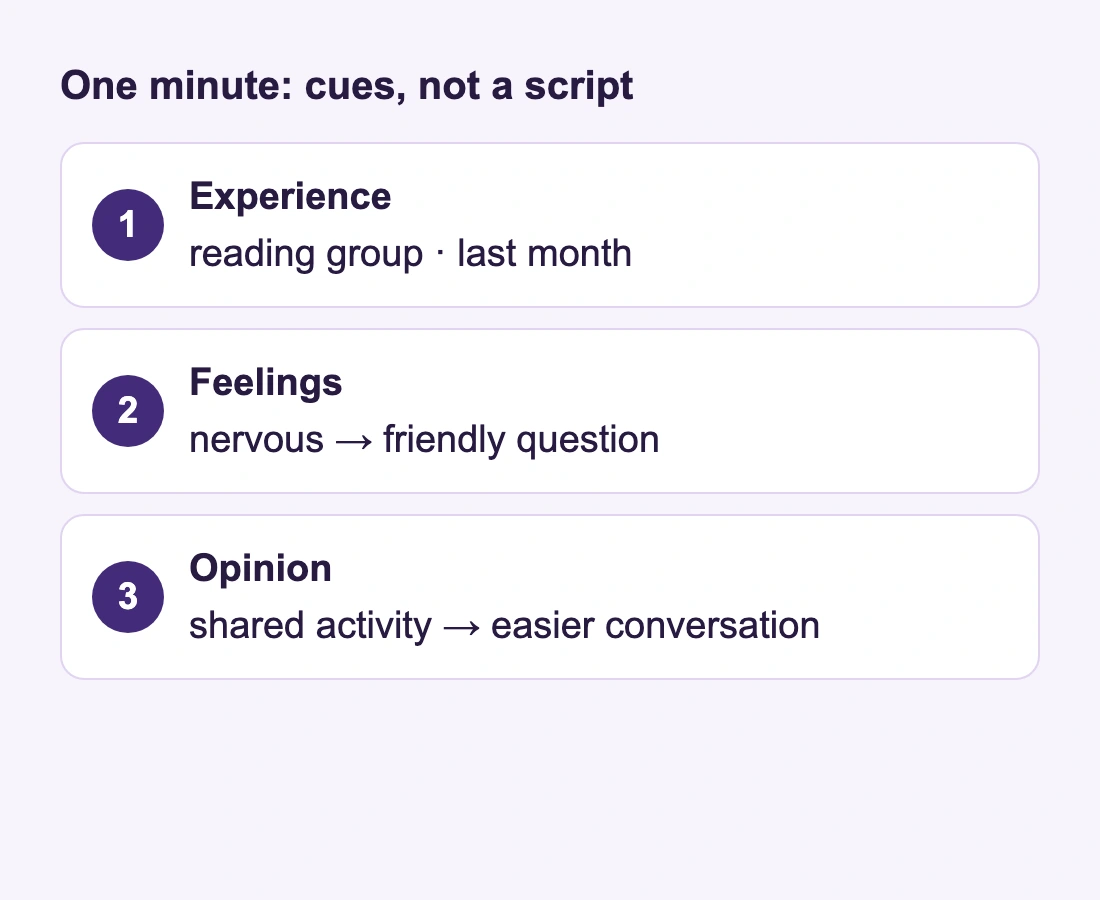
Write a few cues for each question. Try roughly 20 seconds to read and choose an experience, 25 to jot down three boxes, and 15 to check the last question and opening sentence. This split is a practice suggestion, not a test rule.
Short example
Last month, I joined a reading group even though I did not know anyone there. At first I felt nervous, but a friendly question helped me join the discussion. Shared activities bring people together because everyone has something specific to talk about.
Listen to the short answer:
These three sentences form a short outline. Expand towards a two-minute response by explaining what happened at the meeting, why the friendly question helped, and another example of a community benefiting from a shared activity. Move to the opinion question early enough to answer it. Part 4 needs answers to the questions, rather than a description of the picture (General overview).
Replay once to choose one repair
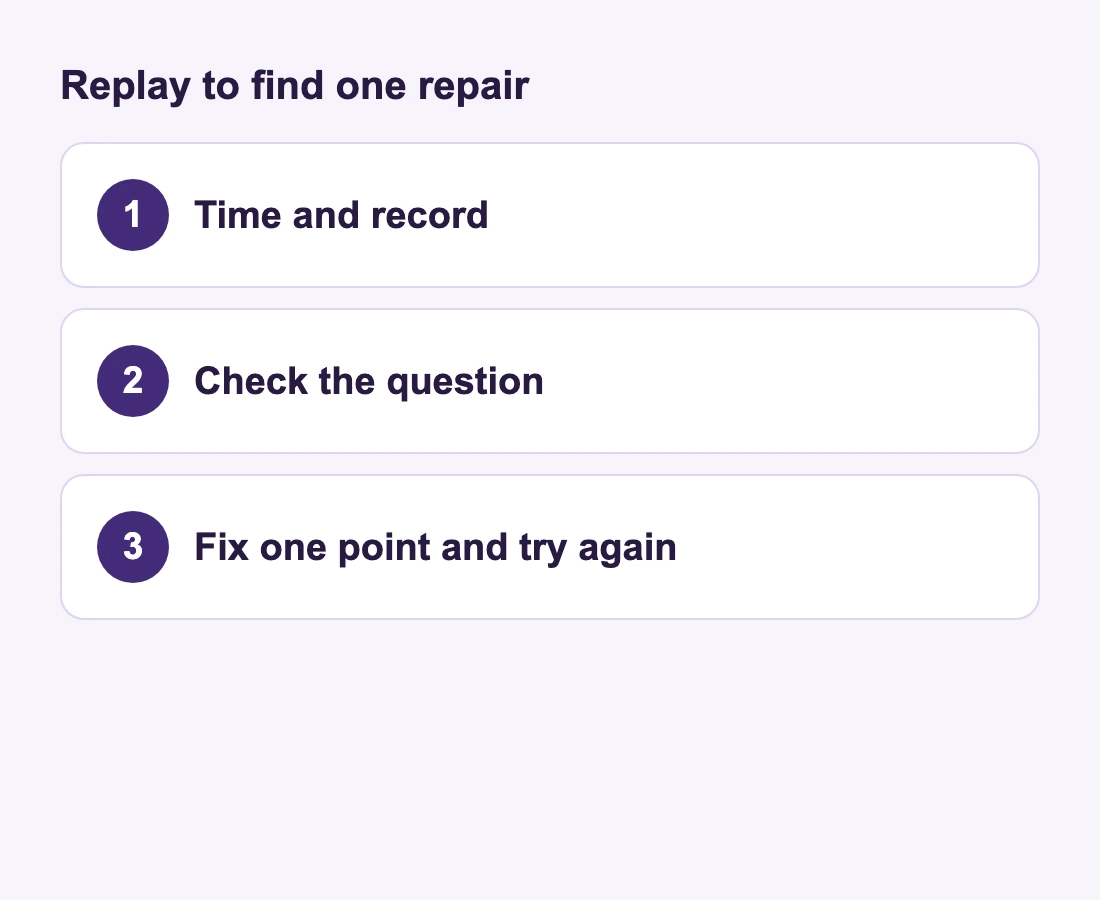
- Hide the example and record with the time limit for the response you are practising. Keep going if one word escapes you.
- Listen for content first: which question remains unanswered? Then choose one hesitation or unclear important word.
- Repair that point and record again under the same limit. Change a question or picture detail next, to check that you can adapt.
To keep a sentence you repeatedly struggle to say, SpeakGain is our product: save the sentence, listen and speak it, then use word-level pronunciation feedback after recording to choose what to practise. Its review schedule uses FSRS to bring phrases back for review. The screens below show saving and listening; SpeakGain does not mark Aptis, predict a score or run a mock exam.
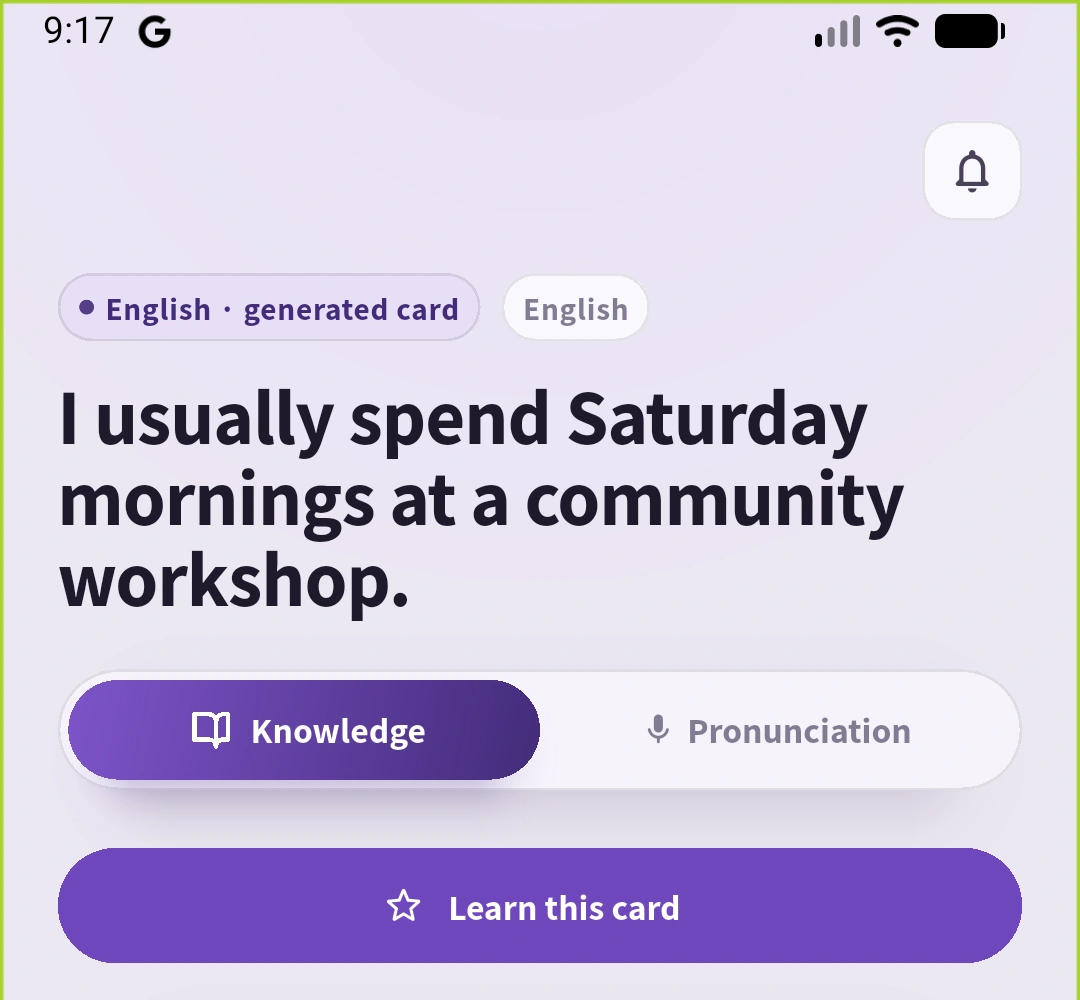
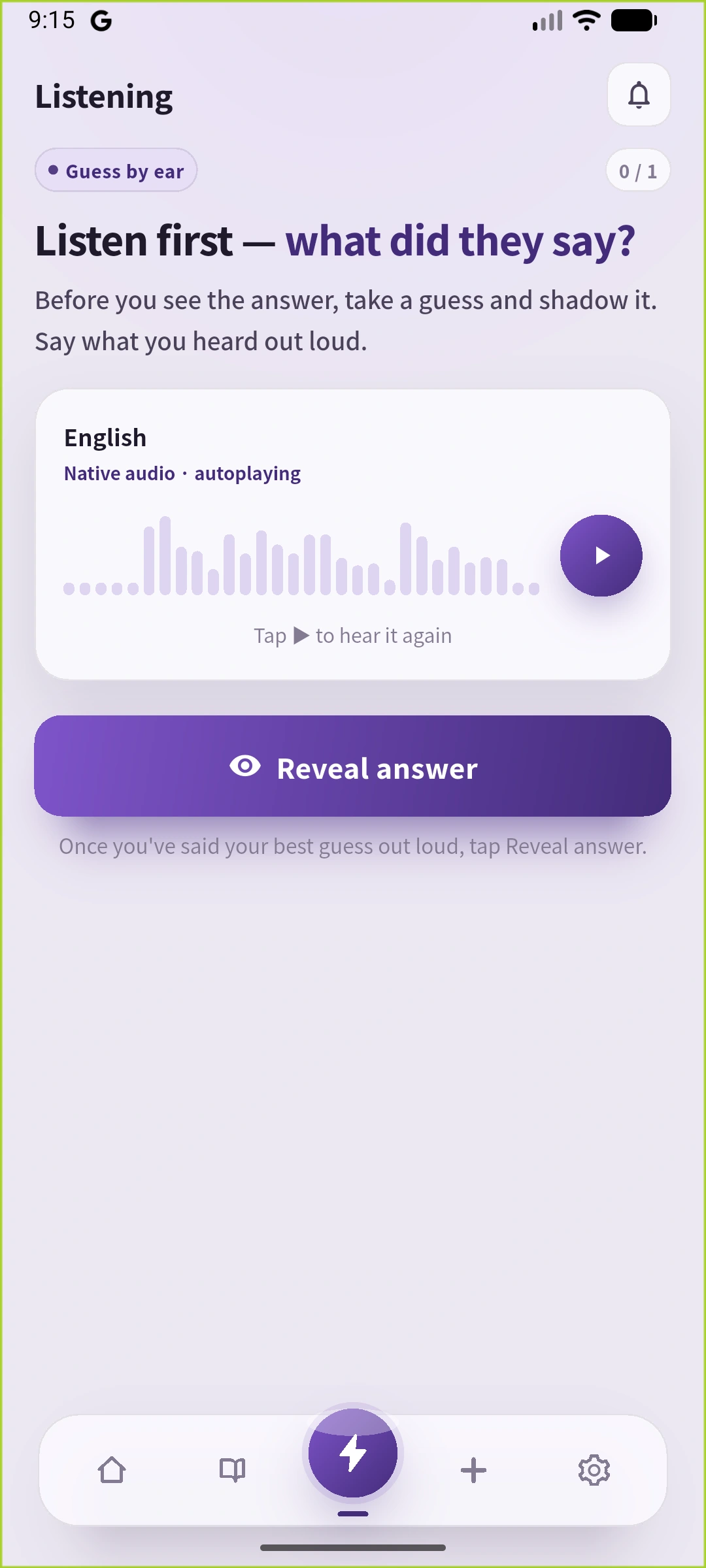
The saved Saturday sentence and its listening flow: Learn this card opens practice; the listening screen offers replay and Reveal answer. All five language versions practise the same English sentence.
When your answer stalls
Should I memorise the examples? Use them to hear how ideas connect, then replace the activity, people and reasons with your own. A new question without the text open is a better check than reciting the same answer again.
What if I have time left? Add a relevant example, cause or result. An empty introductory phrase adds length without answering the question more fully.
What if I forget a word? Explain it with simpler words: describe what a tool does, then continue. Afterwards, save the missing phrase rather than rewriting the entire answer.
Your next recording
Choose the part you find hardest, use a question or illustration above, and keep the recordings before and after one repair. Aim for a clearer, relevant answer you can adapt to a new prompt.